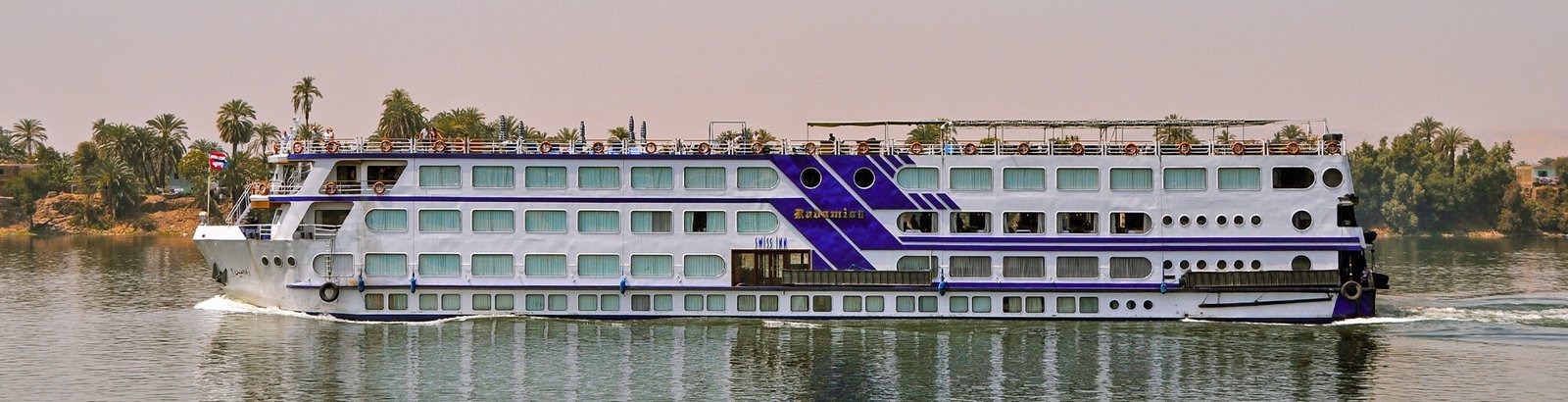
The Radamis Nile Cruise is one of Egypt’s well-established 5-star floating hotels on the Luxor–Aswan route. MS Radamis I carries 72 deluxe cabins and 4 suites, 8 of which are connected — a practical option for families travelling together. Three sailing schedules (4 nights from Luxor, 3 nights from Aswan, 7-night extended) cover every major Upper Egypt temple site with a licensed Egyptologist guide included. This guide covers the ship in full: cabins, dining, the complete itinerary, pricing, and how to book.
Radamis Nile Cruise at a Glance
| Detail | Info |
|---|---|
| Ship name | MS Radamis I Nile Cruise |
| Star rating | 5-star |
| Route | Luxor ↔ Aswan (Upper Egypt) |
| Deluxe cabins | 72 (20 m² each) |
| Suites | 4 |
| Connected cabins | 8 (ideal for families) |
| Sailing schedules | 4N/5D from Luxor (Monday); 3N/4D from Aswan (Friday); 7N/8D extended |
| Meal plan | Full board (breakfast, lunch, dinner) |
| Guide | Licensed Egyptologist on all excursions |
| Restaurant capacity | 140 persons |
| Pool | Large sundeck pool (185 cm depth) + children’s pool |
| Price range | $65–$100/night low season; $90–$150/night high season |
| Best season | October–April |
| Key sites | Karnak, Luxor Temple, Valley of the Kings, Hatshepsut, Edfu, Kom Ombo, Philae, High Dam, Unfinished Obelisk |
Exchange rates fluctuate — verify current rates before travel.
Key features:
- 8 connected cabins — the only Radamis I configuration suited to families or groups wanting adjoining rooms
- Panoramic wall-to-wall windows in all cabins — Nile views at eye level from your bed
- Individual A/C control in every cabin — important at Aswan in summer when outside temperatures hit 40°C+
- Children’s pool on sun deck — rare on standard 5-star Nile cruise ships
- Daily DJ, fancy dress gala party, and Oriental performance — consistent evening entertainment programme
⚠️ Safety Notice
At the time of writing, the Luxor–Aswan cruise route is safe for tourists on organised itineraries. Western government travel advisories classify Upper Egypt’s tourist corridor as requiring normal vigilance. Always check your own government’s official travel advisory before booking.
- 🇬🇧 UK: FCDO Travel Advice — Egypt
- 🇺🇸 USA: US State Department — Egypt
- 🇦🇺 Australia: Smartraveller — Egypt
What Is the Radamis I Nile Cruise?
The MS Radamis I is a 5-star Nile cruise ship operating between Luxor and Aswan on Egypt’s Upper Nile. Two sister ships — Radamis I and Radamis II — operate on the same route; Radamis I is the larger vessel at 72 deluxe cabins and 4 suites, while Radamis II runs 69 standard cabins.
The Radamis I sails two primary schedules: a 4-night/5-day itinerary departing Luxor every Monday, and a 3-night/4-day itinerary departing Aswan every Friday. A 7-night/8-day extended sailing from Luxor runs for travellers who want additional days in Aswan. All sailings include full-board meals and a licensed Egyptologist guide for every temple excursion.
The Radamis I Nile Cruise — Luxury Nile Cruise Between Luxor & Aswan page at Pure Nile Tours shows current departure dates, cabin availability, and full pricing for both schedules.
Radamis I Cabins & Accommodation
The Radamis I carries 72 deluxe cabins and 4 suites across multiple decks. All cabins are equipped with panoramic wall-to-wall windows — a design choice that means the Nile passes at eye level regardless of which deck your cabin sits on. This matters: on many budget 5-star ships, lower-deck windows face dock walls or adjacent vessels when moored.
| Cabin Type | Size | Key Features |
|---|---|---|
| Deluxe Cabin | 20 m² | Panoramic windows, individual A/C, LCD TV, in-room safe, mini-bar, hairdryer, bathtub/shower, 220V socket |
| Suite | Larger | Extended space, separate living area, premium fit-out |
| Connected Cabin | 2× Deluxe | Interconnecting door — suited to families with children or two-room groups |
The 8 connected cabins are a practical differentiator for the Radamis I. Most 5-star Nile cruise ships offer no connecting room option; the Radamis I’s 8 connected pairs allow families to book two adjacent rooms with a shared internal door — separate sleeping areas for parents and children, shared access without corridor. Availability is limited; request connected cabins at time of booking.
Individual air conditioning control in every cabin is standard on the Radamis I. This is a meaningful detail: centralised A/C systems on older ships lock you into a ship-wide temperature. Housekeeping runs twice daily; in-room laundry service is available (charged separately). Satellite channels on the LCD TV include BBC and CNN when the ship is docked.
Dining on the Radamis Nile Cruise
The Radamis I restaurant seats 140 guests and runs a combination of buffet service and waiter-brought hot dishes. Three meals are included daily: breakfast (07:00–09:30), lunch (13:00–14:30), and dinner (19:30–21:00). Timings adjust slightly on heavy excursion days.
The food programme runs primarily international cuisine with Egyptian dishes integrated — grilled meats, fresh salads, warm bread baked on board, rice and lentil dishes, and daily Egyptian desserts including om ali (bread pudding with milk and nuts) and basbousa (semolina cake). Vegetarian options are available at every meal; guests with dietary restrictions should confirm requirements at booking.
Drinks are not included in the full-board package: water carafes are on the table at meals, but soft drinks, alcohol, juices, and hot beverages are charged separately at the bar. At the time of writing, Egyptian pilsner beer runs approximately EGP 100–150 per bottle on board; wine is available by the bottle. Budget EGP 150–300 per person per day for drinks if you consume alcohol regularly, EGP 50–100 if you stick to water and tea. For a broader guide to Egyptian food, Top 7 Egyptian Cuisines to Try covers what to expect at each meal type.

On-Board Facilities & Entertainment
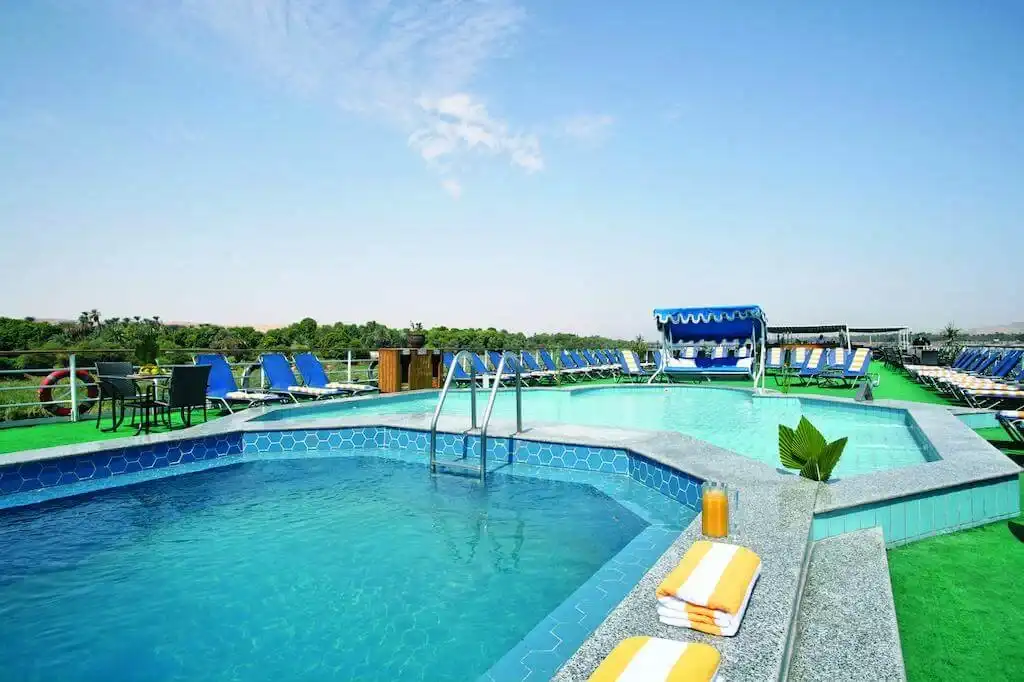
The Radamis I carries a full 5-star facility set: large sun deck with swimming pool (185 cm depth) and a separate children’s pool, sun loungers, panoramic bar, main lounge, discotheque, gift shop and jewellery store, Wi-Fi (payable), international telephone lines, fax service, and laundry. A smoke detector and sprinkler system covers the ship throughout; each cabin has two life jackets and an evacuation plan.
Sun deck: The top deck is the ship’s social centre when the Radamis is moving. The large pool — 185 cm deep, larger than typical Nile cruise ship pools — and the surrounding sun lounger area accommodate the full passenger complement without crowding. The grill area on the deck operates on certain evenings. The passage through the Esna Lock between Luxor and Aswan draws most passengers to the upper deck: the ship navigates a narrow canal-lock while local merchants offer goods from the lock walls — one of the authentic informal experiences of the cruise.
Evening programme: The Radamis I runs a consistent entertainment schedule across the 4-night sailing. Evening highlights include a daily DJ set in the main lounge, a galabeya (traditional Egyptian dress) fancy-dress party where guests are encouraged to wear Egyptian galabeyas for dinner, and an Oriental performance featuring Egyptian folkloric music and belly dancing. These are standard Nile cruise events, but the Radamis I runs them every sailing night rather than on select evenings — a schedule detail worth knowing if you prefer early nights.
Radamis Nile Cruise Itinerary
4 Nights / 5 Days from Luxor (Every Monday)
The Luxor-departure itinerary is the most common format for travellers booking the Radamis Nile Cruise — the fullest schedule, covering the widest range of sites. The ship departs Luxor on Monday and arrives in Aswan on Friday morning.
| Day | Location | Sites |
|---|---|---|
| Day 1 (Monday) | Luxor — embarkation | Check in from 12:00, lunch on board, Luxor Temple, Karnak Temple |
| Day 2 (Tuesday) | Luxor West Bank | Valley of the Kings (3 tombs), Hatshepsut Temple, Colossi of Memnon |
| Day 3 (Wednesday) | Edfu & Kom Ombo | Temple of Horus at Edfu, Kom Ombo double temple, overnight sail to Aswan |
| Day 4 (Thursday) | Aswan | Philae Temple, Aswan High Dam, Unfinished Obelisk, optional Nubian village |
| Day 5 (Friday) | Aswan — disembarkation | Check out by 09:00, transfer to airport/station; optional Abu Simbel |
Day 1 — Embarkation in Luxor: Check-in opens at noon. Lunch is served on board before the afternoon excursion. Luxor Temple — built by Amenhotep III and Ramesses II, with the fully restored Avenue of Sphinxes connecting it to Karnak — is the first stop. Karnak Temple follows in the late afternoon: the Hypostyle Hall’s 134 columns (the tallest at 23 m) are most accessible before 09:00 or after 17:00, and the Radamis I’s Monday afternoon timing hits the latter window well.
Day 2 — Luxor West Bank: The most site-dense day on the itinerary. The Valley of the Kings standard admission covers 3 tombs of your choice; your Egyptologist guide recommends the best available on the day. The tomb of Ramesses VI has the most complete ceiling paintings; Thutmose III’s tomb is the smallest but most intact. The funerary temple of Hatshepsut at Deir el-Bahari follows — three colonnaded terraces cut into a cliff face, built around 1480 BCE. The Colossi of Memnon (two 18-metre quartzite statues of Amenhotep III) are a short stop on the return drive; the photo opportunity is straightforward, the site requires no entrance fee.
Day 3 — Edfu & Kom Ombo: The ship sails south overnight and docks at Edfu by morning. The Temple of Horus at Edfu is the best-preserved ancient temple in Egypt — complete to the roofline, both pylons intact, the original granite naos still in the inner sanctuary. Budget 60–75 minutes. The ship continues south to Kom Ombo for the afternoon: a double temple dedicated to the crocodile god Sobek and the falcon god Haroeris simultaneously, built 180–47 BCE, positioned on a bend in the Nile with views directly over the water. The adjacent Crocodile Museum holds 300+ mummified crocodiles excavated from the site.
Day 4 — Aswan: The Radamis I’s Aswan day covers three distinct sites. Philae Temple on Agilkia Island — reached by a 5-minute motorboat from Shellal dock — is the main temple stop: dedicated to the goddess Isis, relocated block by block between 1972 and 1980. The Aswan High Dam (3.6 km wide, completed 1971) is a 20-minute visit with a strong view across Lake Nasser. The Unfinished Obelisk, cut from the granite bedrock of Aswan and abandoned when a crack appeared in the stone, gives a concrete picture of how obelisks were actually quarried — lying in the bedrock exactly where it was left, 42 m long. The optional Nubian village excursion adds an hour of cultural context for those interested.
Day 5 — Disembarkation: Check-out by 09:00. Transfer to Aswan airport or train station. Travellers who pre-booked Abu Simbel depart Aswan at 06:00 by 45-minute domestic flight, visit the two temples, and return to Aswan by noon for the airport connection. For a full guide to planning the Abu Simbel visit, Abu Simbel Temples: Practical Visitor Guide from Aswan covers logistics, entry fees, and the best arrival timing.
3 Nights / 4 Days from Aswan (Every Friday)
The Aswan-departure itinerary boards in Aswan on Friday and arrives in Luxor on Monday — the same sites covered in reverse order. Day 1: Philae Temple and High Dam. Day 2: Kom Ombo and Edfu. Day 3: Luxor West Bank (Valley of the Kings, Hatshepsut Temple). Day 4: Karnak and Luxor Temple before disembarkation.
The 3-night format suits travellers who start their Egypt itinerary from Aswan (perhaps arriving via Abu Simbel or from Cairo direct), or who are connecting to Luxor at the cruise end for a flight home. The Valley of the Kings day is slightly compressed compared to the 4-night format — one fewer night means less buffer time at West Bank sites. For the standalone 3-night itinerary details, 3 Nights Nile Cruise from Aswan to Luxor covers the schedule and what changes in the reverse direction.
7 Nights / 8 Days Extended Cruise (from Luxor)
The 7-night sailing departs Luxor on Monday and provides 3 full days in Aswan rather than the standard one — time for Abu Simbel as a relaxed excursion (not a predawn sprint), a half-day at Elephantine Island’s Nubian village, and a felucca sunset sail. The extended format suits travellers who want Aswan as a destination rather than a transit point, or those who prefer a slower overall pace with more time at each temple site. For travellers planning a full Nile cruise itinerary, Crafting the Perfect Nile Cruise Itinerary walks through the decision between 3-night, 4-night, and extended formats.
Temple Sites on the Radamis Nile Cruise Route
Luxor Temple & Karnak Temple
Luxor Temple sits in the centre of modern Luxor city on the Nile’s East Bank. Built primarily by Amenhotep III (14th century BCE) and extended by Ramesses II, the temple served as the site of the annual Opet Festival — a celebration that connected the pharaoh’s kingship to divine renewal. The Avenue of Sphinxes, fully excavated and restored between 2021 and 2023, runs 3 km north to Karnak — walking it lit at night is one of the most evocative experiences on the cruise route.
Karnak Temple Complex covers 200 acres, making it the largest ancient religious complex ever built. The Hypostyle Hall — 134 papyrus-form columns, the tallest at 23 m — remains the single most imposing interior architectural space from the ancient world. Construction ran from approximately 1550 BCE to the Ptolemaic period. Open from 06:00; visit before 09:00 or after 17:00 for the most manageable crowds and the best light for photographs.
Valley of the Kings & Hatshepsut Temple
The Valley of the Kings sits on Luxor’s West Bank — 63 royal tombs carved into limestone cliffs, most dating from 1550–1070 BCE. Standard admission (EGP 360) covers 3 tombs from those currently open; the tomb of Ramesses VI has the most complete painted ceiling; Seti I’s tomb (when accessible) has the finest reliefs in the valley. Tutankhamun’s tomb requires a separate ticket (EGP 800) — the chamber itself is compact, since all famous objects are now at Cairo’s Grand Egyptian Museum.
The funerary temple of Hatshepsut at Deir el-Bahari is architecturally unlike anything else in Egypt: three colonnaded terraces rising against a vertical cliff, built around 1480 BCE. The ramps connecting the terraces, the painted expedition and hunting reliefs along the colonnades, and the stark natural backdrop make this the most photographically distinctive site on the West Bank. Budget 45–60 minutes.
Edfu & Kom Ombo
The Temple of Horus at Edfu (237–57 BCE) is the best-preserved ancient temple in Egypt — complete to the roofline, both entrance pylons standing, the inner sanctuary’s granite naos intact. The site takes 60–75 minutes and gives a clearer picture of how a complete Egyptian temple functioned than any partially ruined site can. The large granite Horus falcon statue at the entrance has become the most reproduced single image from the temple.
Kom Ombo’s double temple is unique in the ancient world: one building with two complete sanctuary axes, two sets of hypostyle halls, and two deity dedications — Sobek (crocodile) on the right, Haroeris (falcon) on the left. Built 180–47 BCE, the riverside setting gives a direct view across the Nile from the front courtyard. The Crocodile Museum (included with temple entry) displays 300+ mummified crocodiles — physical evidence that the Sobek cult was literal, not metaphorical.
Philae Temple, High Dam & Unfinished Obelisk
Philae Temple on Agilkia Island is the last classical Egyptian temple built — reliefs and decoration continued into the 3rd century CE, long after Egypt became Roman. Relocated to its current island between 1972 and 1980 after the High Dam created Lake Nasser, the temple’s reliefs retain significant original paint in sheltered interior spaces. The motorboat crossing (5 minutes, included in tours) gives views of Aswan’s granite outcrop landscape.
The Aswan High Dam — 3.6 km wide, 111 m tall, completed 1971 — impounded Lake Nasser and required relocating 100,000 Nubian people and 22 temples. Its construction was one of the largest engineering projects of the 20th century. The Unfinished Obelisk, still lying in the granite bedrock of Aswan’s ancient quarry, is 42 m long — longer than any obelisk successfully erected. The hairline crack that caused its abandonment is visible on the upper surface.
Abu Simbel (Optional Excursion)
Abu Simbel sits 280 km south of Aswan — two rock-cut temples built by Ramesses II around 1264 BCE, relocated 65 m higher by UNESCO between 1964 and 1968. The Great Temple’s four 20-metre seated colossi guard the entrance; the interior hypostyle hall holds Ramesses II battle reliefs and terminates in a four-statue sanctuary. The temple is aligned so that sunlight reaches the innermost sanctuary on 22 February and 22 October each year. The optional excursion from Aswan by 45-minute domestic flight costs approximately $80–$120 per person and returns to Aswan by noon.
How to Book the Radamis I Nile Cruise
The Radamis I Nile Cruise books through Pure Nile Tours as a standalone cruise or as part of a combined Egypt package with Cairo. The Radamis I Nile Cruise — Luxury Nile Cruise Between Luxor & Aswan page shows current departure dates (Monday for Luxor, Friday for Aswan), cabin availability, and current pricing.
Before booking, confirm:
- Sailing direction and start city (Luxor Monday or Aswan Friday)
- Cabin type: Deluxe, Suite, or Connected (connected cabins must be requested at booking)
- Abu Simbel optional excursion — add this at time of booking, not on board
- Dietary requirements for the dining team
- Airport or train station transfer arrangements for arrival and departure
A deposit of 20–30% confirms the booking; the balance is due before travel. Cabins on the Radamis I sell out 8–12 weeks ahead during October–March peak season. December and January bookings should start 3 months in advance. For a full market comparison of Nile cruise pricing across ship categories, Nile Cruise Luxor to Aswan Prices 2026 gives the current landscape.
Radamis Nile Cruise Prices & Inclusions
Cabin rates on the Radamis I run approximately $65–$100 per person per night in low season (May–September) and $90–$150 per person per night in high season (October–April). The 4-night sailing costs approximately $360–$750 per person for the cabin, depending on season and room type.
Included in the cruise price (when booked through Pure Nile Tours):
- Full-board meals (breakfast, lunch, dinner)
- Licensed Egyptologist guide on all excursions
- All temple entrance fees on the standard itinerary
- Motorboat transfer to Philae Temple
- Airport/train station transfers in Luxor and Aswan
- Evening entertainment (galabeya party, Oriental show, daily DJ)
Not included:
- Abu Simbel excursion (~$80–$120 per person, optional add-on)
- Drinks beyond table water (soft drinks, alcohol, hot beverages)
- Wi-Fi on board (payable separately)
- Tips for guide, driver, and cruise crew ($10–$15 per person per day)
- Tutankhamun’s tomb entry (EGP 800, optional at Valley of the Kings)
- Hot air balloon over Luxor (~$70–$120 per person, optional)
- Personal laundry
Exchange rates fluctuate — verify current rates before travel.
Best Time to Sail on the Radamis Nile Cruise
October through April is the comfortable sailing window. November to February gives the most pleasant outdoor conditions: Luxor daytime highs of 22–26°C, Aswan 24–28°C. The Valley of the Kings and Karnak Temple are walkable at any time of day in these months. This window is also peak season — the Radamis I sells out quickly for December and January departures.
March and October offer a useful middle ground: warm enough for the sun deck (26–32°C), but with shorter advance booking requirements than December–February. April has a demand spike during European and North American spring holidays; book 6–8 weeks ahead for this month.
May through September: Aswan and Luxor reach 38–43°C by midday. Temple excursions run 06:00–10:00 to avoid the worst heat; the Radamis I’s pool and air-conditioned cabins become proportionally more valuable. Prices drop 15–25% in this window. For a month-by-month breakdown of Egyptian weather and what it means for cruise planning, Best Months to Visit Egypt: Weather, Crowds & Travel Tips covers the full annual picture.
Radamis I vs Other 5-Star Nile Cruise Ships
The Nile carries approximately 300 cruise ships; most 5-star vessels run the same temple itinerary. Differences between ships in the same class come down to cabin configuration, pool size, entertainment consistency, and specific features like connected rooms.
Radamis I vs standard 5-star competitors:
- 72 deluxe cabins + 4 suites — larger than the average 5-star ship at this price point (most carry 60–75 cabins)
- 8 connected cabins — rare on any Nile cruise ship; directly suited to families or groups of 4+ wanting private but adjacent rooms
- 185 cm deep pool + children’s pool — the children’s pool is uncommon on 5-star ships; most carry adult-only pools
- 140-person restaurant — large enough that even a full sailing avoids queuing at the buffet
- Daily entertainment — DJ, galabeya party, and Oriental show every evening, not just selected nights
Radamis I vs ultra-luxury options: The Dahabiya sailboat (8–16 passengers, $350–$600/night per person) offers a fundamentally different experience — fewer passengers, slower pace, more intimate. The Radamis I is the right choice for travellers who want 5-star comfort and consistent service without the Dahabiya premium.
Other Nile Cruise Options from Pure Nile Tours
If the Radamis I doesn’t match your dates or preferences, Pure Nile Tours offers several other 5-star Nile cruise options on the same Luxor–Aswan route:
Le Fayan Nile Cruise — Luxury Nile Cruise Between Luxor & Aswan — a luxury vessel with a strong reputation for food quality and attentive crew ratio. Suits couples and honeymooners who want a quieter, more refined atmosphere than the Radamis I’s daily entertainment programme.
A Sara Nile Cruise — 5-Star Between Luxor & Aswan — 66 deluxe cabins, all above the waterline, with an on-board doctor on call. Good mid-range 5-star option for first-time cruise passengers who want medical coverage as part of the package.
Jaz Crown Jewel Nile Cruise — the most upmarket option in the Pure Nile Tours fleet on this route. Smaller passenger count, superior cabin fit-out, and a more curated excursion programme than the standard 5-star format.
Egypt Nile River Cruise 5 Days and 4 Nights — a flexible 5-day/4-night format that pairs with various ship options and suits travellers who want the longer Luxor-to-Aswan format without committing to a specific vessel.
All four are bookable through the Pure Nile Tours cruise portfolio. Comparing ships by schedule, cabin type, and price before deciding is straightforward on the individual tour pages.
Tips for First-Time Nile Cruise Passengers
Arrive in Luxor or Aswan the day before embarkation. International connections to Luxor or Aswan involve at least one transit through Cairo. A delay on any leg can cause a same-day check-in miss. One buffer night in the embarkation city costs less than a missed cruise departure.
Pack light for the ship. Deluxe cabins at 20 m² are functional but not spacious. One mid-size rolling suitcase per person is the practical maximum. Bring walking shoes (every temple site involves uneven stone), a hat and SPF 50+ sunscreen (no shade at Edfu, Kom Ombo, or the Giza Plateau), and a light jacket for winter evenings — the Nile drops 6–10°C after sunset between November and February.
Sort drinks before the cruise. Ship bar prices are higher than Aswan or Luxor supermarkets. Buying a few bottles of water and soft drinks at the city before boarding saves noticeably over a 4-night sailing. Alcohol is cheaper on board than in most Egyptian hotels, but still marked up significantly from retail.
Tip at the end, not throughout. The most practical approach: collect tip money and distribute it in one envelope at check-out, divided between your Egyptologist guide, the ship crew collectively, and your driver. $10–$15 per person per day is the standard expectation across all recipients combined.
Use your Egyptologist. The Valley of the Kings, Karnak Temple, and Philae Temple all have minimal English explanatory signage inside the monuments. The 10–15 minute briefing your guide gives before each stop is the prerequisite for the visit making sense. If you need more time at a specific tomb or hall, say so — on a private tour, there is no group pace to keep. For a full Egypt-specific packing checklist, Packing Tips for Egypt covers clothing, health, and electronics.
Dress appropriately at religious sites. Philae Temple (goddess Isis) is an active religious heritage site — shoulders and knees covered for women is the expected standard. The same applies to any mosque visit in Luxor or Aswan city. Men can wear shorts at outdoor archaeological sites; long trousers are required inside mosques. A loose scarf carried in a daypack handles all eventualities. For full guidance on Egyptian social norms, Egypt’s Cultural Etiquette: A Guide for Travelers covers the practical detail.
Frequently Asked Questions
What is the Radamis Nile Cruise?
The MS Radamis I is a 5-star Nile cruise ship sailing between Luxor and Aswan in Upper Egypt. It carries 72 deluxe cabins and 4 suites — including 8 connected cabins suited to families — with a 140-person restaurant, large sundeck pool, children’s pool, and a daily entertainment programme. Two primary sailing schedules: 4 nights from Luxor (Monday departure) and 3 nights from Aswan (Friday departure). A 7-night extended sailing from Luxor is also available. Full-board meals and a licensed Egyptologist guide are included on all sailings.
How much does the Radamis Nile Cruise cost?
At the time of writing, cabin rates run approximately $65–$100 per person per night in low season (May–September) and $90–$150 per person per night in high season (October–April). The 4-night sailing costs approximately $360–$750 per person for the cabin alone, depending on season and cabin type. Full-board meals and guided excursions are included; drinks, tips, and optional extras (Abu Simbel, hot air balloon) are charged separately. For a current comparison across ship categories, Nile Cruise Luxor to Aswan Prices 2026 gives the market overview.
What sites does the Radamis Nile Cruise visit?
The 4-night/5-day itinerary from Luxor covers: Luxor Temple, Karnak Temple Complex, Valley of the Kings (3 tombs), Temple of Hatshepsut, Colossi of Memnon, Temple of Horus at Edfu, Kom Ombo double temple, Philae Temple, Aswan High Dam, and the Unfinished Obelisk. Abu Simbel is available as an optional add-on from Aswan. The 3-night/4-day itinerary from Aswan covers the same sites in reverse order.
Does the Radamis Nile Cruise have connected cabins for families?
Yes — the Radamis I has 8 connected cabins, each consisting of two adjoining 20 m² deluxe cabins with an interconnecting door. This is uncommon on 5-star Nile cruise ships and makes the Radamis I a practical choice for families with children or groups of 4 who want adjacent private rooms. Connected cabins must be requested at the time of booking; availability is limited.
What is the best time to sail on the Radamis Nile Cruise?
October through April, with November to February offering the most comfortable outdoor temperatures (22–28°C in Luxor and Aswan). December and January are peak season — book 8–12 weeks in advance. May through September is possible but involves 38–43°C midday heat at the temple sites; temple visits are restricted to early morning. Prices drop 15–25% in low season. For month-by-month conditions, Best Months to Visit Egypt covers the full picture.
Is the Radamis Nile Cruise suitable for first-time visitors?
Yes. The full-board format, licensed Egyptologist guide, and private transfer inclusions remove the main logistical challenges of independent travel in Upper Egypt. Temple briefings before each excursion give the context that makes the sites comprehensible for visitors with no prior Egyptology background. The children’s pool and connected cabin option also make the Radamis I more family-friendly than most 5-star ships on this route. For a current safety overview, Is Egypt Safe for Tourists in 2026? covers conditions on the Luxor–Aswan corridor specifically.
Does the Radamis Nile Cruise include Abu Simbel?
Abu Simbel is not part of the standard itinerary on either the 4-night or 3-night schedule. It is available as an optional add-on from Aswan — a 45-minute domestic flight departing at approximately 06:00, visiting the two temples of Ramesses II, and returning to Aswan by noon. The excursion costs approximately $80–$120 per person. Book it at the same time as the cruise rather than attempting to add it on board.
What is the difference between the Radamis I and Radamis II?
Both ships operate on the same Luxor–Aswan route with the same itinerary and 5-star rating. The Radamis I carries 72 deluxe cabins and 4 suites; the Radamis II carries 69 standard cabins and 6 suites. The Radamis I has 8 connected cabins (the Radamis II does not). Both ships have panoramic windows, individual A/C, and the same full-board dining format. The Radamis I departs Luxor on Mondays and Aswan on Fridays; the Radamis II runs a different schedule. When booking through Pure Nile Tours, the Radamis I Nile Cruise page covers the Radamis I specifically.
Do I need a visa to travel to Egypt for the Radamis Nile Cruise?
At the time of writing, most nationalities require a visa to enter Egypt. Two options: an e-visa applied online before departure (USD $25, processed in 3–5 business days) or a visa on arrival at Cairo, Luxor, or Aswan airports (USD $25). The e-visa is recommended for peak season travel when arrival queues can reach 45–60 minutes at Cairo airport. For current requirements by nationality, Egypt Visa Requirements for Travelers has an up-to-date breakdown.
Can I combine the Radamis Nile Cruise with a Cairo tour?
Yes — and this is the most common format for first-time visitors to Egypt. Two or three days in Cairo covering the Pyramids of Giza and the Grand Egyptian Museum, then a domestic flight to Luxor to board the Radamis I on Monday, then disembarkation in Aswan on Friday and a return flight to Cairo. Pure Nile Tours offers combined packages that include the Radamis I within a full Egypt itinerary. For available combined tour options, Egypt Tour Packages shows all current structures by length and inclusions.
What should I pack for the Radamis Nile Cruise?
Priority items: comfortable walking shoes (every temple site involves uneven stone and sand), SPF 50+ sunscreen, a wide-brim hat, and sunglasses. A light jacket or fleece for October–March evenings when the Nile breeze drops temperatures to 12–16°C. A loose scarf for women (required at Philae Temple). A small daypack for excursions; leave your main luggage in the cabin. Carry EGP cash for on-site tip-ups and souvenir purchases. For a full Egypt-specific packing list, Packing Tips for Egypt covers clothing, health items, and electronics.