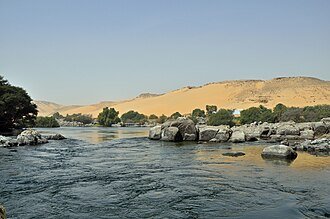
The Nile River near Aswan — home to Egypt’s most famous cataracts. Photo: Unsplash
If you have ever read about ancient Egypt, you have almost certainly encountered the word “cataract” in the context of the Nile River. The ancient Egyptians spoke of the “First Cataract” as the southern boundary of Egypt proper, and any serious study of Nile geography references a sequence of six cataracts stretching from Aswan in southern Egypt deep into Sudan. But what exactly is a cataract in the Nile River? And what do these ancient geographical features look like today?
This complete guide explains what a cataract is, where the six Nile cataracts are located, what they meant to the ancient Egyptians, and how the modern traveler can experience the First Cataract — the most historically significant of all — from Aswan.
What Is a Cataract in a River?
In geographical terms, a cataract is a large, powerful waterfall or a series of rapids formed where a river crosses a zone of hard, resistant rock. The word comes from the Greek katarrhaktēs, meaning “to fall down” or “to rush down.”
Nile cataracts are not waterfalls in the conventional sense — you will not find a dramatic vertical drop like Niagara Falls. Instead, the Nile cataracts are areas where the river encounters outcroppings of hard granite and other igneous rock that force the water into a turbulent network of channels, rapids, whirlpools, and rocky islands. The effect is a stretch of river that is dramatically different from the wide, slow, navigable Nile that flows through most of Egypt and Sudan.
Why Do Cataracts Form in the Nile?
The Nile cataracts exist because of the geological structure of the riverbed in Nubia. The region around Aswan and northern Sudan sits on a zone of ancient Precambrian granite and schist — rocks formed billions of years ago that are far harder than the sedimentary limestone that underlies most of the Nile Valley.
As the Nile erodes southward over millions of years, it cuts through softer rock easily but meets resistance in these granite zones. The result is a series of natural dams where boulders and outcroppings disrupt the river’s flow, creating the characteristic turbulence of a cataract.
The Six Cataracts of the Nile
The Nile has six recognized cataracts, all located between Aswan in southern Egypt and Khartoum in Sudan. They are numbered from north to south — against the direction of the river’s flow. The First Cataract (northernmost) is at Aswan; the Sixth Cataract (southernmost) is near Khartoum.
First Cataract — Aswan, Egypt
The most historically significant of all the cataracts, located at modern Aswan. The First Cataract marks the ancient southern boundary of Egypt proper — in pharaonic times, everything north of this point was “Egypt” and everything south was “Nubia.”
The First Cataract was a major geographical barrier for navigation. Ships could not pass the rapids easily, which made Aswan both a natural border checkpoint and an important trading post.
Today, the First Cataract is largely submerged beneath Lake Nasser, created by the Aswan Low Dam (1902) and the Aswan High Dam (1971). However, the rocky islands and granite outcroppings of the original cataract zone are still visible around Aswan, particularly Elephantine Island and Kitchener Island.
The rocky granite islands of the Nile at Aswan — remnants of the First Cataract zone. Photo: Unsplash
Second Cataract — Wadi Halfa, Sudan
Located near the modern Sudanese town of Wadi Halfa, the Second Cataract was an even more formidable barrier than the First. It marked the effective southern limit of Egyptian military control during the Old and Middle Kingdoms. Now completely submerged beneath Lake Nasser.
Third Cataract — Kerma, Sudan
Located near the ancient city of Kerma, one of the earliest urban centers in sub-Saharan Africa. The Third Cataract was the boundary of the powerful Kingdom of Kerma — one of Egypt’s most significant Nubian rivals during the Middle Kingdom period.
Fourth, Fifth, and Sixth Cataracts — Central and Northern Sudan
The remaining three cataracts are located entirely within modern Sudan. The region between the Third and Sixth Cataracts was known in antiquity as the Nubian kingdom of Meroe. These cataracts are not accessible to conventional tourism.
The First Cataract and Ancient Egypt
The Sacred Geography of Aswan
For the ancient Egyptians, the First Cataract at Aswan was not merely a geographical feature. It was a sacred boundary — the place where the Nile emerged from the underworld, where the annual flood that gave Egypt its agricultural life began.
The ancient name for the First Cataract region was Abu (meaning “elephant” in ancient Egyptian), which became the name of Elephantine Island. The island was believed to be the location of a cavern from which the Nile flood gushed forth annually, controlled by the ram-headed god Khnum. A “Nilometer” — a stone staircase with calibrated markings used to measure the height of the annual flood — was maintained on Elephantine Island.
The Cataract as Border and Trade Gateway
The First Cataract’s natural barrier function made it ideal as a border checkpoint. All trade between Egypt and sub-Saharan Africa — gold, ivory, ebony, exotic animals, incense — had to pass through Aswan. The city became enormously wealthy as a result.
The Granite Quarries of Aswan
Another consequence of the cataract zone’s geology was the presence of the finest granite in Egypt — the distinctive pink and red Aswan granite used for obelisks, sarcophagi, colossal statues, and architectural elements in temples throughout the country.
The most famous relic of this quarrying activity is the Unfinished Obelisk, still lying in its granite quarry exactly where it was abandoned approximately 3,500 years ago when a crack was discovered in the stone. At 42 meters long and an estimated weight of 1,200 tons, it would have been the largest obelisk ever carved if completed.
Experiencing the Cataract at Aswan Today
Modern Aswan gives visitors the best opportunity to understand what a Nile cataract looks like. Although much of the original First Cataract is submerged, the area around Aswan is still characterized by the black granite boulders and rocky islands that define the cataract zone. The Nile here is narrower, more dramatic, and more dynamic than anywhere else in Egypt.
Felucca sailing — Traditional wooden sailboats (feluccas) navigate between the granite islands of the Nile around Aswan, giving passengers a close-up experience of the cataract-zone landscape. A sunset felucca ride around Elephantine Island and Kitchener Island is one of Aswan’s most atmospheric experiences.
Elephantine Island visit — The main island in the ancient cataract zone, home to the Aswan Museum and the Nilometer. Reached by a short motorboat ride from the Aswan Corniche.
Kitchener Island (Botanical Garden) — A lush botanical garden planted by Lord Kitchener in the 1890s, accessible by felucca.
The Old Cataract Hotel
One of the most evocative places to experience Aswan’s cataract atmosphere is from the terrace of the Old Cataract Hotel — a Victorian-era palace hotel perched on a granite outcrop above the Nile. Agatha Christie wrote Death on the Nile here, and the view from its terrace — across the dark granite rocks, the feluccas, Elephantine Island, and the Sahara desert beyond — is one of the most beautiful in Egypt.
Felucca sailing in the Nile at Aswan, in the First Cataract zone. Photo: Unsplash
The Cataract and the Nile Cruise Experience
For travelers on a Nile Cruise between Luxor and Aswan, arriving at Aswan is the point at which the river’s character changes noticeably. The wide, agricultural Nile of the Luxor stretch gives way to something narrower, rockier, and more dramatically beautiful. The cruise ship anchors in a setting of dark granite boulders, desert hills, and island-dotted water that looks nothing like the Nile further north.
This visual transformation is the ancient cataract zone at work. Even though the original rapids are submerged, the geology that created them — and the landscape it produces — is still fully visible and fully extraordinary.
🛥️ Experiencing the First Cataract on a Nile Cruise: Pure Nile Tours includes Aswan in all Nile Cruise itineraries, with expert guides who explain the geography and history of the site. We also include visits to Philae Temple, the Unfinished Obelisk, and the Aswan High Dam. View Nile Cruise Packages →
Combining the Cataract with Other Aswan Attractions
A standard Aswan day tour includes:
- Aswan High Dam — The engineering project that drowned the First Cataract
- Unfinished Obelisk — In the ancient granite quarries of the cataract zone
- Philae Temple — Rescued from the rising cataract waters and reassembled on a new island
- Felucca on the Nile — Sailing between the granite cataract-zone islands
- Elephantine Island — The ancient cataract settlement
For travelers combining Aswan with Luxor, see our guides to the Valley of the Kings, Karnak Temple, and Luxor Temple. For the best time to visit Aswan, see our complete Egypt travel timing guide.
Frequently Asked Questions
What is a cataract in the Nile River? A cataract is an area of turbulent rapids and rocky outcroppings where the Nile crosses a zone of hard granite bedrock, making the river temporarily unnavigable and dramatically scenic.
How many cataracts does the Nile have? Six recognized cataracts, all between Aswan (Egypt) and Khartoum (Sudan), numbered from north to south.
Can you visit the Nile cataracts? The First Cataract at Aswan is the most accessible — you can see the cataract landscape from the Corniche, by felucca, or from the Old Cataract Hotel. The other five cataracts are in Sudan and largely inaccessible.
Is the First Cataract still visible? Partially. The Aswan dams have submerged most of the original cataract rapids, but the granite boulders and rocky islands of the cataract zone are still clearly visible around Aswan.
What was the significance of the cataracts to ancient Egypt? The First Cataract marked the southern boundary of Egypt proper, served as a natural border and trade checkpoint, and was a sacred landscape associated with the source of the Nile flood and the god Khnum.
Is Aswan worth visiting for the cataract? Absolutely. Even without the original rapids, Aswan’s granite-island landscape, the felucca experience, Philae Temple, and the Old Cataract Hotel make it one of Egypt’s most beautiful destinations.
The Nile cataracts are one of the great geographical features of northeastern Africa — barriers that shaped civilizations, determined borders, and created trade routes for five thousand years. Standing at Aswan today, watching a felucca navigate between black granite boulders as the desert sun sets over the western bank, you are experiencing the same landscape that defined the edge of the ancient Egyptian world.
🛥️ Discover the First Cataract on a Nile Cruise: Pure Nile Tours offers luxury Nile Cruise packages with Aswan itineraries that include the cataract zone, Philae Temple, and all major Aswan attractions. Plan your Aswan visit →