Fayoum Egypt Travel Guide: Lake Qarun, Whale Valley & What to See
Most visitors to Egypt follow the well-worn path: Cairo, the Pyramids, Luxor, Aswan. Fayoum sits just 100 kilometers southwest of Cairo and is consistently overlooked by travelers who don’t know what they’re missing. That’s a significant oversight, because Fayoum combines things found nowhere else together in one accessible destination: a UNESCO World Heritage fossil site in the Western Desert, Egypt’s only natural waterfalls, one of the world’s oldest lakes, ancient Greco-Roman ruins, a thriving artistic community in a lakeside pottery village, and some of the best birdwatching in North Africa.
This guide covers everything you need to plan a visit — what to see, how to get there, where to stay, when to go, and the practical details that make the difference between a rushed day trip and an experience that stays with you.
What Is Fayoum?
Fayoum (also spelled Faiyum or Fayum) is both a governorate and a natural oasis — Egypt’s largest oasis and the only one connected to the Nile River rather than fed by underground aquifers. Water reaches the oasis via the ancient Bahr Youssef canal, a channel originally constructed during the Middle Kingdom (around 1900 BCE) to divert Nile floodwater into the Fayoum depression, turning what would otherwise be desert into fertile agricultural land.
The name “Fayoum” derives from the ancient Coptic word “Phaiom,” meaning “sea” or “water” — a reference to the lakes and water bodies that have defined the region for thousands of years.
A Brief History of Fayoum
Fayoum is one of Egypt’s oldest continuously inhabited regions, with archaeological evidence of human presence stretching back tens of thousands of years. In Pharaonic times, the oasis was known for its extraordinary agricultural productivity, fed by the Bahr Youssef canal and the massive lake the ancient Egyptians called Lake Moeris — then a much larger freshwater body that played a central role in the region’s prosperity during the Middle Kingdom.
During the Greco-Roman period (roughly 330 BCE – 400 CE), Fayoum became one of Egypt’s most prosperous agricultural regions. The remarkable “Fayoum Portraits” — naturalistic painted panels placed over mummy faces, considered among the finest surviving examples of ancient portraiture — were created here during this period.
The extraordinary fossils of Wadi El Hitan (Valley of the Whales) preserve evidence of an earlier chapter: roughly 40 million years ago, the entire region was covered by a shallow sea, and the whale ancestors whose remains can be seen today were among its inhabitants.
Top Natural Attractions
Lake Qarun (Birket Qarun)
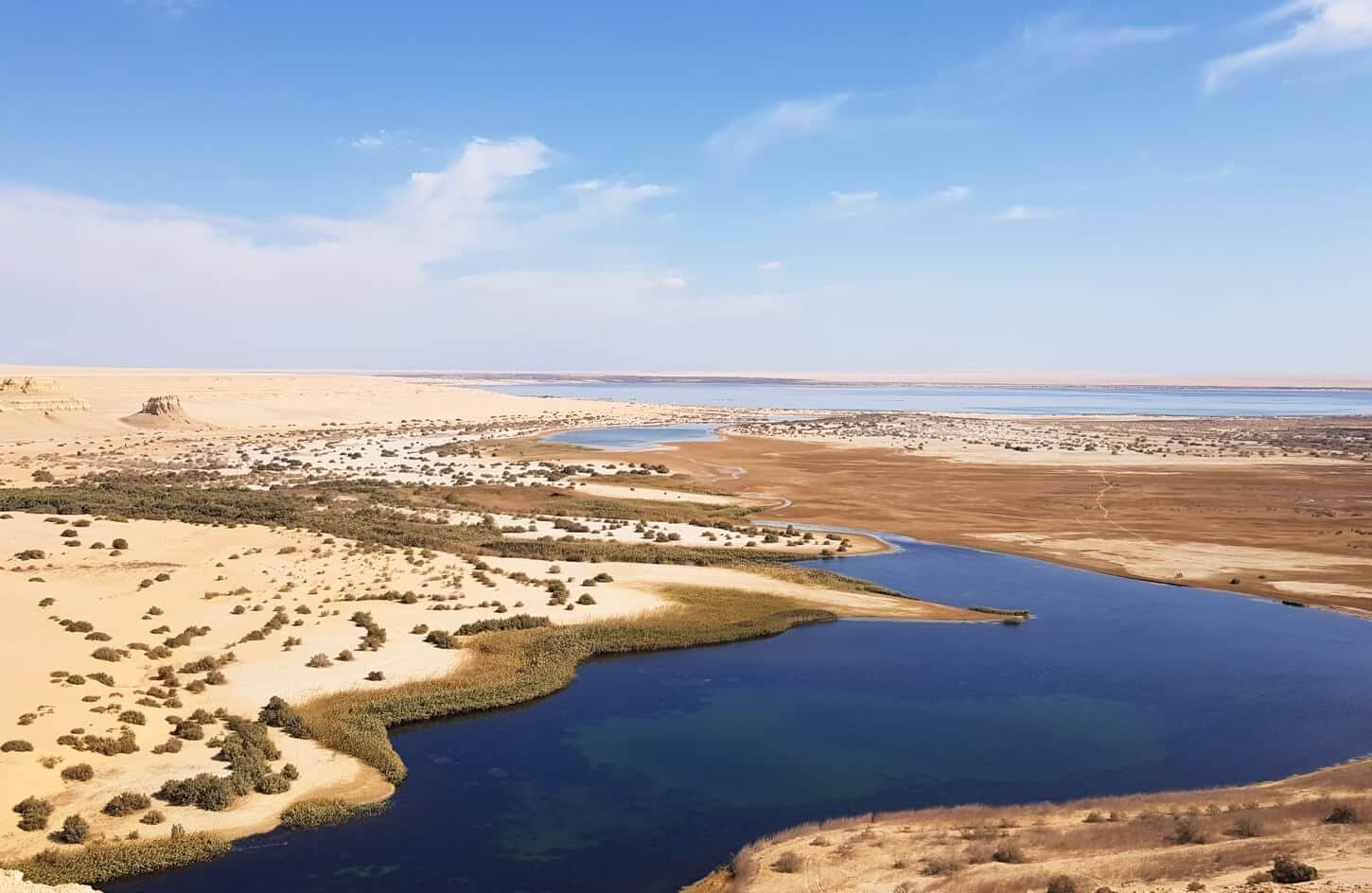
One of the world’s oldest natural lakes, Lake Qarun stretches over approximately 200 square kilometers in the northern part of the Fayoum depression. Known as Lake Moeris in antiquity, it was once a much larger freshwater lake; today it is saltwater, having shrunk considerably over millennia.
Visitors come for boat rides on traditional felucca sailboats, fishing (tilapia and mullet), birdwatching (flamingos, pelicans, herons, and hundreds of migratory species), and extraordinary sunsets over the water with the desert behind it. Not suitable for swimming due to salinity, but Wadi El Rayan’s upper lake offers swimming nearby.
Wadi El Rayan
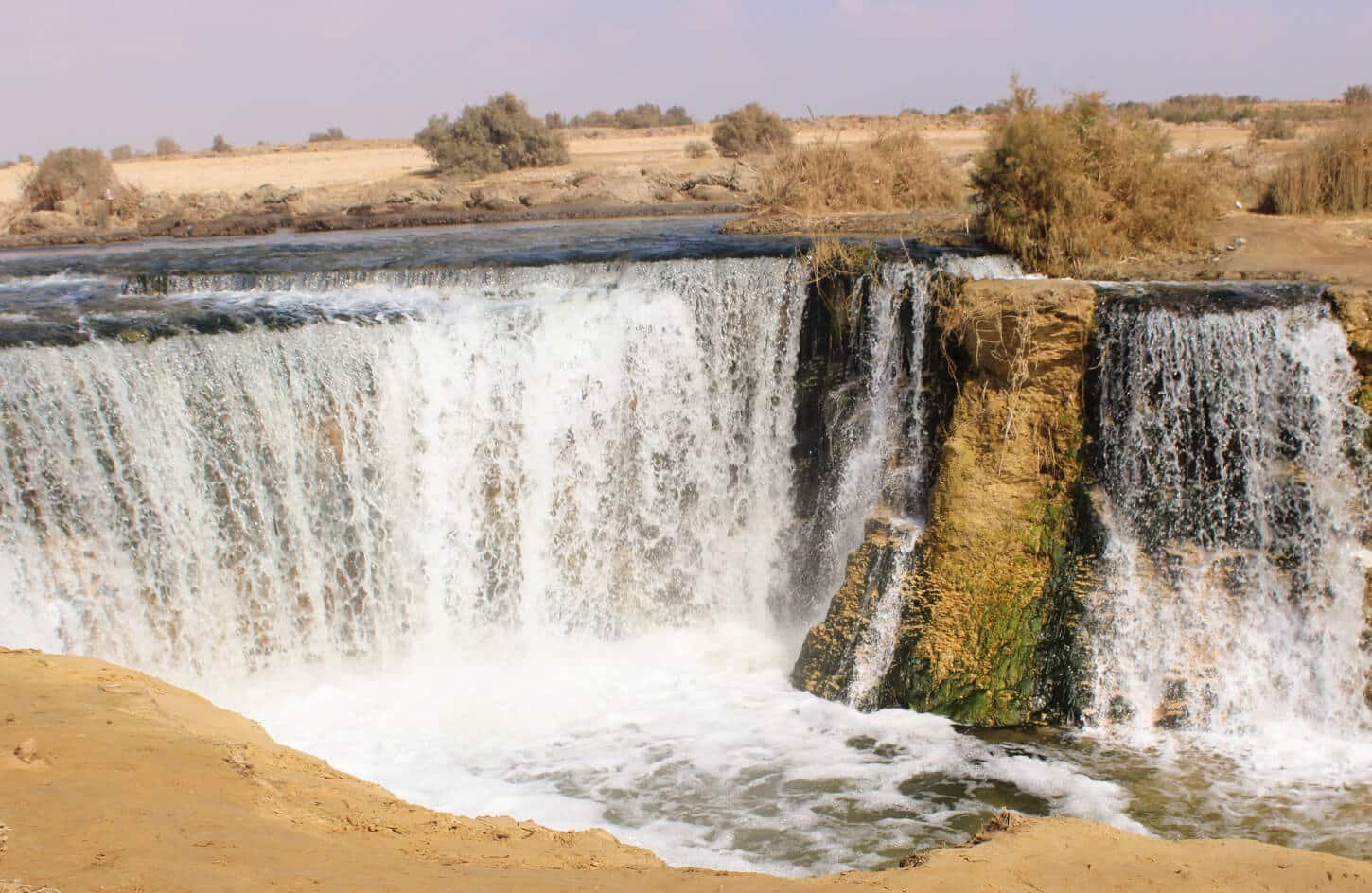
A protected natural reserve approximately 40 km southwest of Fayoum City, Wadi El Rayan is best known for Egypt’s only waterfalls — formed in 1973 when agricultural drainage created two connected lakes separated by a cascade. Modest in scale but extraordinary in desert context.
Beyond the waterfalls: sandboarding on large dunes, swimming in the upper lake, camping, 4×4 desert safari, wildlife watching, and Mudawara Mountain — a three-peaked rocky outcrop with panoramic views over lakes and dunes.
Practical note: Requires a vehicle. Most visitors join an organized day tour from Cairo, or rent a car/hire a driver from Fayoum City.
Wadi El Hitan (Valley of the Whales) — UNESCO World Heritage Site
The crown jewel of Fayoum’s natural attractions. Located approximately 150 km from Fayoum City in the Western Desert, Wadi El Hitan contains the highest concentration of ancient whale fossils in the world — remains of Archaeoceti, early whales that still possessed rudimentary hind limbs, preserved in 40-million-year-old desert rock.
These fossils document the evolutionary transition of whale ancestors from land to sea. Walking among the exposed fossils in open desert, surrounded by dramatic sandstone formations, is a genuinely unique experience anywhere in the world. A well-designed visitor center with introductory film and museum displays provides essential context.
Practical note: Requires a 4×4 vehicle for the final approach. Entry requires a Wadi El Rayan National Park fee (~1,050–2,050 EGP depending on vehicle and group size). Strongly recommended as part of an organized tour.
Main Archaeological Sites
Qasr Qarun (Temple of Dionysias)
A beautifully preserved Ptolemaic temple at the western end of Lake Qarun, built around the 3rd–2nd century BCE. One of the best-preserved temples of its era in Egypt, dedicated to the crocodile god Sobek and Horus. Multi-story interior can be climbed for desert views. Far fewer visitors than Luxor temples — peaceful, uncrowded exploration.
Karanis (Kom Oshim)
Ruins of a prosperous Greco-Roman town near the Cairo entrance to Fayoum, with a worthwhile on-site museum. Flourished from 3rd century BCE through 5th century CE, providing a vivid picture of provincial life in Roman Egypt.
Hawara Pyramid
The pyramid of Amenemhat III (~1850 BCE), accompanied by foundations of the famous Labyrinth — an enormous funerary complex described by ancient Greek visitors as rivaling the Great Pyramid. Most of the Labyrinth’s stones were quarried in antiquity, but the site remains historically significant.
Lahun Pyramid
The pyramid of Senusret II (~1880 BCE) at Lahun. The nearby village preserves remains of an ancient workers’ town — one of the most intact workers’ settlements in Egypt.
Medinet Madi
One of the most complete Pharaonic temple complexes in Fayoum, built during the 12th Dynasty and expanded in the Ptolemaic period. A sphinx-lined avenue leads to the temple — particularly striking.
The Water Wheels (Saqia)
Fayoum’s most recognizable symbol: traditional wooden water wheels used for centuries to raise canal water for irrigation. Several still operational in the city, and have become the defining emblem of Fayoum’s agricultural identity.
Tunis Village: Art, Pottery & Culture
About 12 km from Fayoum City, overlooking Lake Qarun, Tunis Village is Egypt’s most significant rural arts community. Founded as a pottery school by Swiss ceramicist Evelyne Porret in the 1990s, it now hosts numerous potters, artists, and craftspeople working alongside traditional village life.
Visitors can watch potters at work, take pottery classes, visit galleries, buy handmade ceramics, and stay in eco-lodges with beautiful lake and desert views. The atmosphere is creative and peaceful — unlike anywhere else in Egypt.
Restaurants worth knowing near Tunis Village:
- Tunis Village Restaurant — lakeside dining
- Kom El Dikka Restaurant — farm-to-table Egyptian cuisine
- Set El-Beet — traditional home-cooked Egyptian meals
- Elsawy Restaurant — grilled meats by the lakeside
- Qadoura El Fayoumy Fish — local fish dishes
Birdwatching in Fayoum
Fayoum is one of Egypt’s premier birdwatching destinations. Lake Qarun and Wadi El Rayan together host extraordinary species diversity, with the oasis on a major migratory flyway between Europe and Africa. Winter (November–February) brings the largest concentrations: flamingos, pelicans, spoonbills, egrets, ducks, and rare vagrants. Bring binoculars; a local guide who knows seasonal patterns significantly enhances the experience.
Where to Stay
Accommodation concentrated around Lake Qarun’s northern shore:
- Byoum Lakeside Hotel — most popular, directly on the lake
- Lake House Hotel / Tunisia Green Resort — eco-lodge character near Tunis Village
- Lazib Inn Resort & Spa — comfortable resort with lake views
- Tunis Village Guesthouses — most atmospheric, right in the artistic village
- Palm Shadows Resort, Oasis Resort Hotel, New Panorama Resort, Kom El Dikka Agri Lodge — further mid-range options
How to Get to Fayoum from Cairo
By private car or transfer: 1.5–2 hours. Essential if visiting Wadi El Rayan and Wadi El Hitan.
By bus/service taxi: From Ahmed Helmi Station near Ramses Square. ~1.5–2 hours, affordable. Note: won’t get you to Wadi El Rayan or Wadi El Hitan — separate transport required.
By organized tour from Cairo: Most practical for visitors wanting to cover Wadi El Rayan and Wadi El Hitan, which require a 4×4 and local navigation. Many Cairo operators offer full-day or overnight Fayoum packages. To add Fayoum to a broader Egypt itinerary including Cairo’s ancient sites, see our Egypt private tours guide.
Best Time to Visit
October–April: Recommended window. Comfortable temperatures (15–28°C), peak birdwatching season, pleasant conditions for Wadi El Hitan fossil trails.
March–April (Spring): Agricultural lands at their greenest, desert wildflowers possible, ideal temperatures.
Summer (May–September): Hot (35–40°C+). Very early morning starts essential for desert sites. Lake Qarun remains enjoyable in evenings.
A Suggested Itinerary
Day 1: Cairo → Karanis ruins → Lake Qarun hotel check-in → felucca boat ride → sunset at Tunis Village with lakeside dinner
Day 2: Early departure → Wadi El Rayan (waterfalls, sandboarding, Mudawara Mountain) → Wadi El Hitan (UNESCO fossils, visitor center) → return to Cairo via Qasr Qarun temple
One-day visit from Cairo: Tunis Village + Lake Qarun + Wadi El Rayan waterfalls. Reserve Wadi El Hitan for a separate dedicated day — it deserves more time than a rushed afternoon allows.
Frequently Asked Questions
How far is Fayoum from Cairo? ~100 km southwest, about 1.5–2 hours by car.
Is Fayoum worth visiting? Yes — one of Egypt’s most underrated destinations for travelers wanting something beyond the main Nile sites.
What is the best attraction in Fayoum? Wadi El Hitan (UNESCO World Heritage) for scientific significance; Lake Qarun and Wadi El Rayan for natural beauty.
Do you need a 4×4 for Wadi El Hitan? Yes. The final approach crosses open desert — not navigable without an experienced local driver.
Can you swim in Lake Qarun? No — saltwater, not suitable. Wadi El Rayan’s upper lake has designated swimming areas.
Are there pyramids in Fayoum? Yes — Hawara (Amenemhat III) and Lahun (Senusret II) pyramids. For the main Giza Pyramids, see our Pyramids of Giza facts guide.
What is Tunis Village famous for? Its thriving pottery and ceramics community, founded by Swiss ceramicist Evelyne Porret. Egypt’s most significant rural arts destination.
Final Thoughts
Fayoum is the Egypt most international visitors never find. A lake that’s been here since before the pyramids, whale fossils from a desert that was once a sea, waterfalls in the Sahara, an artistic village making ceramics by the shore, and Greco-Roman ruins with almost no other tourists around — all within two hours of Cairo. For travelers with even one extra day after seeing the main sites, Fayoum is the most rewarding addition you can make to any Egypt itinerary.
🏕️ Want to explore Fayoum as part of your Egypt itinerary? Pure Nile Tours arranges day trips and overnight Fayoum excursions from Cairo. Explore Cairo & Fayoum Tours → https://pureniletours.com/egypt-private-tours