
abu simbel day trip from aswan
Abu Simbel is one of Egypt’s most spectacular monuments, but it sits roughly 280 kilometers south of Aswan, close to the Sudanese border — too far for a casual half-day outing. The good news is that a well-planned day trip from Aswan makes it entirely manageable, whether you go by road convoy or a quick domestic flight. This guide covers every practical detail: transport options, timing, costs, what you’ll see on site, and how to make the most of the journey.
Abu Simbel Day Trip: Quick Overview
Why Visit Abu Simbel on a Day Trip From Aswan?
Abu Simbel’s temples, carved by Ramesses II and famously relocated in the 1960s to save them from the rising waters of Lake Nasser, are widely regarded as one of the most impressive monuments in Egypt — arguably rivaling the Pyramids of Giza in sheer visual impact. Because the site sits so far south, Aswan is the natural launching point for most visitors, and a well-organized day trip lets you experience the temples without needing to arrange overnight accommodation at Abu Simbel itself, where options are limited.
How to Get From Aswan to Abu Simbel
Option 1: Road Convoy (Most Popular and Budget-Friendly)
The most common way to reach Abu Simbel is by road, traveling in a supervised convoy of tour vehicles that depart together for security and coordination purposes, typically in the very early morning, often around 4:00 AM, to arrive before the midday heat and the site’s busiest hours. The drive takes roughly 3 to 3.5 hours each way across open desert highway, with a short rest stop typically included along the route.
Pros: Considerably cheaper than flying, includes scenic desert views, widely available through most tour operators.
Cons: Very early wake-up call, long total travel time (6–7 hours round trip on the road alone).
Option 2: Domestic Flight
EgyptAir operates short domestic flights between Aswan and Abu Simbel, taking approximately 25 to 30 minutes each way. This option significantly reduces total travel time, making it appealing for travelers with limited time or those who prefer not to commit to an early-morning road departure.
Pros: Fast, more comfortable, allows a slightly later start.
Cons: Considerably more expensive than the road option, subject to flight schedule availability.
Option 3: Private Guided Tour
For travelers who want the logistics fully handled, a private guided day trip bundles transport (by road or flight), an Egyptologist guide, and entry tickets into a single organized package. This is generally the most comfortable and informative way to see the site, particularly for travelers unfamiliar with the history behind what they’re seeing.
What a Typical Abu Simbel Day Trip Itinerary Looks Like
By Road:
- 4:00–4:30 AM — Pickup from your Aswan hotel or Nile cruise ship
- 4:30–8:00 AM — Drive to Abu Simbel across the desert highway
- 8:00–10:30 AM — Guided tour of the Great Temple and Small Temple
- 10:30–11:00 AM — Free time for photos along the lakeshore
- 11:00 AM–2:30 PM — Return drive to Aswan
- Afternoon — Free time back in Aswan
By Flight:
- Mid-morning — Flight from Aswan to Abu Simbel
- ~2 hours — Guided temple visit
- Early afternoon — Return flight to Aswan
What You’ll See at Abu Simbel
The Great Temple of Ramesses II
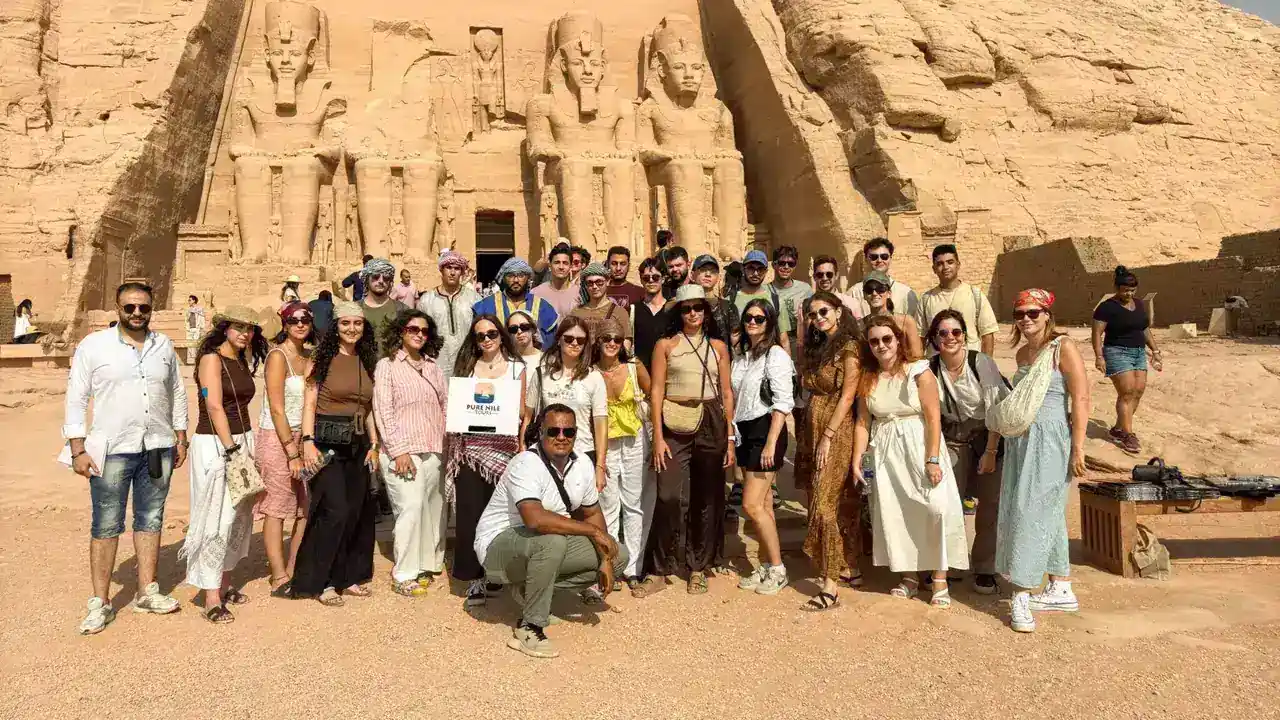
Dominated by four colossal seated statues of Ramesses II, each approximately 20 meters tall, carved directly into the mountainside. Inside, a series of halls lead to an inner sanctuary famous for its twice-yearly solar alignment. For a complete breakdown of the temple’s history and construction, see our guide to Abu Simbel temple facts.
The Small Temple of Nefertari
Dedicated to Ramesses II’s chief wife, Queen Nefertari, and the goddess Hathor, featuring six standing statues on its facade — an unusually prominent tribute to a queen by ancient Egyptian standards.
Lake Nasser
The temples sit directly on the shore of Lake Nasser, one of the largest artificial lakes in the world, created by the Aswan High Dam — the same project that made relocating Abu Simbel necessary in the first place.
Lake Nasser stretches beside the Abu Simbel temple complex — Photo: Unsplash
Best Time to Take an Abu Simbel Day Trip
The cooler months from October through April are the most comfortable for a day trip, with far more manageable daytime temperatures than the intense summer heat of southern Egypt. For travelers who want to witness the famous Abu Simbel Sun Festival, timing a visit around February 22 or October 22 allows you to see the alignment phenomenon in person, though these dates draw larger crowds. See our full best time to visit Egypt guide for broader seasonal planning across the whole country.
Combining Abu Simbel With a Nile Cruise
Many travelers take their Abu Simbel day trip while docked in Aswan as part of a broader Nile cruise itinerary between Luxor and Aswan, since Aswan is typically the cruise’s southernmost stop and the most convenient launching point for the Abu Simbel excursion. Cruise operators and independent tour companies alike commonly offer this as an optional add-on excursion, best booked in advance given limited daily capacity, particularly around the Sun Festival dates.
Practical Tips for the Trip
Book in advance, especially during peak season (December–February) and around the Sun Festival dates, as convoy and flight capacity is limited.
Bring water, sun protection, and a hat — the site offers little natural shade, and even winter sun can be intense at midday.
Expect an early start if traveling by road; this is simply part of the experience given the distance involved.
Bring your passport or a copy, as photo ID may be checked at security checkpoints along the route.
Wear comfortable walking shoes, since the approach to the temple facade involves a walk around the artificial mountain.
Road Trip vs. Flight: Which Should You Choose?
Frequently Asked Questions
How far is Abu Simbel from Aswan?
Abu Simbel is approximately 280 kilometers (174 miles) south of Aswan, close to the border with Sudan.
How long does a day trip to Abu Simbel take?
By road, the round trip typically takes 8–10 hours including the temple visit; by domestic flight, the entire trip can be completed in around 4–5 hours including time on-site.
Is it better to go to Abu Simbel by road or by plane?
Road travel is significantly cheaper but requires a very early departure and a long day; flying is faster and more comfortable but costs considerably more. The right choice depends on your budget and how much time you have available.
Do I need to book an Abu Simbel day trip in advance?
Yes, booking ahead is strongly recommended, particularly during peak season (December–February) and around the Sun Festival dates in February and October, when demand for both road convoy seats and flights increases significantly.
Can I visit Abu Simbel from Luxor instead of Aswan?
While technically possible, Aswan is by far the more practical and common departure point given the shorter distance; most Luxor-based visitors travel to Aswan first, often as part of a Nile cruise.
What should I bring on an Abu Simbel day trip?
Water, sun protection, comfortable shoes, and identification, since the site offers minimal shade and security checkpoints along the road route may require ID checks.
Is Abu Simbel worth the extra travel from Aswan?
Most visitors consider it one of the highlights of their entire Egypt trip, given the scale and historical significance of the temples and the remarkable story of their 1960s relocation.
Final Thoughts
A day trip to Abu Simbel from Aswan asks a little more of travelers than most Egyptian excursions — an early wake-up call or an extra flight cost — but the payoff is one of the most memorable sights in the entire country. Whether you choose the budget-friendly road convoy or the faster flight option, seeing Ramesses II’s colossal statues rising from the desert beside Lake Nasser is an experience well worth the extra effort required to get there.
🚌 Ready to plan your Abu Simbel day trip? Pure Nile Tours arranges private guided excursions from Aswan by road or air, with expert Egyptology guides included. View Tours → (https://pureniletours.com)