Carved into a sandstone cliff in the 13th century BCE, Abu Simbel is one of the clearest surviving statements of how Ramesses II wanted to be seen: victorious, protected by the gods, present at Egypt’s southern frontier, and worthy of worship beside major deities. The complex contains two temples, four colossal seated figures on the Great Temple’s facade, a rare monumental tribute to Queen Nefertari, and interior reliefs that turn history into royal theater.
These Abu Simbel temple facts focus on the monument’s ancient story: why it was built in Nubia, what its statues and reliefs mean, how the two temples were designed, and how the site returned to international attention after centuries of sand accumulation. Practical travel planning belongs in our complete Abu Simbel guide, while the solar phenomenon and twentieth-century rescue have their own specialist guides.
Abu Simbel Temple Facts at a Glance
What Is Abu Simbel?
Abu Simbel is a temple complex on the western side of Lake Nasser in southern Egypt. It consists of two monuments cut into the rock: a Great Temple dominated by Ramesses II and a smaller temple dedicated to Hathor and Queen Nefertari. Although the modern visitor sees them within an engineered artificial hill, the temples were originally carved into a natural sandstone escarpment overlooking the Nile.
The Egyptian Ministry of Tourism and Antiquities describes the Great Temple as one of Egypt’s most awe-inspiring monuments and dates its cutting to around 1264 BCE. Its facade presents four seated versions of the king wearing the double crown of Upper and Lower Egypt. Inside, the architecture leads through increasingly restricted spaces toward the sanctuary, following a pattern familiar from freestanding Egyptian temples while achieving it within solid rock.
The name “Abu Simbel” is modern rather than the ancient formal name of the sanctuary. The complex belongs to a wider landscape of temples and settlements in Lower Nubia, many of which were documented, moved, or lost when the Aswan High Dam transformed the region.
Ramesses II, Nubia, and the Politics Behind the Temple
Ramesses II’s Monumental Program
Ramesses II ruled for more than six decades and left his name across Egypt on new monuments, additions, restorations, and reused inscriptions. Architecture was central to his image. Colossal statues, military narratives, divine scenes, and repeated royal names made his presence difficult to ignore, even for people living generations after his death.
Abu Simbel represents this strategy at its most concentrated. Rather than being a temple where the king appears only as an intermediary before the gods, the Great Temple places his colossal image outside and his deified form in the sanctuary itself. The building collapses the distance between king and god.
Why Build in Nubia?
Nubia was not an empty frontier. It had its own communities, traditions, political histories, and religious landscapes. It was also essential to Egyptian interests because of trade routes and resources, especially gold. Egyptian rulers repeatedly campaigned, built forts, established administrative centers, and created temples in the region.
UNESCO describes Aswan and the territory to its south as a strategic zone for commerce and military activity. Abu Simbel stood far beyond Egypt’s traditional heartland and close to a route used by travelers moving along the Nile. The monument therefore communicated in several directions at once. To Egyptian officials and soldiers, it affirmed royal control. To Nubian communities and elites, it displayed the wealth and supernatural protection of the pharaoh. To the gods, it provided a permanent ritual setting.
A Temple of Power and Worship
It is tempting to describe Abu Simbel only as political propaganda, but that is too narrow. Ancient Egyptian temple architecture joined political authority, cosmic order, and worship. Ramesses’ power was presented as legitimate because it operated within divine order. Military scenes showed him defeating chaos; offering scenes showed him maintaining relationships with the gods; solar orientation connected the sanctuary to the cycles of the natural world.
The Great Temple could therefore be both a border monument and a sacred place. Its political force depended on its religious meaning, and its religious meaning reinforced the king’s political position.
The Great Temple Facade
Four Colossal Images of One King
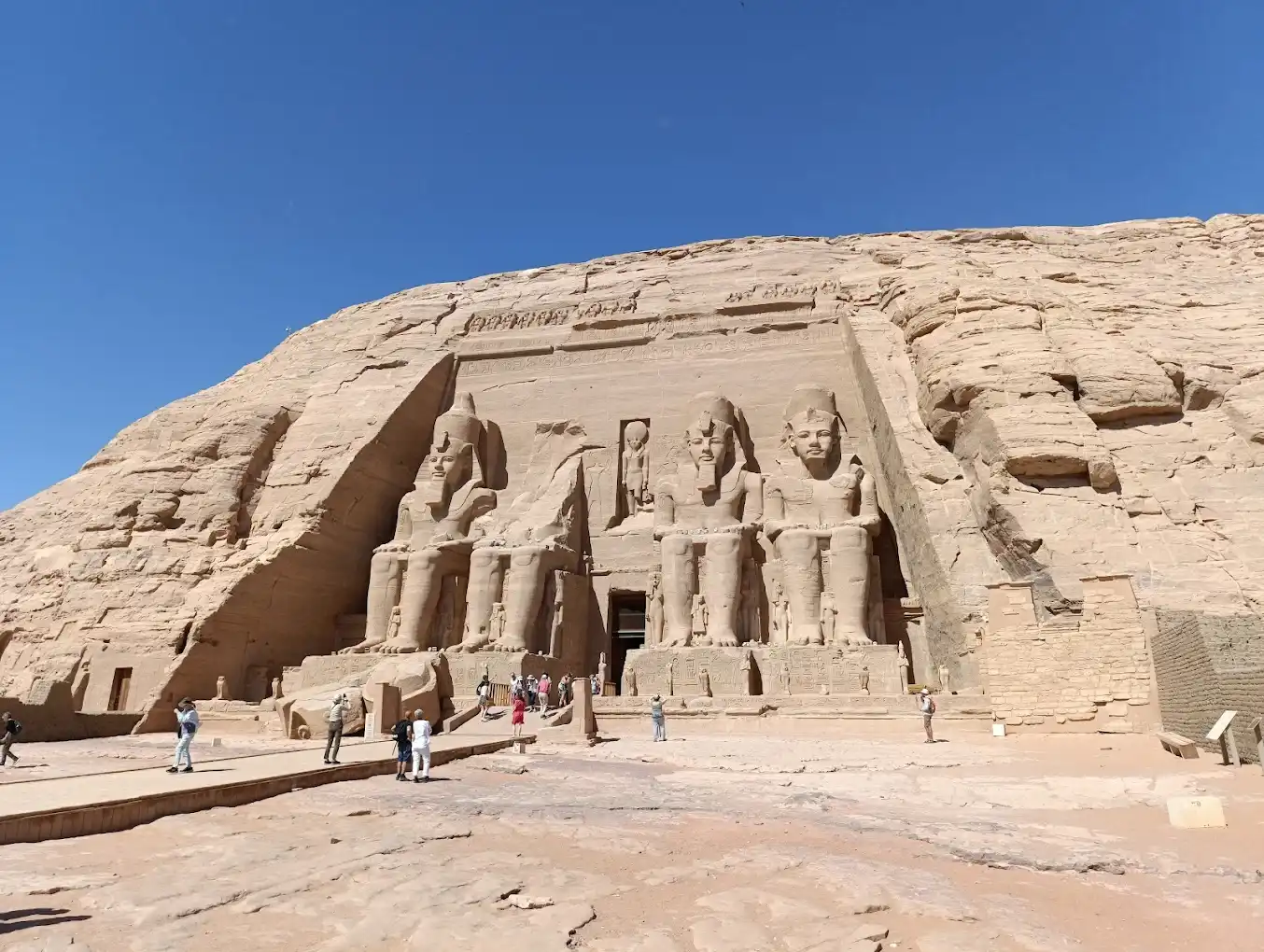
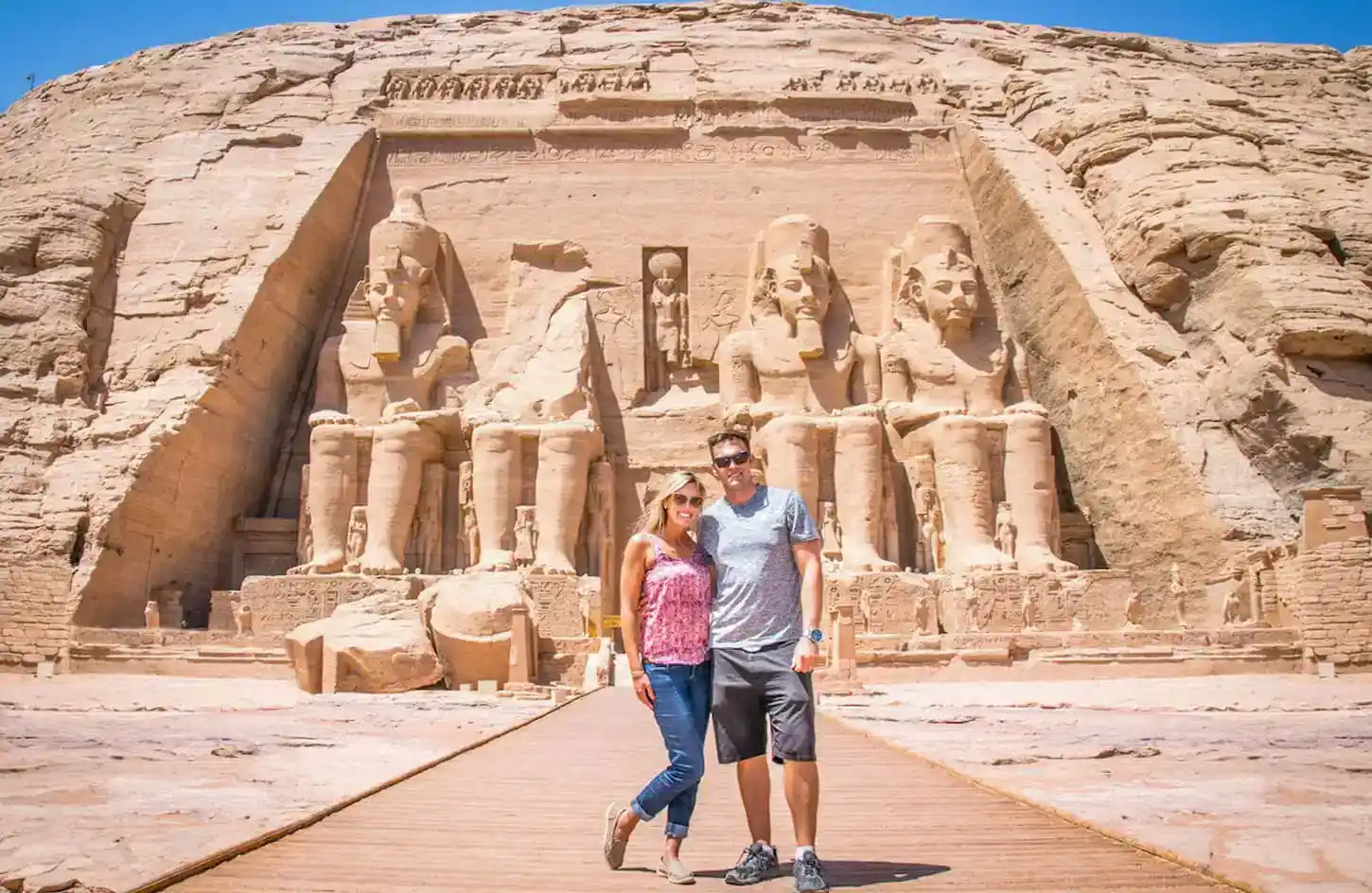
The facade is approximately 30 meters high and is dominated by four seated colossi of Ramesses II, each around 20–21 meters tall. The repetition is deliberate. Instead of showing four different rulers, the monument multiplies the same sovereign until he becomes the architecture.
The figures wear the double crown, symbolizing rule over Upper and Lower Egypt. Their scale creates a hierarchy visible before any inscription is read. Smaller figures beside and between the legs represent members of the royal family, including Queen Nefertari, the king’s mother, princes, and princesses. Their reduced scale is not an attempt at realistic perspective; it expresses status.
Above the entrance, a figure of Ra-Horakhty occupies a niche. The king’s relationship with the solar deity is encoded visually and linguistically into the facade. A line of baboons along the upper edge raises its arms toward the rising sun, reinforcing the solar symbolism before the visitor enters.
Why Is One Colossus Broken?
The upper part of one seated colossus collapsed in antiquity, most likely after an earthquake. Its head and torso remain on the ground near the figure’s feet. During the modern rescue, conservators did not reconstruct it into an idealized complete statue. Preserving the fallen pieces retained evidence of the monument’s long history and the ancient damage it had endured.
The broken colossus is therefore not a failure of the 1960s relocation. It was already damaged centuries earlier and was rebuilt in its historically ruined condition.
Scale as a Message
Travel writing often treats the figures’ height as a spectacular statistic, but their scale had a specific purpose. Anyone approaching along the river would meet an image of the Egyptian king far larger than life. The facade acted like a permanent royal audience: the ruler was seated, immovable, multiplied, crowned, and embedded in the landscape itself.
Inside the Great Temple
The First Hall and Osiride Figures
The entrance leads into a pillared hall where large standing figures of Ramesses are attached to the supports. They are often described as Osiride statues because the king adopts the tightly wrapped form associated with Osiris. The imagery links royal authority with death, regeneration, and divine permanence.
The arrangement transforms movement through the building. Visitors do not simply walk between columns; they pass through repeated royal bodies. Architecture and sculpture become inseparable.
From Public Grandeur to Sacred Restriction
Like many Egyptian temples, the building narrows and becomes more sacred toward the rear. Broad halls give way to smaller chambers and finally the sanctuary. This progression moves from the public declaration of the facade toward the restricted divine core.
Side rooms may have stored ritual equipment and offerings. Walls throughout the complex carry scenes of the king before deities, ritual actions, and military subjects. The temple is not a single story but a network of images in which Ramesses repeatedly demonstrates the qualities of an ideal ruler.
The Four Sanctuary Figures
At the rear sit four figures: Ptah, Amun-Ra, the deified Ramesses II, and Ra-Horakhty. Their placement is one of the most striking facts about the temple. Ramesses does not merely stand before the gods as a mortal king; his own divine image sits among them.
On two periods each year, sunlight penetrates the temple and reaches three of the figures while Ptah remains in shadow. The modern public dates are February 22 and October 22. The popular birthday-and-coronation explanation is not securely proven, and the astronomical interpretation deserves more care than a short fact list can provide. Read our full Abu Simbel Sun Festival guide for the evidence and debate.
The Battle of Kadesh Reliefs
What Was the Battle of Kadesh?
The Battle of Kadesh was fought between the forces of Ramesses II and the Hittite king Muwatalli II near the city of Kadesh in Syria. It was a major confrontation between two powerful states competing for influence in the eastern Mediterranean and Near East.
The surviving evidence does not support a simple Egyptian victory in the modern military sense. Ramesses’ army was surprised, fighting was intense, and the political struggle continued. Egyptian monumental accounts, however, frame the king as the decisive hero who stands firm when others fail.
What the Temple Shows
The relief cycle depicts camps, chariots, troops, enemies, and a king larger than everyone around him. Ramesses charges into combat and overwhelms opponents. Texts emphasize his personal courage and the divine support he receives.
The scene is structured communication rather than neutral reporting. Scale, repetition, and composition guide the viewer toward one conclusion: order is restored because the king is uniquely powerful. The defeated enemy becomes a visual symbol of chaos, while the pharaoh embodies control.
Why Put Kadesh at Abu Simbel?
The subject linked military success with rule at the southern frontier. Even though Kadesh was fought far to the northeast, its message traveled anywhere the relief was displayed. At Abu Simbel, it told viewers in Nubia that Ramesses had faced the great powers of his age and remained the central figure in Egypt’s world order.
The reliefs also connect the temple to other Ramesside monuments where versions of the Kadesh narrative appear. Comparing them shows how the same royal event could be adapted to different architectural settings and audiences.
The Small Temple of Hathor and Nefertari
A Rare Monument to a Queen
The Small Temple stands north of the Great Temple and is dedicated to Hathor and Queen Nefertari, Ramesses II’s Great Royal Wife. Its facade has six standing colossi: four of Ramesses and two of Nefertari.
The remarkable detail is that the queen’s figures are approximately the same height as the king’s. Egyptian art normally uses scale to express hierarchy, and royal wives are often shown much smaller than pharaohs. Nefertari’s equality of scale on this facade gives her an exceptional visual status.
This does not mean that Ramesses and Nefertari held identical political office. It means the monument deliberately elevated her within this sacred program, connecting the queen with Hathor and presenting the royal couple as a coordinated divine image.
Why Hathor?
Hathor carried associations with music, love, motherhood, kingship, the sky, and distant lands. Queens could be closely connected to her cult. At Abu Simbel, Nefertari’s relationship with Hathor gave religious structure to the honor displayed on the facade.
Inside, scenes show the royal couple interacting with deities. The sanctuary contains imagery related to Hathor, and the temple’s rock-cut form creates an intimate counterpart to the overwhelming scale of the Great Temple.
“For Whom the Sun Shines”
Nefertari’s titles and the affectionate language associated with her have made the temple central to modern ideas about the royal marriage. Popular retellings can become romanticized, but the material evidence is genuinely unusual: Ramesses dedicated a major Nubian temple to Hathor and his queen, and represented Nefertari on the facade at a scale normally reserved for the king.
How the Temples Were Carved
Abu Simbel was excavated directly into sandstone rather than assembled as a freestanding building from quarried blocks. Ancient teams had to plan a facade, halls, pillars, side chambers, relief surfaces, and sanctuary along a controlled axis. Removing too much rock or introducing structural weakness could not be easily reversed.
Work likely proceeded through teams with different responsibilities: quarrying and rough excavation, leveling, measuring, smoothing, relief carving, inscription, and painting. The surviving monument reveals both centralized design and the labor of many specialists.
The facade required converting a natural cliff into architectural geometry while leaving enough living rock to support the enormous seated figures. Inside, the diminishing sequence of spaces had to remain aligned. The solar effect added another layer of orientation, although scholars continue to debate precisely how its ancient timing and meaning should be reconstructed.
Traces of color survive in protected areas, reminding visitors that Egyptian temple reliefs were not intended as bare stone. Painted surfaces would have made clothing, skin, divine attributes, hieroglyphs, and battle scenes more legible and vivid.
Symbols Hidden in Plain Sight
The Double Crown
The double crown worn by the colossi combines the traditional crowns of Upper and Lower Egypt. At a southern frontier monument, it reinforces the idea that the king represents the whole Egyptian state.
The Smiter Image
Across Egyptian royal art, the king may be shown striking defeated enemies. This is more than a record of violence. It is a ritual image of the ruler defeating disorder and protecting cosmic balance. At Abu Simbel, military reliefs and divine scenes belong to the same ideological system.
Royal Cartouches
The names and titles of Ramesses appear repeatedly in cartouches. Repetition ensures identification, but it also activates the king’s presence throughout the building. In Egyptian thought, the name was a fundamental part of identity and survival.
Solar Imagery
The eastern orientation, Ra-Horakhty above the entrance, the baboons greeting sunrise, and the sanctuary illumination create a coordinated solar program. The temple does not depend on one spectacular event; solar meaning begins on the facade and continues inward.
Family Figures
Smaller royal figures around the colossi communicate dynasty. They identify the king not as an isolated individual but as the center of a continuing royal household. Their scale preserves hierarchy while their presence supports legitimacy.
The Modern Rediscovery of Abu Simbel
Burckhardt and the Sand-Covered Facade
By the early nineteenth century, accumulated sand concealed much of the Great Temple. In 1813, the Swiss traveler Johann Ludwig Burckhardt identified the site, with only the upper portions of the colossal figures visible. His account drew further European attention to the monument.
The word “discovery” needs qualification. Local Nubian communities knew the landscape; the temple was not discovered in the absolute sense of being unknown to everyone. The term usually refers to its documentation and entry within nineteenth-century European exploration and archaeology.
Belzoni Enters the Great Temple
Giovanni Battista Belzoni reached the site and, after efforts to clear the obstructing sand, entered the Great Temple in 1817. Early exploration combined curiosity, documentation, competition, and collecting practices that would not meet modern archaeological standards.
The episodes surrounding Burckhardt and Belzoni became part of Abu Simbel’s modern mythology: a monumental facade emerging from dunes and an interior sealed by sand. Historical images from the nineteenth century preserve a landscape very different from the lakeside setting visitors see today.
Documentation Before Relocation
The greatest modern change came more than a century later, when surveys recorded the temples before they were cut and moved. Photography, measurement, mapping, and architectural study became essential because engineers needed to reconstruct not simply individual stones, but entire spatial relationships.
For the engineering process, international teams, risks, block system, artificial domes, and the broader Nubian campaign, continue to How Was Abu Simbel Moved?.
What Is Ancient and What Is Modern at Abu Simbel?
The carved temple surfaces, statues, reliefs, and most visible architectural material are ancient. Their current position and supporting landscape are modern. During the rescue, the monuments were divided into numbered sections, lifted, and reassembled within engineered structures covered to resemble natural hills.
This combination does not make Abu Simbel a replica. It is an original ancient monument moved from its original location. UNESCO recognizes that relocation altered the setting, yet notes that careful work preserved the form, design, material, and spirit of the property to a high degree.
The fallen colossus was reconstructed as fallen. The orientation was reproduced with extraordinary care. The visitor’s impression of a temple disappearing into rock was preserved through artificial cliffs rather than exposing the temples as isolated facades.
Understanding this distinction makes the site more interesting. Abu Simbel is simultaneously a masterpiece of New Kingdom royal architecture and a document of twentieth-century conservation philosophy.
Abu Simbel Compared with Other Ramesses II Monuments
Read more about Luxor Temple history and Karnak Temple to place Abu Simbel within Ramesses II’s wider building program.
Frequently Asked Historical Questions
Who built Abu Simbel, and when?
Ramesses II commissioned the two temples during Egypt’s Nineteenth Dynasty in the 13th century BCE. Egypt’s Ministry of Tourism and Antiquities dates the Great Temple to around 1264 BCE.
How many temples are at Abu Simbel?
There are two: the Great Temple associated with Ramesses II and major deities, and the Small Temple dedicated to Hathor and Queen Nefertari.
Why are there four statues of Ramesses II on the facade?
Repeating the king’s colossal seated image magnified his presence and authority. The four figures are not four different pharaohs; they are monumental representations of the same ruler.
Why is one of the great statues broken?
Its upper section collapsed after an earthquake in antiquity. The fallen pieces were deliberately preserved in that condition during the modern relocation.
Why is Nefertari shown at the same height as Ramesses?
The Small Temple gives Nefertari an exceptional sacred status through her connection with Hathor. Equal facade scale was rare for a queen and was a deliberate honor, although it does not imply identical political rank.
What battle is shown inside Abu Simbel?
Reliefs depict Ramesses II’s version of the Battle of Kadesh against the Hittites. They present the king as a heroic defender of order rather than serving as a neutral battlefield report.
Who first entered Abu Simbel in modern times?
Johann Ludwig Burckhardt documented the sand-covered site in 1813. Giovanni Battista Belzoni cleared enough sand to enter the Great Temple in 1817.
Which gods sit in the Great Temple sanctuary?
The four seated figures are Ptah, Amun-Ra, the deified Ramesses II, and Ra-Horakhty.
Is Abu Simbel a replica after its relocation?
No. The ancient carved temple material was dismantled and reassembled in a new position. The surrounding hill and structural support are modern, but the monument itself is original.
Final Thoughts
The most important Abu Simbel temple fact is not a measurement or a date. It is that every major feature works together. The colossal facade, the royal family, the Kadesh reliefs, the divine sanctuary, the solar axis, and Nefertari’s temple all construct a single message about kingship at Egypt’s southern frontier.
The site later acquired a second layer of meaning through rediscovery, documentation, and relocation. Yet its ancient program remains legible: Ramesses II intended Abu Simbel to be encountered as power made permanent in stone.
For logistics, tickets, road and flight options, the best season, and day-trip planning, use the complete Abu Simbel visitor guide.
🏛️ See the history with an expert, not just from the outside. Pure Nile Tours can arrange a private Abu Simbel experience with an Egyptologist guide who explains the reliefs, royal symbolism, and Nubian context. Plan Your Abu Simbel Visit →
Sources and Further Reading
- Egyptian Ministry of Tourism and Antiquities: Abu Simbel
- UNESCO World Heritage: Nubian Monuments from Abu Simbel to Philae
- UNESCO: Working Together — Abu Simbel
- Göran Henriksson, “Rameses II and Sunrise at the Great Abu Simbel Temple,” including discussion of the 1813 and 1817 rediscovery episodes.