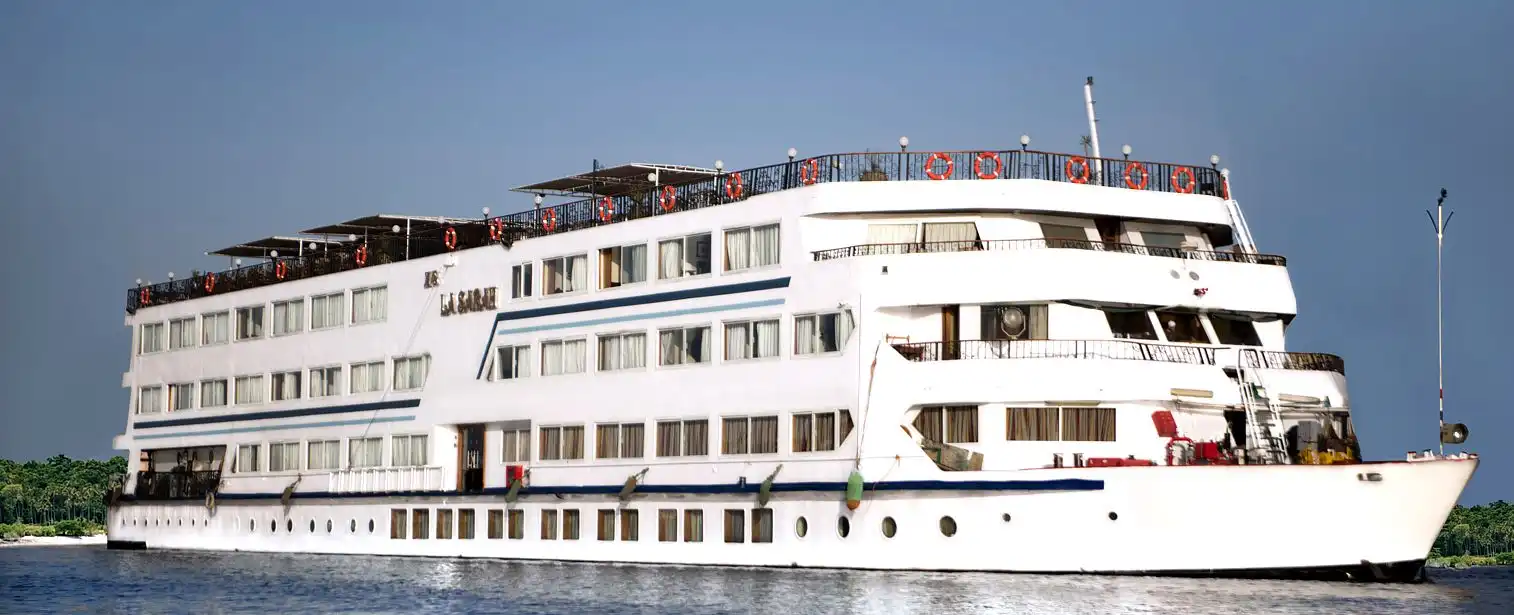
The A Sara Nile Cruise is a 5-star floating hotel sailing between Luxor and Aswan on one of the world’s most historically loaded river routes. Sixty-six deluxe cabins, two junior suites, a sun deck with pool, full-board dining, and a licensed Egyptologist guide at every temple stop. Three sailing schedules — 4 nights from Luxor, 3 nights from Aswan, or an 8-day extended cruise — give travellers flexibility without compromising the itinerary. For anyone planning a Nile cruise in Egypt, here is everything you need to know.
A Sara Nile Cruise at a Glance
The quick-reference table below covers the ship’s key facts before you plan in detail.
| Detail | Info |
|---|---|
| Ship name | MS A Sara Nile Cruise |
| Star rating | 5-star |
| Route | Luxor ↔ Aswan (Nile River, Upper Egypt) |
| Total cabins | 66 deluxe cabins + 2 junior suites |
| Cabin position | All above the waterline |
| Sailing schedules | 4N/5D from Luxor (every Saturday); 3N/4D from Aswan (every Wednesday); 7N/8D extended (from Luxor, Saturdays) |
| Meal plan | Full board (breakfast, lunch, dinner) |
| Guide | Licensed Egyptologist guide on all excursions |
| Price range (per person) | $65–$100/night low season; $90–$150/night high season |
| Best season | October–April |
| Key sites covered | Karnak, Luxor Temple, Valley of the Kings, Hatshepsut Temple, Edfu, Kom Ombo, Philae, High Dam |
| Optional add-on | Abu Simbel excursion from Aswan |
Exchange rates fluctuate — verify current rates before travel.
Key features at a glance:
- All 68 rooms sit above the waterline — natural light and unobstructed Nile views from every cabin
- Full-board pricing covers three meals daily; drinks are charged separately
- Egyptologist guide included on all temple excursions — no additional guide cost on the standard itinerary
- The ship sails year-round; cabins sell out 8–12 weeks ahead during October–March peak season
- Private transfers to and from Aswan or Luxor airport/train station are included in Pure Nile Tours packages
⚠️ Safety Notice
At the time of writing, the Luxor–Aswan Nile cruise corridor is safe for tourists. Egypt’s government travel advisories from major Western countries classify the Upper Egypt tourist route as normal-vigilance territory. The Nile cruise format itself — guided excursions, ship-based accommodation, private transfers — minimises independent navigation risks. Always check your government’s official travel advisory before booking.
- 🇬🇧 UK: FCDO Travel Advice — Egypt
- 🇺🇸 USA: US State Department — Egypt
- 🇦🇺 Australia: Smartraveller — Egypt
What Is the A Sara Nile Cruise?
The MS A Sara is a 5-star Nile cruise ship operating on the classic Luxor–Aswan route in Upper Egypt. The ship runs two standard sailing schedules: a 4-night/5-day itinerary departing Luxor every Saturday, and a 3-night/4-day itinerary departing Aswan every Wednesday. An extended 7-night/8-day sailing from Luxor is also available for travellers who want more time at each temple site.
The ship carries 68 cabins in total — 66 deluxe cabins and 2 junior suites — all positioned above the waterline. This is a practical distinction: on many Nile cruise ships, lower-deck cabins sit at or below waterline, facing the dock wall rather than the river. On the A Sara, every cabin has natural light and an external window or balcony with Nile views.
The A Sara Nile Cruise is bookable as a standalone sailing or as part of a combined Egypt package including Cairo and Abu Simbel. The A Sara Nile Cruise — 5-Star Nile Cruise Between Luxor & Aswan page at Pure Nile Tours has the current schedule, pricing, and availability.
A Sara Nile Cruise Cabins & Accommodation
The A Sara’s accommodation divides into two categories: Deluxe Cabins and Junior Suites. All 68 rooms are above the waterline — a standard that eliminates the dock-wall view problem common on lower-deck cabins on many ships in the same class.
The cabin types are as follows:
| Category | Features |
|---|---|
| Deluxe Cabin | Double or twin beds, individual A/C control, large sliding glass window, mini-fridge, safe, flat-screen TV, en-suite bathroom |
| Junior Suite | Larger floor area, separate living zone, premium furnishings — suited to honeymooners or guests wanting added privacy |
Deluxe Cabins are the standard choice for most travellers. The large sliding glass window — floor height, panoramic — means the Nile passes at eye level from your bed. Individual air conditioning control is an important detail on a ship where outside temperatures can reach 38°C in summer; the ability to set your own cabin temperature independently makes a meaningful difference to sleep quality.
Junior Suites add a separate seating area and a higher level of fit-out. Both bed types — double or twin — are available in most cabin categories; specify your preference when booking. Cabin allocation is typically confirmed closer to the sail date; requesting an upper-deck or river-facing room at the time of booking increases the chance of the best views.
The cabin decor uses warm timber tones, soft lighting, and fitted furniture — functional rather than ornate, but consistently well-maintained. Housekeeping runs twice daily. In-room safe, mini-fridge, and towel change are standard; toiletries are provided.
Dining on the A Sara Nile Cruise
Three meals daily are included in the full-board package: breakfast, lunch, and dinner. Service runs buffet-style with waiter service for hot dishes — a format that combines variety with table service rather than a pure self-serve line.
Breakfast runs 07:00–09:30 on sailing days: eggs cooked to order, fresh bread, cheese, cold cuts, fruit, and Egyptian bean dishes (ful medames). Lunch is the largest meal — hot and cold buffet with Egyptian and international dishes running simultaneously. Dinner follows a set-menu structure with buffet starters and desserts.
Egyptian dishes to look for on the buffet: kofta (spiced minced lamb on skewers), grilled hamour (grouper), molokhia (jute leaf stew with garlic), and om ali (bread pudding with milk and nuts — the standard Nile cruise dessert). Vegetarian options are present at every meal without prior arrangement; dedicated vegetarian or vegan passengers should confirm requirements at booking. For a wider guide to Egyptian food, Top 7 Egyptian Cuisines to Try covers what to expect at each meal type.
Drinks — water beyond the table carafes, soft drinks, alcohol, and hot beverages — are charged separately at the ship’s bar. Budget EGP 150–300 per person per day for drinks if you consume alcohol; EGP 50–100 if you stick to water and tea.

Facilities & On-Board Experience
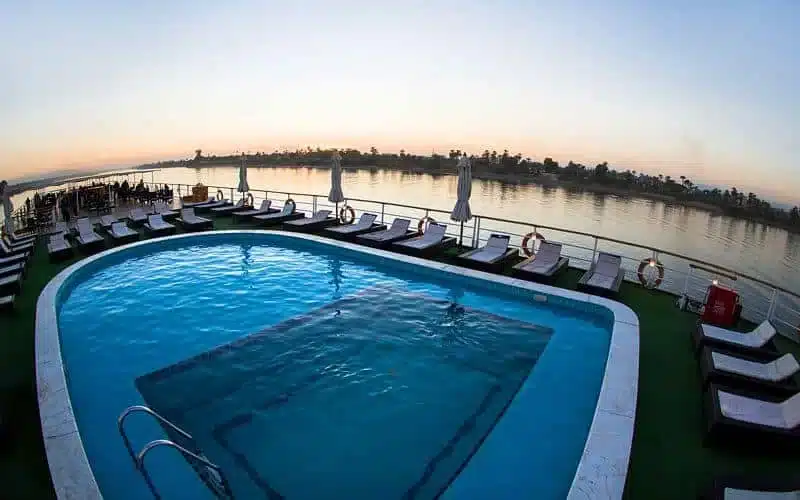
The A Sara carries the standard 5-star Nile cruise facility set: sun deck with outdoor swimming pool, sun loungers, shaded terrace seating, panorama bar, main dining saloon, lounge with entertainment space, on-board doctor (on-call), laundry service, and Wi-Fi (charged separately at most time of writing — confirm current rate at booking).
Sun deck: The top deck is the social centre of the ship during sailing hours. The pool is small — standard for Nile cruise ships of this size — but the surrounding lounger area and bar make it a functional space for the 2–4 hours the ship moves between temple stops. The passage through the Esna Lock (between Luxor and Aswan) draws most passengers to the deck; the ship passes through a narrow canal-lock system while locals sell goods from the lock walls — one of the genuinely unexpected Nile experiences.
Evening entertainment: Every ship on this route runs a galabeya party — guests wear traditional Egyptian dress (galabeyas provided or available to purchase in the nearby markets) for dinner and an evening of Egyptian folkloric music. It is optional, but participation rates among travellers are consistently high. An Egyptian folklore show with local performers runs on at least one evening of the 4-night itinerary.
Lounge: The main lounge serves as a briefing space before each excursion — your Egyptologist guide uses this room to give context before disembarkation. The 10–15 minute temple briefings are standard practice on all 5-star ships and meaningfully improve comprehension at the site itself.
A Sara Nile Cruise Itinerary
4 Nights / 5 Days from Luxor (Every Saturday)
This is the standard format for most travellers booking the A Sara — the most common schedule, covering the widest range of sites. The ship departs Luxor on Saturday and arrives in Aswan on Wednesday morning.
| Day | Location | Sites |
|---|---|---|
| Day 1 (Saturday) | Luxor — embarkation | Check in, lunch on board, Luxor Temple, Karnak Temple evening visit |
| Day 2 (Sunday) | Luxor West Bank | Valley of the Kings (3 tombs), Hatshepsut Temple, Colossi of Memnon |
| Day 3 (Monday) | Edfu & Kom Ombo | Temple of Horus at Edfu, Kom Ombo double temple, sail to Aswan |
| Day 4 (Tuesday) | Aswan | Philae Temple (boat transfer), Aswan High Dam, optional Nubian village |
| Day 5 (Wednesday) | Aswan — disembarkation | Check out, transfer to airport or station; optional Abu Simbel excursion |
Day 1 — Embarkation in Luxor:
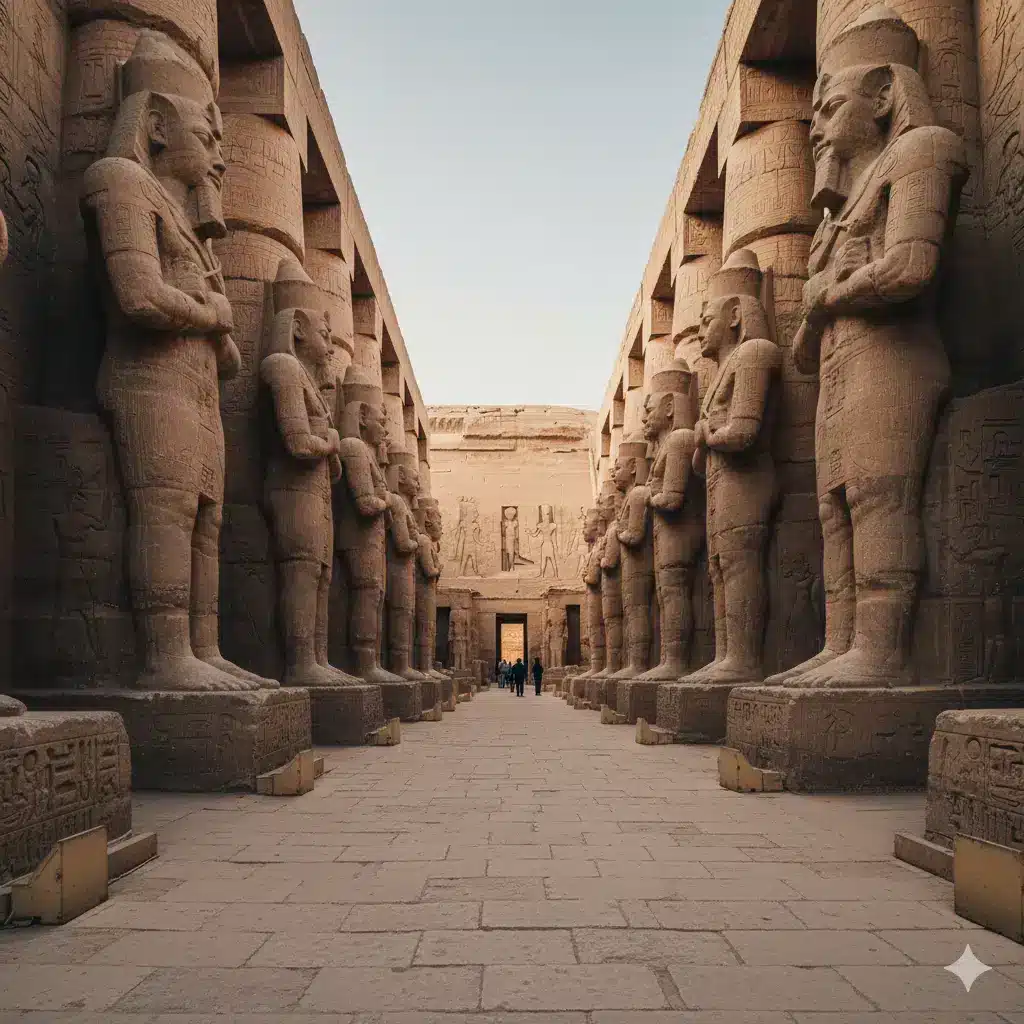
Check-in opens from 12:00. Lunch is served on board before the afternoon excursion to Luxor Temple — a massive open-air complex on the East Bank of the Nile, connected to Karnak by the recently restored Avenue of Sphinxes (3 km of ram-headed sphinxes, fully excavated and lit at night). Karnak Temple is the evening stop: the Hypostyle Hall’s 134 columns, the tallest at 23 m, are significantly more manageable before 09:00 or after 17:00 when tour groups thin out.
Day 2 — West Bank, Valley of the Kings:
The West Bank is where pharaohs were buried. Standard admission covers 3 tombs of your choice from those currently open; the tomb of Ramesses VI has the most complete ceiling paintings; the tomb of Seti I (when accessible) has the finest reliefs. Tutankhamun’s tomb requires a separate ticket (EGP 800) — the actual chamber is smaller than most visitors expect, since all the famous objects are now at the Grand Egyptian Museum in Cairo. The funerary temple of Hatshepsut, immediately after, is cut into a cliff face on three ascending terraces — the scale and the precision of the construction are the draws, not the decoration.
Day 3 — Edfu & Kom Ombo:
The ship moves south overnight and docks at Edfu by morning. The Temple of Horus at Edfu is the best-preserved ancient temple in Egypt — built 237–57 BCE, the two massive entrance pylons are intact, and the inner sanctuary still holds its original granite naos (god’s shrine). Budget 60–75 minutes. The ship continues to Kom Ombo for the afternoon stop: a unique double temple dedicated simultaneously to the crocodile god Sobek and the falcon god Haroeris, positioned on a bend in the Nile with views directly over the water. The adjacent Crocodile Museum holds over 300 mummified crocodiles.
Day 4 — Aswan:
Philae Temple sits on Agilkia Island in the middle of the Nile near Aswan — reached by a 5-minute motorboat from the Shellal dock. The temple was dismantled and moved block by block between 1972 and 1980 to save it from the rising waters behind the Aswan High Dam. The reliefs are among the sharpest in Egypt; the columns and colonnades around the main temple are photographically strong in morning light. The High Dam itself — 3.6 km wide, completed 1971 — created Lake Nasser, one of the largest reservoirs in the world. The dam’s upper roadway gives a view across both the Nile valley and the lake.
Day 5 — Disembarkation:
Check-out by 09:00. Transfer to Aswan airport or train station for onward travel. Passengers who pre-booked the Abu Simbel optional excursion depart Aswan at 06:00 for the 45-minute flight south; they return by noon and transfer directly to the airport. For full detail on what to expect at the temples, Abu Simbel Temples: Practical Visitor Guide from Aswan covers the site, the logistics, and the best times to arrive.
3 Nights / 4 Days from Aswan (Every Wednesday)
The reverse itinerary — boarding in Aswan on Wednesday and arriving in Luxor on Saturday — covers the same temple sites in the opposite order: Philae and High Dam on Day 1, Kom Ombo and Edfu on Day 2, Valley of the Kings and Hatshepsut on Day 3, Karnak and Luxor Temple on the final morning before disembarkation.
The practical difference: you arrive in Luxor at the end of the cruise rather than the beginning, which suits travellers flying out of Luxor or connecting to Cairo from there. The 3-night format loses one full day compared to the 5-day sailing — Day 1 from Aswan is shorter, and the Valley of the Kings visit is sometimes compressed. For travellers with a fixed schedule, the 3 Nights Nile Cruise from Aswan to Luxor package covers this itinerary in detail.
7 Nights / 8 Days Extended Cruise (from Luxor, Saturdays)
The longest A Sara sailing departs Luxor on Saturday and gives passengers two additional days to explore Aswan and the surrounding area before returning north. The extra time accommodates Abu Simbel as a relaxed excursion (rather than a dawn sprint), a half-day at the Nubian village on Elephantine Island, and a felucca sunset sail — experiences that fit poorly into the 4-night format. This schedule suits travellers whose only Egypt priority is the Nile valley, with no Cairo component planned.
Temple Sites on the A Sara Nile Cruise Route
Luxor Temple & Karnak Temple Complex
Luxor Temple sits on the East Bank of the Nile, in the centre of modern Luxor city. Built mainly by Amenhotep III and Ramesses II (14th–13th century BCE), the temple served as a site for the Opet Festival — an annual celebration of the Nile flood that linked the kingship of the pharaoh to divine renewal. The Avenue of Sphinxes connecting Luxor Temple to Karnak was fully excavated and restored between 2021 and 2023; walking its 3 km at night, with the columns lit on either side, is one of the most striking experiences on the cruise route.
Karnak Temple Complex covers 200 acres — the largest religious complex ever built. Construction ran from approximately 1550 BCE to the Ptolemaic period (30 BCE), with every pharaoh who reigned in between adding a hall, a pylon, or an obelisk. The Hypostyle Hall — 134 papyrus-column columns, the largest reaching 23 m — remains the single most imposing interior space in ancient architecture. Opens 06:00; visit before 09:00 or after 17:00 for the best conditions.
Valley of the Kings & Hatshepsut Temple
The Valley of the Kings sits on Luxor’s West Bank, carved into the limestone cliffs of the Theban Necropolis. 63 tombs have been documented; most date from 1550–1070 BCE. Standard admission covers entry to 3 tombs — your Egyptologist guide will recommend the best open tombs on the day of your visit, since access rotates for conservation. The painted ceilings and walls in the better tombs (Ramesses VI, Seti I, Thutmose III) have survived 3,000 years in near-intact condition; the combination of scale and precision makes the Valley of the Kings unlike any museum or gallery in the world.
The funerary temple of Hatshepsut — one of ancient Egypt’s few female pharaohs — is cut into the cliff face at Deir el-Bahari on three colonnaded terraces. The architecture is startlingly modern in appearance for a structure built around 1480 BCE. The ramps connecting the terraces, the painted hunting and expedition scenes along the colonnades, and the cliff backdrop make this the most photographically distinctive site on the West Bank.
Temple of Horus at Edfu
The Temple of Horus at Edfu is the best-preserved ancient temple in Egypt. Built during the Ptolemaic period (237–57 BCE), the structure is complete to the roofline — both entrance pylons, the forecourt, the hypostyle halls, and the inner sanctuary with its granite naos all stand intact. The temple is dedicated to the falcon god Horus; a large granite falcon statue at the entrance is the most reproduced image from the site. Budget 60–75 minutes.
Kom Ombo Double Temple
Kom Ombo is architecturally unique: a single temple with a doubled axis, two sanctuaries, two sets of halls, and two sets of deity dedications — one side for the crocodile god Sobek, one for the falcon god Haroeris. Built 180–47 BCE, the temple sits directly on the Nile bank; the view from the front courtyard across the water is one of the best on the cruise route. The adjacent Crocodile Museum (free with temple entry) displays 300+ mummified crocodiles recovered from the site — practical evidence of Sobek’s actual cult practice.
Philae Temple & Aswan High Dam
Philae Temple on Agilkia Island is the last great temple built in the classical Egyptian style — construction continued until the 3rd century CE, long after Egypt had become part of the Roman Empire. The temple’s reliefs retain significant original paint in protected interior spaces. The boat crossing to the island (5 minutes, included in guided tours) gives a view of the surrounding Nile granite outcrops — the landscape that defines Aswan and distinguishes it from every other Nile city.
The Aswan High Dam, 12 km south of Aswan city, is a different kind of site: a 3.6 km-wide earthwork dam completed in 1971 that reshaped the Nile and created Lake Nasser. Its construction required the relocation of 100,000 Nubian people and 22 ancient temples — including Abu Simbel and Philae. The dam is included in the standard Aswan day of the A Sara itinerary; the upper road gives a perspective on the scale that photographs rarely convey.
Abu Simbel (Optional Excursion from Aswan)
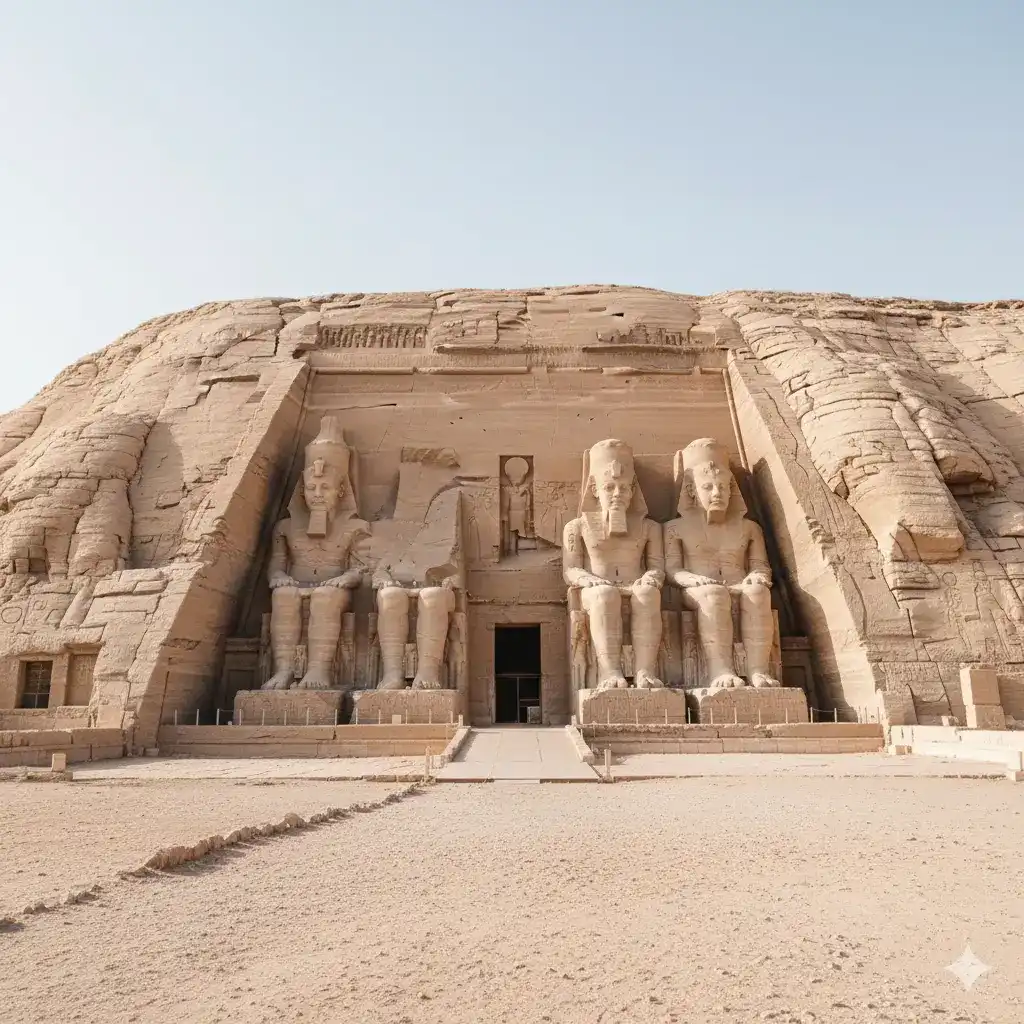
Abu Simbel is 280 km south of Aswan — not part of the standard A Sara itinerary, but available as an optional add-on from the Day 4 or Day 5 Aswan stop. Two rock-cut temples built by Ramesses II around 1264 BCE, both relocated 65 m higher between 1964 and 1968 by UNESCO and the Egyptian government to save them from Lake Nasser. The Great Temple’s four 20-metre seated colossi and the internal hypostyle hall with Ramesses II battle reliefs are the main draws. The optional excursion departs Aswan at 06:00 by 45-minute flight; passengers return to Aswan by 12:00 and connect to their onward travel. For practical visitor information, Abu Simbel Temples: Practical Visitor Guide from Aswan covers logistics, entry costs, and the best arrival times.
How to Book the A Sara Nile Cruise
The A Sara Nile Cruise is bookable as a standalone cruise or as part of a combined Egypt package with Cairo. The A Sara Nile Cruise — 5-Star Nile Cruise Between Luxor & Aswan page at Pure Nile Tours shows the current departure dates, cabin availability, and full pricing for both the 4-night and 3-night schedules.
Booking process:
- Select your sailing direction and dates (Luxor departure: Saturdays; Aswan departure: Wednesdays)
- Choose cabin type (Deluxe or Junior Suite) and bed configuration (double or twin)
- Pay a 20–30% deposit to confirm the booking
- Balance is due before travel; specific terms are confirmed on the tour page
What to confirm before booking:
- Whether Abu Simbel is included or available as an add-on
- Airport or train station transfer arrangements for arrival and departure days
- Cabin deck and river-view preference (upper decks give the best views)
- Any dietary requirements for the on-board dining team
Cabins on the A Sara sell out 8–12 weeks in advance during peak season (October–March). Travelling in December or January? Start the booking process 3 months out. For a wider view of Nile cruise pricing across different ship categories, Nile Cruise Luxor to Aswan Prices 2026 gives a current market comparison.
A Sara Nile Cruise Prices & What’s Included
The A Sara operates at 5-star pricing. At the time of writing, cabin rates run approximately $65–$100 per person per night in low season (May–September) and $90–$150 per person per night in high season (October–April). The 4-night sailing therefore costs approximately $360–$750 per person for the cabin alone, depending on season and cabin type.
Included in the cruise price:
- Full-board meals (breakfast, lunch, dinner)
- Licensed Egyptologist guide on all excursions
- Private motorboat transfer to Philae Temple
- All temple entrance fees on the standard itinerary
- Airport/station transfers in Luxor and Aswan (when booked through Pure Nile Tours packages)
- Galabeya party and evening entertainment
Not included in the cruise price:
- Abu Simbel excursion (optional add-on, ~$80–$120 per person by plane)
- Drinks beyond water at meals (alcohol, soft drinks, hot beverages)
- Wi-Fi on board (charged separately, rate varies)
- Tips for crew and guide ($10–$15 per person per day is standard)
- Tutankhamun’s tomb entry in Valley of the Kings (EGP 800 separate ticket)
- Hot air balloon over Luxor (optional, ~$70–$120 per person)
- Personal laundry
Exchange rates fluctuate — verify current rates before travel.
For a broader Egypt tour that combines the A Sara cruise with Cairo’s Pyramids, Grand Egyptian Museum, and Khan El-Khalili, Egypt Tour Packages has combined itineraries at various lengths.
Best Time to Sail on the A Sara Nile Cruise
October through April is the comfortable sailing window. November to February offers the most pleasant conditions: daytime temperatures in Luxor and Aswan run 22–28°C, mornings at the temple sites are cool enough for extended walking, and Nile sunset temperatures on the sun deck are ideal. These months are also peak season — cabins fill quickly.
March and October sit in a useful position: warm (26–32°C), shorter booking lead times than December–February, and manageable crowds at the Valley of the Kings and Karnak. April sees holiday periods in Europe and North America drive a short demand spike; book 6 weeks ahead for this month.
May through September: Aswan and Luxor temperatures reach 38–43°C by midday. Temple visits run 06:00–10:00 to avoid the worst heat; afternoon excursions are largely impractical. The ship’s pool and A/C cabins become proportionally more valuable. Cruise prices drop 15–25% in this window — a significant saving if you can manage the heat.
For a month-by-month breakdown of Egyptian weather and how it affects travel planning, Best Months to Visit Egypt: Weather, Crowds & Travel Tips covers the full annual cycle.
A Sara Nile Cruise vs Other 5-Star Ships
The Nile between Luxor and Aswan carries around 300 cruise ships. Most 5-star vessels run the same itinerary — Karnak, Valley of the Kings, Edfu, Kom Ombo, Philae — and the temple programme is standardised across the fleet. The differentiators between ships in the same class come down to four factors: cabin position (above or below waterline), cabin size, food quality, and crew ratio.
The A Sara’s main advantages over average 5-star competitors on the same route:
- All cabins above waterline. Many ships in the 4-star and budget 5-star bracket have lower-deck cabins that face the dock wall or sit partially below the waterline. On the A Sara, every cabin has an external window at or above the Nile surface.
- 68 cabins only. Smaller than the largest ships (which carry 120+ passengers), which translates to a better crew ratio and less queuing at buffets and disembarkation points.
- Doctor on call. Not standard on all cruise ships in this class; the A Sara carries a ship’s doctor available throughout the sailing.
- Individual A/C control. Some ships run centralised air conditioning with no per-cabin control. The A Sara allows independent temperature setting in each cabin.
The trade-off versus ultra-luxury Dahabiya sailboats: a Dahabiya carries 8–16 passengers, sails slower (4–6 days for the same route), and costs 3–4 times more per person. The A Sara is the right choice for travellers who want 5-star comfort and service at mid-to-upper market pricing without the Dahabiya premium.
Tips for First-Time Nile Cruise Passengers
Arrive in Luxor or Aswan the day before embarkation. Same-day arrivals from international flights risk missing check-in if connections are delayed. Budget a buffer night in the embarkation city.
Pack light for the ship. Cabin storage is functional but not extensive. A mid-size rolling suitcase per person is the practical maximum for a Deluxe Cabin. Bring: walking shoes (uneven stone at every temple site), a hat and sunscreen (no shade on the Giza Plateau or at Kom Ombo), a light layer for evenings (the Nile breeze drops the temperature after 20:00 in winter), and a small daypack for excursions.
Carry EGP cash for on-site extras. Entrance fee top-ups (Tutankhamun’s tomb, Abu Simbel), souvenir purchases, and toilet fees at the temples require Egyptian pounds. The ATM at Aswan airport and Luxor airport dispense EGP; rates are better there than at ship-side exchange desks.
Use your guide at every site. The Valley of the Kings and Karnak Temple both have minimal English signage. The briefings your Egyptologist gives before each stop are a prerequisite for the site visit making sense. If you find the pace too fast at any temple, tell your guide — private tours have no group timetable to keep.
Tip at the end of each day. Crew tips ($10–$15 per person per day, covering guide, driver, and ship staff collectively) are paid at the end of the cruise rather than daily. Bring small USD or EGP notes. For full packing guidance specific to Egypt travel, Packing Tips for Egypt covers the essentials.
Dress for religious sites. At Philae Temple (dedicated to Isis) and the Coptic monuments in the region, shoulders and knees covered is the respectful and expected standard. Men can wear shorts at outdoor archaeological sites like the Valley of the Kings; long trousers are required for any mosque visit. For complete guidance on Egyptian social norms, Egypt’s Cultural Etiquette: A Guide for Travelers has the practical detail.
Frequently Asked Questions
What is the A Sara Nile Cruise?
The MS A Sara is a 5-star Nile cruise ship sailing between Luxor and Aswan in Upper Egypt. The ship runs three schedules: a 4-night/5-day sailing from Luxor every Saturday, a 3-night/4-day sailing from Aswan every Wednesday, and a 7-night/8-day extended sailing from Luxor. It carries 66 deluxe cabins and 2 junior suites, all positioned above the waterline. Full-board meals and a licensed Egyptologist guide are included on all sailings.
How much does the A Sara Nile Cruise cost?
At the time of writing, cabin rates run approximately $65–$100 per person per night in low season and $90–$150 per person per night in high season (October–April). A 4-night sailing costs approximately $360–$750 per person for the cabin alone, depending on season and cabin type. Full-board meals and guided excursions are included; drinks, tips, and optional extras (Abu Simbel, hot air balloon) are charged separately. For a current pricing comparison across Nile cruise ship categories, Nile Cruise Luxor to Aswan Prices 2026 has the detail.
What sites does the A Sara Nile Cruise visit?
The 4-night/5-day itinerary from Luxor covers: Luxor Temple, Karnak Temple Complex, Valley of the Kings, Temple of Hatshepsut, Colossi of Memnon, Temple of Horus at Edfu, Kom Ombo double temple, Philae Temple, and the Aswan High Dam. Abu Simbel is available as an optional add-on excursion from Aswan on Day 4 or 5. The 3-night/4-day itinerary from Aswan covers the same sites in reverse order.
Is the A Sara Nile Cruise suitable for first-time visitors to Egypt?
Yes — the A Sara is well-suited to first-time visitors. The full-board format, licensed guide, and private transfer inclusions remove the main logistical challenges of independent Nile travel. Temple briefings before each excursion give context that makes the sites significantly more comprehensible for travellers with no prior Egyptology background. The on-board doctor provides an additional safety net. For a broader safety overview of Egypt travel, Is Egypt Safe for Tourists in 2026? covers current conditions.
What is the best time to book the A Sara Nile Cruise?
October through April for comfortable temperatures; November through February for the most pleasant conditions. Book 8–12 weeks in advance for peak season (October–March) — the A Sara’s 68 cabins sell out substantially in advance during this window. For December and January travel, 3 months ahead is the recommended lead time. For a month-by-month weather guide, Best Months to Visit Egypt covers each month’s conditions and crowd levels.
What is the difference between the 4-night and 3-night A Sara itinerary?
The 4-night/5-day itinerary departs Luxor on Saturday and finishes in Aswan on Wednesday — it adds an extra full day on the Luxor West Bank (Valley of the Kings, Hatshepsut Temple) before the ship moves south. The 3-night/4-day itinerary departs Aswan on Wednesday and finishes in Luxor on Saturday — the same sites are covered in reverse, with slightly less time at each stop. Travellers connecting to Abu Simbel often prefer the Aswan-start itinerary, since they arrive in Aswan with a full day for the optional excursion. Travellers flying into Cairo first typically prefer the Luxor-start, since the Cairo–Luxor flight connects naturally to a Saturday embarkation.
Does the A Sara Nile Cruise include Abu Simbel?
Abu Simbel is not part of the standard itinerary — it is an optional excursion from Aswan, available to passengers on both the 4-night and 3-night sailings. The excursion departs Aswan at approximately 06:00 by a 45-minute domestic flight, visits the two temples (Great Temple of Ramesses II and Temple of Nefertari), and returns to Aswan by noon. The optional excursion costs approximately $80–$120 per person. For full visitor information, Abu Simbel Temples: Practical Visitor Guide from Aswan has the practical logistics.
Can I book the A Sara as part of a wider Egypt tour?
Yes. The A Sara Nile Cruise connects naturally with a Cairo itinerary — 2–3 days at the Pyramids and Grand Egyptian Museum, then a domestic flight to Luxor to board the cruise, then a return flight from Aswan to Cairo. Pure Nile Tours offers combined packages that include the A Sara cruise within a full Egypt itinerary. For available combined tour structures, Egypt Tour Packages shows all current options by length and inclusions.
Do I need a visa to travel to Egypt for the A Sara Nile Cruise?
At the time of writing, most nationalities need a visa to enter Egypt. Two options: an e-visa applied online before departure (USD $25, processed in 3–5 business days) or a visa on arrival at Cairo, Luxor, or Aswan airports (USD $25). The e-visa is recommended for peak season travel when arrival queues are longer. For current requirements by nationality, Egypt Visa Requirements for Travelers has an up-to-date breakdown.
What should I pack for the A Sara Nile Cruise?
Comfortable walking shoes are the first priority — every temple site involves uneven stone, sand, and sometimes significant distances on foot. Sun essentials: SPF 50+ sunscreen, a wide-brim hat, and sunglasses. A light jacket or fleece for evenings between October and March (the Nile breeze after sunset drops temperatures to 12–16°C in Aswan in January). A loose scarf or shawl for women — required at Philae Temple and useful at mosque stops. Carry a small daypack for excursions; leave your main luggage on the ship. For a complete Egypt-specific packing list, Packing Tips for Egypt covers clothing, health, and electronics.