
How Were the Pyramids of Giza Built Ask any Egyptologist how the Pyramids of Giza were actually built, and you’ll get a confident answer about who built them, roughly how long it took, and where the materials came from — followed by an honest admission that the precise method used to raise multi-ton blocks hundreds of feet into the air is still genuinely debated. This isn’t a knowledge gap born of mystery or lost secrets; it’s simply that no construction manual from Khufu’s era has ever been found, and the physical evidence supports multiple plausible methods without definitively confirming any single one.
This guide walks through what’s solidly established, what remains debated, and the leading construction theories currently being tested by archaeologists and engineers — including research published as recently as 2025.
What We Know for Certain
Before getting into the unresolved debates, it’s worth being clear about how much of the construction process actually is well documented and confidently understood.
The Materials and Their Origins
The pyramids were built primarily from limestone, quarried both locally at Giza and from finer-quality deposits across the Nile at Tura, used for the smooth outer casing stones. The King’s Chamber’s red granite came from quarries near Aswan, roughly 800 kilometers to the south. Copper tools came from mines in the Sinai Peninsula, and timber — scarce in Egypt itself — was imported from Lebanon.
The Water Transport System
Perhaps the most significant confirmed discovery of the past two decades is the existence of a Nile-connected harbor and canal system built specifically to support pyramid construction. Archaeologist Mark Lehner’s excavations uncovered evidence of this ancient port system directly at the base of the Giza plateau, allowing workers to float massive stone blocks much closer to the construction site than would have been possible by overland transport alone. Materials from Tura and Aswan were loaded onto barges and moved using the Nile’s annual flood cycle, which temporarily raised water levels close to the plateau itself.
The Workforce
Tens of thousands of organized, largely paid Egyptian laborers — not slaves — built the pyramids, working in rotating shifts and supported by a substantial state-run logistics operation including dedicated housing, food production, and medical care. For the full picture of who these workers were, see our guide to who built the Pyramids of Giza.
The Direct Documentary Evidence
In 2013, French archaeologist Pierre Tallet and his team discovered papyrus fragments at Wadi al-Jarf, near the Red Sea — the logbooks of workers directly involved in transporting stone for the Great Pyramid. Egyptologist Roland Enmarch has described this discovery as one of the most important finds of his career, since it confirms construction was, in his words, fundamentally “a very large logistical undertaking” rather than anything requiring mysterious or unexplained capabilities.
A Confirmed Ramp at Hatnub
In 2018, archaeologists discovered a 4,500-year-old ramp system at Hatnub, an alabaster quarry in Egypt’s Eastern Desert, used during the same general period as Giza’s construction. This ramp featured a steep incline flanked by staircases with post holes, which researchers believe supported a sledge-hauling system using ropes anchored to wooden posts — providing the first physical, archaeologically confirmed example of a ramp-and-sledge transport system from this era, even though it wasn’t found at Giza itself.
What Remains Genuinely Debated: How Were Blocks Raised to Height?
This is the unresolved core of the pyramid construction question. Multiple theories exist, each with supporting evidence and unresolved problems, and as of 2025, ongoing research continues to test and refine these competing models.
Theory 1: The Straight External Ramp
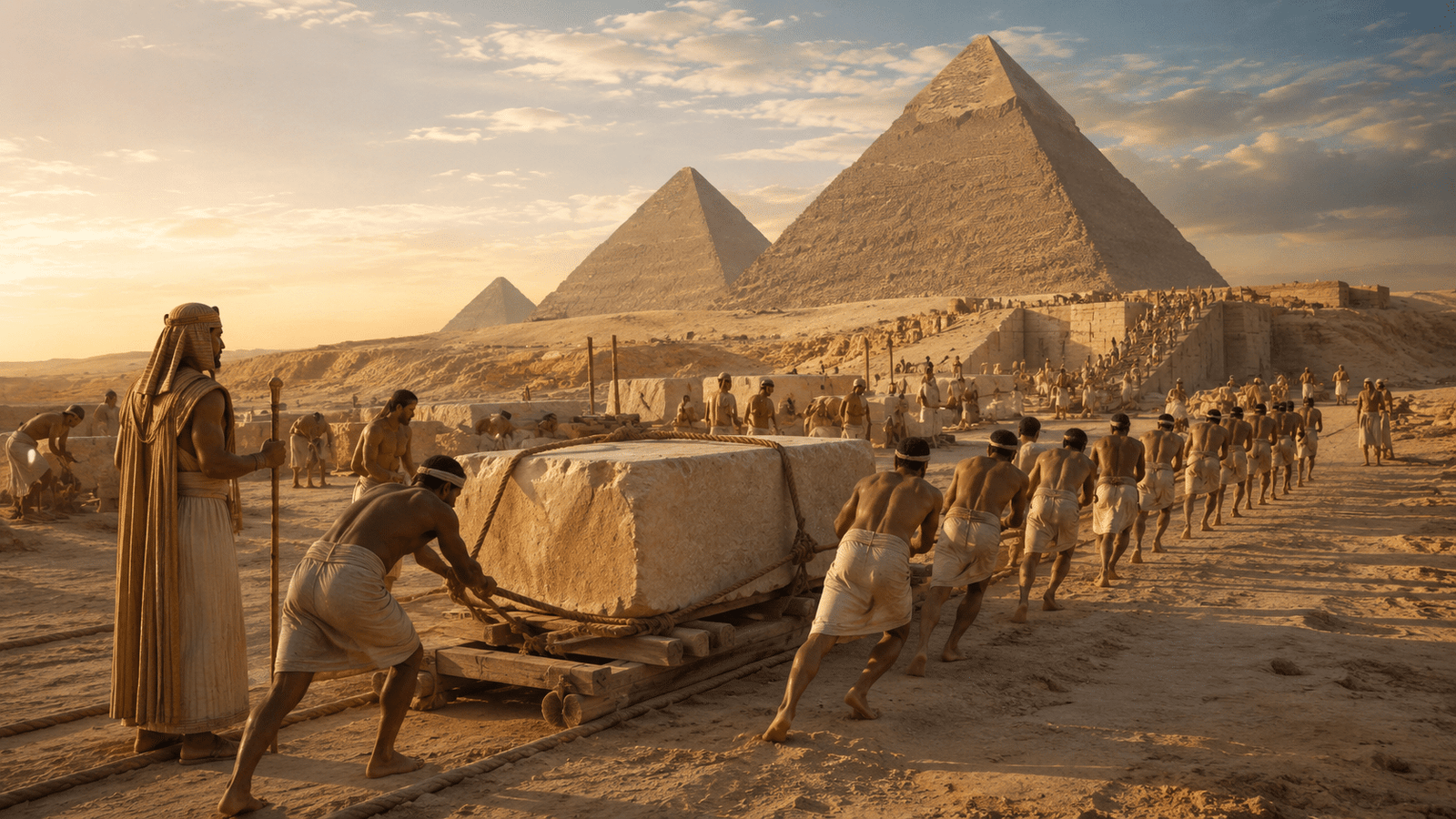
The simplest and longest-standing theory proposes a single straight ramp, built from rubble and earth, extending from ground level up to the pyramid’s working height, growing taller and longer as construction progressed. Workers would have dragged stone-laden sledges up this ramp using ropes, rollers, and wetted sand or clay to reduce friction.
The problem: at the scale required for the Great Pyramid, a straight ramp reaching the full height would need to extend roughly 1.5 kilometers — longer than the Giza plateau itself can accommodate. Researchers have also noted that removing such a massive ramp after construction would have left visible scarring or debris evidence around the site, which has not been found.
Theory 2: The Spiral (Zigzag) External Ramp
This theory proposes a ramp that wound around the exterior of the pyramid as it rose, rather than extending straight out from one side — solving the space problem of the straight-ramp theory.
The problem: a spiraling exterior ramp would have obscured the pyramid’s corners during construction, making it extremely difficult for ancient surveyors to maintain the precise corner alignment and angles the finished pyramid actually displays — and the casing stones at the corners would have been inaccessible for installation until the ramp was removed.
Theory 3: The Internal Spiral Ramp
A more recent and increasingly discussed theory, notably developed by French architect Jean-Pierre Houdin, proposes that an external ramp was used only for the lower third of construction, after which builders switched to an internal ramp spiraling upward through the pyramid’s core itself — solving both the space and the corner-visibility problems of the external ramp theories.
Supporting evidence cited for this theory includes a distinctive notch visible on the pyramid’s northeast corner, roughly 270 feet up, which proponents argue could have been used to help maneuver and turn stone blocks at internal ramp corners, along with reports from a 1986 French survey team of unusual cavities consistent with an internal passage system. This theory remains debated and unconfirmed by direct excavation, since deliberately tunneling into the pyramid to test it is not considered an acceptable archaeological approach given the structure’s preservation status.
Theory 4: Levers and Counterweight Systems
A 2025 study published in the journal npj Heritage Science proposed a construction model combining sliding-ramps with pulley-like systems using counterweights, suggesting that simpler lever-and-counterweight mechanisms, rather than purely ramp-based hauling, may have played a more central role in raising blocks at the upper levels of the pyramid than previously emphasized. This remains an active area of ongoing computational and archaeological research rather than a settled conclusion.
Theory 5: Multi-Ramp and Terrace Systems
Other researchers, including German archaeologist Frank Müller-Römer, have proposed systems involving multiple short, tangential ramps and terraces rather than a single continuous ramp structure — though critics note this approach would have required frequent reconfiguration, tight turning spaces for sledges, and a scale of winch and lever hardware not otherwise well attested in Old Kingdom archaeological evidence.
Why No Single Theory Has “Won”
Each major theory solves some of the engineering, logistical, and physical-evidence problems of the others — but each also runs into its own unresolved difficulties at the actual scale of the Great Pyramid. As Egyptologist Dr. Eman Ghoneim of the University of North Carolina Wilmington has put it, genuine scientific debate continues among researchers about the exact method used to raise these blocks to such heights, even as the broader picture of who built the pyramids and how materials were sourced has become increasingly well established.
What the Ancient Greeks Said
Some of the earliest written accounts of pyramid construction actually come not from Egyptian sources, but from Greek historians writing well over a thousand years after the pyramids were completed.
Herodotus, who traveled to Egypt around 450 BCE, reported being told by local priests that the Egyptians used “machines” to lift the blocks — a vague description scholars believe likely referred to some form of lever or crane-like device, though the exact translation and meaning remains debated.
Diodorus of Sicily, writing roughly three hundred years after Herodotus, instead described the use of ramps (referred to in some translations as “mounds”) to move the blocks into position — closer to the modern ramp-based consensus, though still written well over two thousand years after the actual construction took place, and therefore not considered direct primary evidence.
Neither account should be treated as definitive, since both were recorded many centuries after construction, relying on oral tradition rather than firsthand knowledge or contemporary documentation.
How Precise Was the Construction — and Why Does That Matter for These Theories?
Part of what makes the construction debate so genuinely difficult to resolve is the sheer precision of the finished structure. The Great Pyramid’s base is level to within roughly 2 centimeters across its entire 230-meter length, and all three Giza pyramids are aligned to true north, south, east, and west with deviations of only fractions of a degree.
This precision matters directly to the ramp debate: whichever method was actually used had to be compatible with maintaining this level of accuracy throughout a construction process spanning roughly two decades — which is part of why theories requiring ramps that obscure the pyramid’s corners (like the simple spiral external ramp) face particular skepticism, since they would have made the kind of ongoing precision surveying visible in the finished structure considerably more difficult to achieve.
How Long Did Construction Actually Take?
Estimates for the Great Pyramid’s construction generally suggest a timeframe of approximately 20 to 23 years, based on the reign length of Khufu and calculations of the rate at which roughly 2.3 million blocks would need to have been quarried, transported, and placed to complete the structure within that window. This works out, by some calculations, to placing a new block roughly every two to three minutes during active construction periods — a logistics challenge that itself helps explain why researchers increasingly emphasize organizational sophistication as much as raw engineering cleverness when discussing how the pyramids were actually built.
Testing the Theories: Experimental Archaeology
Because no ancient construction manual survives, researchers have repeatedly turned to experimental archaeology — physically attempting to replicate ancient construction techniques at smaller scale — to test which proposed methods are actually practical.
Small-scale block-moving experiments using sledges, ropes, and wetted sand have successfully demonstrated that ancient Egyptian techniques depicted in tomb art (such as workers pouring water in front of sledges) measurably reduce friction and make moving multi-ton blocks with relatively modest manpower genuinely feasible — confirming at least the basic mechanics described by surviving ancient artwork.
Reconstructed ramp models, including computational simulations like the 2025 multi-ramp framework study, attempt to test whether specific proposed ramp configurations are physically and logistically viable at the actual scale of the Great Pyramid, accounting for factors like required ramp volume, worker traffic flow, and the physical evidence (or lack of evidence) for ramp remnants around the site.
Lever and counterweight experiments have tested whether simple ancient technology — wooden levers, ropes, and counterweight systems — could plausibly have assisted with the final, most precise placement of blocks, particularly the massive granite roofing beams above the King’s Chamber, which required exceptional positioning accuracy.
These experiments don’t single-handedly resolve the broader debate, but they do meaningfully narrow the range of physically plausible methods, ruling out approaches that fail at scale (like a single straight ramp requiring 1.5 kilometers of length) while lending credibility to combined, multi-method approaches more consistent with the evidence.
Why Some Fringe Theories Persist Despite the Evidence
Given how much solid evidence exists — worker logbooks, a confirmed ramp at Hatnub, an excavated workers’ settlement, and a documented water transport system — it’s worth briefly addressing why alternative or “lost civilization” theories continue to circulate in popular culture despite lacking archaeological support.
Part of the explanation is genuinely human: the scale and precision of the pyramids feels intuitively difficult to reconcile with Bronze Age tools, and the unresolved specifics of the ramp debate (a real, ongoing scientific question) sometimes get conflated in popular media with broader, unsupported claims about who built the pyramids and how. Egyptologist Roland Enmarch has specifically noted that documentary discoveries like the Wadi al-Jarf papyri are valuable precisely because they “dispel more outlandish theories” by demonstrating, in concrete written records, that construction was approached as a large, organized logistical project — remarkable in its scale and execution, but not mysterious in its fundamental nature.
Putting It All Together: A Realistic Picture
The most balanced, current understanding of pyramid construction combines several elements rather than crediting any single breakthrough technique:
- A sophisticated water transport system, using a Nile-connected harbor and canal network, moved the heaviest materials (Aswan granite, Tura limestone) close to the construction site with comparatively modest labor
- Ramps of some configuration — whether straight, spiral, internal, or some hybrid combination — were almost certainly used to move blocks the final distance up the growing structure, though the specific configuration remains debated
- Sledges, ropes, rollers, and wetted sand or clay reduced friction for moving blocks over land, a technique directly depicted in surviving ancient Egyptian tomb art
- Levers and possibly counterweight or pulley-like systems assisted with final positioning and precise placement, particularly at upper levels and for especially heavy blocks like the King’s Chamber’s granite roofing beams
- An extraordinarily well-organized labor and logistics system, including food production, housing, and medical support, sustained the workforce required to execute all of the above at the necessary speed and scale
For the practical visitor details about seeing this engineering achievement firsthand, see our complete Pyramids of Giza facts guide and our guide to what’s inside the Great Pyramid.
🏛️ Want the construction debate explained on-site, in front of the actual structures? Pure Nile Tours’ private Egyptologist-guided tours cover the engineering theories, the latest archaeological research, and the practical visitor experience together. Book a Private Pyramids Tour →
Frequently Asked Questions
Do Egyptologists know exactly how the pyramids were built?
Egyptologists are confident about the materials used, the workforce, and the logistics system (including a Nile-connected harbor network), but the precise method used to raise blocks to height remains genuinely debated, with several competing ramp and lever theories still actively studied.
What is the most widely accepted theory?
Some form of ramp system, combined with sledges, ropes, and levers, is the most widely accepted general theory. The specific ramp configuration — straight, spiral, internal, or a combination — remains the central point of ongoing debate.
Is there any evidence the pyramids were built with help from aliens or a lost advanced civilization?
No credible archaeological evidence supports this claim. Direct documentary evidence, including worker logbooks discovered at Wadi al-Jarf in 2013, confirms construction was carried out through conventional (if highly sophisticated) ancient Egyptian engineering and organizational methods.
How long did it take to build the Great Pyramid?
Most estimates suggest approximately 20 to 23 years, based on Khufu’s reign length and calculations of the construction rate required to place an estimated 2.3 million blocks within that timeframe.
What is the internal ramp theory?
A theory proposing that builders used an external ramp only for the lower portion of construction, then switched to a ramp spiraling internally through the pyramid’s core for the upper sections — addressing space and corner-visibility problems faced by purely external ramp designs. It remains debated and unconfirmed.
Has any actual ramp been found at Giza itself?
No complete ramp structure has been confirmed at the Giza pyramids specifically, though a confirmed 4,500-year-old ramp system was discovered in 2018 at Hatnub, a quarry site in Egypt’s Eastern Desert used during the same general construction period.
Why haven’t archaeologists definitively solved this question yet?
No construction records or technical manuals from Khufu’s era have been found describing the lifting method used, and directly testing some theories (such as the internal ramp theory) would require invasive excavation considered inappropriate given the pyramid’s preservation status as a protected ancient monument.
Final Thoughts
The honest, current answer to “how were the pyramids built” is that ancient Egyptian engineers combined a remarkably sophisticated water transport system, some configuration of ramps, and a vast, well-organized labor force to achieve something that remains genuinely impressive by any era’s engineering standards — while the precise method used to raise stone to the pyramid’s full height continues to be actively researched and debated by archaeologists and engineers today, including in studies published as recently as 2025. Rather than diminishing the achievement, this ongoing scholarly uncertainty is part of what makes the pyramids’ construction such a compelling subject nearly 4,500 years later.
🏛️ Ready to see this engineering achievement in person? Pure Nile Tours’ private Giza Plateau tours bring the construction debate to life with expert Egyptologist commentary at the actual site. Explore Private Pyramids Tours →