Most visitors to Giza see the Great Pyramid only from the outside — an enormous, sun-baked mass of limestone blocks. But for an additional ticket, you can actually climb inside it: crouch through a narrow ascending passage, walk the length of the soaring Grand Gallery, and stand inside the granite-lined King’s Chamber where Khufu’s empty sarcophagus has sat for roughly 4,500 years.
It’s not a comfortable experience — the passages are steep, narrow, and hot — but for many travelers, it’s the single most memorable part of an Egypt trip. This guide covers exactly what’s inside the Great Pyramid, how to visit, what tickets cost, and whether it’s worth the climb.
Can You Actually Go Inside the Great Pyramid?
Yes. Unlike many ancient monuments where “interior access” really means a roped-off viewing area, visitors to the Great Pyramid can physically enter the structure and walk through its internal passages to reach the King’s Chamber at its heart. This requires a separate, additional ticket beyond standard Giza Plateau admission, and access is sometimes limited to a set number of visitors per day for conservation reasons.
How You Enter: The Robbers’ Tunnel
Modern visitors don’t use the pyramid’s original sealed entrance. Instead, you enter through what’s known as the Robbers’ Tunnel (sometimes called the al-Ma’mun tunnel), a forced passage cut into the pyramid’s north face around 820 CE by the Abbasid Caliph al-Ma’mun, who was searching for treasure inside the monument. This tunnel intersects with the pyramid’s original internal passage system and remains the standard entry point used today.
What’s Inside: A Walk Through the Chambers
The Ascending Passage
After entering through the Robbers’ Tunnel, visitors climb the Ascending Passage — a narrow corridor only about 1.05 meters (roughly 3.5 feet) tall, requiring most adults to crouch or walk bent over for approximately 39 meters. This is the part of the visit that surprises people most: it’s tight, the air is still and humid, and there’s a real sense of the weight of the structure pressing down around you.
The Grand Gallery
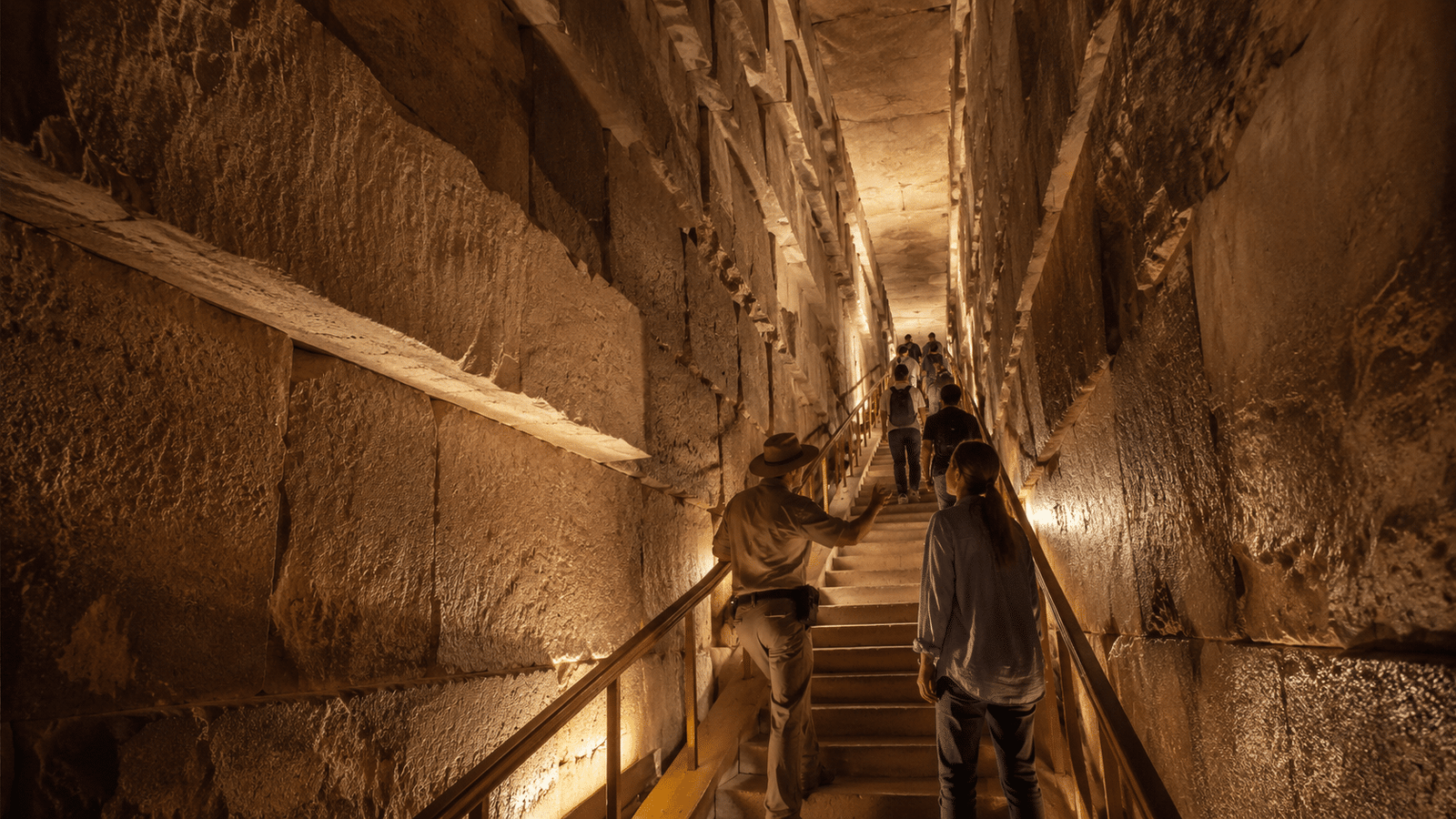
The Ascending Passage opens dramatically into the Grand Gallery — one of the most architecturally striking spaces inside any ancient Egyptian monument. The gallery rises steeply for approximately 47 meters, with a soaring corbelled ceiling reaching around 8.6 meters (28 feet) high, built from precisely fitted limestone blocks that step inward as they rise.
The Grand Gallery’s exact purpose remains debated. Some Egyptologists believe it served a structural function, helping distribute the immense weight of stone above the King’s Chamber; others have proposed it held machinery used to maneuver the massive granite blocks that seal the upper passages, or that it carried symbolic, ceremonial significance connected to the pharaoh’s journey to the afterlife.
The Queen’s Chamber
A horizontal passage branches off partway up the system, leading to the so-called Queen’s Chamber — a name assigned by early Arab explorers and not believed to reflect its actual historical purpose, since no queen was ever buried in the Great Pyramid. Smaller and simpler than the King’s Chamber, it features a distinctive niche carved into one wall whose function remains unclear. Some Egyptologists suggest the chamber may have been designed to house a statue representing Khufu’s “ka” (spirit double) rather than a body, while others believe it represents an earlier, abandoned design for the pyramid’s main burial chamber before the King’s Chamber was built higher up.
Access to the Queen’s Chamber is not always included in every visit and can depend on current site management policy — ask your guide whether it’s accessible on the day of your visit.
The King’s Chamber
At the top of the Grand Gallery lies the King’s Chamber — the primary burial chamber, and the centerpiece of the entire interior visit. Unlike the rougher limestone passages leading up to it, the King’s Chamber is built entirely from polished red granite, transported over 800 kilometers (500 miles) from quarries near Aswan.
Inside sits Khufu’s sarcophagus — a single block of red granite, now empty and without its original lid. The sarcophagus is notably wider than the passages leading into the chamber, confirming it was placed inside during construction, before the upper sections of the pyramid were completed and sealed around it.
Many visitors comment on the chamber’s unusual acoustics — the hard granite surfaces create a reverberation that makes even a quiet voice or whisper carry noticeably, adding to the atmosphere of the space.
Above the visible ceiling of the King’s Chamber lie five narrow relieving chambers, stacked to redistribute the enormous weight of stone above and protect the chamber below from structural collapse — a sophisticated engineering solution for a structure built roughly 4,500 years ago.
The Subterranean Chamber
Beneath the pyramid, cut directly into the bedrock, lies an unfinished Subterranean Chamber, reached via a separate descending passage. This chamber appears to have been abandoned partway through construction, possibly representing an early, later-discarded plan for the pyramid’s burial chamber. It is rough, undecorated, and not always included in standard visitor access.
The Mysterious Shafts
Running diagonally from both the King’s and Queen’s Chambers toward the pyramid’s exterior are a series of narrow shafts, long assumed to serve a ventilation function. Modern research has shown some of these shafts align with specific stars — including Orion and Sirius — significant in ancient Egyptian religious belief about the afterlife, suggesting a symbolic or ritual purpose alongside any practical function.
In recent years, small robotic exploration vehicles sent into these shafts have discovered stone blocks and copper fittings deep within them, the purpose of which remains unexplained — one of several genuine, unresolved mysteries still being actively investigated inside the Great Pyramid.
The 2017 Hidden Void Discovery
In 2017, an international team using muon-detection technology — a non-invasive scanning method capable of “seeing” through massive stone structures — identified a previously unknown large void above the Grand Gallery, estimated to be at least 30 meters long. The void’s purpose remains unknown, and it is not accessible to visitors, but its discovery confirmed that even after more than a century of intensive study, the Great Pyramid still holds genuine architectural secrets.
Tickets and Practical Information
Do You Need a Separate Ticket?
Yes. General Giza Plateau admission does not automatically include interior pyramid access. A separate, additional ticket is required specifically to enter the Great Pyramid’s interior passages and chambers.
How Much Does It Cost?
As of 2026, the additional interior-access ticket for the Great Pyramid runs approximately 1,000 EGP (roughly $20 USD) per person, on top of standard plateau admission — though prices are periodically revised, so confirm current rates before booking.
Is Access Limited?
Yes — a limited number of interior tickets are typically sold per day, and they can sell out, particularly during peak season (December–February). If visiting the interior matters to you, it’s worth arranging this in advance through a guide or reputable operator rather than risking availability on arrival.
What About Khafre and Menkaure’s Pyramids?
The interiors of the Pyramids of Khafre and Menkaure can also sometimes be entered, typically via separate tickets, though access to all three pyramids’ interiors simultaneously is not always available — site management sometimes rotates or limits access for conservation reasons. Confirm current access policy for all three monuments before your visit if seeing more than one interior matters to you.
The Engineering Behind the Interior
What makes the Great Pyramid’s interior so remarkable isn’t decoration — it’s the engineering required to build functional internal spaces inside a solid mass of roughly 2.3 million stone blocks.
The relieving chambers above the King’s Chamber represent one of the structure’s most sophisticated solutions. Five stacked chambers, separated by massive granite beams, sit directly above the King’s Chamber’s flat ceiling. Their purpose was to redistribute the colossal weight of stone above — without them, the immense downward pressure could have cracked or collapsed the flat-roofed chamber below. The uppermost of these five chambers has a peaked, gabled stone roof, finally directing the weight outward to the pyramid’s solid mass rather than straight down onto the chamber.
The Grand Gallery’s corbelled ceiling uses a construction technique where each course of stone slightly overlaps the one below it, gradually narrowing the gap until a single course of stone slabs can span the remaining width at the top. This method allowed builders to create a tall, dramatic interior space without needing the kind of true arch technology that wouldn’t be developed in most ancient construction traditions for centuries.
The granite transport itself represents a separate engineering achievement: the King’s Chamber’s red granite blocks were quarried near Aswan, roughly 800 kilometers south, and transported down the Nile by boat before being hauled into position — a logistics challenge layered on top of the construction challenge itself.
A History of Exploration Inside the Pyramid
The Great Pyramid’s interior has drawn explorers, treasure hunters, and scholars for well over a thousand years, and much of what we know about its passages comes from this long history of investigation.
c. 820 CE — Caliph al-Ma’mun’s forced entry. The Abbasid ruler ordered workers to tunnel into the pyramid’s north face searching for treasure, creating the Robbers’ Tunnel still used as the visitor entrance today. Historical accounts suggest his expedition found the chambers already empty, having likely been looted in antiquity.
18th–19th centuries — European exploration. As European travel to Egypt increased, the pyramid’s interior became a destination for diplomats, scholars, and even military figures. Graffiti left inside the King’s Chamber by historical visitors — including figures associated with Lord Nelson and the Duke of Wellington — has itself become a minor historical curiosity, preserved rather than removed by modern conservators.
Late 19th century — Flinders Petrie’s survey. The British Egyptologist conducted one of the first rigorous scientific surveys of the pyramid’s interior measurements, producing data still referenced by researchers today, including evidence of ancient administrative graffiti recording construction-era information.
2017 — Muon scanning project. An international research collaboration used cosmic-ray muon detection — a technique capable of revealing internal structures without any physical excavation — to identify the previously unknown large void above the Grand Gallery, demonstrating that non-invasive modern technology can still reveal genuinely new information about a structure that has been studied for over a thousand years.
This long exploration history is part of why the Great Pyramid’s interior feels different from a typical museum exhibit: you’re walking through spaces shaped not just by its original Fourth Dynasty builders, but by centuries of subsequent human curiosity, intrusion, and discovery.
What to Expect: Honest Tips Before You Go
It is physically demanding. The Ascending Passage requires sustained crouching or bent-over walking for nearly 40 meters. The Grand Gallery is a steep climb. This is not a comfortable, accessible experience, and it’s genuinely unsuitable for visitors with significant mobility limitations, severe claustrophobia, or respiratory conditions.
It’s hot and humid inside, even though it feels noticeably cooler than the exterior desert heat — the still air and confined space create a distinct, sometimes uncomfortable humidity.
There’s no decoration to see. Unlike the elaborately painted tombs of the Valley of the Kings, the Great Pyramid’s interior chambers are plain, undecorated stone. The experience here is about scale, engineering, and atmosphere — not visual artwork.
Photography may be restricted. Rules around photography inside the chambers can change; check current policy at the entrance before assuming you can take photos.
Large bags and bulky camera equipment may need to be left outside with site security, so plan accordingly.
Wear sturdy, grippy shoes. Interior floors and ramps are uneven, worn smooth in places by millennia of foot traffic, and can be slippery.
Budget 30–45 minutes for the interior visit itself, on top of the time you’ll spend exploring the rest of the Giza Plateau.
How It Compares to Other Egypt Interior Experiences
If you’re trying to decide whether the Great Pyramid’s interior is worth your time and budget, it helps to know how it compares to other “go inside” experiences available elsewhere in Egypt.
Compared to the Valley of the Kings tombs in Luxor, the Great Pyramid’s interior is far less visually impressive — there’s no painted artwork, no color, no hieroglyphic storytelling. What it offers instead is unmatched scale and a sense of structural achievement; the Valley of the Kings offers the opposite experience, with smaller spaces but extraordinary preserved decoration.
Compared to entering Khafre’s or Menkaure’s pyramids, the Great Pyramid’s interior is generally considered the more complete and dramatic experience, featuring the full sequence of the Grand Gallery and King’s Chamber, whereas the other two pyramids’ interiors are comparatively simpler and shorter.
Compared to Abu Simbel’s interior in southern Egypt, which does feature impressive decorated halls and statuary, the Great Pyramid’s interior is more about raw physical engineering than artistic content — a different kind of “wow” rather than a lesser one.
For travelers with limited time who have to choose between interior experiences, the general guidance from most Egyptologist guides is: prioritize the Valley of the Kings for visual spectacle, and prioritize the Great Pyramid’s interior for the singular experience of physically entering the most famous structure on Earth.
Is It Worth Going Inside?
This comes down to personal priorities. If you’re drawn to atmosphere, scale, and the sense of standing inside a structure that has stood for 4,500 years — many visitors describe it as genuinely profound, even with no decoration to look at. If you’re claustrophobic, have mobility concerns, or are mainly interested in visual art and color (which you’ll find in far greater abundance at sites like the Valley of the Kings or Luxor Temple), the interior visit may be less essential, and your time and budget might be better allocated elsewhere on your Egypt itinerary.
For context on the rest of the Giza Plateau and how the interior visit fits into a complete trip, see our guides to Pyramids of Giza facts, the Great Sphinx, and who built the pyramids.
🏛️ Want to experience the Great Pyramid’s interior without the guesswork? Pure Nile Tours can arrange private interior access tickets and an expert Egyptologist guide who’ll prepare you for exactly what to expect inside — no surprises, no wasted time. Book a Private Pyramids Tour →
Frequently Asked Questions
Can tourists actually go inside the Great Pyramid?
Yes, with a separate additional ticket beyond standard Giza Plateau admission. Visitors can walk through the Ascending Passage, Grand Gallery, and into the King’s Chamber.
How much does it cost to go inside the Great Pyramid?
As of 2026, the additional interior-access ticket costs approximately 1,000 EGP (around $20 USD) per person, on top of general plateau admission. Confirm current pricing before booking, as rates are periodically revised.
Is it safe to go inside the Great Pyramid?
Yes, the interior is structurally stable and visited by thousands of tourists regularly. However, the passages are narrow, steep, and require crouching, which can be physically demanding or uncomfortable for some visitors.
What will you actually see inside?
The route typically includes the Ascending Passage, the Grand Gallery, and the King’s Chamber, which contains Khufu’s empty granite sarcophagus. Access to the Queen’s Chamber and Subterranean Chamber can vary.
Is the inside of the Great Pyramid decorated like the Valley of the Kings tombs?
No. The interior chambers are plain, undecorated stone. The experience is about scale, engineering, and atmosphere rather than visual artwork or color.
How long does it take to visit the interior?
Most visitors spend approximately 30–45 minutes inside, though this can vary based on crowd levels and how long you linger in the King’s Chamber.
Is it suitable for claustrophobic visitors?
It can be genuinely challenging. The Ascending Passage is narrow and requires sustained crouching, and the overall environment is confined and humid. Visitors with significant claustrophobia may want to consider this carefully before purchasing the interior ticket.
Do you need to book interior tickets in advance?
It’s strongly recommended, particularly during peak season (December–February), since a limited number of interior-access tickets are sold per day and can sell out.
Final Thoughts
Standing inside the King’s Chamber — surrounded by granite blocks quarried and transported over 800 kilometers nearly 4,500 years ago, with millions of tons of stone resting silently above you — is an experience that photographs simply can’t replicate. It’s uncomfortable, it’s hot, and there’s nothing decorative to look at. And yet for many travelers, it remains the single moment from their entire Egypt trip that they remember most vividly.
If you have the time, the ticket budget, and reasonable physical mobility, going inside the Great Pyramid is very much worth the climb.
🏛️ Ready to step inside one of the world’s most extraordinary ancient structures? Pure Nile Tours’ private Giza Plateau tours include expert guidance on interior access, timing, and what to expect — making sure you get the most out of every minute inside. Explore Private Pyramids Tours →