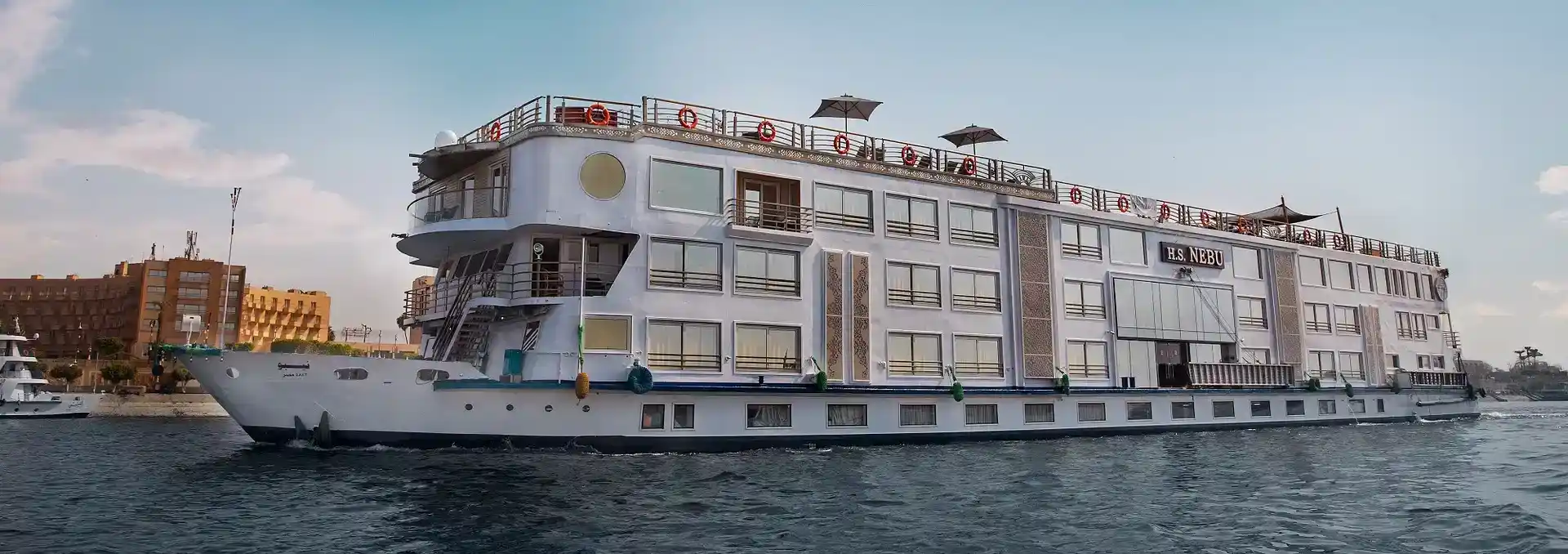
The Nebu Nile Cruise carries just 40 suites and never more than 84 passengers between Luxor and Aswan — making it one of the most uncrowded luxury ships on the entire river. Starting from $1,170 per person, it operates on a 3-night (Aswan to Luxor) or 4-night (Luxor to Aswan) sailing schedule, with full-board dining, licensed Egyptologist guides, and private transfers included in every package.
Nebu Nile Cruise at a Glance
The figures below reflect Pure Nile Tours pricing at the time of writing. Prices vary by season and cabin category.
| Detail | Information |
|---|---|
| Ship capacity | 40 suites / max 84 guests |
| Launched | February 2020 |
| Routes | Luxor → Aswan (4 nights / 5 days) or Aswan → Luxor (3 nights / 4 days) |
| Departures (Luxor start) | Every Saturday |
| Departures (Aswan start) | Every Wednesday |
| Starting price (per person) | From $1,170 (3-night) / from $1,400 (4-night) |
| Board basis | Full board (all meals included) |
| Guides | English-speaking licensed Egyptologist; groups of 1–8 max |
| Onboard | Pool, spa, gym, lounge bar, Wi-Fi |
Exchange rates fluctuate — verify current rates before travel.
Key highlights at a glance:
- Suite-only accommodation across five decks, with the largest average cabin size among comparable Nile ships
- Guided visits to the Valley of the Kings, Karnak, Luxor Temple, Philae, Edfu, Kom Ombo, and the Aswan High Dam
- Crocodile Mummification Museum at Kom Ombo included
- Optional add-ons: Abu Simbel day trip, hot air balloon over Luxor, Nubian village visit
- Private transfers from Luxor or Aswan airport, train station, or hotel (East Bank only)
- Solo cabins available with no single supplement
Why Choose the Nebu Nile Cruise Over Other Ships
Most standard 5-star Nile cruises carry between 60 and 80 passengers. The Nebu Nile Cruise runs with a maximum of 84 guests spread across 40 suites — a ratio that creates a noticeably quieter atmosphere both on deck and at the sights. The difference becomes clear the moment you board: corridors are calm, the sun deck is rarely crowded, and temple visits feel less like group tours.
The ship launched in February 2020 as a purpose-built vessel focused on space and wellness. Every suite includes a sitting area, panoramic windows, individually controlled air-conditioning, minibar, in-room safe, telephone, and a private bathroom with a bathtub. The Owner Suite runs 700–800 sq ft; standard doubles sit around 310 sq ft — both considerably larger than the average Nile cabin.
Four dedicated solo cabins are available without a single supplement, which removes one of the most common cost barriers for independent travellers considering an Egypt Nile cruise. Four connected cabins can also be arranged for families or travelling companions who want adjoining rooms.
The crew-to-guest ratio of roughly 1.35 crew members per passenger keeps service personal. Staff remember dietary preferences, cabin preferences, and itinerary questions without the anonymity that larger ships can produce.

Onboard Facilities and Cabins
Cabin Categories
The Nebu Nile Cruise offers five cabin types across the ship’s five decks:
| Cabin Type | Approximate Size | Notes |
|---|---|---|
| Owner Suite | 700–800 sq ft | Top-deck position, largest on board |
| Executive Suite | ~500 sq ft | Panoramic windows, sitting room |
| Standard Double/Twin | ~310 sq ft | Bathtub, sitting area, minibar |
| Solo Cabin | Compact | No single supplement charged |
| Connected Cabin | Two linked rooms | For families or groups |
All cabins share the same core amenities: private bathroom with bathtub and hair dryer, individual climate control, minibar, in-room safe, telephone, and satellite TV.
Amenities Throughout the Ship
The top-deck swimming pool with bar service is the social centre of the Nebu Nile Cruise during daytime sailing. The pool deck is where most guests read, watch the western bank slide past, or take the sun before afternoon shore excursions.
The spa and massage centre offers treatments that can be booked on board; the fitness room with basic gym equipment sits on the same level. A lounge bar, piano bar, boutique, and library round out the public spaces. Wi-Fi is available throughout the ship. 24-hour cabin service means you are never far from a meal or a drink, regardless of sailing hours.
Evening entertainment varies by night: a Galabeya (traditional dress) party, Nubian folkloric performances, and themed dinners break the routine between temple visits. Dining is open-buffet for breakfast and lunch — with top-deck breakfast service on the sun deck — and à la carte for dinner, featuring international and Egyptian cuisine.
The Nebu Nile Cruise Itinerary: What You See Each Day
The two sailing directions cover identical sites in reverse order. The 4-night Luxor to Aswan sailing departs every Saturday; the 3-night Aswan to Luxor direction leaves every Wednesday. For anyone planning a first-time Egypt Nile cruise, the Crafting the Perfect Nile Cruise Itinerary guide on pureniletours.com explains how to choose the best direction for your travel dates.
4-Night / 5-Day: Luxor → Aswan (Saturday Departure)
Day 1 — Luxor East Bank Board before noon at Luxor. After lunch on deck, the afternoon covers Karnak Temple Complex — the largest religious structure ever built — and Luxor Temple on the East Bank. Dinner and overnight moored in Luxor.
Day 2 — Luxor West Bank + Sail South Valley of the Kings in the morning: three royal tombs are included in the standard ticket. Hatshepsut Temple at Deir el-Bahari and the Colossi of Memnon follow. The ship sails south through the Esna Lock in the afternoon. Optional hot air balloon at dawn over Luxor can be arranged for this morning at extra cost.
Day 3 — Edfu + Kom Ombo Edfu Temple dedicated to the falcon god Horus — one of the best-preserved temples in Egypt, with detailed reliefs covering every wall. The horse-drawn carriage ride from the dock to the temple gate is part of the experience. The Nebu Nile Cruise then sails to Kom Ombo for the double temple and the adjacent Crocodile Mummification Museum.
Day 4 — Aswan Sightseeing Philae Temple on Agilkia Island, accessible by motorboat from the Aswan dock. The Aswan High Dam. The Unfinished Obelisk in the granite quarries — still lying in the stone exactly where ancient workers abandoned it 3,500 years ago. Optional Nubian village visit available at extra cost.
Day 5 — Disembark Aswan Breakfast on board, then check-out. Transfer to Aswan airport, train station, or East Bank hotel. Optional Abu Simbel day trip can be arranged for this morning before departure.
3-Night / 4-Day: Aswan → Luxor (Wednesday Departure)
The same sites in the opposite direction: Aswan sightseeing on Day 1, Kom Ombo and Edfu on Day 2, Luxor West Bank on Day 3, and East Bank temples before disembarkation on Day 4.
Current pricing for both routes is detailed in the Nile Cruise Luxor to Aswan Prices 2026 post, which includes seasonal variations and comparison notes.
Shore Excursions: Temples and Sites Included
Every excursion listed below is included in the Nebu Nile Cruise package price — entrance fees, private transport to and from sites, and the Egyptologist guide.
Valley of the Kings, Luxor
Three tombs from an active open set are included in the standard ticket. The tombs of Ramesses IV, Ramesses IX, and Merenptah are typically accessible. The tomb of Tutankhamun requires a separate ticket ($20–$25 at time of writing) and is not included.
Hatshepsut Temple (Deir el-Bahari), Luxor
The mortuary temple of Egypt’s most prominent female pharaoh rises from the limestone cliffs on the West Bank in three colonnaded terraces. The scale is striking and the relief carvings are among the most detailed on the West Bank.
Colossi of Memnon, Luxor
Two 18-metre sandstone statues of Amenhotep III have stood at this spot since around 1350 BC. No entrance ticket needed — the statues sit in an open field and a short stop here takes around 20 minutes.
Karnak Temple Complex, Luxor
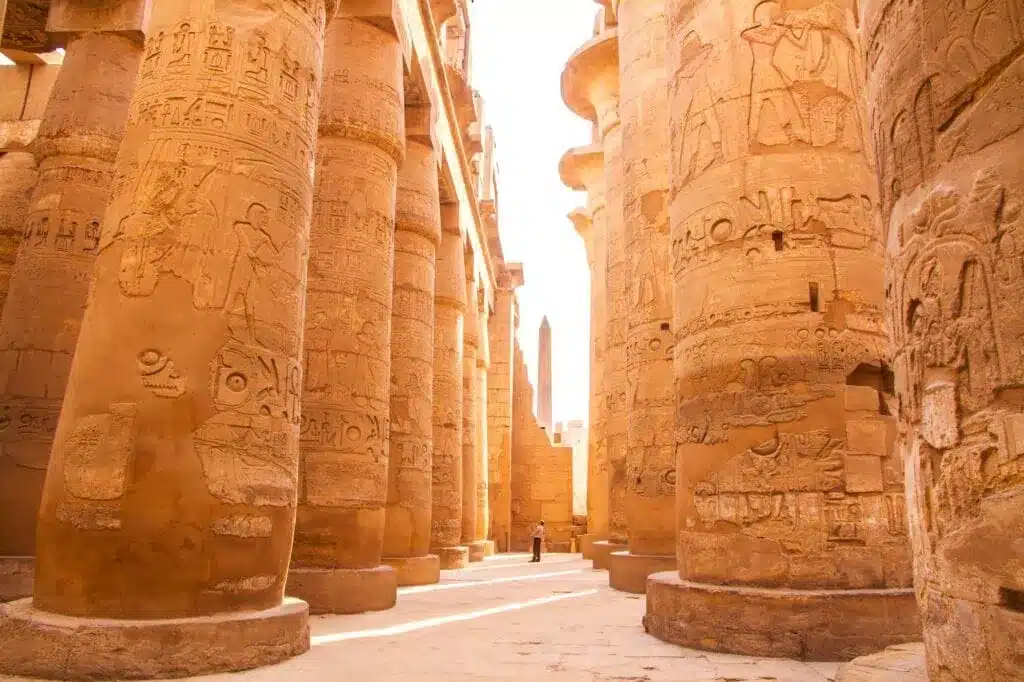
The Hypostyle Hall alone — 134 massive columns covering an area larger than Notre Dame Cathedral — makes Karnak the single most impressive ancient structure most visitors will ever walk through.
Luxor Temple, Luxor
Built around 1400 BC and illuminated after dark, Luxor Temple sits directly on the East Bank corniche. The avenue of ram-headed sphinxes connecting it to Karnak stretches nearly 3 kilometres and is one of the most extraordinary processional routes in the ancient world.
Edfu Temple
Dedicated to Horus, the falcon god of kingship, Edfu Temple was built during the Ptolemaic period (237–57 BC) and is the best-preserved large temple in Egypt. The towering entrance pylon rises 36 metres above the surrounding plain.
Kom Ombo Temple + Crocodile Museum
The only double temple in Egypt, symmetrically divided between Sobek (the crocodile god) and Horus the Elder. Ancient medical instruments, a crocodile calendar, and carved surgical tools are preserved on the inner walls. The Crocodile Mummification Museum, opened in 2012 inside the adjacent building, displays dozens of mummified crocodiles recovered from the site.
Philae Temple, Aswan
Relocated stone by stone in the 1970s UNESCO rescue project from the submerged island of Philae to Agilkia Island, this temple to Isis is reached by a short motorboat crossing from the Aswan dock. The evening sound-and-light show here is one of the best in Egypt, though it is an optional extra.
Aswan High Dam
Built between 1960 and 1970, the dam created Lake Nasser — one of the world’s largest artificial lakes — and ended the annual Nile floods that had shaped Egyptian agriculture for millennia. The viewing platform gives a clear sense of scale: the dam is 3.8 kilometres wide at the top.
Unfinished Obelisk, Aswan
Commissioned by Queen Hatshepsut, this granite obelisk was abandoned in place when a crack appeared during carving. At 42 metres long and an estimated 1,200 tonnes, it would have been the largest obelisk in the ancient world. The quarry visit takes around 30–40 minutes.
For visitors considering an extension to the deep south, the Abu Simbel Temples: Practical Visitor Guide from Aswan covers everything needed to plan the day trip add-on.
Optional Excursions Worth Considering
None of the following are included in the base package. All can be arranged through Pure Nile Tours at time of booking or on board.
Hot air balloon over Luxor — Departs before sunrise from the West Bank. Flights last 45–60 minutes and cover the Valley of the Kings, Hatshepsut Temple, and the Nile. Prices typically run $80–$120 per person at time of writing, depending on operator and group size.
Abu Simbel day trip — Two rock-cut temples of Ramesses II and Nefertari, relocated between 1964 and 1968 in one of the most ambitious engineering projects in history. The site is 280 kilometres south of Aswan. By road: approximately 3.5 hours each way, departing around 4 AM. By domestic flight: 45 minutes. Cost approximately $85–$120 per person including transport and entrance fee.
Nubian village visit, Aswan — A short motorboat trip from the Aswan corniche to a traditional Nubian village. The visit takes 1.5–2 hours and typically includes a home visit and tea.
Tutankhamun’s Tomb, Valley of the Kings — Costs around $20–$25 extra on top of the standard Valley ticket. The tomb itself is smaller than most visitors expect; the painted walls remain in exceptional condition.
Sound and Light Show, Philae — Around $20 per person. The narrated show illuminates the temple’s colonnade and pylons for roughly 45 minutes.
Best Time to Sail on the Nebu Nile Cruise
October through April is the most comfortable window for a Nebu Nile Cruise sailing. Temperatures on the Nile corridor between Luxor and Aswan sit between 18°C (64°F) and 28°C (82°F) during this period, with almost no rainfall. The sun deck is usable from morning onwards, and temple visits in the late morning remain manageable.
July and August are the hottest months: Aswan regularly exceeds 40°C (104°F) at midday, and shore excursions are physically demanding without acclimatisation. The ship’s air conditioning and pool make the boat itself comfortable, but the midday temple sites are punishing.
December and January are peak season for European travellers. The Nebu Nile Cruise‘s limited capacity means it books up several months in advance for the December 22 – January 4 holiday window — during which a 10% seasonal supplement typically applies. Advance booking of three to four months is advisable for this period.
Ramadan timing shifts annually. Shore experiences change meaningfully during Ramadan: some restaurants close during daylight hours, though the ship’s full-board dining is unaffected. The Best Months to Visit Egypt guide covers seasonal crowd patterns, weather by month, and Ramadan dates through 2026–2027.
How to Get to Luxor or Aswan to Board
Flying to Luxor
EgyptAir operates direct flights from Cairo to Luxor (approximately 70 minutes). International charter flights arrive at Luxor from various European cities, particularly between October and April. The airport is on the East Bank, roughly 7 kilometres from the city centre; transfer time to the ship is 20–30 minutes. Pure Nile Tours includes the airport pickup in the package.
Flying to Aswan
Aswan International Airport is 25 kilometres from the city centre and the cruise dock. EgyptAir operates Cairo–Aswan flights (approximately 80 minutes). Transfer time to the ship is around 35–40 minutes.
Arriving by Train
Egypt’s overnight sleeper train from Cairo connects to both Luxor and Aswan. The Cairo–Luxor leg takes approximately 10 hours; Cairo–Aswan is around 14 hours. The train stations in both cities are on the East Bank. Private coaches from EgyptAir Road have also emerged as a comfortable alternative from Hurghada to Luxor (approximately 3.5 hours). For full guidance on overland and rail connections, the Mastering Public Transport in Egypt article covers train classes, ticketing, and journey times.
What’s Included — and What Isn’t
The table below reflects Pure Nile Tours package inclusions for the Nebu Nile Cruise at time of writing. Always confirm the current inclusions list before booking.
| Included | Not Included |
|---|---|
| 3 or 4 nights full-board accommodation | International flights |
| All meals on board (breakfast, lunch, dinner) | Egypt visa fee ($25 on arrival, most nationalities) |
| Private A/C transfers (airport / train / hotel) | Travel insurance |
| Licensed English-speaking Egyptologist guide | Alcoholic beverages |
| Entrance fees to all listed temples | Tips for guide, driver, and crew |
| 1 litre of water per person per day | Optional excursions (balloon, Abu Simbel, etc.) |
| Taxes and service charges | Personal expenses (laundry, spa, etc.) |
| Pickup from East Bank Luxor or Aswan hotel | Meals outside full-board (e.g., at land restaurants) |
Tipping is standard practice in Egypt. For guides and drivers, $5–$10 per person per day is the accepted range. Crew gratuities on Nile cruises typically run $3–$5 per person per day, left in an envelope at the end of the voyage.
Nebu Nile Cruise Prices and How to Book
At the time of writing, Pure Nile Tours lists the following base prices for the Nebu Nile Cruise:
- 3 nights / 4 days (Aswan to Luxor): from $1,170 per adult
- 4 nights / 5 days (Luxor to Aswan): from $1,400 per adult
These are per-person prices and include all package inclusions listed above. Prices vary by season and cabin category. Holiday periods (Christmas/New Year, Easter) carry a 10% supplement.
Booking directly through pureniletours.com/tour/nebu-nile-cruise/ gives access to current departure calendars, real-time availability, and the option to customise with add-ons like Abu Simbel or airport extensions. A deposit secures the dates; the balance is typically due closer to travel.
Booking three to four months in advance is strongly recommended for the October–April peak season. The ship’s 40-suite limit means it fills earlier than standard 60–80 passenger vessels.
Sample 5-Day Nebu Nile Cruise Journey (Luxor to Aswan)
The schedule below reflects the standard Saturday departure from Luxor. Times are approximate; the guide adjusts based on site crowds and sailing conditions.
Day 1 (Saturday) — Luxor East Bank Noon: board and check in. Lunch on the sun deck while the ship prepares to depart. 14:30: Karnak Temple Complex (allow 90 minutes minimum for the Hypostyle Hall and sacred lake). 17:00: Luxor Temple as the light softens and the columns turn amber. Dinner on board; overnight moored in Luxor.
Day 2 (Sunday) — West Bank + Esna Lock 07:00: optional hot air balloon (pre-booked). 08:30: Valley of the Kings for three tombs. Hatshepsut Temple at Deir el-Bahari. Colossi of Memnon. Lunch on board as the ship sails south. Esna Lock passage in the afternoon — a narrow lock that lowers the ship to the next section of river; guests gather on deck to watch. Galabeya party in the evening.
Day 3 (Monday) — Edfu + Kom Ombo 09:00: disembark at Edfu by horse-drawn carriage to the temple gate. Edfu Temple tour (allow 75–90 minutes). Return to the Nebu Nile Cruise for lunch on the move. 15:00: Kom Ombo Temple and Crocodile Museum (allow 60–75 minutes). Sail to Aswan; dinner on board with traditional entertainment.
Day 4 (Tuesday) — Aswan 09:00: Philae Temple by motorboat. Aswan High Dam viewing platform. Unfinished Obelisk. Lunch on board or at a local restaurant. Afternoon free in Aswan — the corniche along the first cataract, the Nubian Market, or a felucca ride around Elephantine Island. Optional Nubian village visit. Farewell dinner on board.
Day 5 (Wednesday) — Disembark Breakfast on board. Check-out by 09:00. Transfer to airport, train station, or hotel. Optional Abu Simbel departure at 04:30 for those who added the excursion.
Packing for a Nile Cruise
The Nebu Nile Cruise covers both formal temple environments and a casual shipboard setting. The packing list needs to serve both.
For the temples:
- Lightweight, loose-fitting clothes that cover shoulders and knees (required at Philae; strongly advised at Karnak, Luxor, and Edfu)
- Closed-toe walking shoes or sturdy sandals — temple floors are uneven stone
- Hat with a brim; SPF 50+ sunscreen
- A small daypack for water, camera, and sunscreen
For the ship:
- Smart-casual clothes for dinner; no formal dress code, but Galabeya party nights are more fun with a galabeya purchased in Luxor ($5–$15 at the market)
- Light swimwear for the pool deck
- A light jacket or fleece for evening sailing (October–February nights on the river can drop to 10–12°C)
Practical items:
- Copies of passport and visa on your phone
- US dollars or euros for tipping and optional excursion payments (ATMs exist in Luxor and Aswan but are not on the ship)
- Universal plug adapter (Egypt uses Type C/F, 220V)
The Packing Tips for Egypt guide covers the full packing list for an Egypt trip including visa documents, medication, and photography gear.

Culture, Etiquette and Dress Code on Board and at Sites
The Nebu Nile Cruise operates within Egypt’s cultural conventions, and a few practical rules make the experience smoother at both religious sites and local communities.
Dress at temples: Covered shoulders and knees are required to enter Philae Temple — the most actively observed rule on this itinerary. At Karnak and Edfu, the rule is less enforced but remains respectful practice. Lightweight linen trousers and a loose shirt handle both the heat and the dress requirements simultaneously.
Photography inside tombs: A photography permit ($1–$2) is sold at the Valley of the Kings ticket office and covers photography inside the standard three included tombs. Some individual tombs prohibit flash; signs at each entrance indicate current rules. Tripods are rarely permitted.
Bargaining at local markets: Prices at the Luxor and Aswan bazaars are not fixed. A polite counteroffer at 40–60% of the opening price is standard. Walking away usually results in a revised offer; there is no obligation to buy.
Tipping culture: On the Nebu Nile Cruise, tipping is expected but not compulsory. Collecting a group tip from your travelling party and handing it to the guide and driver at the end of each day is cleaner than individual payments. Crew gratuities are typically collected in an envelope left in the cabin on the final night.
Alcohol on board: Wine, beer, and spirits are available for purchase on board. Prices are higher than on land. Drinking in public in Egypt outside licensed venues is restricted by law; the ship’s bar is a licensed space. The Egypt’s Cultural Etiquette: A Guide for Travelers post covers broader behavioural norms.
Practical Tips: Money, SIM, Safety, and Tipping
Money and Payments
The Egyptian pound (EGP) is the local currency. US dollars and euros are accepted for tipping and many optional excursion payments. The Nebu Nile Cruise itself bills in US dollars. ATMs are available at Luxor and Aswan airports and city centres; withdraw local currency before boarding as there are no ATMs on board.
Credit cards (Visa, Mastercard, American Express) are accepted for paying onboard extras and for the cruise booking itself. Budget approximately $30–$60 in cash per person for the voyage, covering tips and any minor purchases ashore.
Exchange rates fluctuate — verify current rates before travel.
SIM and Internet
Egyptian SIM cards from Vodafone, Orange, or WE are available at both airports. A tourist SIM with 20–30 GB of data costs around 100–200 EGP ($2–$4 at time of writing). Signal quality on the Nile between Luxor and Aswan is generally good, though connectivity drops in a few remote stretches overnight. Wi-Fi is included on the Nebu Nile Cruise, though connection speeds vary by location on the river.
Safety
The Luxor–Aswan corridor has been a mainstream international tourism route for decades and is considered safe for travellers. Security personnel are present at all major archaeological sites. At the time of writing, Egypt maintains broadly stable conditions for tourism. The Is Egypt Safe for Tourists in 2026? guide covers the current security situation in detail and links to relevant government travel advisory pages.
The main practical risks on a cruise itinerary are: petty scams at market entrances (aggressive vendors claiming to be “official guides”), sunstroke during midday site visits between April and September, and stomach upset from drinking tap water. All food on the Nebu Nile Cruise is prepared on board under controlled conditions; stick to bottled water throughout.
Tipping Summary
| Recipient | Suggested Tip |
|---|---|
| Egyptologist guide | $5–$10 per person per day |
| Driver | $2–$5 per person per day |
| Cruise crew (overall) | $3–$5 per person per day |
| Hotel porter (if used) | 20–50 EGP per bag |
Frequently Asked Questions
How many cabins does the Nebu Nile Cruise have?
The ship has 40 suites and staterooms across five decks, accommodating a maximum of around 84 guests. The breakdown includes an Owner Suite (~700–800 sq ft), two Executive Suites (~500 sq ft), standard double and twin rooms (~310 sq ft), four solo cabins, and four connected family cabins.
What is the difference between the 3-night and 4-night Nebu Nile Cruise?
The 3-night sailing runs from Aswan to Luxor, departing every Wednesday. The 4-night sailing runs from Luxor to Aswan, departing every Saturday. Both itineraries cover the same temples and sites; the Luxor-start direction typically allows slightly more time at the West Bank monuments. The 4-night option costs from $1,400 per person; the 3-night from $1,170 per person.
Is the Nebu Nile Cruise suitable for solo travellers?
Four dedicated solo cabins are available with no single supplement. Solo travellers pay the same per-person rate as those sharing a cabin rather than a doubled single-occupancy rate, which is unusual for a luxury cruise ship. The maximum group size of 1–8 per guide also means solo guests are not placed in large anonymous tour groups.
What temples and sites are included in the cruise price?
Every excursion within the Luxor–Aswan corridor is covered: Karnak Temple, Luxor Temple, Valley of the Kings (three tombs), Hatshepsut Temple, Colossi of Memnon, Edfu Temple, Kom Ombo Temple, Crocodile Mummification Museum, Philae Temple, the Aswan High Dam, and the Unfinished Obelisk. Entrance fees for all of these are included. Abu Simbel is not included; it is an optional add-on from Aswan at approximately $85–$120 per person.
Is Abu Simbel included in the Nebu Nile Cruise?
Abu Simbel is not part of the standard itinerary, but it can be added as a day trip from Aswan on Day 5 before departure. The site is 280 kilometres south of Aswan: by road it takes around 3.5 hours each way (depart at approximately 04:00); by domestic flight it is 45 minutes. See the Abu Simbel Temples: Practical Visitor Guide from Aswan for full logistics and timing.
Do I need a visa to visit Egypt?
At the time of writing, most nationalities — including citizens of the US, UK, EU countries, Australia, and Canada — can purchase an Egypt e-visa online before travel or a visa on arrival at Cairo, Luxor, and Aswan airports. The standard tourist visa costs $25. Details can change — check the Egypt Visa Requirements for Travelers guide and confirm via your government’s official channels before booking.
Is Wi-Fi available on the Nebu Nile Cruise?
Wi-Fi is available on board throughout the cruise. Coverage is generally stable when the ship is moored in Luxor and Aswan; it may slow in more remote stretches of the river overnight. For consistent connectivity, Egyptian tourist SIM cards from Vodafone or Orange provide a reliable data backup.
What is the best time of year to sail on the Nebu Nile Cruise?
October through April is the most comfortable period. Temperatures are manageable for temple visits, the sun deck is usable throughout the day, and evening sailing is cool. December and January are peak months for European travellers; the holiday window around Christmas and New Year fills several months in advance and carries a 10% price supplement. July and August are the hottest months — Aswan exceeds 40°C at midday — and require planning for heat. Sailing is possible year-round.
Is it safe to eat the food on board?
Food is prepared in the ship’s kitchen under controlled conditions. Buffet-style meals use filtered and treated water in cooking. Stick to bottled water throughout the trip — including for brushing teeth — rather than tap water, which can cause stomach upset. The buffet selection covers international and Egyptian dishes; dietary requirements (vegetarian, gluten-free) can be communicated to the crew and are generally accommodated.
What should I wear at the temples?
Covered shoulders and knees are required or strongly advised at most sites on this itinerary. Philae Temple enforces the rule most consistently. Lightweight linen or cotton trousers and a long-sleeved shirt handle both the heat and the dress code at all sites. Closed-toe walking shoes or sturdy sandals with ankle support are better than flip-flops on uneven temple stone.
Can I combine the Nebu Nile Cruise with a Cairo extension?
Yes. The most practical packages start with two to three days in Cairo for the Pyramids of Giza and the Grand Egyptian Museum, fly to Luxor for the cruise, and end in Aswan or return to Cairo. The 8 Days Cairo and Nile Cruise with Abu Simbel package from Pure Nile Tours combines all three destinations with internal flights included.
External Links
Egyptian Ministry of Antiquities / Ministry of Tourism and Antiquities