Philae Temple Aswan If there is one ancient site in Egypt that genuinely surprises visitors, it is Philae Temple. Most travelers arrive in Aswan knowing they will see the High Dam and perhaps a felucca on the Nile. But the moment their boat pulls away from the marina and that golden temple rises from the shimmering water of Agilkia Island, something shifts. This is not just another ruin on a dusty plain. Philae is a living island sanctuary, surrounded by water, bathed in light, and carrying one of the most dramatic survival stories in the history of archaeology.
This complete guide covers everything you need to know about Philae Temple — its history, architecture, the extraordinary UNESCO rescue mission that saved it, how to get there, tickets, the best times to visit, and how to include it in an Aswan tour or Nile Cruise itinerary.
What Is Philae Temple?
Philae Temple is an ancient Egyptian temple complex dedicated primarily to the goddess Isis, located on Agilkia Island in the reservoir of the Aswan Low Dam, about eight kilometers south of modern Aswan. It is one of the last great temples built in the classical Egyptian style, and one of the most beautifully preserved.
The original island of Philae — from which the temple takes its name — was considered one of the most sacred places in ancient Egypt. According to Egyptian mythology, it was here that Isis found the heart of her husband Osiris after he was killed and dismembered by Set. This made Philae an intensely important pilgrimage site for thousands of years, drawing worshippers from across Egypt and the ancient Mediterranean world.
Today, what visitors see on Agilkia Island is the result of one of the greatest rescue operations in modern archaeological history. The entire temple complex was physically dismantled and rebuilt on higher ground to save it from the rising waters created by the Aswan dams. That story — and the temple itself — is what makes Philae unlike any other ancient site in Egypt.
History of Philae Temple
The Sacred Island of Philae
For ancient Egyptians, Philae was not merely a place — it was a threshold between the human world and the divine. The island sat in the first Nile cataract region, a zone of rushing rapids and black granite islands that ancient Egyptians believed marked the boundary of Egypt itself. The cataracts were understood as the source of the Nile’s annual flood, the force that gave Egypt life, and Philae sat at the heart of this sacred geography.
The earliest religious structures on Philae date to the reign of Pharaoh Taharqa (690–664 BCE) of the 25th (Kushite) dynasty, and possibly even earlier. The island attracted worshippers of Isis over many centuries, and construction continued through the Late Period and into the Ptolemaic era.
The Ptolemaic Temple Complex
The main temple complex we see today was largely built during the Ptolemaic period (305–30 BCE), when Egypt was ruled by the Greek-speaking dynasty founded by Ptolemy I, one of Alexander the Great’s generals. Ptolemy II Philadelphus began construction of the Great Temple of Isis around 280 BCE, and successive Ptolemaic rulers added courts, pylons, chapels, and colonnades over the following two centuries.
The Ptolemies were politically astute rulers who understood the religious power of the Isis cult. By dedicating magnificent temples to her and placing themselves in the tradition of the ancient pharaohs, they reinforced their legitimacy among the Egyptian population. Philae became one of their most important religious investments.
The Roman emperors continued this tradition after Egypt became a Roman province in 30 BCE. Emperors Augustus, Tiberius, Claudius, and Hadrian all added structures or decorations to the Philae complex, making it one of the most layered and historically rich temple sites in Egypt.
The Last Hieroglyphs in Egypt
Philae holds a remarkable distinction: it was the site of the last known inscription written in ancient Egyptian hieroglyphics. The inscription, dated to 394 CE, was carved on the walls of the Temple of Isis during a period when the Roman Empire was increasingly Christian and the old religions were being suppressed.
The last inscription in Demotic script — another ancient Egyptian writing system — was also found at Philae, dated to 452 CE. After this, the old knowledge of reading and writing hieroglyphics was lost for over 1,300 years, until Jean-François Champollion deciphered the Rosetta Stone in 1822.
For this reason, Philae is sometimes described as the place where the ancient Egyptian world ended. It is a poignant and extraordinary thought to carry with you as you walk through its colonnades.
The Roman and Christian Periods
As Christianity spread through the Roman Empire in the 4th and 5th centuries CE, Philae became a contested sacred space. The Emperor Theodosius I issued edicts closing pagan temples in 391 CE, but Philae’s remoteness — and the continued devotion of nearby Nubian tribes — allowed it to remain active as a center of Isis worship longer than almost any other temple in Egypt.
The Byzantine Emperor Justinian I finally ordered the permanent closure of Philae’s pagan temples around 535–537 CE and converted the Temple of Isis into a Christian church. Visitors today can still see Coptic crosses carved into the temple walls alongside the ancient hieroglyphics and reliefs — a striking visual record of the transition from one belief system to another.
The UNESCO Rescue Mission: How Philae Was Saved
The story of how Philae Temple came to stand on Agilkia Island is one of the most remarkable engineering and archaeological achievements of the 20th century.
The First Aswan Dam (1902)
When the British colonial administration built the first Aswan Low Dam in 1902, the island of Philae was partially submerged for much of the year. For decades, the temple sat partially underwater, its columns rising from the flooded Nile like a mirage. Photographs from the early 20th century show tourists rowing boats through the flooded hypostyle hall. While these images are hauntingly beautiful, the permanent submersion was gradually damaging the ancient reliefs and stonework.
The Aswan High Dam and the Threat of Total Submersion
When Egypt built the Aswan High Dam in the 1960s — a project that created Lake Nasser and permanently regulated the Nile flood — the island of Philae faced complete and permanent submersion. The rising waters of the new reservoir would have swallowed the temple entirely.
UNESCO launched an emergency international appeal in 1960 to save the monuments of Nubia threatened by the new dam. The most famous result was the relocation of the colossal Abu Simbel temples, but Philae was equally at risk and equally urgent.
The Relocation Operation (1972–1980)
Between 1972 and 1980, a consortium of international engineers and Egyptologists undertook the extraordinary task of dismantling Philae Temple piece by piece and reassembling it on Agilkia Island, a nearby island that was reshaped and landscaped to mirror the original topography of Philae as closely as possible.
The operation involved:
- Building a coffer dam around the original Philae island to pump out the water and allow dry-land access to the temple foundations
- Numbering and documenting every single stone block — over 40,000 in total — before removal
- Carefully dismantling the temple structures, recording the exact position of every carved relief and inscription
- Transporting the blocks by barge to Agilkia Island
- Reassembling the entire complex in its original configuration on the new island
The result is a temple that looks and feels entirely authentic, because it is. Every stone is original. Every carving is exactly where it was before. Only the island beneath it is different.
UNESCO declared the Philae relocation project a triumph of international cultural cooperation and heritage preservation. It remains one of the organization’s proudest achievements and a model for future rescue operations worldwide.
Architecture and What to See at Philae Temple
The Outer Temple Enclosure and First Pylon
The approach to Philae by boat is one of the most dramatic arrivals in Egyptian tourism. As your motorboat crosses the water, the First Pylon — the massive decorated gateway towers that mark the temple’s main entrance — rises directly ahead of you. The pylon is covered in relief carvings depicting Ptolemy XII in the traditional posture of a pharaoh striking down enemies before the gods.
On either side of the pylon stand two granite lions, brought here from Nubia in antiquity, and two incomplete obelisks. Just beyond them begins the outer court.
The Colonnaded Forecourt
Between the outer enclosure and the main temple lies a long colonnaded forecourt. On the western side stands the Kiosk of Nectanebo I, one of the oldest surviving structures on the island, dating to around 380 BCE. This small open colonnade is the only surviving remnant of an earlier phase of construction before the Ptolemaic temple.
The eastern colonnade is a later Ptolemaic addition. Together, they create a processional approach to the main temple that was designed to build anticipation and awe — and it still works, three thousand years later.
The Great Temple of Isis
The Great Temple of Isis is the heart of the Philae complex. After passing through the First and Second Pylons, visitors enter a series of courts and hypostyle halls decorated with scenes from the mythology of Isis and Osiris, the creation of Horus, and the divine kingship of the pharaohs.
The interior sanctuaries, where the statue of Isis would have been kept, are among the best-preserved spaces in the temple. The walls here are covered in detailed relief carvings that still show traces of their original paint in places — red, yellow, blue, and green pigments that give you a sense of how vivid and colorful these temples once were.
Key highlights inside the temple include:
- The Birth House (Mammisi): A smaller chapel dedicated to the birth of Horus, Isis’s son. Birth houses were a standard feature of Ptolemaic temples and served as the setting for rituals celebrating divine kingship.
- The Chapel of Osiris: A small but richly decorated chapel on the upper floor of the temple, with scenes depicting the myth of Osiris’s death, dismemberment, and resurrection by Isis.
- The Coptic Church: An early Christian church was created within the temple by converting the main hypostyle hall. Visitors can see where the ancient carvings were deliberately damaged (defaced by early Christians) and where Coptic crosses were carved into the walls — a layered palimpsest of religious history.
The Kiosk of Trajan
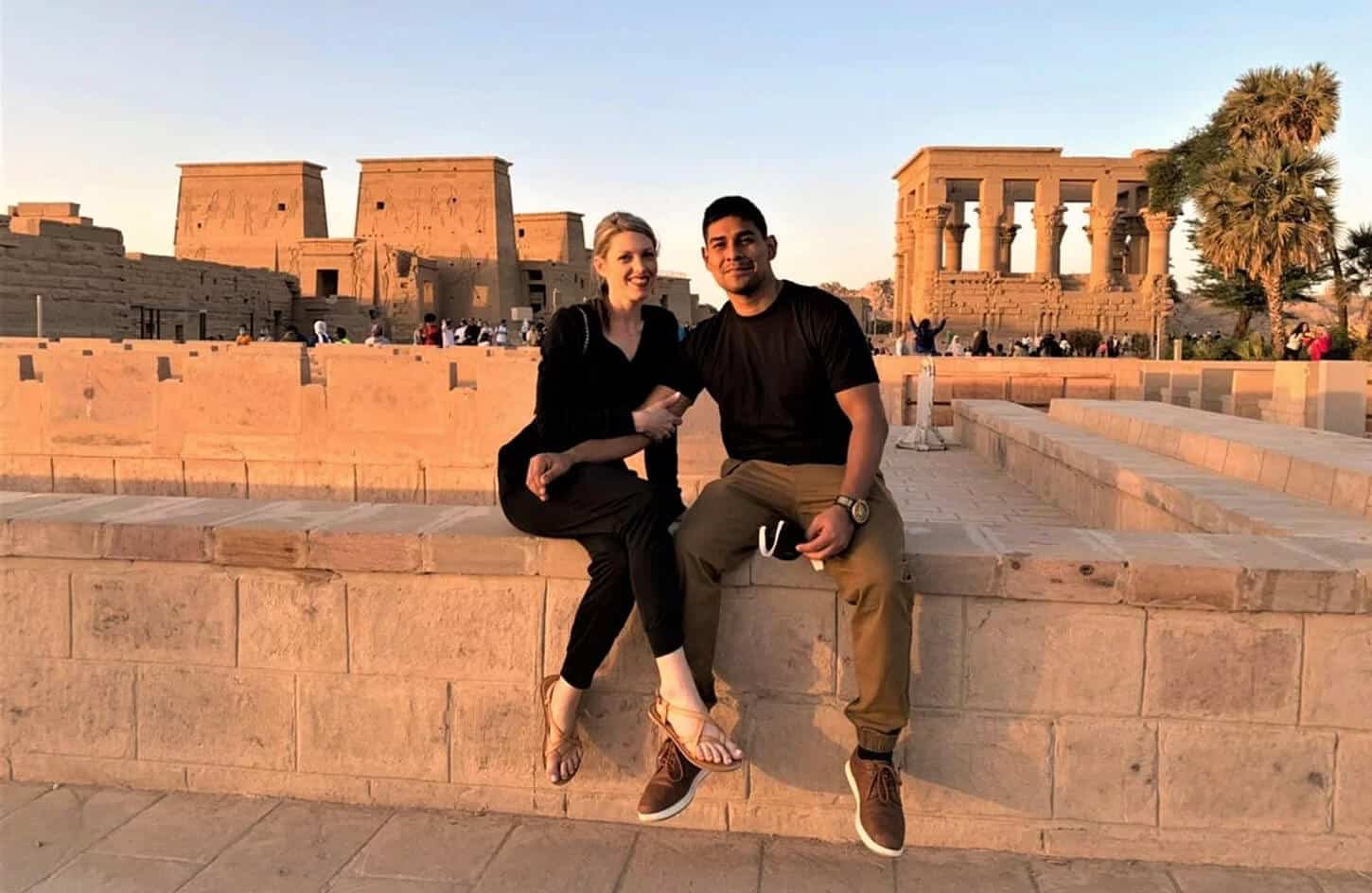
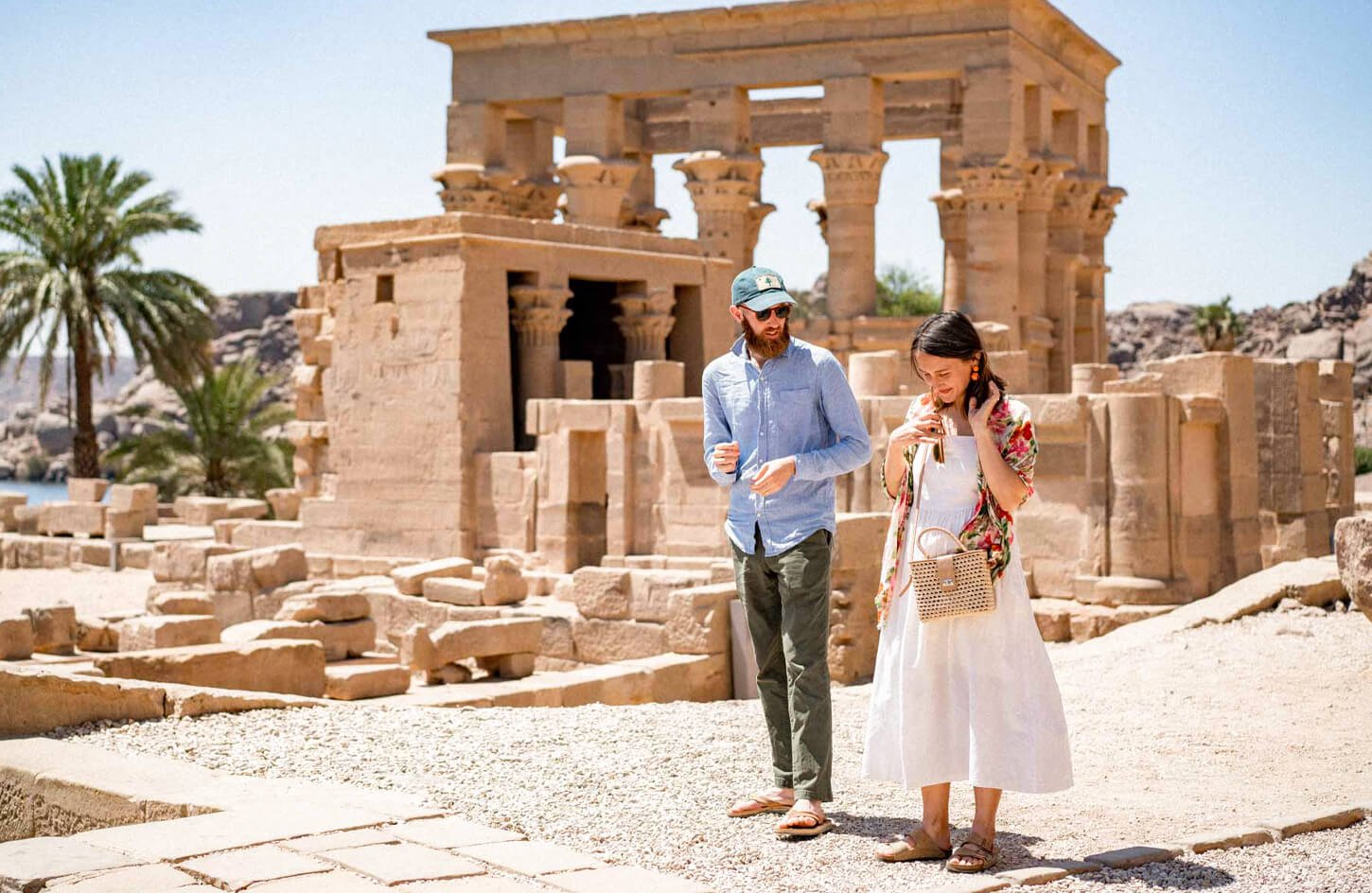
The most photographed structure at Philae, and one of the most recognizable images in all of Egyptian tourism, is the Kiosk of Trajan (sometimes called Pharaoh’s Bed). This elegant, open-sided structure with 14 ornately decorated columns was built by the Roman Emperor Trajan around 100 CE as a formal ceremonial gateway to the island.
Although it was never completed — the column capitals were prepared for decoration but left unfinished — the kiosk is extraordinarily beautiful. Its proportions are perfect, its location at the island’s edge frames it against the Nile, and it photographs magnificently at any time of day.
The Temple of Hathor
On the eastern edge of the island stands a smaller temple dedicated to Hathor, goddess of love, music, and beauty. This Ptolemaic structure is notable for its unusual decorations, which include scenes of musicians playing instruments — including what appears to be a harpist, a lute player, and Bes, the dwarf deity associated with music and childbirth. These carvings are far more informal and joyful in tone than the solemn religious imagery in the main temple.
The Sound and Light Show
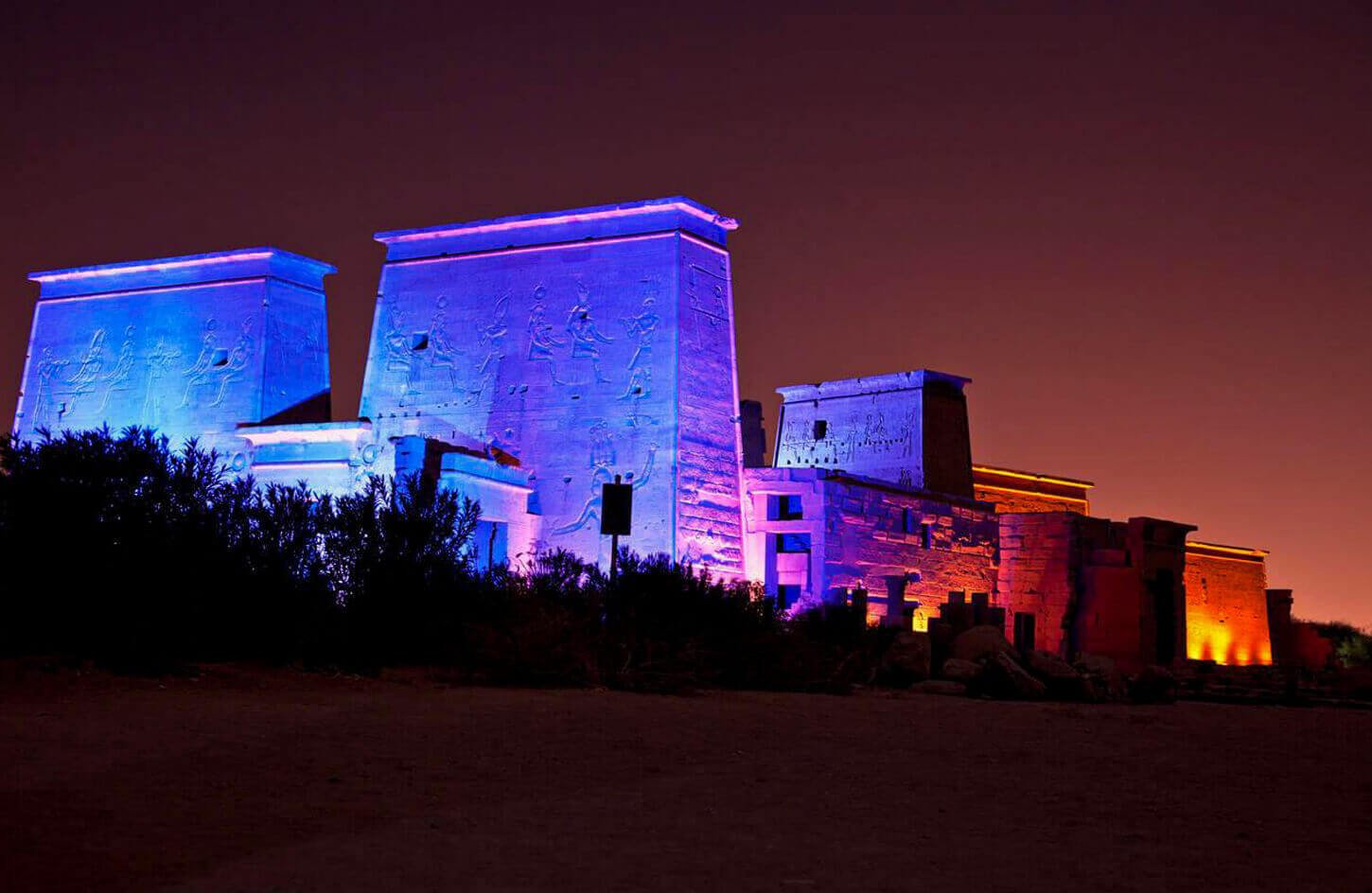
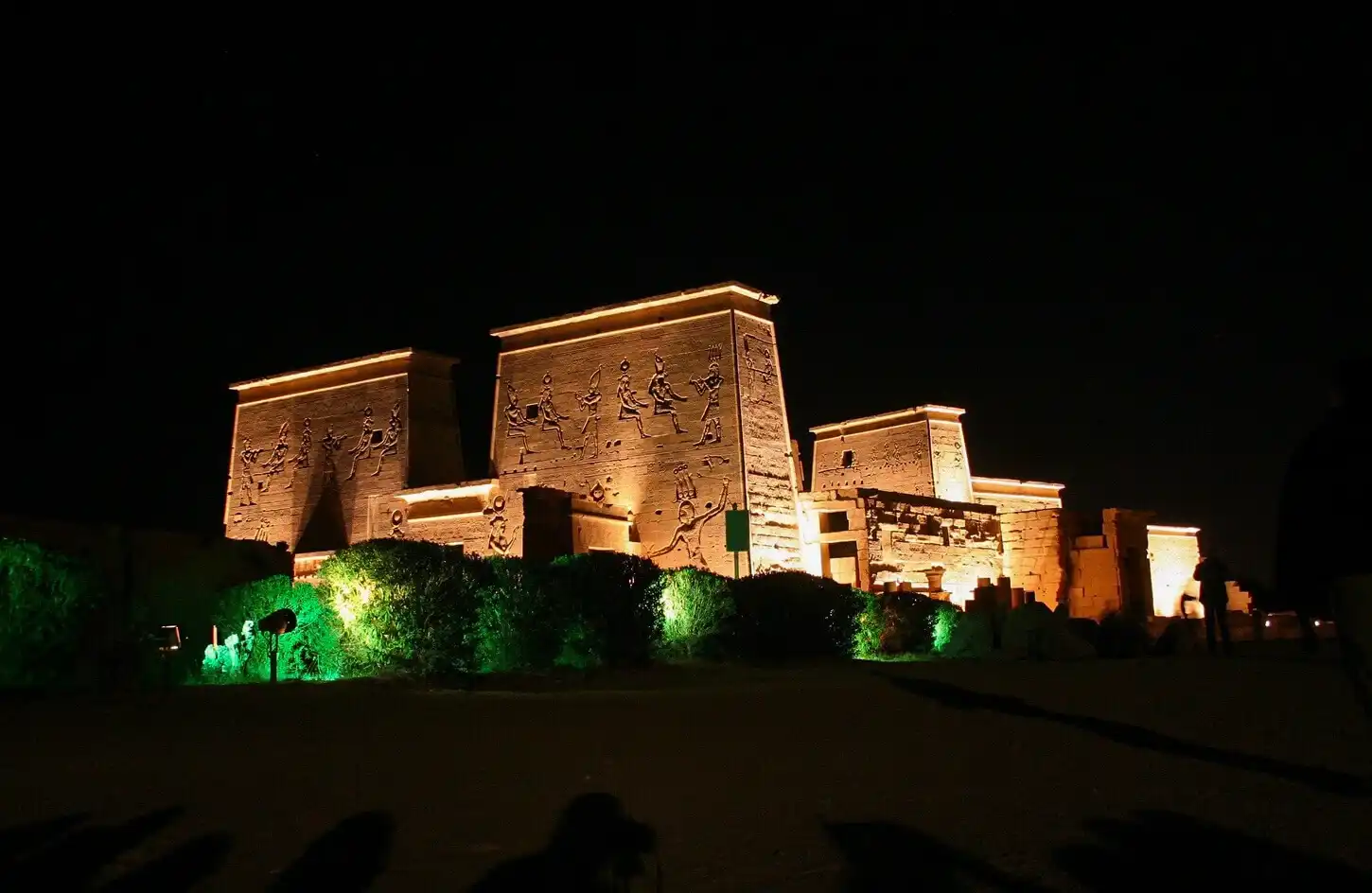
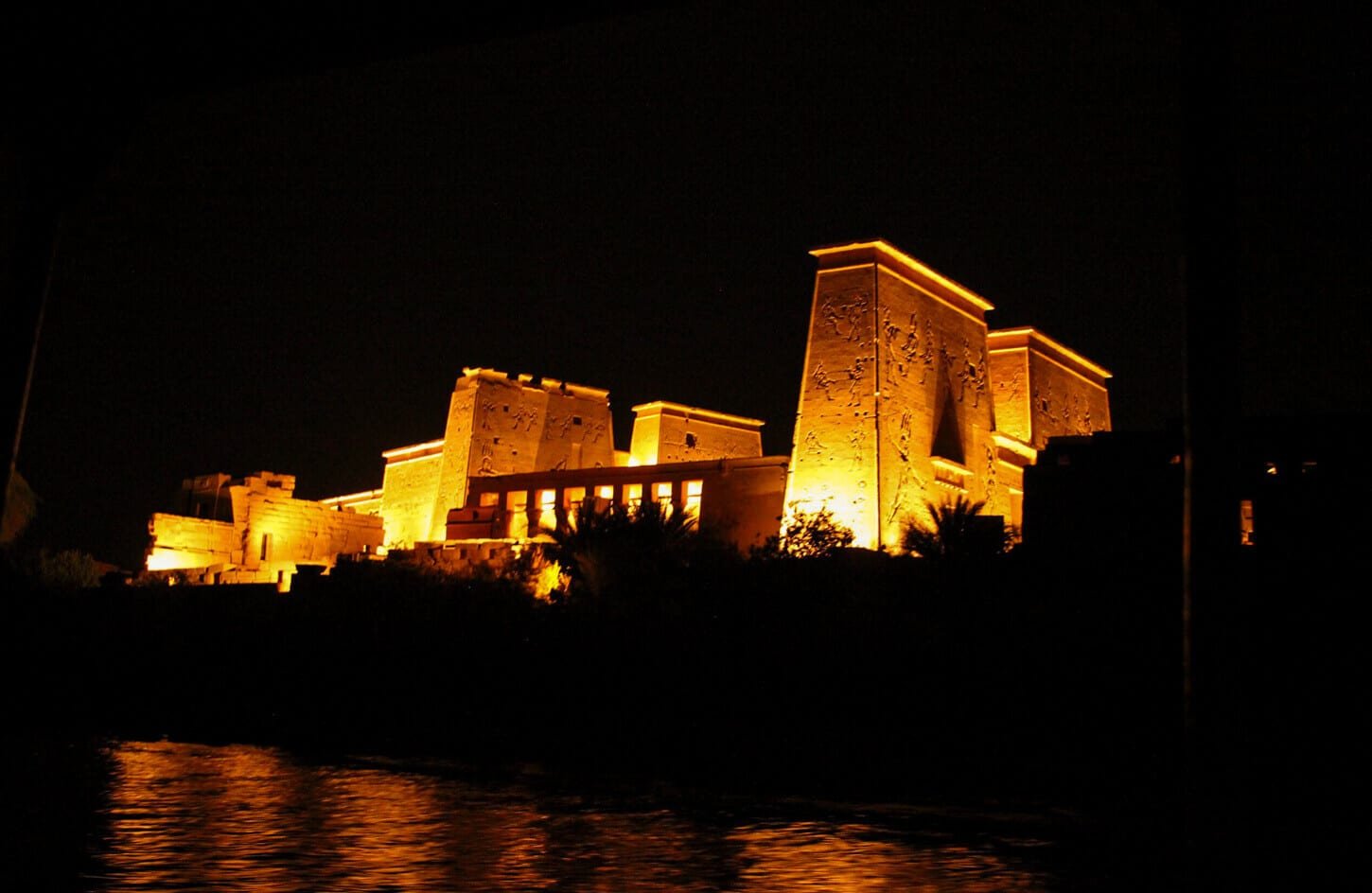
Each evening, Philae hosts one of Egypt’s most celebrated Sound and Light shows. As darkness falls over the island, the temple complex is illuminated with colored lights while a narrated story recounts the myth of Isis and Osiris in dramatic fashion.
The show lasts approximately one hour and runs multiple times per night in different languages — typically English, French, Arabic, Italian, and German, depending on the day. The experience of watching the colonnades and pylons glow against the dark Nile water is genuinely magical, and it offers a completely different perspective on the temple from the daytime visit.
Tickets for the Sound and Light show are purchased separately from the daytime admission ticket and cost approximately $15–20 USD per person.
Practical Information: How to Visit Philae Temple
Getting to Philae
Philae Temple is located on Agilkia Island, which can only be reached by boat. There are two steps to getting there:
Step 1: Get to the Aswan Marina
The embarkation point for boats to Philae is the Shellal Marina, located approximately eight kilometers south of central Aswan, near the Aswan Low Dam. You can reach it by taxi from central Aswan (approximately 20–30 minutes, around 50–80 EGP each way) or as part of an organized tour.
Step 2: Take a Motorboat to the Island
At the marina, you board small motorboats that ferry visitors to the island. The boat ride takes about five minutes each way and the views of the Nile islands are beautiful. Note that the boat is shared — you typically negotiate with the boat captain for the return trip as well. Fixed prices are posted at the marina entrance; as of 2026, the boat fare is approximately 100–150 EGP per person roundtrip.
Entrance Tickets
- Adult (Foreign): 450 EGP (approximately $15 USD)
- Student (Foreign with valid ID): 225 EGP
- Egyptian Adult: 60 EGP
- Egyptian Student: 30 EGP
Tickets are purchased at the marina ticket office before boarding the boat. Note that temple tickets and boat fare are separate payments.
Opening Hours
Philae Temple is open daily from 7:00 AM to 5:00 PM (winter) and 7:00 AM to 6:00 PM (summer). The Sound and Light Show begins after sunset, typically around 7:00 PM.
Best Time to Visit Philae
Best time of day: Early morning (7:00–9:00 AM) for cooler temperatures, soft light on the stone, and fewer crowds. Late afternoon (3:00–5:00 PM) is also excellent for photography, with golden light on the pylons.
Best season: October through April. Aswan has some of the most extreme summer temperatures in Egypt — regularly exceeding 42°C between June and August — which makes an outdoor temple visit genuinely uncomfortable and potentially dangerous. The winter months offer ideal conditions: warm, sunny days with temperatures between 20–28°C.
Avoid: Midday in summer (May–September) and the busiest weeks of the Christmas/New Year peak season if you want smaller crowds.
Combining Philae with Other Aswan Attractions
Philae Temple is rarely visited in isolation. Most visitors to Aswan combine it with two or three other major sites in a single full-day or half-day itinerary.
Classic Aswan Half-Day Tour
A well-organized half-day tour from central Aswan typically includes:
- Aswan High Dam — 30–45 minutes. The engineering feat that necessitated Philae’s relocation, and essential context for understanding the temple’s story.
- The Unfinished Obelisk — 30–45 minutes. Lying in its ancient quarry exactly as it was abandoned 3,500 years ago due to a crack in the stone. Fascinating for understanding how the Egyptians carved these colossal monuments.
- Philae Temple — 1.5–2 hours. The centerpiece of any Aswan visit.
Philae as Part of a Nile Cruise
If you are sailing a Nile Cruise between Luxor and Aswan (or reverse), Philae Temple is typically included in the Aswan day’s itinerary. It is usually visited on the morning of your arrival in Aswan or on the day of departure, depending on your cruise direction and itinerary.
🛥️ Pure Nile Tours offers Nile Cruises that include a private guided visit to Philae Temple as part of the Aswan itinerary. Our Egyptologist guides bring the mythology of Isis and Osiris to life in a way that transforms the experience. View Aswan Cruise Packages →
Extending to Abu Simbel
Many travelers visiting Aswan add a day trip to Abu Simbel, the colossal rock-cut temples of Ramesses II and Nefertari located 280 km further south. Abu Simbel can be reached by a convoy road trip (approximately 3 hours each way), by a short flight from Aswan Airport, or by a Lake Nasser cruise. It is one of the most awe-inspiring sites in all of Egypt and worth the extra day if your itinerary allows.
Tips for Getting the Most from Your Philae Visit
Hire a licensed guide. Philae’s mythology and architectural symbolism are complex and deeply rewarding once explained. The reliefs tell intricate stories from the Isis/Osiris cycle that are invisible to the uninitiated eye. A good Egyptologist guide can turn a 90-minute visit into a transformative experience.
Wear comfortable shoes. The temple complex has uneven stone paving throughout. Sandals are fine but sturdy shoes are better, especially in the cooler months when you will want to explore the entire island.
Bring water. There are no refreshment stands on the island itself. Bring at least one liter of water per person, more in summer.
Don’t rush the boat approach. Resist the urge to look at your phone during the five-minute boat crossing. The approach to the island — with the temple rising from the water — is one of the most iconic visual experiences in Egyptian travel and deserves your full attention.
Visit the Kiosk of Trajan last. Walk to the far end of the island first, then return to the Kiosk of Trajan as your final stop. The afternoon light from the west illuminates it beautifully, and the surrounding water adds to the effect.
Consider the evening Sound and Light show. If you can arrange your schedule to visit both in the afternoon and return for the evening show, you will experience two completely different versions of the same temple. It is one of the most atmospheric evenings you can spend in Egypt.
Frequently Asked Questions About Philae Temple
Is Philae Temple worth visiting?
Absolutely. It is consistently rated among the top five sites in Egypt by travelers who have seen it. The combination of beautiful architecture, extraordinary mythology, and the dramatic story of its rescue from the rising Nile waters makes it unlike anything else in the country.
How long do I need at Philae Temple?
Plan for a minimum of 90 minutes to see the main structures. Two hours is more comfortable and allows you to absorb the atmosphere properly. If you add the boat journey to and from the marina, allow a total of three hours for the complete experience.
Can I visit Philae independently without a guide?
Yes. The island is well-signed and the main structures are easy to navigate. However, a licensed Egyptologist guide will significantly enrich your understanding of what you are seeing. Consider at minimum a brief guided orientation before exploring on your own.
Is Philae Temple suitable for children?
Very much so. The boat ride is exciting for children, the scale of the temple is impressive without being overwhelming, and the story of the Isis and Osiris mythology (suitably adapted) captures young imaginations. The island is relatively compact and manageable with small children.
What is the difference between Philae and Abu Simbel?
Both are UNESCO World Heritage Sites rescued from the rising waters of Lake Nasser. Philae is a Ptolemaic temple complex dedicated to Isis, smaller in scale but extraordinarily beautiful and rich in detail. Abu Simbel is a New Kingdom temple carved directly into rock cliffs by Ramesses II, monumental and overpowering in scale. If possible, visit both.
Is the Sound and Light show worth it?
For most visitors, yes. It provides a dramatically different atmospheric experience from the daytime visit. The quality of narration varies, but the illumination of the temple at night is consistently beautiful. If you have the time and energy, it is a worthwhile addition to your Aswan itinerary.
Philae Temple and the Nile Cruise Experience
For travelers sailing a Nile Cruise between Luxor and Aswan, Philae Temple is one of the emotional highpoints of the journey. After several days of desert landscapes and pharaonic monuments, arriving at Aswan and then traveling by boat to this island sanctuary has a particular resonance.
The combination of cruising the Nile — one of the world’s great river journeys — and then arriving at Philae by another boat within a boat is one of those travel experiences that remains vivid for decades. It connects you to the ancient experience of pilgrims who made the same journey in the same direction for thousands of years, arriving at this island to honor the goddess Isis and ask for her blessing.
🛥️ Looking to experience Philae as part of a full Nile Cruise? Pure Nile Tours offers cruises on luxury ships including the Historia, Soleil, Movenpick Hamees, and the intimate Sonesta Amiral Dahabiya — all with Aswan itineraries that include a private guided visit to Philae Temple. Browse Nile Cruise Packages →
Final Thoughts
Philae Temple is more than a beautiful ancient ruin. It is a story about survival — of a goddess worshipped for three millennia, of a temple rescued from drowning by an international community that believed beauty and history are worth saving, and of an island that carries the memory of the last practitioners of the ancient Egyptian religion.
Whether you visit as part of a Nile Cruise, a dedicated Aswan itinerary, or a longer Egypt tour, make Philae Temple a priority. The boat crossing, the island setting, the layered history from Ptolemaic through Roman to Christian and back to ancient again, and the sheer beauty of the architecture combine to create an experience that is, quite simply, unforgettable.
Aswan is worth the journey. And Philae is worth Aswan.