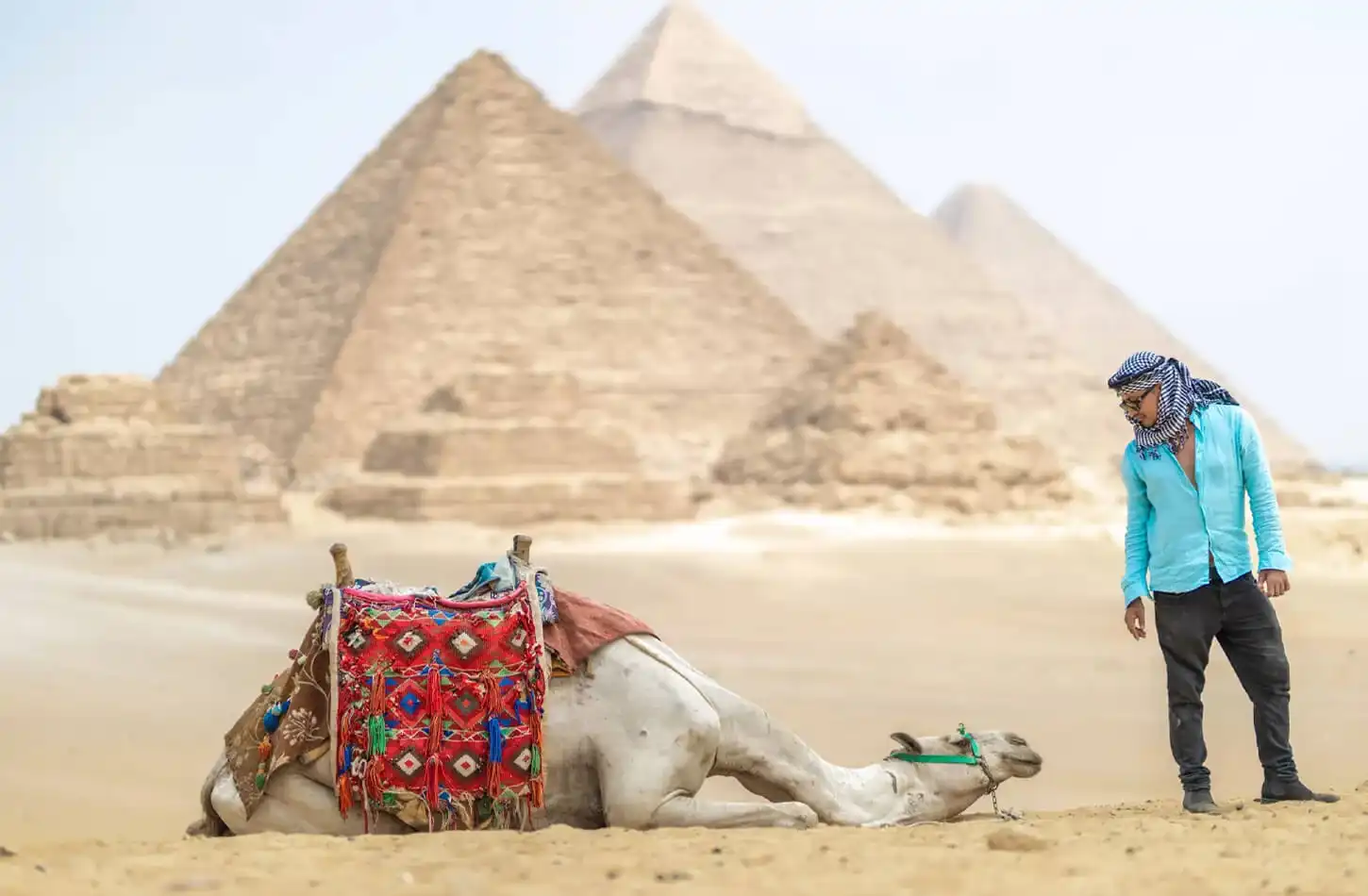
Most visitors fly into Cairo, see the Pyramids of Giza, and leave Egypt assuming they’ve seen the pyramid. Few realize that roughly 30 kilometers south, a different, older, and arguably more historically important structure rises from the desert: the Step Pyramid of Djoser at Saqqara — the very first pyramid ever built in Egypt, and the structure that made Giza possible.
This guide covers the Step Pyramid’s history, the genius architect behind it, what you can actually see today, and why it deserves a place on your Cairo itinerary alongside (or even before) Giza itself.
What Is the Saqqara Step Pyramid?
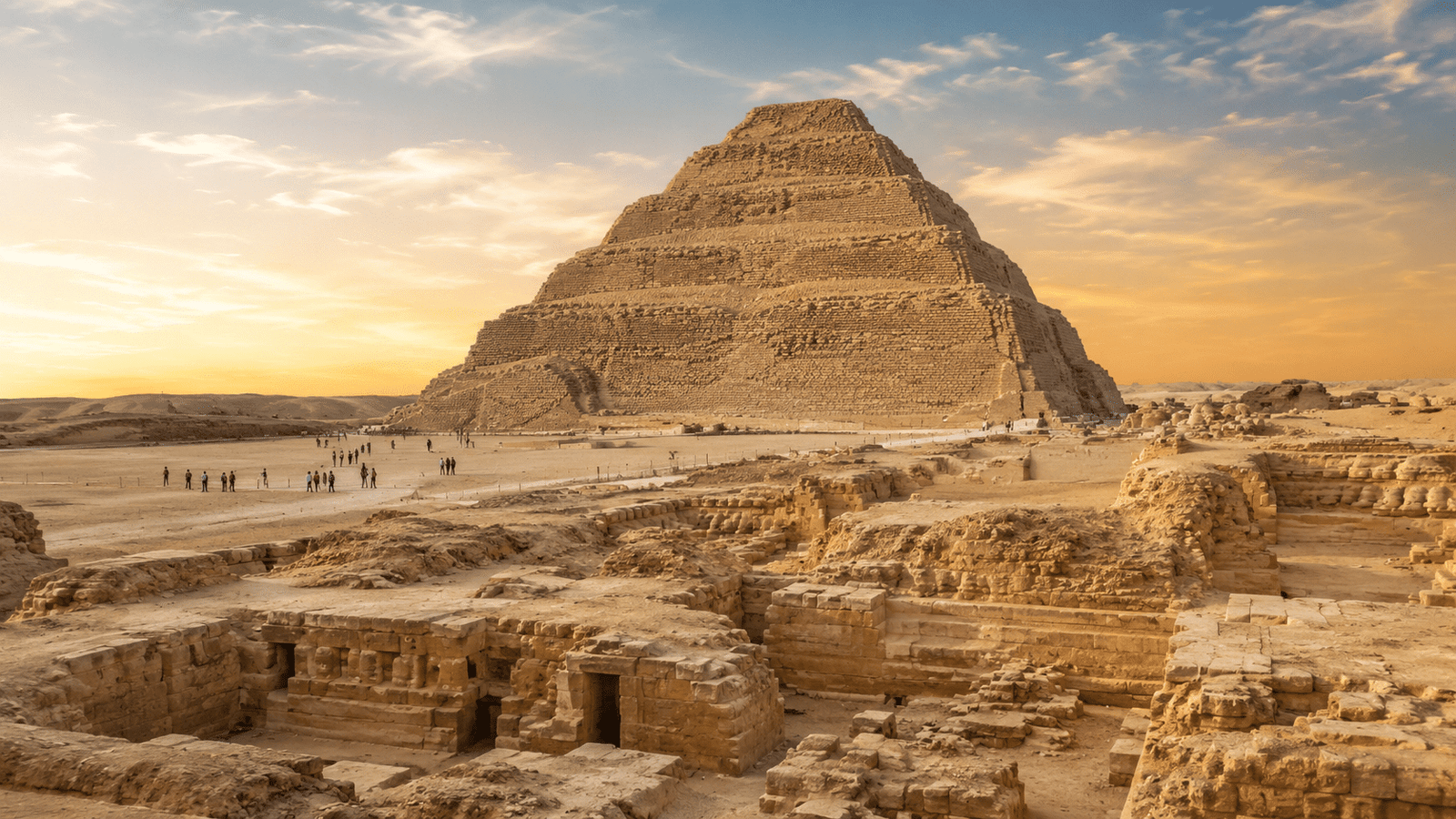
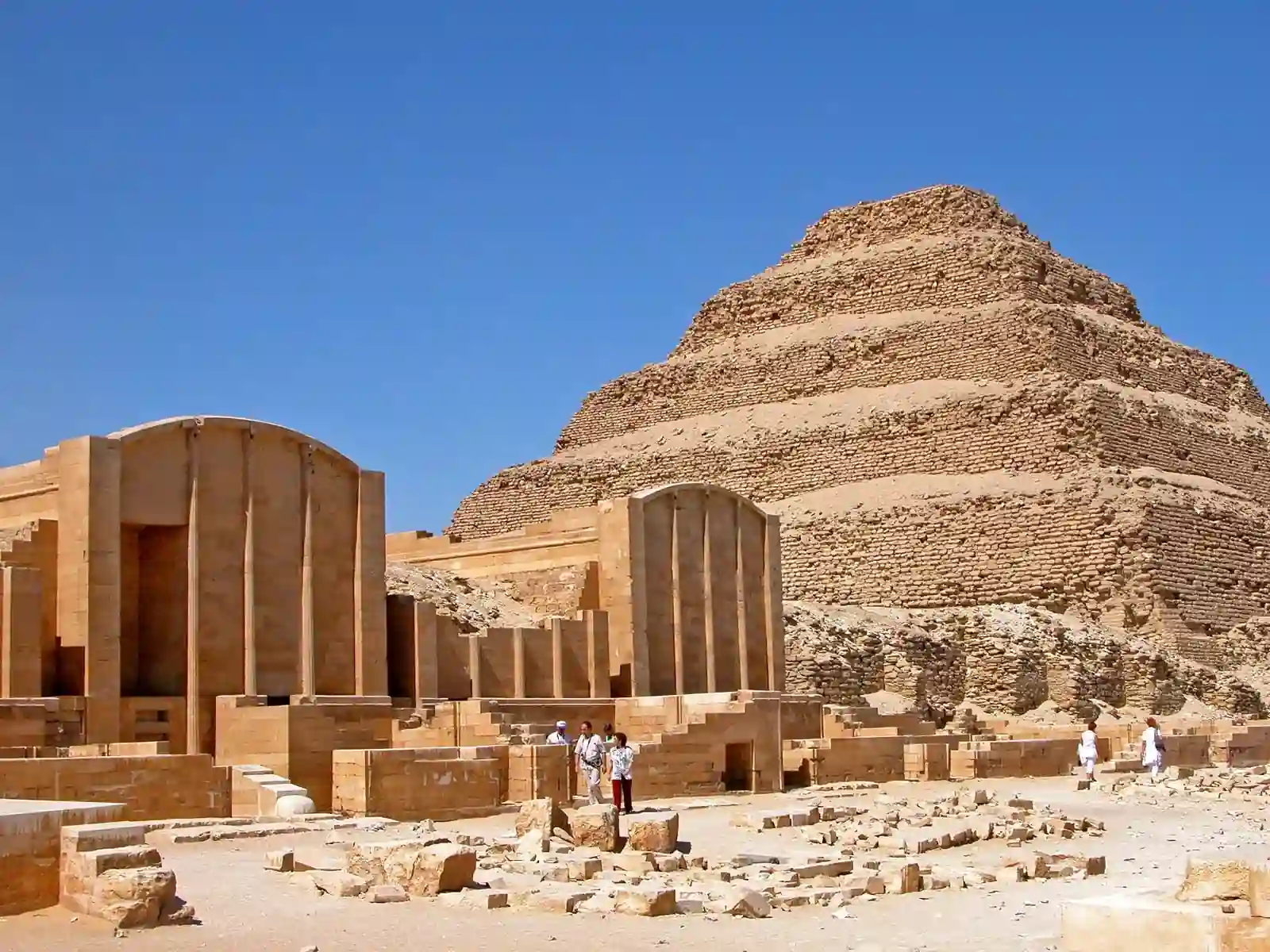
The Step Pyramid of Djoser is Egypt’s oldest large-scale stone monument, built around 2670 BCE during the Third Dynasty as the tomb of Pharaoh Djoser. Rather than the smooth, true-pyramid shape made famous by Giza, the Step Pyramid rises in six distinct tiers, or “steps,” reaching a height of approximately 62 meters (203 feet) — created by stacking progressively smaller mastaba-style tombs on top of one another.
It sits at the center of a much larger funerary complex covering more than 15 hectares, within the vast Saqqara necropolis — the ancient burial ground for Memphis, which served as the capital of Egypt during the Old Kingdom period.
Quick facts:
Who Built the Step Pyramid — and Why It Matters
Pharaoh Djoser
Djoser, whose original throne name was Netjerykhet (meaning roughly “divine of body”), was the second king of Egypt’s Third Dynasty, generally believed to be the son of the last ruler of the Second Dynasty, Khasekhemwy. Relatively little is known about the specific political events of his reign, but he was held in unusually high regard for centuries afterward — a later inscription known as the Famine Stele, carved more than two thousand years after his death, credits Djoser with ending a seven-year famine by restoring a temple to the god Khnum, illustrating the lasting cultural memory of his reign.
Imhotep: The First Named Architect in History
The Step Pyramid’s true significance lies as much in who designed it as in the structure itself. Djoser’s vizier, Imhotep, conceived and oversaw its construction — and in doing so became the first architect in recorded history whose name we actually know, attached to a specific, datable monumental building.
Imhotep was extraordinarily accomplished beyond architecture alone: ancient sources credit him as a physician, astronomer, scribe, and high priest of Heliopolis. His reputation grew so significant in the centuries following his death that he was eventually deified, worshipped as a god of wisdom, medicine, and healing — an extraordinary elevation for a non-royal historical figure in ancient Egyptian religion.
Djoser himself recognized Imhotep’s singular achievement: breaking with the standard convention of inscribing only the pharaoh’s name on royal monuments, Djoser had Imhotep’s name carved alongside his own — a rare honor reflecting just how exceptional his vizier’s accomplishment was considered at the time.
How the Step Pyramid Was Built: From Mastaba to Pyramid
What makes the Step Pyramid genuinely fascinating from an engineering history perspective is that it wasn’t originally conceived as the towering monument we see today — archaeological investigation has revealed it evolved through several distinct construction phases.
Phase 1: A simple mastaba. Imhotep appears to have begun with a conventional, single-story mastaba tomb — the standard rectangular, flat-roofed tomb style used for Egyptian elite burials before Djoser’s reign — reaching an initial height of around 6 meters (20 feet).
Phase 2: Expansion and reconsideration. Rather than finishing a standard mastaba, Imhotep enlarged the structure, then made the conceptually radical decision to stack a second, smaller mastaba directly on top of the first.
Phase 3: The full six-tiered step pyramid. Through several additional building phases, Imhotep continued stacking progressively smaller mastaba-shaped tiers, ultimately reaching six steps and the structure’s final height of approximately 62 meters — transforming what began as a conventional tomb into something architecturally unprecedented in human history.
This evolutionary building process is part of why the Step Pyramid matters so much to the broader pyramid story: it represents the actual, physical, archaeologically traceable moment when Egyptian monumental architecture shifted from flat mastaba tombs toward the pyramid form — a transition that would culminate, roughly a century later, in Khufu’s Great Pyramid at Giza.
The Step Pyramid’s Place in Egypt’s Pyramid Timeline
Understanding how Saqqara connects to Giza helps put both sites in their proper historical context:
c. 2670 BCE — The Step Pyramid of Djoser, Egypt’s first major stone pyramid, designed by Imhotep.
c. 2600 BCE — Sneferu’s pyramids at Dahshur, including the Bent Pyramid (where the construction angle was changed partway through, likely due to structural concerns) and the Red Pyramid, generally considered the first successful “true,” smooth-sided pyramid.
c. 2600–2560 BCE — The Great Pyramid of Khufu at Giza, Sneferu’s son, building directly on the engineering lessons of both Djoser’s stepped pyramid and his own father’s experimental designs.
In other words: without Imhotep’s breakthrough at Saqqara, the smooth-sided pyramids of Giza, built only about a century later, would not have been architecturally possible. For the complete story of the Giza pyramids that followed, see our Pyramids of Giza facts guide.
What’s Inside and Around the Step Pyramid Complex
The Underground Tunnel Network
Beneath the Step Pyramid lies an extensive network of tunnels and chambers, reportedly stretching over 5 kilometers in total — including storage galleries, false doors, and the pharaoh’s actual burial chamber, reached via a vertical shaft descending approximately 28 meters (92 feet) into the bedrock. Djoser’s pink granite sarcophagus still rests within this burial chamber today. Visitors with the appropriate ticket can descend into this burial shaft as part of a Saqqara visit — a genuinely atmospheric experience distinct from anything available at Giza.
The Heb-Sed Court
A large open courtyard within the complex, designed to ceremonially host the Heb-Sed festival — a ritual renewal of the pharaoh’s strength and right to rule, traditionally held after 30 years of a king’s reign. The court’s surrounding dummy buildings (non-functional stone facades mimicking real structures) represent some of the earliest known examples of decorative, purely symbolic architecture in Egyptian history.
The House of the North and House of the South
Two ceremonial structures within the complex, their facades carved with proto-Doric style columns — architectural details that predate similar column designs in Greek architecture by well over two thousand years, a detail that continues to interest architectural historians studying the origins of classical column design. These columns are not freestanding in the structural sense familiar from later Greek temples — they were carved directly into the limestone walls as engaged, decorative columns, since Imhotep’s builders had not yet developed (or had reason to develop) freestanding stone column-and-lintel construction. Even so, the fluted, ribbed surface treatment closely anticipates the visual vocabulary later associated with Doric architecture, leading some architectural historians to describe Saqqara as containing the conceptual seeds of a column style that wouldn’t fully emerge in the Mediterranean world for over two millennia.
The Serdab
A small, sealed chamber near the pyramid’s base containing a statue of Djoser (the original now housed in the Egyptian Museum, with a replica in place at the site), positioned with small eye-holes allowing the statue to symbolically “see” out toward the temple — intended to allow the pharaoh’s spirit to observe ongoing offerings and rituals performed in his honor.
Restoration Work (2006–2020)
The Step Pyramid underwent a major, multi-year restoration project carried out by Egypt’s Supreme Council of Antiquities between 2006 and 2020, addressing structural instability that had developed over more than four and a half millennia, including damage from a 1992 earthquake. This restoration is part of why visitors today can safely access portions of the interior, including the burial chamber descent, that were not previously open.
Visiting the Step Pyramid Today
Location and Getting There
Saqqara lies approximately 25–30 kilometers southwest of central Cairo, on the west bank of the Nile near the ancient capital of Memphis. The drive typically takes 45 minutes to just over an hour, depending on traffic and your starting point in Cairo.
Opening Hours
Tickets
As of 2026, general admission for foreign visitors runs approximately 450 EGP, with a discounted student rate (with valid ISIC identification) of around 230–250 EGP. Entry to the underground burial chamber may require an additional, modest surcharge. Prices are periodically revised, so confirm current rates before your visit.
Best Time to Visit
Early morning is strongly recommended — Saqqara draws far fewer visitors than Giza overall, but the site is large and exploring comfortably without midday heat or tour-group crowding is considerably more pleasant earlier in the day.
How Much Time to Budget
Saqqara is not a quick stop. Beyond the Step Pyramid itself, the surrounding necropolis includes numerous other tombs and monuments — including the Mastaba of Ti, known for exceptionally well-preserved relief carvings, and the Serapeum, an extraordinary underground complex of massive granite sarcophagi built for sacred Apis bulls. A half-day visit (3–4 hours) allows reasonable time to see the Step Pyramid complex plus one or two additional nearby sites.
Recent Discoveries at Saqqara
Far from being a fully excavated, “finished” archaeological site, Saqqara remains one of the most active excavation zones in Egypt, with significant new discoveries reported regularly in recent years. Egyptian and international archaeological missions have uncovered numerous previously unknown tombs, sealed sarcophagi, and burial shafts across the wider necropolis throughout the 2020s — including elaborately decorated New Kingdom-era tombs belonging to officials and priests, well beyond the immediate Step Pyramid complex itself.
This ongoing excavation activity is part of why Saqqara feels different from a fully “completed” tourist site like much of Giza: there’s a genuine sense that new discoveries connected to the broader necropolis could continue to emerge, even as the core Step Pyramid complex itself has now been fully restored and stabilized.
Common Misconceptions About the Step Pyramid
Misconception: The Step Pyramid was meant to look exactly as it does today, as a deliberate architectural choice from the start. As covered above, archaeological evidence clearly shows the structure evolved through several distinct construction phases, beginning as a conventional single-story mastaba before Imhotep’s design ambitions expanded.
Misconception: Saqqara is a single pyramid with nothing else to see. In reality, the Step Pyramid sits within an enormous funerary complex covering more than 15 hectares, and the broader Saqqara necropolis extends across roughly 6.5 kilometers of desert, containing dozens of additional tombs, temples, and monuments spanning multiple periods of Egyptian history — not just Djoser’s Third Dynasty complex.
Misconception: Imhotep’s tomb has been found. Despite his historical significance and later deification, Imhotep’s own burial place has never been definitively located, despite extensive search efforts at Saqqara — one of the genuine remaining mysteries connected to the site.
Saqqara vs. Giza: Which Should You Visit?
This is one of the most common questions travelers ask when planning limited time in Cairo. The honest answer: if you can fit both into your itinerary, do — they tell complementary parts of the same story. But if you’re choosing one over the other:
Choose Giza if you want the iconic, unmistakable Egypt photo, the largest and most famous pyramids in the world, and the Great Sphinx.
Choose Saqqara if you’re interested in genuine archaeological depth, want a noticeably less crowded experience, and want to understand the actual origin point of pyramid-building — plus the unique experience of descending into Djoser’s burial chamber, an interior access experience generally considered less physically demanding than the Great Pyramid’s narrow ascending passage.
Many Egyptologist guides and seasoned travelers consider Saqqara, not Giza, the more intellectually rewarding stop precisely because of its lower crowds and its direct connection to the origin of Egyptian monumental architecture — though Giza remains, understandably, the must-see for first-time visitors prioritizing iconic scale.
For a complete picture of how Saqqara fits into a broader Cairo and Giza itinerary, see our guides to the Pyramids of Giza and who built the pyramids.
🏛️ Want to see where Egypt’s pyramid-building story actually began? Pure Nile Tours offers private Egyptologist-guided tours combining Saqqara and Giza in a single day, with expert context connecting Imhotep’s breakthrough to the monuments that followed. Book a Private Saqqara & Giza Tour →
Frequently Asked Questions
Is the Saqqara Step Pyramid older than the Pyramids of Giza?
Yes. The Step Pyramid was built around 2670 BCE, roughly 70 to 100 years before the Great Pyramid of Khufu at Giza, making it Egypt’s oldest large-scale stone monument and the first pyramid ever built.
Who designed the Step Pyramid?
Imhotep, vizier to Pharaoh Djoser, designed and oversaw its construction. He is considered the first architect in recorded history known by name, and was later deified as a god of wisdom and medicine.
Can you go inside the Step Pyramid?
Yes, with the appropriate ticket, visitors can descend into the underground burial chamber via a roughly 28-meter vertical shaft, where Djoser’s pink granite sarcophagus still rests.
How far is Saqqara from Cairo?
Approximately 25–30 kilometers southwest of central Cairo, typically a 45-minute to just over one-hour drive depending on traffic and starting location.
Why is it called a “step” pyramid instead of a true pyramid?
It was built by stacking six progressively smaller mastaba-shaped tiers on top of one another, creating a stepped silhouette, rather than the smooth, flat-sided design later achieved at Dahshur and Giza.
Is Saqqara worth visiting if I’ve already seen Giza?
Many travelers and guides consider Saqqara a highlight precisely because it’s less crowded and offers genuine insight into the origins of pyramid construction — widely regarded as a complementary, rather than redundant, experience alongside Giza.
What else is there to see at Saqqara besides the Step Pyramid?
The broader Saqqara necropolis includes the Mastaba of Ti (known for detailed relief carvings), the Serapeum (an underground complex of massive sarcophagi for sacred Apis bulls), and numerous other tombs and monuments across the site.
Final Thoughts
The Step Pyramid of Djoser doesn’t draw the crowds or instant recognition that Giza commands, but it holds a genuinely unique place in human history: it is the moment a single architect’s ambition transformed Egyptian funerary architecture forever, setting in motion a building tradition that would culminate, just a century later, in the Great Pyramid. Standing before its six weathered tiers, knowing you’re looking at the literal starting point of monumental stone architecture — designed by history’s first named architect — adds a dimension to an Egypt trip that the more famous pyramids at Giza, for all their scale, simply can’t replicate.
🏛️ Ready to discover where it all began? Pure Nile Tours’ private Cairo tours include Saqqara as part of a complete ancient Egypt itinerary, with expert Egyptologist guides bringing Imhotep’s extraordinary achievement to life. Explore Private Cairo Tours →