
The Tanoura Show at Wekalet El Ghouri is one of the most practical cultural evenings you can do in Cairo: it’s central, it’s indoors, and it fits well into a first-time itinerary around Historic/Islamic Cairo.
This guide focuses on decisions you need to make:
-
When to go (and how early to arrive)
-
How tickets usually work (and what not to assume)
-
How to get there safely and calmly at night
-
What the show actually is (so expectations match reality)
If you want a polished “big theatre” production with fixed seating and guaranteed online tickets, this may feel more informal. If you want an authentic-feeling night in old Cairo with live music and a historic venue, it’s usually a strong choice.
Tanoura Show at Wekalet El Ghouri at a Glance
Here are the key planning points most first-time visitors need.
-
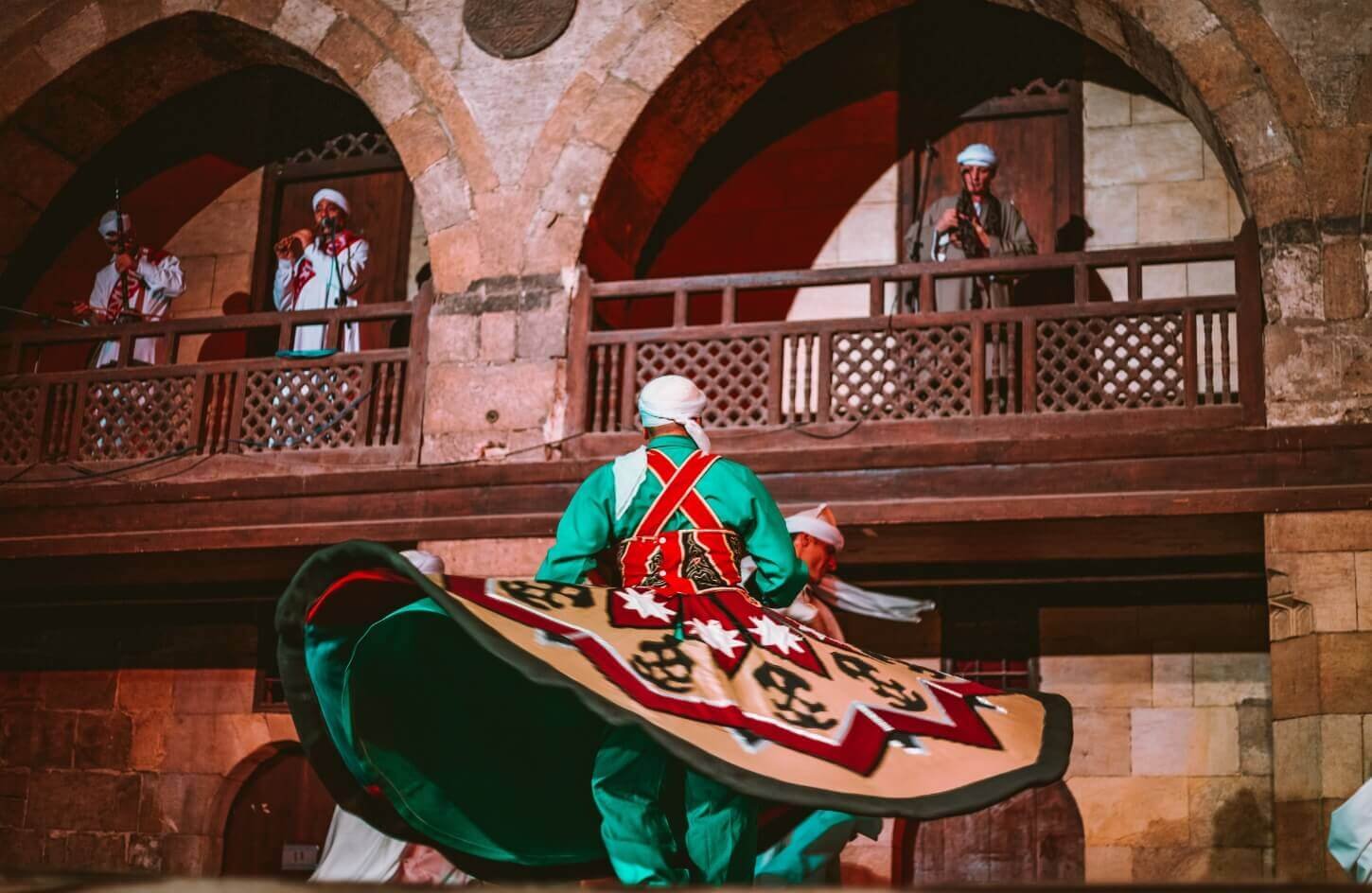
What it is: A traditional Egyptian Tanoura performance with live music and spinning dancers (often described as a “Sufi dance show” or “whirling dervish show” by travellers).
-
Where it is: Wekalet el-Ghouri / Wikalat al-Ghouri, in Islamic Cairo near the Al-Muizz Street area (close to the Khan el-Khalili district).
-
When it runs: At the time of writing (February 2026), the Cultural Development Fund states performances are at 8:00 pm on Saturday, Monday, and Wednesday—but details can change, so always confirm close to your visit using the official listing.
-
How long to plan for: Allow 2–3 hours total (transport + queue + seating + show + exiting), even if the performance itself feels shorter.
-
Tickets: Often handled on-site. Do not assume you can buy a confirmed ticket online from an unofficial seller.
-
Best for: A first cultural night in Cairo, travellers staying in Downtown/Zamalek/Garden City, and anyone already planning to visit Khan el-Khalili or Al-Muizz Street.
-
Not ideal for: Travellers who struggle with stairs/crowds, or those who want a late-night activity (it’s an early evening plan).
Table 1: Quick planning checklist (fast decisions)
| Planning item | Practical answer |
|---|---|
| Show days | At the time of writing: Saturday, Monday, Wednesday (confirm on the official listing) |
| Start time | At the time of writing: 8:00 pm (confirm on the official listing) |
| How early to arrive | Aim for 45–60 minutes early if you want a calmer entry and better chance of good seating |
| Ticket method | Often buy at/near the venue (carry cash in EGP) |
| Best transport | Ride-hailing is usually simplest for first-timers; avoid negotiating late at night if you can |
| Best nearby pairing | Al-Muizz Street stroll + early dinner + show |
| Best for | Culture-focused visitors, families with older kids, photographers (if allowed that night) |
A very rough budget snapshot (for planning only)
Costs in Cairo can change quickly, and exchange rates vary. Think in categories, not promises:
-
Budget style day: local eats + public/ride-hailing + low-cost attractions
-
Mid-range style day: comfortable meals + ride-hailing + a few paid sights
-
Luxury style day: private transfers + top restaurants + premium experiences
For this specific evening, the biggest “variables” are usually:
-
Transport (traffic + distance + surge pricing)
-
Dinner choice (simple local vs. sit-down restaurant)
-
Ticket rules on that specific date
Tanoura dance: what you’re actually watching and why it matters
Many visitors search for “whirling dervish show in Cairo” and end up at a Tanoura performance. The words get mixed online, so it helps to understand the basics.
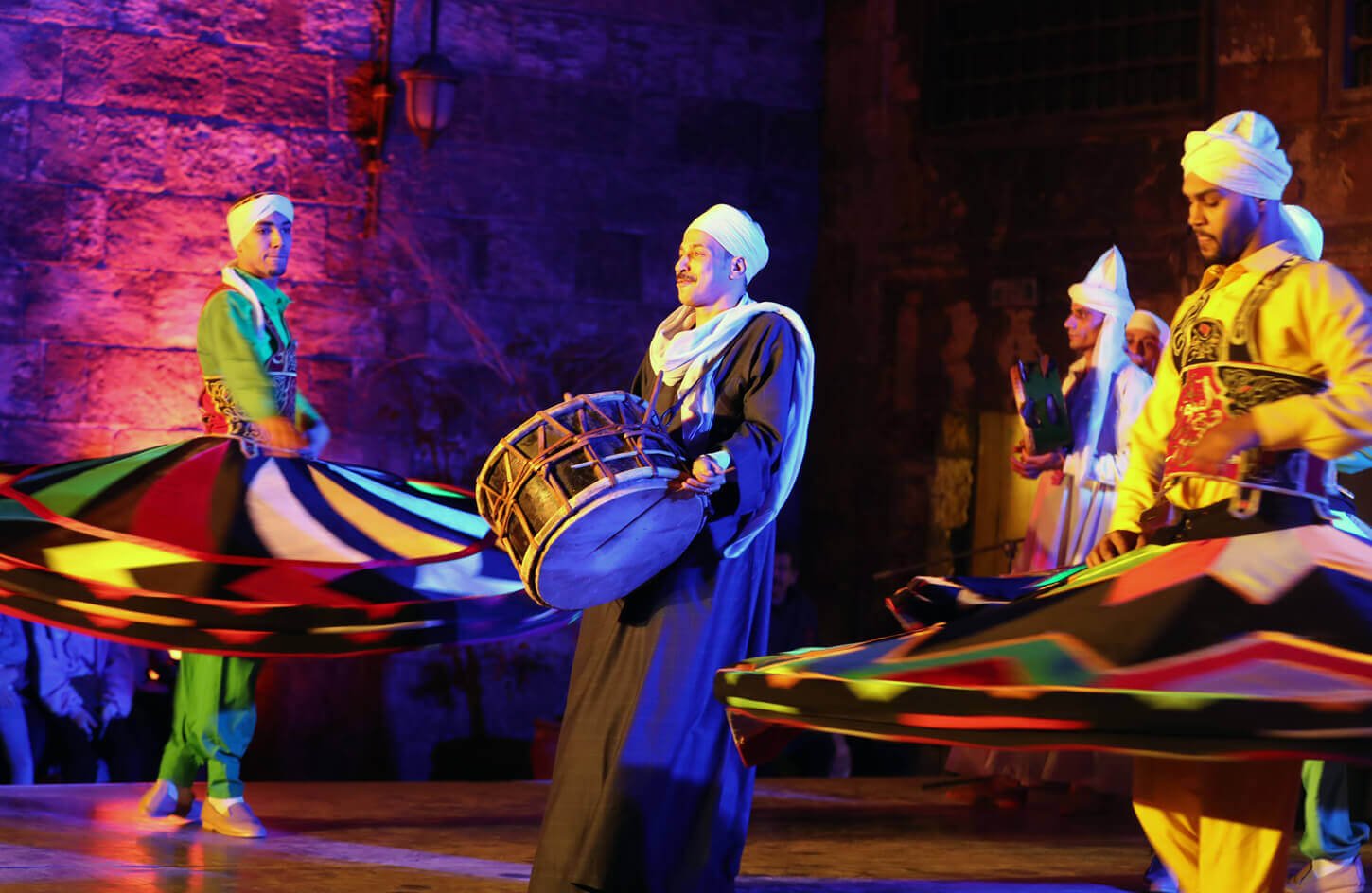
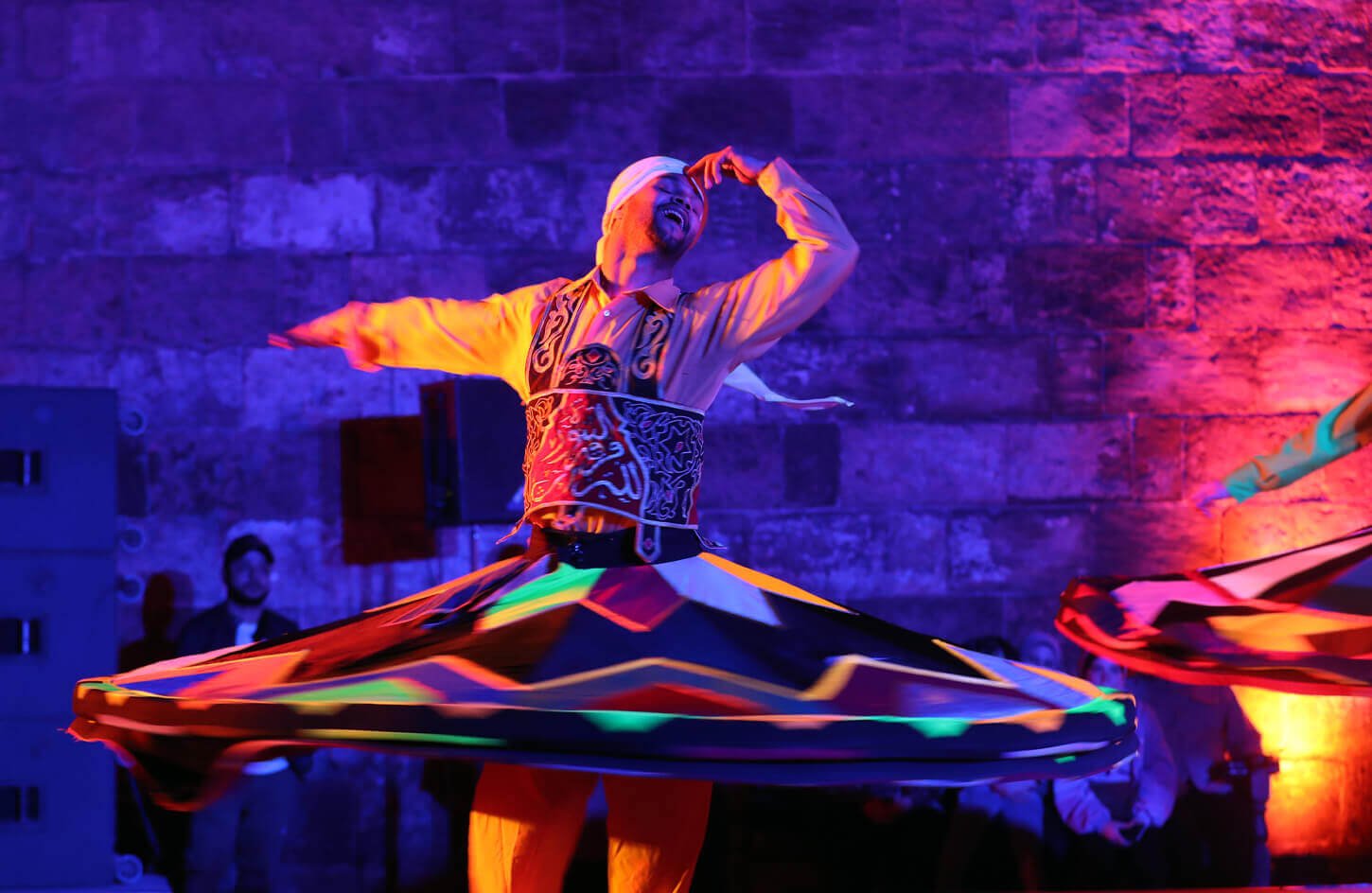
A Tanoura show is built around continuous circular movement (spinning) and live traditional music. It’s often presented as a cultural performance, even when it has roots connected to spiritual practices.
The Cultural Development Fund’s description highlights the circular movement idea and connects it to a Sufi-inspired philosophy of motion returning to the same point, with singing that can include praise and devotional themes alongside popular/folk topics.
What you may notice during the performance:
-
Layered skirts and colour changes: The dancer can reveal different colours/patterns as the costume shifts.
-
Pacing and stamina: Spinning is demanding. Part of the “wow” is endurance and control.
-
Live instruments: You may hear traditional instruments and strong rhythm sections, which can feel loud in a stone courtyard setting.
Tanoura dance
If the phrase “Tanoura dance” shows up in your planning, think of it like this:
-
It’s a folk performance style strongly associated with spinning and circular movement.
-
It can be described in spiritual terms, but as a visitor, it is fine to approach it as a respectful cultural show.
-
The best mindset is: watch quietly, follow venue rules, and avoid treating it like a club or party event.
Wikala of al Ghouri: what the venue is and why it’s special
Wekalet el-Ghouri is not just a stage. It’s a historic structure tied to a larger complex in Islamic Cairo.
According to the Ministry of Tourism & Antiquities monument listing, Al-Ghuri’s wikala was part of a complex founded by Sultan Qansuh al-Ghuri, built around 1503–1504 AD.
A “wikala” (also written wekala / wakala / wikala) was essentially a commercial building supporting trade:
-
The monument listing describes a rectangular open courtyard surrounded by halls and multiple floors.
-
Lower levels were used for storage/warehouses, while upper floors included rooms used as lodgings for merchants.
In other words: it’s a historic “merchant hub” building, adapted today as a cultural space.
Wikala of al Ghouri
If you see “Wikala of al Ghouri” in your research, it refers to this same idea:
-
A historic trade-and-lodging structure
-
Part of a larger architectural complex (mosque, madrasa, and other elements are mentioned in the official description)
-
A setting that feels different from a modern theatre, which is part of the attraction
Daytime visit vs. evening show (do not mix these up)
The monument listing includes daytime opening hours and monument ticket prices for visits (separate from the evening performance experience).
If you’re going for the show, treat the evening as its own plan with its own entry/ticket process.
Tanoura show Cairo schedule: when to go, when to arrive, and queue strategy
Tanoura show Cairo schedule
At the time of writing (February 2026), the Cultural Development Fund states the Tanoura troupe performs at 8:00 pm on Saturday, Monday, and Wednesday at Wekalet El Ghouri. Details can change, so check the latest update on the official announcement before you go.
Use this simple timing plan:
-
Target arrival: 7:00–7:15 pm if you want less stress and better seating chances.
-
Minimum arrival: 7:30 pm (still can be fine, but you may face a longer queue).
-
Avoid arriving at: 7:50 pm or later. In Cairo, a “short distance” can become slow quickly, and late arrival is one of the most common ways visitors miss part of the evening.
Queue (UK spelling) tips that actually help:
-
Queue calmly and keep your place. Crowds can compress near entrances.
-
Keep small notes accessible (not your full wallet) in case you need to pay quickly.
-
Don’t accept last-minute “help” from strangers claiming the official ticket office is “closed” unless you can verify it at the venue.
Wekalet El Ghouri Arts Center tickets: how it usually works
Wekalet El Ghouri Arts Center tickets
Ticket arrangements can change by season and by event, and not every update is easy to find in English. The safest approach for first-time US/UK visitors is:
-
Plan to buy tickets on-site (or at the venue’s official point of sale if directed).
-
Carry cash in Egyptian pounds (EGP). Even if you can pay by card elsewhere in Cairo, tap-to-pay may vary, and small cultural venues often move faster with cash.
-
Bring small notes so you’re not stuck needing change.
-
Carry a photo ID in case it’s requested (this is not always required, but it’s a sensible default when attending venues).
What not to assume:
-
Do not assume there is always a reliable official online ticket checkout for foreign cards.
-
Do not assume a third-party seller is “official” just because they are standing nearby or wearing a lanyard.
Common mistakes (and how to avoid them)
-
Arriving late and expecting entry to be flexible: Plan to arrive early.
-
Buying from a random person outside: If there’s a ticket window/desk, use that.
-
Not carrying cash: Bring enough for tickets, small tips, and a backup taxi/ride home.
-
Forgetting the location is in a busy market district: Give yourself extra buffer time.
How to get to Wekalet el-Ghouri (Islamic Cairo) without stress
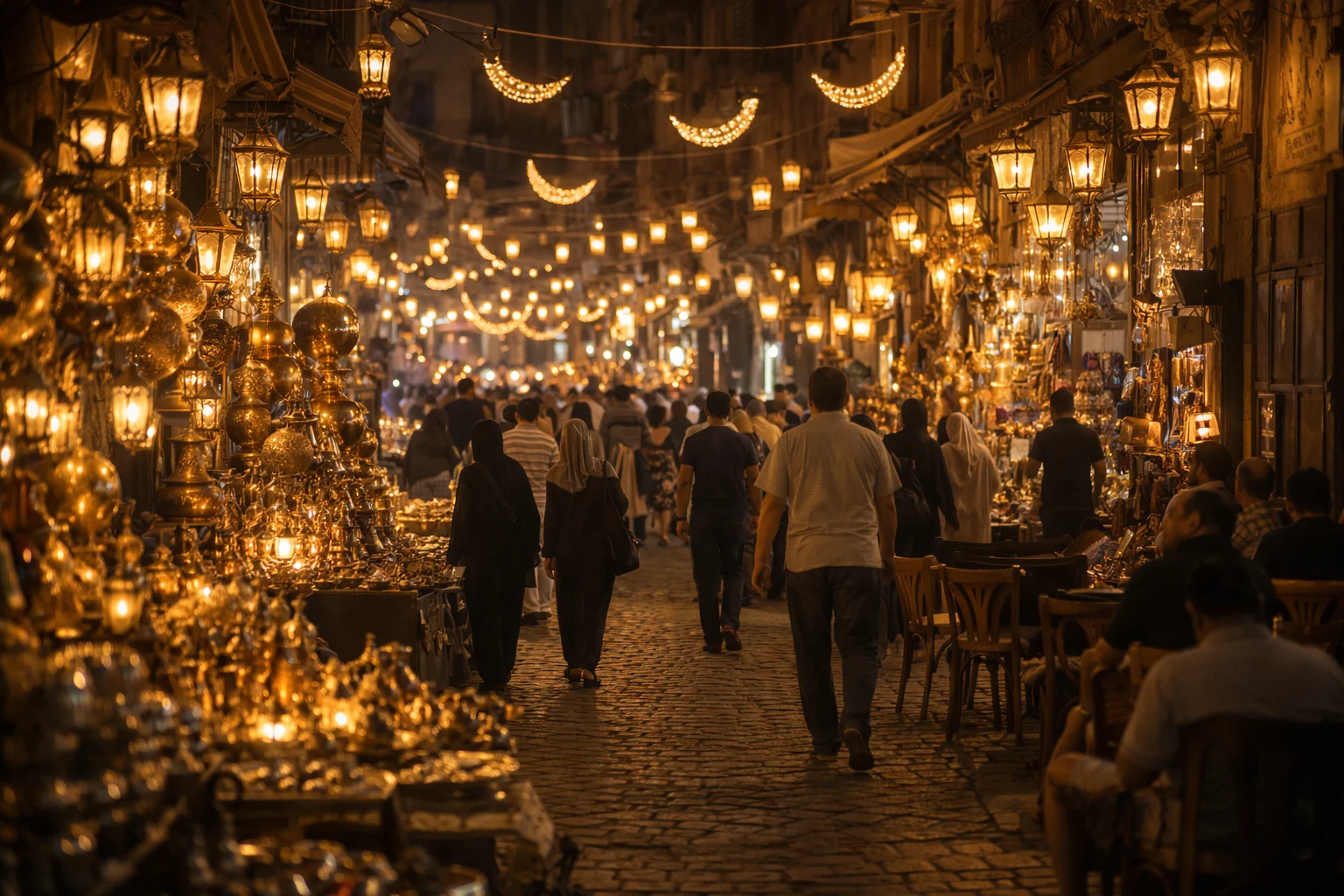
Wekalet el-Ghouri sits in a dense part of Islamic Cairo. Narrow streets, foot traffic, and evening crowds are normal—especially near Khan el-Khalili and along major historic corridors.
The simplest, first-timer-friendly approach:
-
Use ride-hailing to get close.
-
Expect the final few minutes may be on foot, depending on traffic and police/vehicle restrictions.
Helpful landmark language for drivers:
-
“Wekalet El Ghouri”
-
“Al-Azhar Street”
-
“Khan el-Khalili area”
-
“Al-Muizz Street area”
Practical time planning (no promises, just realistic thinking):
-
From Downtown / Tahrir area: often manageable, but traffic can still be heavy.
-
From Zamalek: allow extra time due to bridge traffic.
-
From Giza: plan a bigger buffer, especially around peak hours.
-
From New Cairo: allow a large buffer; distances are longer.
Table 2: Getting there options (pros/cons)
| Option | Pros | Cons | Best for |
|---|---|---|---|
| Ride-hailing (app) | Clear price estimate, less haggling, easy pickup after | Surge pricing; pickup point may be a short walk away | First-time visitors, US/UK tourists |
| Street taxi | Can be quick to find | Price negotiation risk; overcharging; language barriers | Confident negotiators, short trips |
| Guided transfer / hotel car | Less stress; door-to-door support | More expensive; needs pre-arranging | Families, anxious travellers, late-night return |
Safety note for the return trip:
-
Before the show ends, consider where you will request your pickup (a well-lit main street is better than a tiny side lane).
-
If using a taxi, agree on the price before you get in.
What to expect on the night: seating, photos, comfort, and pacing
Most evenings follow a simple rhythm:
-
Arrive, find the correct entrance area
-
Queue
-
Entry and seating
-
Performance
-
Exit with the crowd
What the venue experience can feel like:
-
Historic and atmospheric, not “polished theatre”.
-
Busier than expected in peak travel seasons.
-
Louder than you might expect in an enclosed stone courtyard.
Photography and video
-
Rules can vary by event and by staff direction.
-
A respectful approach:
-
If filming is allowed, avoid blocking views.
-
Avoid flash.
-
If told not to record, stop (arguing rarely helps and can spoil the evening).
-
Comfort tips
-
Bring a small bottle of water (if allowed).
-
Wear closed, comfortable shoes (streets can be uneven).
-
In cooler months, a light layer helps after sunset.
Dress code & etiquette for an Islamic Cairo night show
A Tanoura night is not a strict religious service, but it is a respectful cultural space in a historic Islamic Cairo setting.
Simple dress code guidance (works well for US/UK tourists):
-
Aim for modest, comfortable clothing.
-
Shoulders and knees covered is a safe default.
-
Avoid very short shorts, very low-cut tops, or party outfits.
Etiquette that keeps things smooth:
-
Keep voices low during quiet musical moments.
-
Don’t push through crowds for a better photo.
-
If locals are treating it calmly, mirror that energy.
Is it safe to go at night in Islamic Cairo?
Islamic Cairo can feel intense at night because it is busy, not because tourists are automatically unsafe. The key is to plan like you would in any crowded district in a major city.
Good safety habits (high impact, low effort)
-
Keep your phone and wallet secure (front pocket or zipped bag).
-
Stick to lit main streets when walking.
-
Don’t follow “shortcuts” through quiet alleys if you don’t know the area.
-
If someone is overly persistent, a firm “no, thank you” and walking on is usually best.
Common scams and friction points near tourist areas
-
Taxi overcharging: Agree the price first, or use ride-hailing.
-
“Helpful” strangers: Offering directions, then demanding a fee.
-
Unofficial guiding: Someone walks with you uninvited and asks for money.
-
Shop pressure: Being invited “just to look” and then pressured.
Solo travellers (including solo female)
-
Many people do visit this area, but comfort matters.
-
Consider:
-
Ride-hailing door-to-door
-
Arriving earlier (before it’s very crowded)
-
Sitting near families/couples inside the venue
-
Avoiding lingering outside after the show ends
-
Families
-
Generally suitable for families with older children who can sit quietly.
-
Bring snacks for kids before the show (not during).
Accessibility: what to realistically expect in a historic building
Wekalet el-Ghouri is a historic structure. That usually means:
-
Stairs and uneven surfaces may exist.
-
Seating may not be “soft theatre seats”.
-
Tight entry points and crowded moments are common.
If you have mobility needs:
-
Consider going early so movement is slower and easier.
-
Consider a companion for support on steps.
-
Keep expectations flexible: full step-free access may not be available in historic venues.
Pair it with Khan el-Khalili / Al-Muizz Street: a simple evening plan
This is one of the best ways to make the night feel complete without overplanning.
A calm structure that works for first-time visitors:
-
Late afternoon / early evening: Walk a main section of Al-Muizz Street (or the edges of Khan el-Khalili).
-
Early dinner: Eat before the show so you’re not searching for food at the last minute.
-
Show: Arrive early, enjoy the performance.
-
Return: Pre-plan your ride pickup.
Table 3: Do / Don’t checklist (quick safety + timing)
| Do | Don’t |
|---|---|
| Do arrive 45–60 minutes early | Don’t arrive “right at 8:00” and expect a smooth entry |
| Do carry small cash (EGP) | Don’t rely on tap-to-pay everywhere (it may vary) |
| Do use ride-hailing if unsure | Don’t negotiate a taxi price mid-journey |
| Do keep valuables zipped | Don’t put your phone in an open back pocket |
| Do stick to well-lit streets | Don’t follow strangers into side alleys |
Sample “Tanoura night” itinerary (with buffer time)
| Time (example) | Plan | Notes |
|---|---|---|
| 5:30 pm | Arrive to the broader Islamic Cairo area | Start earlier if coming from Giza/New Cairo |
| 5:45–6:45 pm | Walk a main, well-lit route near Al-Muizz Street | Keep it simple; don’t aim to “see everything” |
| 6:45–7:15 pm | Early dinner | Eat before the venue queue forms |
| 7:15 pm | Head to Wekalet el-Ghouri area | Allow for slow walking + crowd density |
| 7:15–7:45 pm | Queue + tickets (if needed) | Keep cash ready |
| 8:00 pm | Show start (confirm time close to your visit) | Times can change—check official updates |
| After | Exit with the crowd + ride home | Choose a well-lit pickup point |
Tanoura show at wekalet el ghouri review: how to decide if it’s worth it
Tanoura show at wekalet el ghouri review
People search for reviews because they want to know if this is “touristy” or truly worth the time.
A realistic way to decide:
You will probably love it if you want:
-
A cultural evening that feels connected to Cairo’s heritage
-
Live music and performance that is different from a museum visit
-
A historic setting (stone, courtyard, old Cairo atmosphere)
You might skip it if:
-
Crowds and queues stress you out
-
You need guaranteed reserved seating and strict start/finish times
-
You strongly dislike loud live music or tightly packed venues
Expectation-setting that helps:
-
Think “historic cultural night”, not “West End theatre”.
-
The venue experience is part of the package: it can be slightly chaotic, and that is normal in busy districts.
Whirling dervish show Cairo: alternatives and similar experiences
Whirling dervish show Cairo
If your dates don’t match the schedule, there are still other ways to build a cultural evening:
-
Look for other official cultural centre programmes (not third-party resellers).
-
Consider a different heritage site visit earlier in the day, then a calm dinner in a neighbourhood you know well.
If you are short on time, it’s often better to do one well-planned cultural evening than to rush multiple stops and arrive late.
Practical tips (UK/US-friendly): money, tap-to-pay, tipping, SIM/eSIM, language
Money and payments
-
Carry small cash (EGP) for tickets, small purchases, and tips.
-
Tap-to-pay may vary by venue and by device/network, so have cash as backup.
-
ATMs are common in central Cairo, but don’t leave cash withdrawal to the last minute.
Tipping (baksheesh)
-
Small tips are common in service contexts.
-
Keep a few small notes separate so you’re not flashing your full wallet.
SIM/eSIM and internet
-
Mobile data helps with ride-hailing pickups and map orientation.
-
Screenshot your pickup point and venue name in English and Arabic if possible.
Useful phrases
-
“La, shukran” (No, thank you) can reduce vendor pressure.
-
A polite but firm tone works better than debating.
Frequently Asked Questions
Tanoura show Cairo schedule
At the time of writing (February 2026), the official Cultural Development Fund announcement states the show runs at 8:00 pm on Saturday, Monday, and Wednesday. Details can change, so confirm close to your date using the official listing.
Wekalet El Ghouri Arts Center tickets
Ticket rules can change, and not every update is easy to find in English. A safe plan is to arrive early and expect to buy tickets at/near the venue with cash in EGP. Avoid unofficial sellers outside.
How early should you arrive for the Tanoura show at Wekalet El Ghouri?
Aim for 45–60 minutes early. This reduces stress, improves seating chances, and gives you time if the entrance area is crowded.
Is the Tanoura show worth it in Cairo?
For many first-time visitors, yes—especially if you want a cultural evening in Islamic Cairo that is not a museum. It is most “worth it” when you:
-
Arrive early
-
Pair it with a short, safe walk nearby
-
Keep expectations realistic (historic venue, not luxury theatre)
Can you visit without a tour?
Yes, many travellers go independently. Ride-hailing plus an early arrival is the simplest approach if you don’t want a guide.
Is it family-friendly?
Often yes for families with older children who can sit quietly and enjoy live music. For very young kids, the crowding and noise can be challenging.
Can you take photos or video?
Rules can vary by night. If recording is allowed:
-
Avoid flash
-
Don’t block views
-
Stop immediately if staff ask you to
What should you wear?
Modest, comfortable clothing is a safe choice:
-
Covered shoulders and knees (recommended)
-
Comfortable shoes for uneven streets and standing in queues
Is it safe to go at night in Islamic Cairo?
Many people do it safely, but it’s busy and can feel intense. The best approach:
-
Use ride-hailing
-
Stick to well-lit main streets
-
Keep valuables secured
-
Avoid unsolicited “help” that comes with payment pressure
What are the most common scams near the venue?
The most common issues are:
-
Taxi overcharging or “meter not working”
-
Uninvited guiding followed by a demand for money
-
Persistent vendors trying to lead you somewhere else
-
Claims that tickets are “sold out” unless you buy from them
Where exactly is Wekalet el-Ghouri?
It’s in Islamic Cairo, near the Khan el-Khalili / Al-Muizz Street area. For the exact pin, use a map app and search “Wekalet El Ghouri”.
How do you get there from Downtown Cairo?
Ride-hailing is usually easiest for first-time visitors. Add extra buffer time for traffic and expect a short walk at the end.
How do you get there from Giza?
Plan extra travel time. Leaving earlier reduces stress and lowers the risk of missing the start.
What is the difference between the monument ticket and the show ticket?
The Ministry of Tourism & Antiquities listing includes daytime opening hours and monument ticket pricing for visits. The evening show entry can be handled differently and should be treated as a separate plan.
How long is the show?
It can vary. A safe plan is to allow 2–3 hours total for the evening (arrival, queue, seating, performance, exit), rather than fixating on the exact performance length.
Should you carry cash?
Yes. Even if you use cards elsewhere, tap-to-pay may vary, and small venues can be cash-first. Carry small notes in EGP.
What is the best neighbourhood to stay in for this evening?
For easy access, many first-time visitors choose:
-
Downtown / Garden City (central)
-
Zamalek (comfortable but allow extra bridge time)
If staying far out (New Cairo), add more time and plan your return ride carefully.
Wikala of al Ghouri
A “wikala” was a commercial building supporting trade, storage, and lodging for merchants. The official monument description notes features like an open courtyard and multi-floor structure used for goods and merchant rooms.
Tanoura dance
Tanoura is a performance built around circular spinning movement with live music. It is often described in spiritual terms, but for visitors it’s best approached as a respectful cultural show.
Tanoura show at wekalet el ghouri review
If you like heritage settings, live music, and traditional performance, it’s often a highlight. If you dislike crowds, queues, or informal seating, it may feel stressful unless you arrive very early.
Whirling dervish show Cairo
This phrase is commonly used online for spinning performances. In Cairo, Tanoura is one of the best-known formats visitors attend. Always confirm the official schedule close to your visit date.
Suggested External Links
-
Cultural Development Fund (Ministry of Culture) – official Tanoura announcement/schedule
-
Ministry of Tourism & Antiquities – Discover Egypt’s Monuments: Al-Ghuri’s wikala background/history