who built the pyramids of giza It’s one of the first questions every visitor to Giza asks their guide — and one of the most persistently misunderstood facts in all of ancient history. For decades, popular culture sold us an image of whip-driven slaves dragging stone blocks under a merciless sun. Modern archaeology has overturned that picture almost entirely.
This guide answers who actually built the Pyramids of Giza — the pharaohs who commissioned them, the tens of thousands of workers who built them, and the archaeological discoveries that rewrote our understanding of pyramid construction over the past three decades.
The Short Answer
The three main Pyramids of Giza were commissioned by three pharaohs across three generations of the same Fourth Dynasty royal family:
- The Great Pyramid — built for Khufu (Cheops), c. 2600–2560 BCE
- The Pyramid of Khafre — built for Khafre (Chephren), Khufu’s son, c. 2570–2530 BCE
- The Pyramid of Menkaure — built for Menkaure (Mycerinus), Khafre’s son, c. 2510–2490 BCE
But “who built them” in the practical sense — the people who physically quarried, transported, and assembled millions of limestone blocks — were not the pharaohs themselves, but an estimated workforce of tens of thousands of organized, largely paid Egyptian laborers, supported by a sophisticated state logistics system.
The Pharaohs Who Commissioned the Pyramids
Khufu: The Great Pyramid
Khufu (known to the Greeks as Cheops) was the second pharaoh of Egypt’s Fourth Dynasty and the son of Sneferu, who had spent his own reign experimenting with pyramid design at Dahshur. Khufu inherited not just the throne but a generation’s worth of engineering lessons, which his architects — likely led by his vizier Hemiunu — applied to create the largest and most precisely engineered pyramid ever built.
Surprisingly little is known about Khufu’s personal reign and character from surviving records; most of what we know comes from the monument itself and from a small ivory statuette, the only confirmed three-dimensional image of him that survives.

Khafre: The Second Pyramid and the Sphinx
Khafre, Khufu’s son, built the second Giza pyramid — slightly smaller than his father’s but appearing taller due to its position on higher bedrock. Khafre’s complex also includes the Great Sphinx, widely believed (though not universally agreed) to bear his likeness. For the full story behind this connection, see our guide to the Great Sphinx of Giza.
Menkaure: The Third and Smallest Pyramid
Menkaure, Khafre’s son, completed the trio with a noticeably smaller pyramid, built using a distinctive combination of limestone and red granite. Some Egyptologists attribute the reduced scale to a shorter reign; others point to declining state resources by this point in the Fourth Dynasty.
For full architectural details and dimensions of all three pyramids, see our complete Pyramids of Giza facts guide.
So Who Actually Built Them? The Workers Behind the Pyramids
For most of modern history, the dominant narrative — popularized by the Greek historian Herodotus, writing roughly 2,000 years after the pyramids were built, and later cemented by Hollywood films — held that the pyramids were constructed by masses of enslaved workers. Archaeological discoveries since the late 1980s have substantially overturned this picture.
The Discovery That Changed Everything
In 1988, American archaeologist Mark Lehner, working with the Ancient Egypt Research Associates (AERA) and Egypt’s Supreme Council of Antiquities, uncovered the remains of a purpose-built settlement southeast of the pyramids, known as Heit el-Ghurab (“Wall of the Crow”) — now often called the “Lost City of the Pyramid Builders.”
This was not a slave camp. Excavations revealed a highly organized urban settlement, including:
- Long barracks-style galleries, likely housing rotating teams of workers
- Industrial-scale bakeries, capable of producing thousands of loaves of bread daily
- Breweries, producing beer that formed a standard part of workers’ rations
- Fish-processing facilities, handling large-scale preparation of Nile fish
- A royal administrative center, indicating direct state oversight of the workforce
- A dedicated medical facility, evidenced by skeletal remains showing healed fractures, successful amputations, dental treatment, and even skull surgery (trepanation)
Radiocarbon dating confirmed the settlement was active across the reigns of Khufu, Khafre, and Menkaure — meaning it directly supported the construction of all three Giza pyramids.
The Workers’ Cemetery
Just as significant as the settlement itself was the discovery of a nearby workers’ cemetery, where laborers who died during construction were buried with care — in mudbrick tombs positioned in the shadow of the pyramids they helped build. As former Egyptian antiquities chief Zahi Hawass put it, slaves “would not have prepared their tombs for eternity, as kings and queens did” — and would not have received burial sites this close to royal monuments.
Inscriptions and grave goods found in these tombs further support the conclusion that the builders were honored, organized laborers rather than coerced slaves.
How Many Workers, and How Were They Organized?
Estimates of the workforce size vary, but a commonly cited figure suggests around 10,000 laborers were active on the Giza projects at any given time, organized into rotating shifts of roughly three months each — meaning the total number of people who contributed to pyramid construction over the decades-long building campaigns was considerably larger than any single workforce snapshot.
Workers were organized into teams called phyles, further divided into smaller gangs that sometimes gave themselves identifying names recorded in graffiti found within the pyramids themselves — names like “Friends of Khufu” and “Drunkards of Menkaure,” suggesting a workforce with genuine pride, camaraderie, and even humor about their labor, rather than the demoralized image of slave gangs.
What the Workers Ate
Archaeological evidence from the workers’ settlement paints a picture of a well-fed labor force: an estimated 4,000 pounds of meat — cattle, sheep, and goats — were slaughtered daily to feed workers, alongside bread, beer, fish, fruit, and on special occasions, dates and honey normally reserved for higher-status Egyptians. This level of provisioning, consistent with a state-funded welfare and nutrition system, is difficult to reconcile with a slave-labor narrative.
Papyrus Evidence: The Diary of Merer
In 2013, French archaeologists discovered a cache of papyri at the ancient Red Sea harbor of Wadi el-Jarf — the oldest known papyri in the world. Among them was the logbook of an official named Merer, who led a team of workers transporting limestone blocks from Tura to Giza during Khufu’s reign.
Merer’s logbook describes his team receiving gifts of textiles and a diet that included poultry, fish, fruit, bread, cakes, and beer — and indicates that at least some workers were skilled, well-compensated, and operated in close coordination with royal administrative institutions, including what may have been Khufu’s own valley temple. This is some of the most direct documentary evidence available confirming that key elements of pyramid construction were carried out by organized, valued state workers rather than an anonymous slave class.
The Corvée System in Context
It’s worth understanding corvée labor a little more precisely, since it’s central to answering “who built the pyramids” accurately. Unlike chattel slavery — where people are permanently owned as property, often for life, frequently inherited across generations, and stripped of legal and social standing — corvée labor in ancient Egypt functioned more like a rotating civic obligation, similar in concept (though not identical in detail) to systems used in various forms throughout history, including military conscription or mandatory public works duty in other ancient and even some modern societies.
Workers under this system retained their names, family identities, and community ties; they rotated in and out of service on fixed terms (commonly cited as roughly three-month shifts); and crucially, they returned to their home villages and ordinary lives once their service period ended. This is a fundamentally different social and economic relationship than slavery, and it’s the distinction modern Egyptologists are careful to emphasize when discussing who actually built the pyramids.
Where Did the Workers Come From?
The pyramid-building workforce appears to have drawn from across Egypt, organized through a system known as corvée labor — a form of mandatory, rotating public service owed to the state, distinct from chattel slavery. Under this system, communities throughout Egypt were responsible for contributing workers (and supplies of food) on a rotating basis, not unlike a national mobilization or large-scale public works levy.
This system suggests pyramid-building functioned as something closer to a unifying national project — a way of organizing and demonstrating the pharaoh’s authority over the entire Egyptian state — rather than the output of a single enslaved underclass.
Alongside this rotating conscripted labor, a smaller permanent population of skilled specialists — master masons, architects, engineers, sculptors, and artists — lived at the site year-round, providing the technical expertise that rotating laborers would not have had time to develop.
The Skilled Specialists Behind the Pyramids
Beyond the rotating conscripted labor force, pyramid construction depended on a smaller, permanent population of highly skilled specialists who lived at Giza year-round and provided expertise no rotating worker could develop in a three-month shift.
Master masons and quarrymen were responsible for cutting limestone blocks to precise dimensions, using copper chisels, stone hammers, and wooden wedges soaked in water to split rock along natural fracture lines — a technique still studied by experimental archaeologists today.
Architects and engineers, almost certainly including high-ranking officials like Khufu’s vizier Hemiunu, were responsible for the overall design, surveying, and the extraordinary precision of alignment and leveling that modern engineers still find remarkable — the Great Pyramid’s base, for example, is level to within roughly 2 centimeters across its entire 230-meter length.
Sculptors and artists carved the fine relief work found in associated temples and tombs, requiring years of specialized training passed down through workshop traditions.
Surveyors, likely using simple but effective tools involving sighting instruments and astronomical observation, achieved the cardinal alignment accuracy seen across all three Giza pyramids — deviations of only fractions of a degree from true north, south, east, and west.
This combination of a large rotating general labor force and a smaller permanent specialist class mirrors how many large-scale construction projects, ancient and modern, organize their workforce — a detail that further undermines the simplistic “slave labor” narrative in favor of a far more organizationally sophisticated picture.
A Brief Timeline: From Commission to Completion
c. 2589 BCE — Khufu becomes pharaoh, inheriting both the throne and a generation of pyramid-building experimentation from his father Sneferu’s projects at Dahshur.
c. 2580s–2560s BCE — Construction of the Great Pyramid. Quarrying, transport, and construction proceed across an estimated two decades, drawing on a rotating national labor force and a permanent skilled workforce based at Giza.
c. 2570s BCE — Khafre succeeds Khufu and begins construction of the second Giza pyramid, along with the Sphinx and associated valley temple complex.
c. 2530s–2510s BCE — Menkaure succeeds Khafre, completing the third and smallest of the main Giza pyramids.
c. 2503 BCE — Menkaure’s death, marking the end of the primary Giza pyramid-building phase, though smaller satellite pyramids and tombs continued to be added by later officials and family members.
1988 CE — Mark Lehner’s excavation of Heit el-Ghurab begins the modern archaeological process of recovering the true identity and living conditions of the pyramid builders, a process that continues with ongoing excavation and research today.
2013 CE — Discovery of the Wadi el-Jarf papyri, including the diary of the official Merer, provides the most direct documentary evidence yet of how skilled, organized workers participated in Khufu’s construction project.
How Were the Blocks Actually Moved and Raised?
While the identity and treatment of the workforce is now reasonably well understood, the precise engineering methods used to move and raise multi-ton stone blocks remain genuinely debated among Egyptologists.
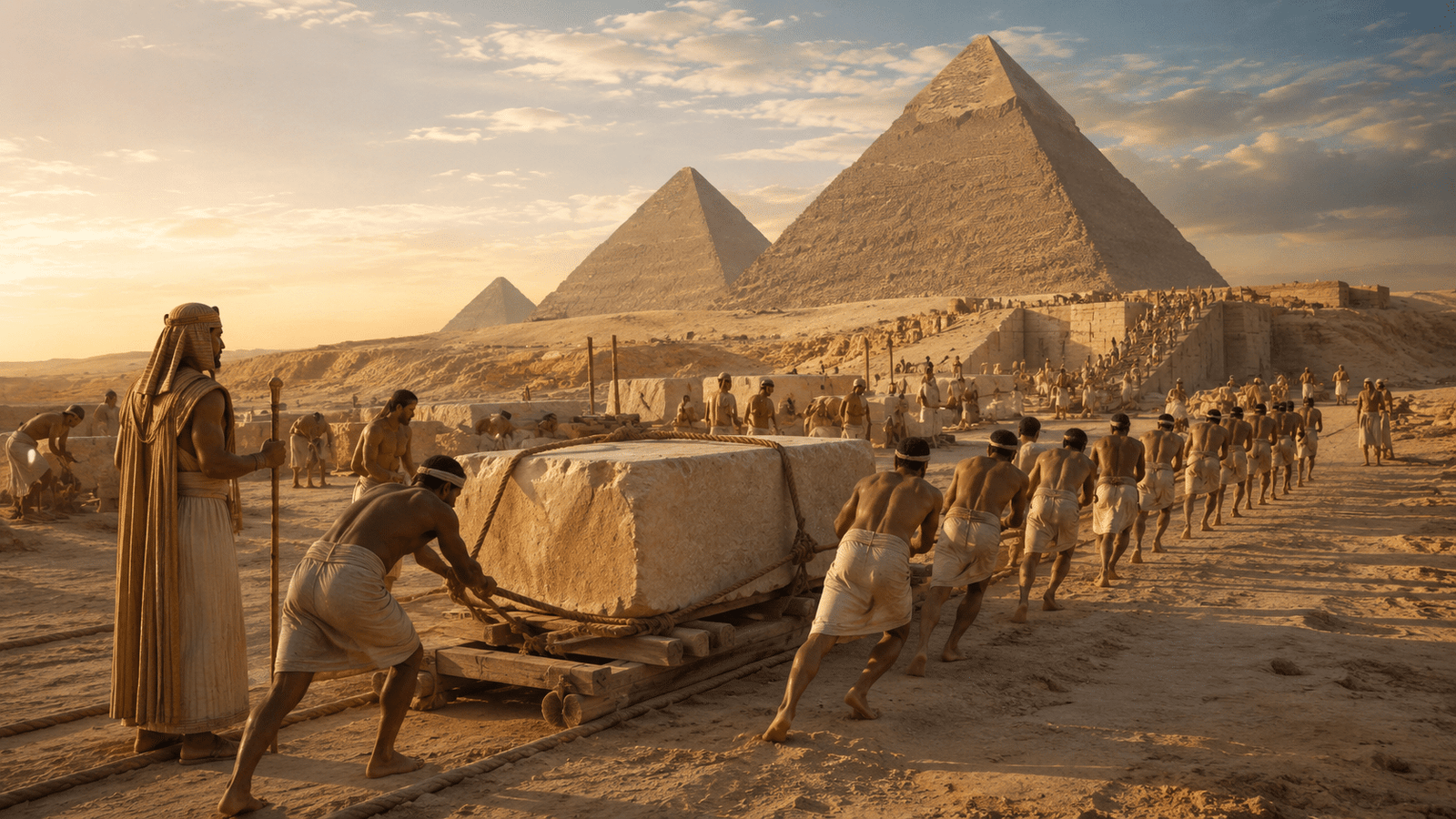
What’s well established: workers used a combination of ramps, sledges, levers, and what was likely a system of wetting sand in front of sledges to reduce friction — a technique depicted in ancient Egyptian tomb art and confirmed by modern experimental archaeology. Recent research has also confirmed that a Nile-connected harbor and canal system played a central role, allowing limestone blocks quarried at Giza and across the river at Tura to be transported efficiently close to the construction site by boat.
What remains debated is the specific ramp configuration used to raise blocks to increasing heights as the pyramids grew taller — whether through a single straight ramp, a spiraling exterior ramp, an internal ramp system, or some combination of these. For a complete breakdown of the competing construction theories, see our dedicated guide: How Were the Pyramids of Giza Built?
Common Myths About Who Built the Pyramids
Myth: Slaves, including enslaved Israelites, built the pyramids. No archaeological or documentary evidence supports this claim, and the chronology doesn’t align — the Giza pyramids were built roughly a thousand years before the traditional dating of the biblical Exodus narrative. This myth largely originates from Herodotus’s account, written around 450 BCE, more than two thousand years after construction, and was later amplified by 20th-century film.
Myth: A lost or extraterrestrial civilization built the pyramids, because ancient Egyptians “couldn’t have” achieved this level of engineering. This claim has no supporting archaeological evidence and is generally regarded by Egyptologists as dismissive of the well-documented, gradual evolution of Egyptian engineering — from early mastabas, through Djoser’s Step Pyramid at Saqqara, through Sneferu’s experimental pyramids at Dahshur, culminating in the Giza pyramids.
Myth: A single pharaoh built all three Giza pyramids. In fact, the three main pyramids were built by three different pharaohs — Khufu, his son Khafre, and his grandson Menkaure — across roughly three successive generations.
Myth: The workers lived and died in miserable conditions with no support. Archaeological evidence — including organized housing, large-scale food production, medical care including successful surgery, and honored burial near the pyramids — point to a structured, state-supported workforce, not a population subjected to neglect or abuse.
Visiting the Pyramids and Workers’ Settlement Today
The main Giza pyramids and the Sphinx remain open to visitors year-round, and represent the centerpiece of any Cairo itinerary. The workers’ settlement at Heit el-Ghurab, while an active archaeological site of major historical significance, is generally not part of the standard visitor circuit and access can be limited — ask your guide about current visiting options if this aspect of pyramid history particularly interests you.
For the practical details of visiting the pyramids themselves — tickets, hours, and the best times to visit — see our complete Pyramids of Giza facts guide.
🏛️ Want the full story behind the Pyramids of Giza, told by an expert? Pure Nile Tours’ private Egyptologist-guided tours go beyond the standard visitor circuit, covering the real history of who built these monuments and how — informed by the latest archaeological research. Book a Private Pyramids Tour →
Frequently Asked Questions
Were the Pyramids of Giza built by slaves?
No. Modern archaeological evidence — including a purpose-built workers’ settlement, organized labor gangs, honored burials near the pyramids, and well-documented food and medical provisions — strongly indicates the pyramids were built by an organized, largely paid Egyptian workforce, not enslaved laborers.
Who specifically built the Great Pyramid?
It was commissioned by Pharaoh Khufu and likely designed by his vizier Hemiunu. The physical construction was carried out by an estimated workforce of around 10,000 rotating laborers at any given time, supplemented by permanent skilled craftsmen.
How long did it take to build the Pyramids of Giza?
Estimates for the Great Pyramid alone suggest roughly 20 years of construction, though estimates vary among researchers. Combined, the three main Giza pyramids were built across a period of approximately 80–100 years.
Where did the pyramid workers live?
Archaeological excavations at Heit el-Ghurab (“Lost City of the Pyramid Builders”), southeast of the pyramids, uncovered a substantial purpose-built settlement including housing, bakeries, breweries, and medical facilities supporting the workforce.
Were the workers paid?
Workers were compensated primarily through provisions — food (including regular meat, bread, and beer), housing, and medical care — rather than currency in the modern sense, consistent with the broader Egyptian economic system of the period, which operated largely without coined money.
Why did Herodotus claim the pyramids were built by forced, oppressed labor?
Herodotus visited Egypt and wrote his account around 450 BCE — roughly 2,000 years after the pyramids were built — relying on local oral traditions of uncertain reliability rather than firsthand knowledge or contemporary records, which likely explains the discrepancy with modern archaeological evidence.
Final Thoughts
The question of who built the Pyramids of Giza has two true answers, both worth knowing. In the official sense, they were commissioned by three pharaohs — Khufu, Khafre, and Menkaure — across three generations of ambition and engineering refinement. In the human sense, they were built by tens of thousands of organized, fed, housed, and largely respected Egyptian laborers, working in rotating shifts as part of one of the largest coordinated state projects in human history.
That the dominant popular image of pyramid-building — chained slaves under the whip — has been so thoroughly overturned by modern archaeology is itself one of the more remarkable correction stories in Egyptology, and it’s worth carrying that fuller, more accurate picture with you when you stand at the base of the Great Pyramid for the first time.
🏛️ Ready to see the Pyramids of Giza and learn the real story behind their construction? Pure Nile Tours offers private Egyptologist-guided tours that bring the latest archaeological research to life on-site. Explore Private Pyramids Tours →