The MS Le Fayan Nile Cruise is one of the most highly rated 5-star floating hotels on Egypt’s Upper Nile. Fifty-seven deluxe cabins with floor-to-ceiling panoramic windows, three luxury suites with private jacuzzis, a spa, gym, fine dining restaurant, and complimentary Wi-Fi set the Le Fayan Nile Cruise ship apart from standard 5-star competitors on the same Luxor–Aswan route. Three sailing schedules — 4 nights from Luxor, 3 nights from Aswan, and a 7-night extended cruise — cover every major Upper Egypt temple site. Here is everything you need to know before booking.
MS Le Fayan Nile Cruise at a Glance
| Detail | Info |
|---|---|
| Ship name | MS Le Fayan Nile Cruise |
| Star rating | 5-star ultra-deluxe |
| Route | Luxor ↔ Aswan (Upper Egypt) |
| Total decks | 5 decks |
| Deluxe cabins | 57 (floor-to-ceiling panoramic windows) |
| Luxury suites | 3 (private jacuzzi, living room, dining area) |
| Sailing schedules | 4N/5D from Luxor (Monday); 3N/4D from Aswan (Friday); 7N/8D extended |
| Meal plan | Full board (breakfast, lunch, dinner) |
| Guide | Licensed Egyptologist on all excursions |
| Spa & gym | Yes — spa with treatments, gym with professional equipment |
| Wi-Fi | Complimentary throughout |
| Price range | $80–$130/night per person low season; $110–$180/night high season |
| Best season | October–April |
| Key sites | Karnak, Luxor Temple, Valley of the Kings, Hatshepsut, Edfu, Kom Ombo, Philae, High Dam, Unfinished Obelisk |
| Abu Simbel | Optional add-on from Aswan |
Exchange rates fluctuate — verify current rates before travel.
What makes the MS Le Fayan Nile Cruise ship stand out:
- Complimentary Wi-Fi throughout the ship — unusual at 5-star Nile cruise level where most ships charge for internet
- 3 private jacuzzi suites — each with its own living room, dining area, and floor-to-ceiling windows; Suite 555 is the largest
- Spa and high-spec gym — Precor commercial equipment confirmed by guest reviews; uncommon on ships at this price point
- Outside dining option on deck — a distinct feature, as most Nile cruise ships offer only indoor restaurant dining
- 5 decks — more deck space than the average 4-deck 5-star ship, translating to better sun deck capacity
⚠️ Safety Notice
At the time of writing, the Luxor–Aswan Nile cruise corridor is safe for tourists on organised itineraries. Western government travel advisories classify Upper Egypt’s tourist route as requiring normal vigilance. Always check your government’s official advisory before booking.
- 🇬🇧 UK: FCDO Travel Advice — Egypt
- 🇺🇸 USA: US State Department — Egypt
- 🇦🇺 Australia: Smartraveller — Egypt
What Is the MS Le Fayan Nile Cruise Ship?
The MS Le Fayan is a modern 5-star ultra-deluxe Nile cruise ship built to a higher specification than the standard 5-star ships that dominate the Luxor–Aswan route. While most Nile cruise ships in the 5-star bracket carry 60–75 cabins on 4 decks with identical facilities, the Le Fayan Nile Cruise ship runs 60 total rooms across 5 decks, adds a spa and professional gym, offers complimentary Wi-Fi, and includes 3 suites with private jacuzzis — features that push it clearly above the standard 5-star category.
The ship departs Luxor every Monday (4-night schedule) and Aswan every Friday (3-night schedule). A 7-night extended sailing from Luxor is available for travellers who want additional time in Aswan. All sailings include full-board meals and a licensed Egyptologist guide on every temple excursion. The Le Fayan Nile Cruise — Luxury Nile Cruise Between Luxor & Aswan page at Pure Nile Tours has current departure dates, cabin availability, and pricing.
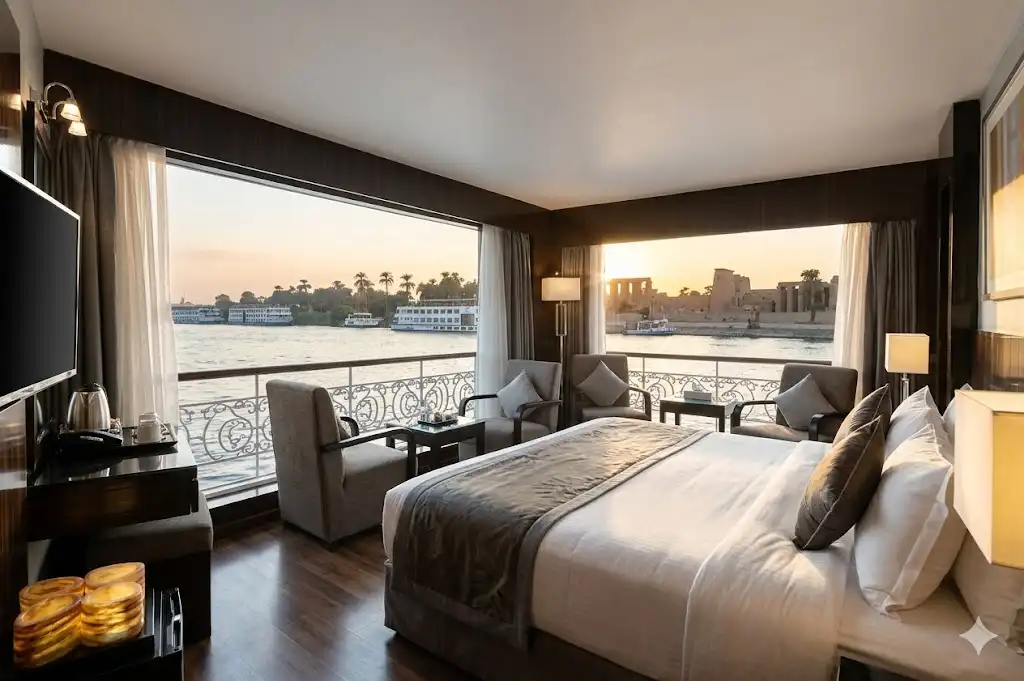
Le Fayan Nile Cruise Ship — Cabins & Suites
Deluxe Cabins
The MS Le Fayan Nile Cruise carries 57 deluxe cabins configured in twin and double bed formats. Each cabin measures on the larger side for the Nile cruise category — the defining feature is the floor-to-ceiling panoramic window that opens, giving a direct, unobstructed Nile view from the bed. This is not universal on Nile cruise ships: many standard 5-star competitors use fixed portholes or half-height windows on lower decks.
Standard inclusions in every deluxe cabin: individual air conditioning (cold and warm), LCD flat-screen TV with satellite channels, mini-bar, in-room safe (complimentary), direct-dial telephone, music channels, en-suite bathroom with bathtub and shower, hairdryer, make-up mirror, and shaving socket. Complimentary Wi-Fi reaches all cabins — no surcharge for internet access, unlike most ships in the same class. The balcony or sitting area adjacent to the panoramic window adds a private outdoor element to standard cabin bookings.
| Cabin Feature | MS Le Fayan Standard |
|---|---|
| Window type | Floor-to-ceiling panoramic (openable) |
| A/C | Individual control (cold & warm) |
| Bathroom | Bathtub + shower, white marble |
| Wi-Fi | Complimentary |
| Safe | Complimentary |
| Balcony/sitting area | Yes |
| Mini-bar | Yes |
| TV | LCD satellite |
Luxury Suites & Suite 555
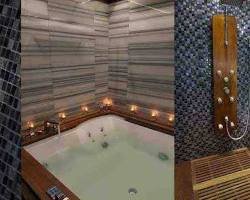
The MS Le Fayan Nile Cruise ship carries 3 luxury suites — the most distinctive accommodation on the ship. Each suite includes a separate living room with lounge chairs, a private dining area, a large flat-screen LCD television, floor-to-ceiling windows, mini-bar, electronic safe, multiple closets, and a modern white marble and wood bathroom with a multi-head shower and private jacuzzi.
Suite 555 is the largest of the three. It adds a full dining table (seated meals in the suite are possible), a dark blue mosaic-tiled shower, and an expanded jacuzzi. The suite format makes the Le Fayan Nile Cruise ship the right choice for honeymooners, anniversary travellers, and anyone who wants a Nile experience that extends beyond the cabin into a proper living space. Room service is available for suite guests; the private jacuzzi operates during all sailing and docked periods. Suites sell out earliest on peak departures — book 3–4 months ahead for December and January.
Dining on the MS Le Fayan Nile Cruise
The Le Fayan Nile Cruise ship runs two distinct dining formats simultaneously: a fine dining restaurant with prix-fixe menus for set meals and a breakfast buffet, and an outside dining option on deck for guests who prefer to eat with the Nile as their backdrop rather than indoors. This dual format is genuinely uncommon on the Luxor–Aswan cruise circuit.
Three meals are included daily in the full-board package. Breakfast (07:00–09:30) runs as an open buffet: eggs cooked to order, warm bread baked on board, Egyptian ful medames, fresh fruit, cheese, and cold cuts. Lunch is the main meal — a combination of Egyptian and international dishes, with a hot section and cold section running simultaneously. Dinner follows a prix-fixe structure in the main restaurant or a relaxed buffet depending on the evening programme.
The food quality on the Le Fayan receives consistent positive feedback in guest reviews — “delicious with plenty of variety” and “unexpectedly good” are phrases that appear repeatedly across multiple verified travel platforms. Egyptian nights, where the kitchen prepares a full traditional Egyptian menu, consistently earn the highest ratings of any individual meal service on board. For a broader guide to Egyptian cuisine, Top 7 Egyptian Cuisines to Try covers the full range of dishes you’ll encounter on and off the ship.
Drinks — soft drinks, alcohol, juices, and hot beverages beyond the included water and tea — are charged separately at the bar. Budget approximately EGP 150–300 per person per day for drinks if you consume alcohol; EGP 50–100 for water and non-alcoholic beverages.
Le Fayan Nile Cruise Ship Facilities
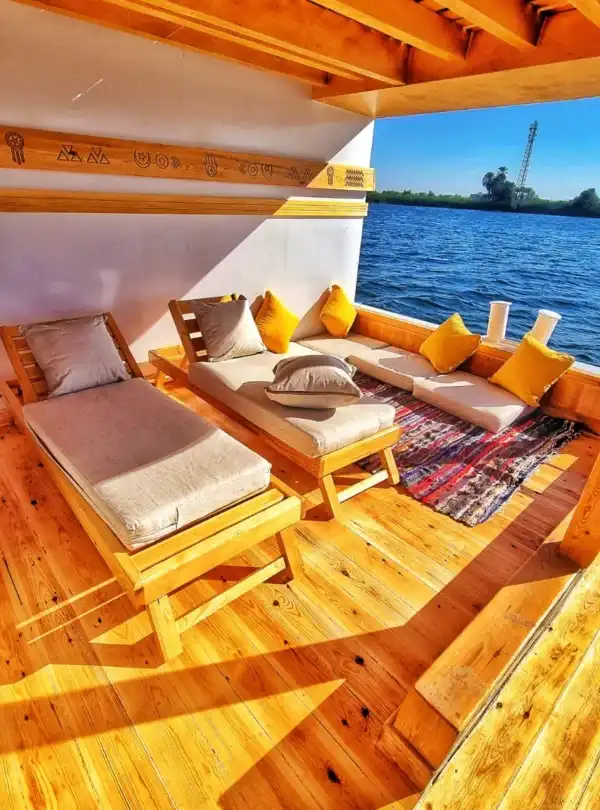
The MS Le Fayan Nile Cruise ship offers a facility set that exceeds the standard 5-star Nile cruise specification. Five decks provide more usable space per passenger than the typical 4-deck ship; the sun deck sits on the top floor with a swimming pool, sun loungers, and a bar.
Spa: The Le Fayan’s spa offers a range of massage and treatment options — guest reviews specifically mention positive experiences with the spa staff and the quality of treatments relative to what is available elsewhere in Luxor and Aswan. The spa operates by appointment; book your preferred treatments at embarkation to secure a slot on sailing days.
Gym: The Le Fayan carries a small but properly equipped gym fitted with Precor commercial-grade equipment — treadmills, ellipticals, and free weights. This is the detail that separates the Le Fayan from most Nile cruise ships, where the “gym” is typically a single treadmill and a resistance machine. Confirmed by multiple independent guest reviews.
Sun deck and pool: The top-deck pool is standard Nile cruise size, but the 5-deck structure means the surrounding sun deck area is proportionally larger. Outside dining on the deck makes the top deck functional for meals as well as relaxation.
Wi-Fi: Complimentary throughout the ship — in cabins, public areas, and the sun deck. This is a meaningful differentiator: at most 5-star Nile cruise ships, Wi-Fi is either charged by the hour or only available in the main reception area.
Entertainment: Evening programme includes Egyptian folkloric performances, a galabeya (traditional dress) party, and cultural presentations. For guidance on planning a Nile cruise itinerary from Luxor or Aswan, Crafting the Perfect Nile Cruise Itinerary covers route options, ship types, and what to expect.
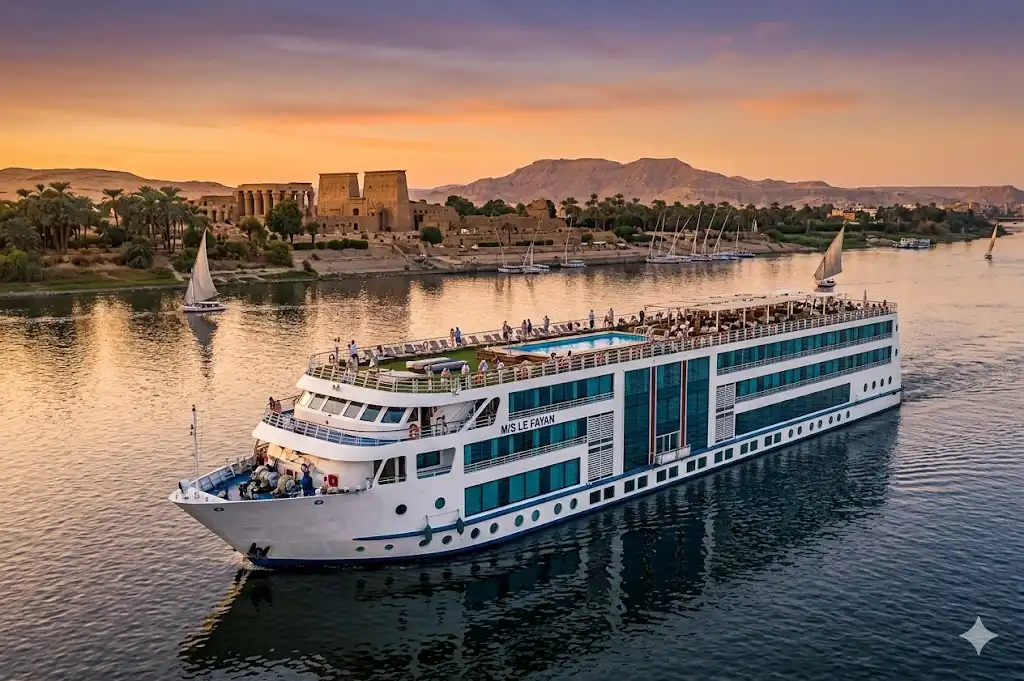
MS Le Fayan Nile Cruise Itinerary
4 Nights / 5 Days from Luxor (Every Monday)
The Luxor-departure sailing is the flagship schedule for the MS Le Fayan Nile Cruise — the most complete itinerary, covering the largest number of sites in the most logical geographic sequence. The ship departs Luxor every Monday and arrives in Aswan on Friday morning.
| Day | Location | Sites |
|---|---|---|
| Day 1 (Monday) | Luxor — embarkation | Check in from noon, lunch on board, Luxor Temple, Karnak Temple |
| Day 2 (Tuesday) | Luxor West Bank | Valley of the Kings (3 tombs), Hatshepsut Temple, Colossi of Memnon |
| Day 3 (Wednesday) | Edfu & Kom Ombo | Temple of Horus at Edfu, Kom Ombo double temple |
| Day 4 (Thursday) | Aswan | Philae Temple, Aswan High Dam, Unfinished Obelisk, optional Nubian village |
| Day 5 (Friday) | Aswan — disembarkation | Check out by 09:00, transfer to airport/station; optional Abu Simbel |
Day 1 — Embarkation in Luxor: Check-in opens at noon. Lunch is served on board before the afternoon excursion to Luxor Temple — a massive open-air complex on the East Bank, connected to Karnak by the 3 km Avenue of Sphinxes, fully excavated and lit at night. Karnak follows in the late afternoon: the Hypostyle Hall’s 134 columns, the tallest reaching 23 m, are best visited before 09:00 or after 17:00. The Monday timing of the Le Fayan’s Luxor departure hits the late afternoon window for Karnak — cooler, better light, fewer visitors.
Day 2 — Luxor West Bank: The Valley of the Kings standard admission covers 3 tombs from those currently open. The tomb of Ramesses VI has the most complete ceiling paintings; Seti I’s tomb (when accessible) has the most detailed reliefs in the valley. Tutankhamun’s tomb requires a separate ticket (EGP 800) — the burial chamber is compact; the famous objects are now at Cairo’s Grand Egyptian Museum. The funerary temple of Hatshepsut at Deir el-Bahari follows: three colonnaded terraces cut into a cliff face around 1480 BCE, among the most precisely constructed structures in Upper Egypt.
Day 3 — Edfu & Kom Ombo: The Le Fayan Nile Cruise ship sails south overnight and docks at Edfu by morning. The Temple of Horus at Edfu is the best-preserved ancient temple in Egypt — both entrance pylons standing, the inner sanctuary’s original granite naos intact, built 237–57 BCE. Budget 60–75 minutes. The ship continues to Kom Ombo for the afternoon: a double temple on the Nile bank dedicated simultaneously to the crocodile god Sobek and the falcon god Haroeris. The Crocodile Museum adjacent to the main temple displays 300+ mummified crocodiles. Dinner on board; overnight sail to Aswan.
Day 4 — Aswan: Philae Temple on Agilkia Island — a 5-minute motorboat ride from Shellal dock — is the main temple stop. Dedicated to the goddess Isis, relocated stone by stone between 1972 and 1980 to save it from Lake Nasser. The reliefs retain significant original paint in sheltered interior spaces. The Aswan High Dam (3.6 km wide, completed 1971) and the Unfinished Obelisk (42 m long, still lying in the granite bedrock of the ancient quarry) complete the morning. Afternoon: optional Nubian village visit or a felucca sailing on the Nile among Aswan’s granite outcrops.
Day 5 — Disembarkation: Check-out by 09:00. Transfer to Aswan airport or train station. Guests who pre-booked Abu Simbel depart at approximately 06:00 by 45-minute domestic flight, visit both temples, and return by noon. For full Abu Simbel visitor logistics, Abu Simbel Temples: Practical Visitor Guide from Aswan covers entry fees, best arrival times, and the flight vs. road options.
3 Nights / 4 Days from Aswan (Every Friday)
The reverse itinerary — boarding in Aswan on Friday and arriving in Luxor on Monday — covers the identical temple sites in reverse order: Philae and the High Dam on Day 1, Kom Ombo and Edfu on Day 2, Valley of the Kings and Hatshepsut on Day 3, Karnak and Luxor Temple on the final morning before disembarkation.
The 3-night format suits travellers flying into Aswan first (perhaps arriving via Abu Simbel or directly from Cairo), or those connecting to a Luxor flight home after the cruise ends. Valley of the Kings time is slightly compressed in this format — one fewer sailing night means a tighter schedule on the West Bank morning. For the standalone Aswan-start itinerary, 3 Nights Nile Cruise from Aswan to Luxor covers the programme and logistics.
7 Nights / 8 Days Extended Cruise (from Luxor)
The 7-night sailing from Luxor provides 3 full days in Aswan rather than one — enough time for Abu Simbel as a relaxed morning excursion (no predawn sprint), a half-day in the Nubian village, a felucca afternoon, and time to walk Aswan’s spice souk without rushing back to the ship. This format also allows an additional day in Luxor at the start for travellers who want to visit both banks in depth rather than covering the West Bank in a single morning. The Le Fayan Nile Cruise page covers the extended sailing schedule and availability.
Temple Sites on the Le Fayan Cruise Route
Karnak Temple & Luxor Temple
Karnak Temple Complex covers 200 acres on Luxor’s East Bank — the largest ancient religious complex ever built. Construction ran from approximately 1550 BCE into the Ptolemaic period, with every pharaoh who reigned adding a hall, a pylon, or a pair of obelisks. The Hypostyle Hall: 134 papyrus-form columns, the largest reaching 23 m, covering 5,000 m². Arrive before 09:00 or after 17:00 for the best conditions. The adjacent Sacred Lake gives a different perspective on the complex’s scale from water level.
Luxor Temple sits at the river’s edge, 3 km south of Karnak, connected by the restored Avenue of Sphinxes. Built by Amenhotep III and extended by Ramesses II (14th–13th century BCE), the temple was partially buried under a medieval city for centuries; a mosque built in 1279 CE still stands inside the complex at upper-floor level. The temple is lit at night — walking the avenue after 19:00 is the most atmospheric experience available in Luxor.
Valley of the Kings & Hatshepsut Temple
The Valley of the Kings on Luxor’s West Bank holds 63 royal tombs cut into limestone cliffs. Standard admission (EGP 360) covers 3 tombs; your Egyptologist guide advises on which are currently open and worth visiting. The tomb of Ramesses VI has the most complete astronomical ceiling; the tomb of Thutmose III is the most difficult to reach but the most intimate in scale. Tutankhamun’s tomb (EGP 800 separate) is historically significant but spatially modest — the objects are at the Grand Egyptian Museum in Cairo.
The funerary temple of Hatshepsut at Deir el-Bahari is architecturally striking — three colonnaded terraces rising against a sheer cliff face, built around 1480 BCE. Hatshepsut was one of Egypt’s rare female pharaohs, ruling as pharaoh rather than regent for approximately 20 years. The painted reliefs along the lower colonnade depict a trading expedition to the Land of Punt (modern-day Somalia or Eritrea). The Colossi of Memnon — two 18 m quartzite statues of Amenhotep III — are a brief stop on the return drive; no entrance fee required.
Edfu & Kom Ombo
The Temple of Horus at Edfu (237–57 BCE) is the most complete ancient temple in Egypt. Both entrance pylons stand intact to full height; the forecourt, two hypostyle halls, and the inner sanctuary with its original granite naos are all accessible. The large granite Horus falcon at the entrance is the most reproduced image from the site. Budget 60–75 minutes — the site is large and the decoration detailed enough to reward slow walking.
Kom Ombo is architecturally unique: a double temple with two complete sets of rooms, two deity dedications (Sobek the crocodile god on one side, Haroeris the falcon god on the other), and two sanctuary axes running parallel. Built 180–47 BCE on a Nile bend with direct river views from the courtyard. The Crocodile Museum (adjacent, free with temple entry) holds over 300 mummified crocodiles excavated from the site — direct physical evidence of the Sobek cult’s practice.
Philae Temple, High Dam & Unfinished Obelisk
Philae Temple on Agilkia Island is the final classical Egyptian temple built — construction and decoration continued into the 3rd century CE. Relocated stone by stone between 1972 and 1980 by UNESCO to save it from rising Lake Nasser waters. The temple’s reliefs are among the sharpest in Egypt in sheltered interior spaces; the island setting with the Nile visible on all sides is one of the most distinctive on the entire cruise route. Reached by 5-minute motorboat from the Shellal dock.
The Aswan High Dam (3.6 km wide, 111 m tall) was completed in 1971 after 11 years of construction. It created Lake Nasser, impounded the Nile’s annual flood, and provided Egypt with 10–40% of its national electricity production for the following two decades. The Unfinished Obelisk remains in the Aswan granite quarry where it was abandoned — 42 m long, the largest obelisk ever attempted. The hairline crack that halted its cutting is visible on the upper surface; the site gives a clearer picture of ancient quarrying technique than any museum exhibit.
Abu Simbel (Optional Add-On from Aswan)
Abu Simbel sits 280 km south of Aswan — two rock-cut temples commissioned by Ramesses II around 1264 BCE, relocated 65 m uphill between 1964 and 1968 in one of the largest archaeological rescue operations in history. The Great Temple’s four 20-metre seated colossi guard the entrance; the inner sanctuary is aligned to catch sunlight on 22 February and 22 October — the dates of Ramesses II’s coronation and birthday according to ancient Egyptian reckoning. The optional excursion from Aswan departs at approximately 06:00 by 45-minute domestic flight and returns by noon; cost approximately $80–$120 per person.
How to Book the MS Le Fayan Nile Cruise
The MS Le Fayan Nile Cruise books through Pure Nile Tours as a standalone cruise or as part of a combined Egypt package with Cairo. The Le Fayan Nile Cruise — Luxury Nile Cruise Between Luxor & Aswan page shows current departure dates, cabin and suite availability, and pricing for the 4-night, 3-night, and 7-night schedules.
Confirm before booking:
- Sailing direction and start city (Luxor Monday or Aswan Friday)
- Room type: Deluxe Cabin (twin or double) or Luxury Suite (Suite 555 for the largest)
- Abu Simbel optional excursion — book at the same time as the cruise, not on board
- Dietary requirements for the dining team
- Spa treatments — pre-book at embarkation for sailing-day slots
- Airport or train station transfer arrangements
A 20–30% deposit confirms the booking; the balance is due before travel. Suites and the 7-night sailing sell out earliest — book 3–4 months in advance for December and January departures. Peak season cabins follow at 8–12 weeks. For a market-wide comparison of Nile cruise pricing by ship category, Nile Cruise Luxor to Aswan Prices 2026 gives the full context.
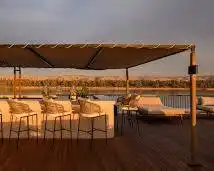
Le Fayan Nile Cruise Prices & What’s Included
The MS Le Fayan operates at the upper end of the 5-star Nile cruise price range. Deluxe cabin rates run approximately $80–$130 per person per night in low season (May–September) and $110–$180 per person per night in high season (October–April). The 4-night sailing costs approximately $440–$900 per person for the cabin. Suites carry a significant premium above the cabin rate.
Included in the cruise price (when booked through Pure Nile Tours):
- Full-board meals (breakfast, lunch, dinner — indoor and outdoor dining)
- Licensed Egyptologist guide on all standard excursions
- All temple entrance fees on the standard itinerary
- Motorboat transfer to Philae Temple
- Airport/train station transfers in Luxor and Aswan
- Complimentary Wi-Fi throughout the ship
- Evening entertainment (galabeya party, folkloric performances)
Not included:
- Abu Simbel excursion (~$80–$120 per person, optional)
- Drinks beyond included water at meals (bar drinks billed separately)
- Spa treatments (charged per session)
- Tips for Egyptologist guide, driver, and cruise crew ($10–$15 per person per day)
- Tutankhamun’s tomb entry (EGP 800, optional at Valley of the Kings)
- Hot air balloon over Luxor (~$70–$120 per person, optional)
- Personal laundry
Exchange rates fluctuate — verify current rates before travel.
Best Time to Sail on the Le Fayan Nile Cruise
October through April is the primary sailing window for comfortable outdoor excursions. November to February gives the most stable conditions: Luxor daytime highs of 22–26°C, Aswan 24–28°C. The Valley of the Kings, Karnak, and Edfu are walkable at any time of day in these months without heat management becoming the dominant concern.
December and January are peak season — the Le Fayan’s suites sell out 3–4 months ahead, and deluxe cabins follow at 8–12 weeks. March and October offer a useful middle position: warm enough for the sun deck and pool (26–32°C), with shorter booking lead times than peak winter. April sees demand spikes during European and North American spring school holidays.
May through September: Aswan and Luxor temperatures reach 38–43°C by midday. Temple excursions run 06:00–10:00 to avoid the worst heat. Prices drop 15–25%; the spa and air-conditioned cabins become central to the experience rather than supplementary. For a month-by-month breakdown of Egyptian weather and what it means for cruise planning, Best Months to Visit Egypt: Weather, Crowds & Travel Tips covers the full annual picture.
MS Le Fayan vs Other 5-Star Nile Cruise Ships
The Nile carries approximately 300 cruise ships between Luxor and Aswan; the temple itinerary is standardised across the fleet. The differentiators at the premium level come down to cabin quality, spa and gym provision, Wi-Fi access, suite format, and food quality. The MS Le Fayan Nile Cruise ship scores highly across all five:
| Feature | MS Le Fayan | Standard 5-star competitor |
|---|---|---|
| Wi-Fi | Complimentary throughout | Usually charged; often reception-area only |
| Suites | 3 with private jacuzzis | 0–2, rarely with private jacuzzi |
| Spa | Full treatments, positive reviews | Often sauna only |
| Gym | Precor commercial equipment | Typically 1–2 pieces |
| Outside dining | Yes — deck dining option | Rare |
| Decks | 5 | Usually 4 |
| Cabin windows | Floor-to-ceiling, openable | Often fixed, half-height |
Against ultra-luxury alternatives: the Dahabiya sailboat (8–16 passengers, $350–$600+/night) offers fewer passengers and a slower pace at a significantly higher price point. The Le Fayan sits between standard 5-star and Dahabiya — luxury amenities at a manageable price, with a passenger count (60 rooms) that keeps the experience more intimate than larger 75–100-cabin ships.
Other Nile Cruise Options from Pure Nile Tours
If the MS Le Fayan Nile Cruise ship doesn’t match your specific dates, budget, or preference, Pure Nile Tours offers several alternatives on the same Luxor–Aswan route:
Radamis I Nile Cruise — Luxury Nile Cruise Between Luxor & Aswan — 72 deluxe cabins and 4 suites, with 8 connected cabins ideal for families. Strong option for groups of 4+ who need adjacent private rooms.
A Sara Nile Cruise — 5-Star Between Luxor & Aswan — 66 deluxe cabins, all above the waterline, with an on-board doctor. Good mid-range 5-star option for first-time cruisers who want medical coverage as part of the package.
Jaz Crown Jewel Nile Cruise — the most upmarket option in the Pure Nile Tours fleet on this route. Smaller passenger count, superior cabin finish, more curated excursion programme.
Dahabiya Nile Sailing Cruise — 5 Days / 4 Nights Luxor to Aswan — traditional wooden sailing boat, 8–16 passengers maximum, a fundamentally different pace and atmosphere. The right choice for small groups who want the Nile without the floating-hotel format. For a guide to choosing between cruise types and schedules, Crafting the Perfect Nile Cruise Itinerary walks through the decision.
Tips for First-Time Nile Cruise Passengers
Arrive the day before embarkation. International connections to Luxor or Aswan typically route through Cairo, adding a transit segment. A buffer night in the embarkation city protects against delays and avoids a rushed check-in.
Pre-book the spa. The Le Fayan’s spa fills quickly on sailing days, when passengers have downtime between excursions. Book your preferred treatments at check-in — don’t wait until you’re underway to ask. The spa desk is open from embarkation day.
Use the outside dining option. The Le Fayan’s on-deck dining is a standout feature — breakfasting or lunching with the Nile riverbank moving past at eye level is a different experience from the indoor restaurant. Ask the dining team at embarkation which meals are available outdoors.
Carry EGP cash for on-site extras. Entrance fee top-ups (Tutankhamun’s tomb, Abu Simbel), souvenir purchases, and toilet fees at the temples require Egyptian pounds. ATMs at Aswan and Luxor airports dispense EGP at better rates than ship-side exchange desks.
Dress for religious sites. Philae Temple, Karnak, and Luxor Temple all have dress codes: shoulders and knees covered for women; long trousers required inside mosques on any optional city visit. Carry a loose scarf in your daypack — it handles all situations. For cultural etiquette in Egypt including photography rules and market conduct, the full guide covers what to expect at each site type.
Pack light. Cabin storage on the Le Fayan is generous by Nile cruise standards but not unlimited. One mid-size rolling suitcase per person keeps the cabin functional. Bring walking shoes (every temple site involves uneven stone and sand), SPF 50+ sunscreen, and a light jacket for October–March evenings when the Nile drops 8–10°C after sunset. For a complete Egypt-specific packing checklist, Packing Tips for Egypt covers clothing, health items, and electronics.
Frequently Asked Questions
What is the MS Le Fayan Nile Cruise?
The MS Le Fayan is a 5-star ultra-deluxe Nile cruise ship sailing between Luxor and Aswan in Upper Egypt. It carries 57 deluxe cabins with floor-to-ceiling openable panoramic windows, and 3 luxury suites each with a private jacuzzi, separate living room, and dining area. The ship has 5 decks, a full spa, a professional gym, complimentary Wi-Fi throughout, and an outside dining option on deck. Sailing schedules: 4 nights from Luxor (Monday), 3 nights from Aswan (Friday), and a 7-night extended cruise from Luxor.
How much does the MS Le Fayan Nile Cruise cost?
Deluxe cabin rates run approximately $80–$130 per person per night in low season and $110–$180 per person per night in high season (October–April). The 4-night sailing costs approximately $440–$900 per person for the cabin, depending on season and bed configuration. Suites carry a significant premium. Full-board meals, guided excursions, and complimentary Wi-Fi are included; drinks, tips, spa treatments, and optional extras are charged separately. For a current comparison across ship categories, Nile Cruise Luxor to Aswan Prices 2026 gives the full market context.
What sites does the MS Le Fayan Nile Cruise visit?
The 4-night/5-day itinerary from Luxor covers: Luxor Temple, Karnak Temple Complex, Valley of the Kings (3 tombs), Hatshepsut Temple, Colossi of Memnon, Temple of Horus at Edfu, Kom Ombo double temple, Philae Temple, Aswan High Dam, and the Unfinished Obelisk. Abu Simbel is available as an optional add-on from Aswan on Day 5. The 3-night/4-day itinerary from Aswan covers the same sites in reverse order.
Does the MS Le Fayan Nile Cruise have a spa?
Yes. The Le Fayan’s spa offers a range of massage and treatment options — it is one of the features that separates the Le Fayan Nile Cruise ship from standard 5-star competitors on the same route. Guest reviews consistently mention positive spa experiences, particularly the professionalism of the therapists and the quality of treatments relative to what is available at similar price points elsewhere in Egypt. Pre-book treatments at embarkation; spa slots fill quickly on sailing days.
What is Suite 555 on the Le Fayan Nile Cruise?
Suite 555 is the largest of the three luxury suites on the MS Le Fayan Nile Cruise ship. It includes a full dining table (room service dining is possible), a dark blue mosaic-tiled shower, a private jacuzzi, a separate living room with lounge chairs, floor-to-ceiling panoramic windows, a large flat-screen LCD, mini-bar, and electronic safe. The suite is suited to honeymooners, anniversary travellers, or any guest who wants the Le Fayan’s most spacious and private accommodation. Suites sell out 3–4 months ahead for December and January sailings.
What is the best time to sail on the MS Le Fayan Nile Cruise?
October through April, with November to February offering the most comfortable outdoor conditions: Luxor and Aswan daytime highs of 22–28°C, evenings that drop to 12–16°C. December and January are peak season — suites book 3–4 months ahead, deluxe cabins 8–12 weeks ahead. May through September involves 38–43°C midday heat at outdoor temple sites; excursions run 06:00–10:00, and prices drop 15–25%. For a month-by-month Egyptian weather guide, Best Months to Visit Egypt covers every month’s conditions.
Is the MS Le Fayan Nile Cruise good for solo travellers?
Yes. Guest reviews from solo travellers on the Le Fayan are consistently positive — several specifically mention the attentiveness of reception staff in ensuring solo passengers reach each temple and return safely, an extra level of care not universally available on larger, less attentive ships. The Le Fayan’s 60-room capacity keeps the passenger count manageable; solo travellers are not lost in a crowd. Single supplement pricing applies for solo occupancy of a double cabin; request a twin-bedded cabin at booking to avoid the supplement if you prefer not to pay it.
Does the Le Fayan Nile Cruise include Abu Simbel?
Abu Simbel is not part of the standard itinerary on any Le Fayan sailing schedule. It is available as an optional add-on from Aswan, departing at approximately 06:00 by a 45-minute domestic flight, with a return to Aswan by noon. The excursion costs approximately $80–$120 per person. Book it at the same time as the cruise reservation; do not attempt to add it after boarding. For full site logistics, Abu Simbel Temples: Practical Visitor Guide from Aswan covers entry fees, flight times, and what to see.
Can I combine the MS Le Fayan with a Cairo tour?
Yes — and this is the most common itinerary structure for first-time visitors to Egypt. Two or three days in Cairo covering the Pyramids of Giza and the Grand Egyptian Museum, then a domestic flight to Luxor to board the Le Fayan on Monday, then disembarkation in Aswan on Friday and a return flight to Cairo. Pure Nile Tours offers combined packages that include the Le Fayan within a full Egypt itinerary. For available combined options by length and inclusions, Egypt Tour Packages shows the full range.
Do I need a visa to travel to Egypt for the Le Fayan Nile Cruise?
At the time of writing, most nationalities need a visa to enter Egypt. Two options: an e-visa applied online before departure (USD $25, processed in 3–5 business days) or a visa on arrival at Cairo, Luxor, or Aswan airports (USD $25). The e-visa is strongly recommended for peak season travel to avoid 45–60-minute arrival queues at Cairo airport. For current requirements by nationality, Egypt Visa Requirements for Travelers has the up-to-date breakdown.
What should I pack for the MS Le Fayan Nile Cruise?
Walking shoes are the first priority — every temple site involves uneven stone, sand, and significant distances on foot. SPF 50+ sunscreen and a wide-brim hat are non-negotiable at Edfu, Kom Ombo, and the Giza Plateau (no shade). A light jacket or fleece for October–March evenings (the Nile drops 8–10°C after sunset). A loose scarf for women (required at Philae Temple and useful inside Karnak’s inner sanctuaries). A small daypack for excursions; leave your main luggage in the cabin. EGP cash for entrance fee top-ups and tips. For a complete Egypt-specific packing list, Packing Tips for Egypt covers everything.