Valley of the Kings: History, Famous Tombs & Complete Visitor Guide
The Valley of the Kings on Luxor’s West Bank — Photo: Unsplash
There is a valley on the west bank of the Nile, directly across the river from modern Luxor, where the ancient Egyptians chose to bury their greatest kings for nearly five centuries. It is a remote, sun-bleached limestone valley surrounded by cliffs that shimmer in the desert heat. From the outside, it looks like nothing more than a dry wadi in an ochre desert. But beneath its surface lies the richest concentration of royal treasures, painted mythology, and dynastic history anywhere on earth.
This is the Valley of the Kings — one of the most extraordinary archaeological sites in the world, and without question one of the most important historical places a traveler can visit in Egypt today.
What Is the Valley of the Kings?
The Valley of the Kings is the ancient royal necropolis of Egypt’s New Kingdom pharaohs, located on the west bank of the Nile in Luxor, approximately 5 kilometers from the city center. It served as the primary burial ground for the rulers of ancient Egypt’s most powerful era — the New Kingdom (1550–1070 BCE) — spanning the 18th, 19th, and 20th Dynasties.
The valley contains 63 known tombs and chambers (numbered KV1 through KV63), cut directly into the limestone bedrock. The tombs range from simple single-chamber pits to elaborate multi-room complexes descending more than 100 meters into the earth, decorated floor-to-ceiling with the most sophisticated religious and artistic programs in the ancient world.
The site was designated a UNESCO World Heritage Site in 1979 as part of the Ancient Thebes with its Necropolis designation.
Why Did the Ancient Egyptians Choose This Valley?
The Mountain of Silence
Rising above the valley is a natural pyramid-shaped peak known in Arabic as Al-Qurn (“the horn”). This natural formation, which resembles a pyramid from the valley floor, was understood by the ancient Egyptians as sacred — the home of the goddess Meretseger (“She Who Loves Silence”). Building royal tombs beneath a natural pyramid, hidden from the valley floor, was considered the ultimate combination of divine protection and practical security.
Security Through Invisibility
After centuries of pyramid construction, the New Kingdom pharaohs recognized a fundamental problem: pyramids are excellent advertisements for buried treasure. Virtually every major pyramid had been robbed in antiquity. The solution was to separate the mortuary temple from the actual tomb hidden in a remote valley, and to cut the tomb into solid rock rather than building a visible monument above ground.
The West Bank and the Afterlife
In Egyptian cosmology, the west — where the sun sets — was the realm of the dead, the land of Osiris. The Nile’s west bank was therefore inherently associated with the afterlife, and the entire Theban necropolis was situated on the western shore.
History of the Valley of the Kings
The 18th Dynasty: Establishing the Tradition (1550–1292 BCE)
The valley was inaugurated as a royal burial ground during the early 18th Dynasty. Pharaoh Thutmose I is generally credited as the first ruler to be buried here, beginning a tradition that would continue for nearly five centuries.
The 18th Dynasty produced some of the most famous tombs in the valley:
- KV62: Tutankhamun — The only royal tomb found substantially intact in modern times, discovered by Howard Carter in 1922. Over 5,000 objects including the golden death mask filled the Egyptian Museum in Cairo.
- KV57: Horemheb — One of the largest and most elaborately decorated tombs.
- KV34: Thutmose III — Located in a remote section of the valley with exquisite astronomical ceiling paintings.
The 19th Dynasty: The Age of Ramesses (1292–1186 BCE)
- KV17: Seti I — The largest and most beautifully decorated tomb in the valley, discovered by Giovanni Belzoni in 1817.
- KV7: Ramesses II — Massive in scale but severely damaged by ancient flooding.
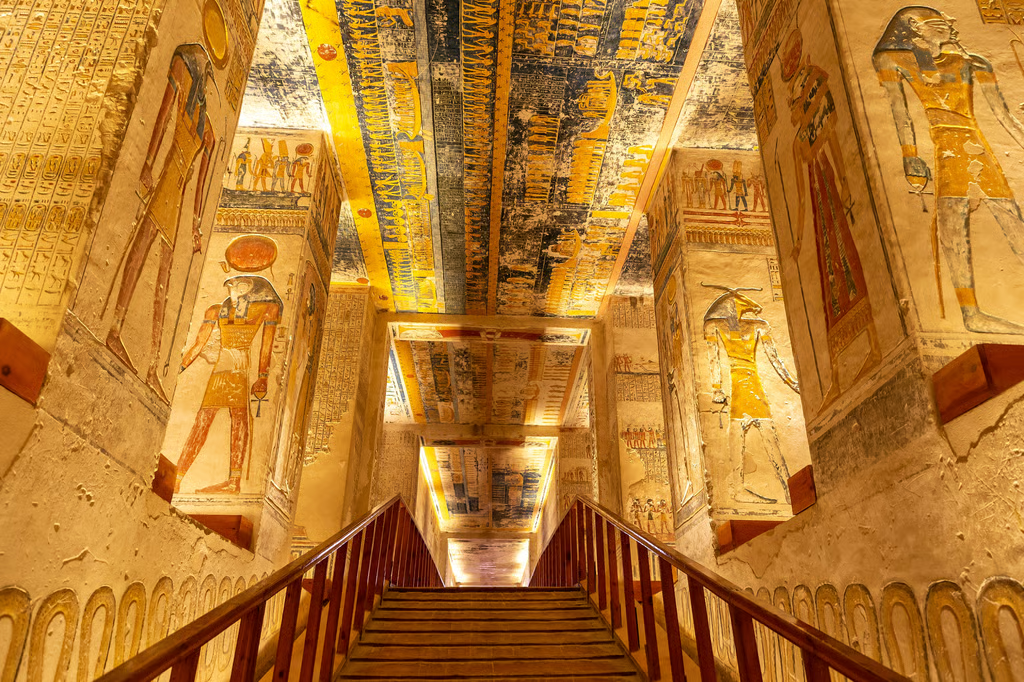
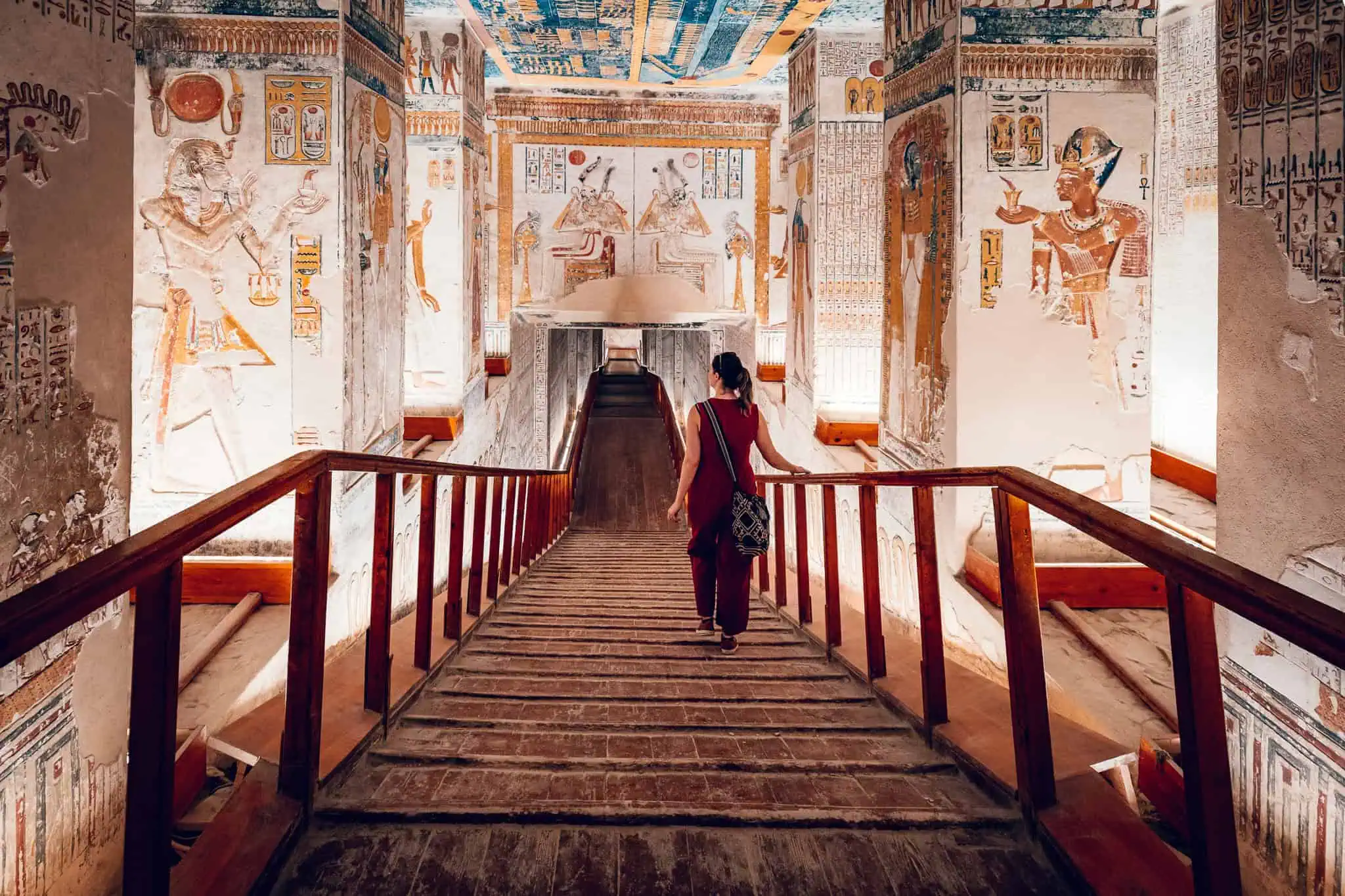
Interior tomb paintings — among the finest surviving examples of ancient Egyptian art. Photo: Unsplash
The 20th Dynasty: The Final Chapter (1186–1070 BCE)
Increasing social and economic instability led to systematic tomb robbing. Ancient papyri recording the trials of tomb robbers survive — detailed accounts of organized gangs and judicial proceedings that read with startling modernity.
By 1070 BCE, priests relocated the remaining royal mummies to two hidden caches — the Deir el-Bahari cache and the KV35 cache — where they rested undiscovered until the 19th century CE.
The Famous Tombs: What to See
Of the 63 known tombs, approximately 20 are open to visitors at any given time. Your standard entrance ticket includes access to three tombs.
KV62: Tomb of Tutankhamun
The most famous tomb in the world. The tomb itself is modest — four small chambers. The burial chamber walls are painted with scenes from the Book of the Dead. Tutankhamun’s mummified body still lies in his outermost coffin within the tomb. Entry requires a separate additional ticket (approximately 300 EGP).
KV9: Tomb of Ramesses V and Ramesses VI
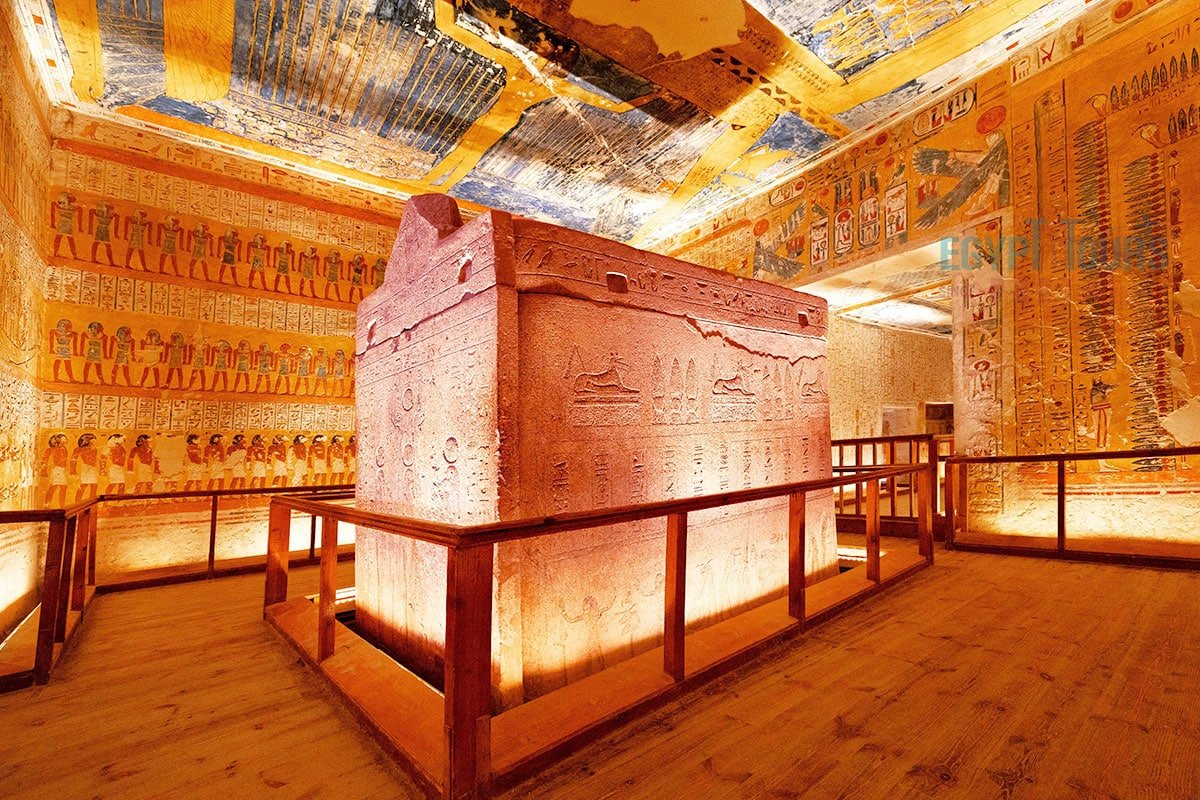
One of the most visually spectacular tombs, included in the standard ticket. This double tomb has some of the most elaborate astronomical ceilings in Egypt — the entire Book of the Night and Book of the Day depicted in vivid color across the burial chamber ceiling.
KV11: Tomb of Ramesses III
One of the longest tombs in the valley, notable for its unusual side chambers containing rare scenes of everyday life — harpers, butchers, workshops — unique in royal tomb decoration.
KV34: Tomb of Thutmose III
Accessed via a steep metal staircase, it rewards with one of the valley’s most extraordinary interiors: an oval-shaped burial chamber whose walls are covered in stick-figure illustrations from the Amduat, giving the chamber the appearance of an enormous illustrated papyrus scroll.
KV2: Tomb of Ramesses IV
One of the most accessible and well-lit tombs, with particularly well-preserved ceiling paintings. A good choice for first-time visitors.
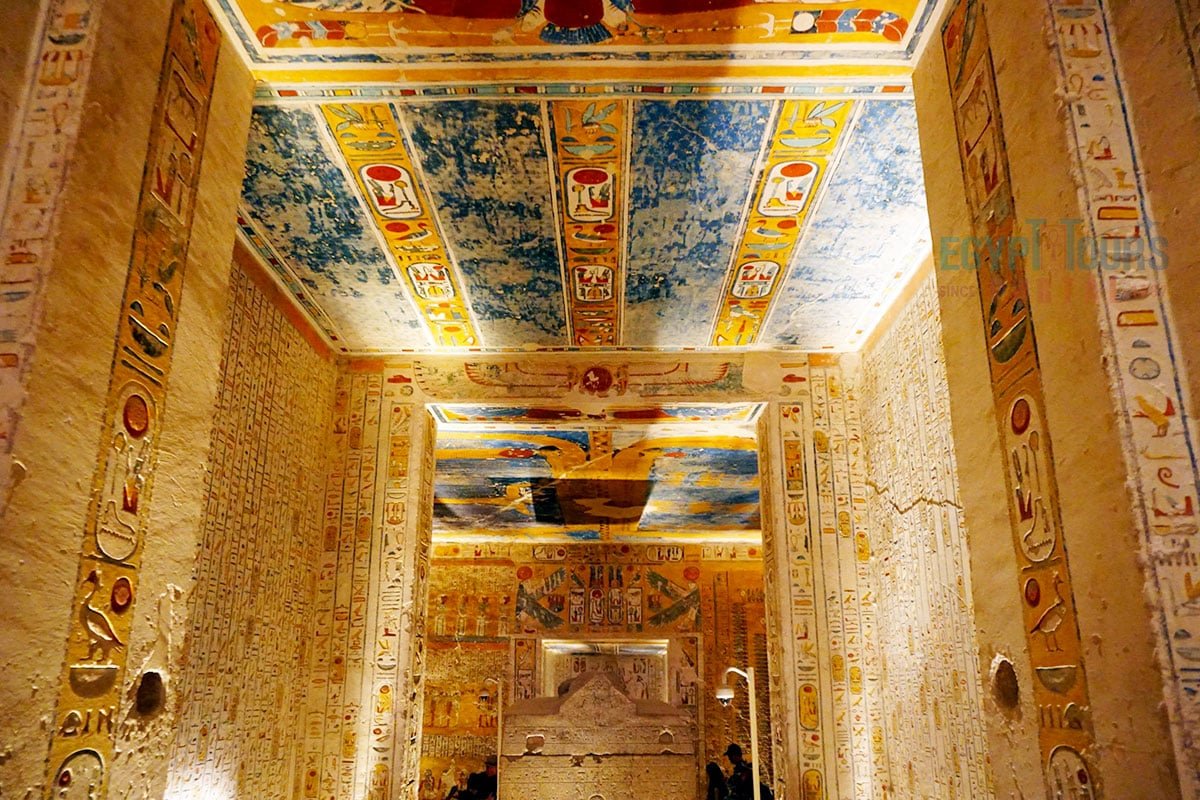
Hieroglyphics in the Tomb of Ramesses IV — Photo: Unsplash
Key Facts About the Valley of the Kings
The Discovery of Tutankhamun
By 1922, most Egyptologists believed the Valley of the Kings had given up all its secrets. Howard Carter, funded by Lord Carnarvon, had been systematically excavating the valley floor for years.
On November 4, 1922, Carter’s workmen found a stone step beneath the sand. By the next day, a staircase of 16 steps had been cleared. Carter cabled Carnarvon: “At last have made wonderful discovery in Valley. A magnificent tomb with seals intact.”
On November 26, 1922, Carter made a small hole in the sealed inner doorway. Carnarvon asked: “Can you see anything?” Carter replied: “Yes, wonderful things.”
What he saw — the antechamber packed floor to ceiling with golden furniture, statues, chariots, and royal treasures — took ten years to fully excavate and document. It remains the greatest archaeological discovery in history.
Practical Visitor Information
Getting There
The Valley of the Kings is located on Luxor’s West Bank, approximately 5 km from the Nile.
- Taxi or private car from central Luxor (15–20 minutes)
- Organized tour — most Nile Cruise itineraries include the Valley of the Kings
- Bicycle — scenic but exposed; avoid in summer heat
See also our guides to Luxor Temple History and Karnak Temple for full Luxor planning.
Entrance Tickets (2026)
Opening Hours
- Summer (April–September): 6:00 AM – 5:00 PM
- Winter (October–March): 6:00 AM – 4:00 PM
Best Time to Visit
Best time of day: 6:00–9:00 AM before heat and coach tour crowds arrive.
Best season: October through April — Luxor’s summer temperatures regularly exceed 42°C, making the valley genuinely dangerous in midday heat.
Insider Tips
Hire an Egyptologist guide. Without expert interpretation, the valley is a series of impressive but opaque painted corridors. With a guide, those corridors become a journey through the most sophisticated religious imagination in the ancient world. Pure Nile Tours provides Egyptologist guides for all Luxor private tours.
Choose your three tombs wisely. A good combination: KV9 (spectacular ceiling), KV11 (unique side chambers), KV2 (well-preserved and accessible). Add Tutankhamun separately if historical significance matters to you.
Bring a small torch. Even with electric lighting, some tomb sections are dimly lit.
No flash photography. Flash damages ancient pigments. Use available light only.
Combining with Other Luxor Sites
Classic West Bank Half-Day:
- Valley of the Kings (2–3 hours)
- Temple of Hatshepsut (45 minutes)
- Colossi of Memnon (15-minute photo stop)
Full Luxor Two-Day Itinerary:
- Day 1 (West Bank): Valley of the Kings + Hatshepsut Temple + Medinet Habu
- Day 2 (East Bank): Karnak Temple + Luxor Temple + Luxor Museum
🛥️ Visiting on a Nile Cruise? Pure Nile Tours includes a private guided West Bank tour in all Luxor-based cruise itineraries. View Nile Cruise Packages →
Frequently Asked Questions
How many tombs can I visit? Standard ticket covers 3 tombs. Tutankhamun (KV62) and Seti I (KV17) require additional tickets. Approximately 15–20 tombs are open on any given day.
Is Tutankhamun’s mummy still in the valley? Yes. His mummy remains in his outermost coffin within KV62. Other royal mummies were moved to Cairo museums.
Was the valley ever robbed? Almost every tomb was robbed in antiquity. Tutankhamun’s survived because it was buried beneath debris from a later tomb.
Are there queens buried here? Most queens are in the nearby Valley of the Queens. However, Hatshepsut has a tomb here (KV20).
Is the Valley of the Kings worth visiting? Absolutely. It consistently ranks among the most impactful archaeological sites on earth.
The Valley of the Kings is where ancient Egypt confronted its greatest question: what happens after death? The answer — painted across hundreds of meters of underground corridors in exquisite detail — remains one of humanity’s most elaborate, beautiful, and moving responses to that eternal inquiry.
🏛️ Plan your West Bank tour: Pure Nile Tours offers private guided tours of the Valley of the Kings and complete Nile Cruise packages. Book a Luxor Private Tour →