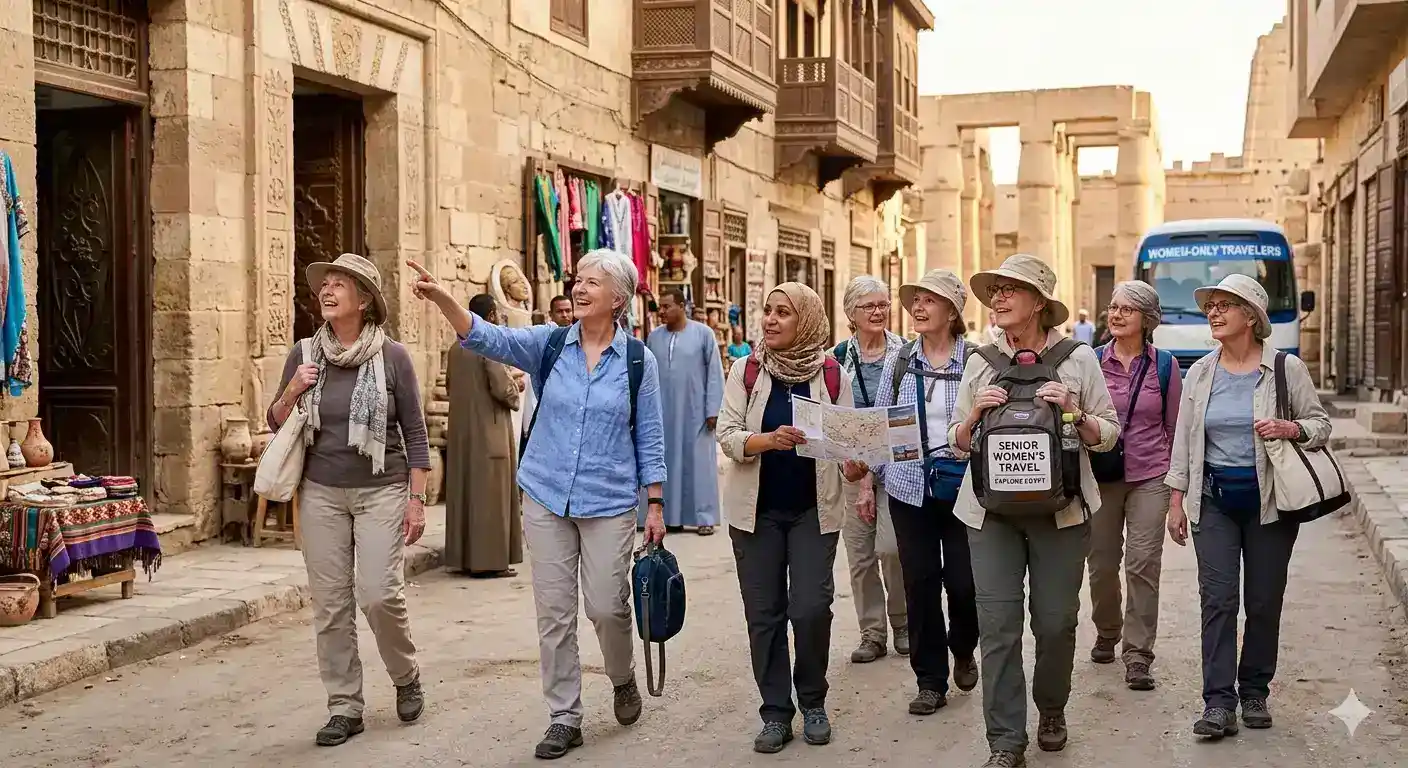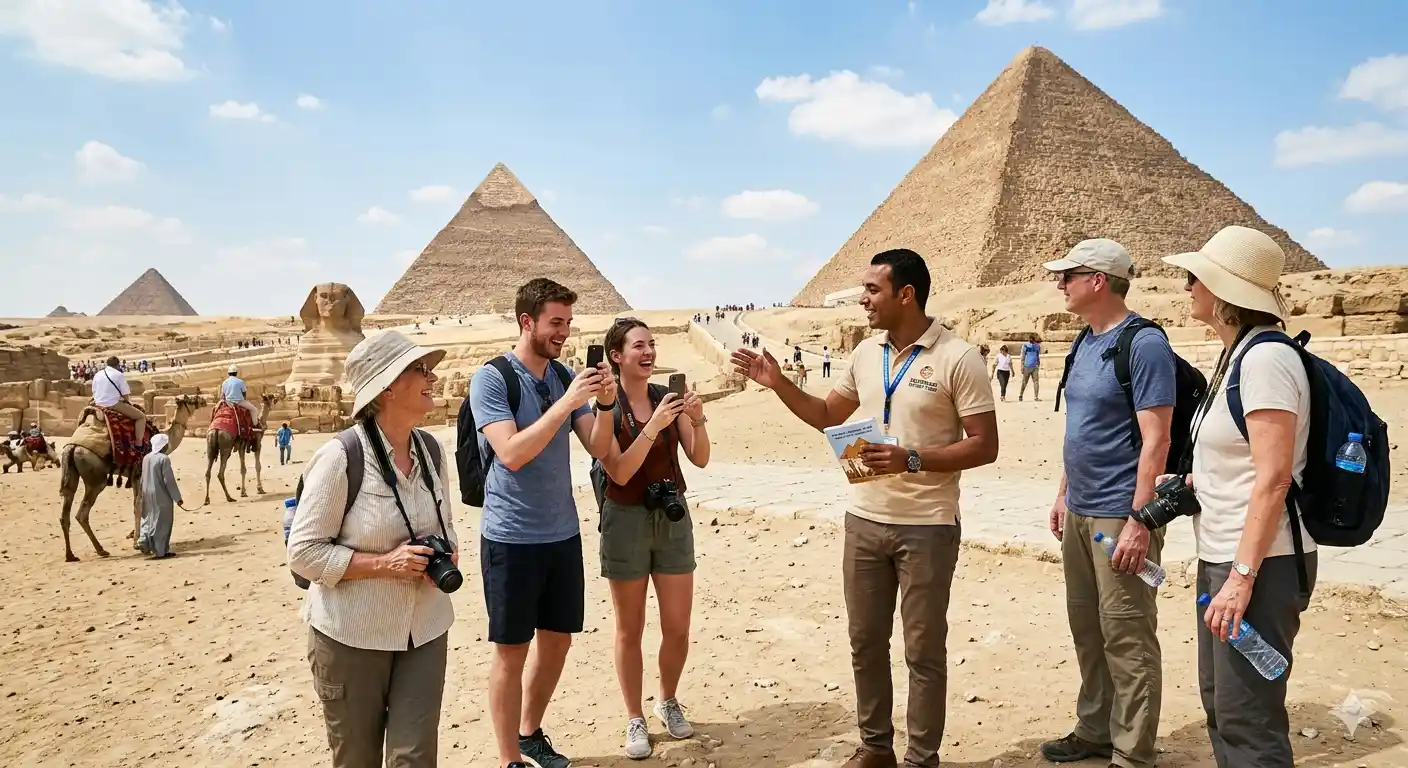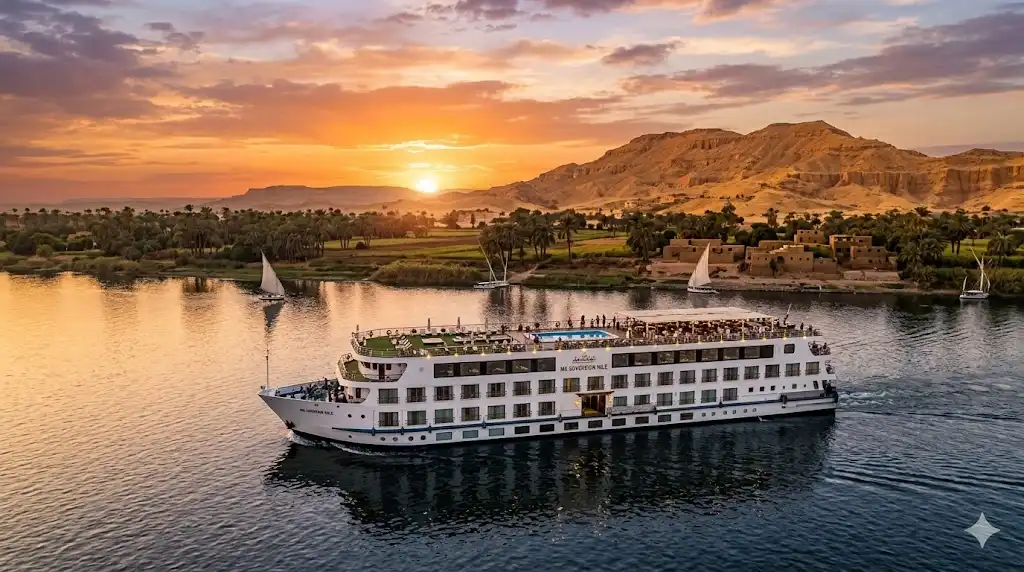
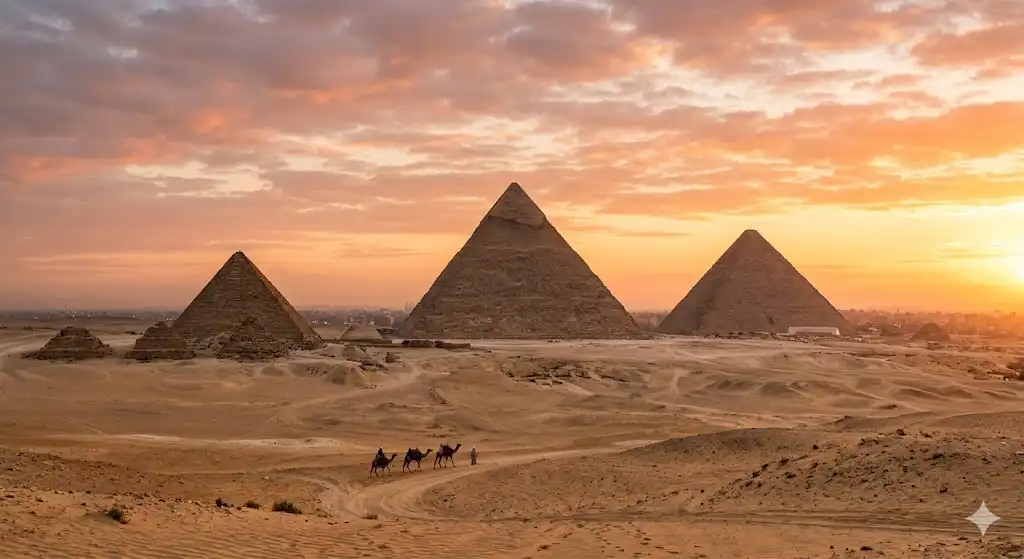
Egypt’s landmarks are spread across four main regions — Cairo and Giza in the north, Luxor and the Nile Valley in Upper Egypt, Aswan and Nubia in the deep south, and the coastal cities of Alexandria and the Red Sea. Most travelers combine at least two of these regions in a single trip, typically pairing Cairo’s pyramids with a Nile cruise between Luxor and Aswan. The on pureniletours.com breaks down each region in detail if you want to start mapping your route before diving into individual landmarks.
Before choosing which famous Egyptian landmarks to visit, a few quick facts help set expectations.
-
Ideal trip length: 7–10 days covers the essential landmarks comfortably; 12–14 days adds Alexandria, the Western Desert, or Red Sea beach time
-
Best seasons: October to April offers cooler temperatures (18–28 °C / 64–82 °F in most areas); March and November are sweet spots for fewer crowds and moderate heat
-
Key regions: Cairo/Giza, Luxor (East and West Banks), Aswan/Abu Simbel, Alexandria
-
Currency: Egyptian Pound (EGP); approximately 50 EGP = 1 USD at the time of writing
-
Payment at sites: Since 2026, almost all major archaeological sites accept only credit or debit cards — cash is no longer accepted at the Pyramids, Karnak, or GEM
-
Top 3 highlights for a short trip: Pyramids of Giza + Grand Egyptian Museum, Karnak Temple, Valley of the Kings
A rough daily budget for a mid-range traveler looks like this:
| Expense | Budget Range (EGP) | Approx. USD |
|---|---|---|
| Mid-range hotel (double room) | 2,500–4,000 | $50–$80 |
| Meals (3 per day, mix of local & tourist restaurants) | 500–1,000 | $10–$20 |
| Site entry fees (per major site) | 450–1,500 | $9–$30 |
| Local transport (taxis, metro, ferries) | 200–500 | $4–$10 |
| Daily total | 3,650–7,000 | $73–$140 |
Exchange rates fluctuate — verify current rates before travel.
1. The Pyramids of Giza and the Great Sphinx
No list of famous landmarks in Egypt starts anywhere else. The Giza Plateau sits on the western edge of Cairo, roughly 18 km from Tahrir Square. Three pyramids dominate the skyline: the Great Pyramid of Khufu, the Pyramid of Khafre, and the smaller Pyramid of Menkaure, all built during the Fourth Dynasty around 2550–2490 BCE. The Great Pyramid stood as the tallest human-made structure on Earth for nearly 3,800 years.
Khufu’s pyramid rises 138 meters today — down from an original 146 meters before its outer casing stones were stripped — and covers a base of 230 meters per side. Builders used an estimated 2.3 million stone blocks, each weighing around 2 tonnes on average. The interior holds three known chambers: the King’s Chamber, the Queen’s Chamber, and the Subterranean Chamber. Entering the pyramid means climbing through narrow, steeply inclined passageways in humid air, so it is not suitable for anyone with claustrophobia or mobility issues.
The Great Sphinx crouches just east of Khafre’s pyramid. Carved from a single ridge of limestone, it measures approximately 73 meters long and 20 meters high. Most Egyptologists believe it represents Pharaoh Khafre, though the debate has never fully settled.
Visiting Practicalities
General entry to the Giza Plateau (including the Sphinx) costs 700 EGP (~$14) for foreign adults. Entering the Great Pyramid requires a separate 1,500 EGP (~$30) ticket, and only 300 visitors per day are admitted. Khafre’s pyramid interior costs 280 EGP, while Menkaure’s costs 200 EGP. Tickets must be paid by card at the gate.
The plateau opens at 7:00 AM in winter and 6:00 AM in summer. Arrive within the first hour to photograph the pyramids in soft morning light and avoid the midday crowds. Allow at least three hours — longer if you plan to enter any pyramids.
Getting there from central Cairo takes 30–45 minutes by taxi (approximately 150–250 EGP one way) or Uber. The site sits just two kilometers from the Grand Egyptian Museum, making it natural to combine both in a full day. If you prefer a guided experience, the package covers both sites with private transport and an Egyptologist guide.
2. The Grand Egyptian Museum (GEM)
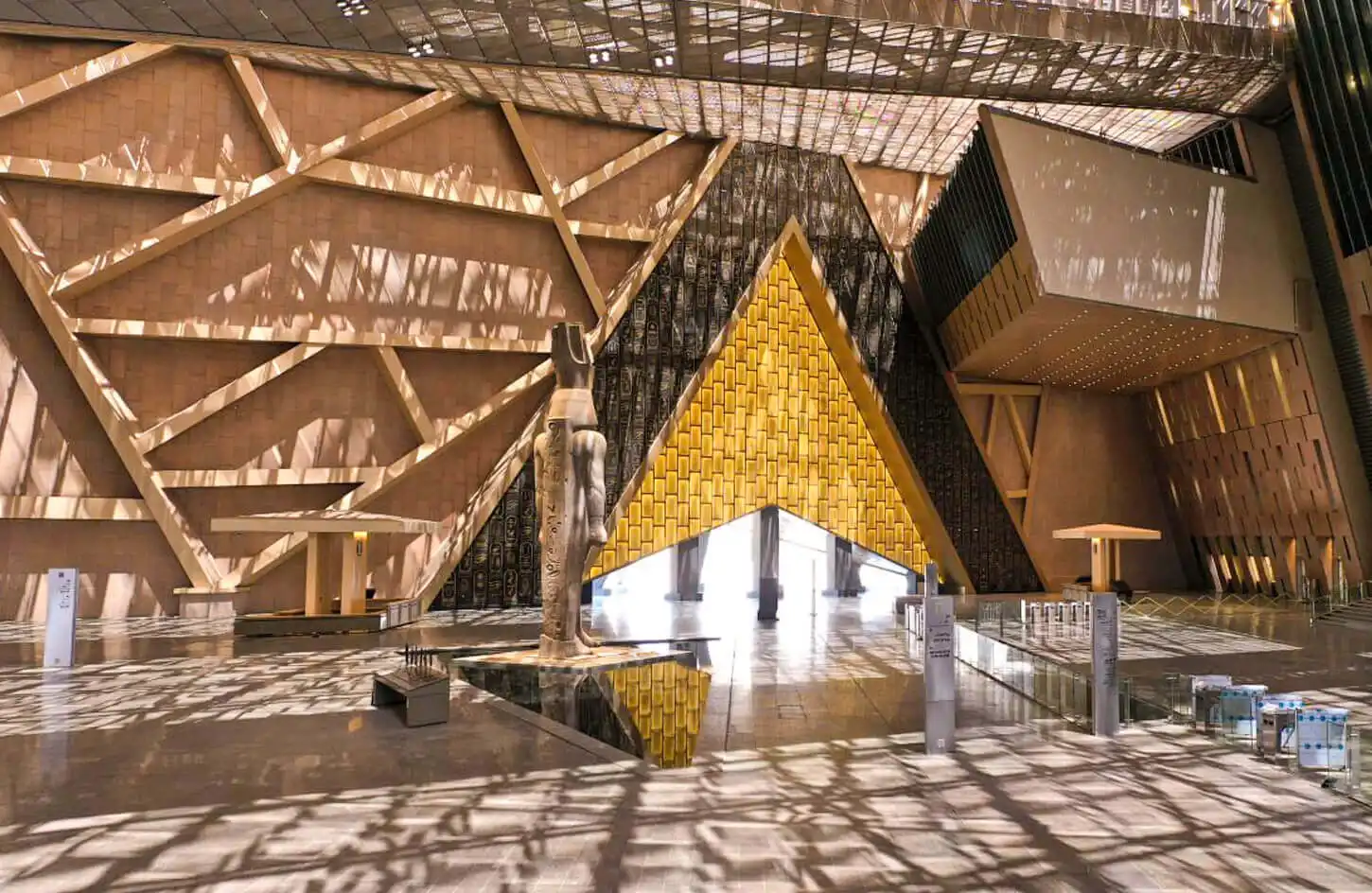
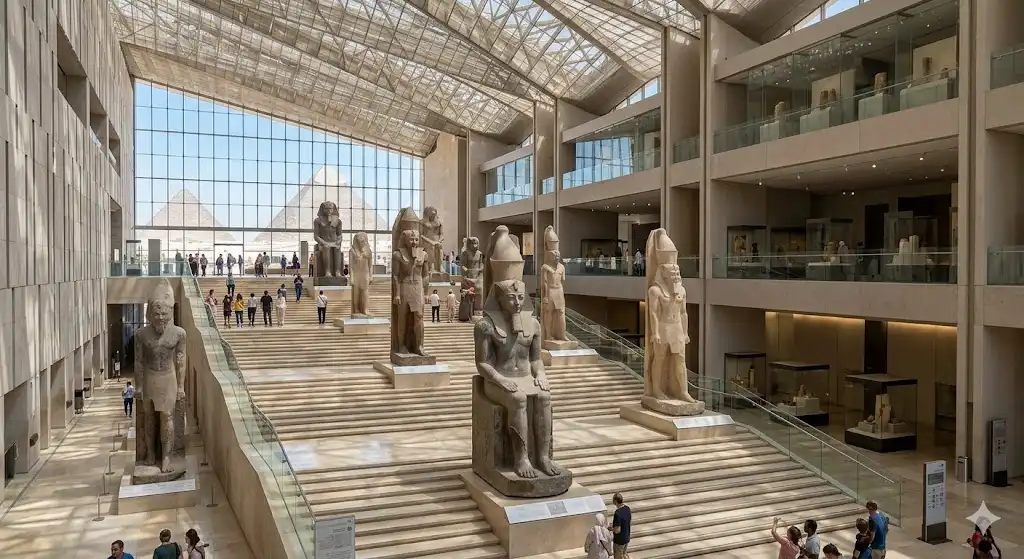
The Grand Egyptian Museum opened to the public in November 2025 after more than two decades of planning and construction. Located on the Giza Plateau about two kilometers from the Pyramids, it is the largest archaeological museum in the world dedicated to a single civilization — and already one of the most talked-about landmarks in Egypt. Galleries stretch across 500,000 square meters and house over 100,000 artifacts spanning prehistoric Egypt through the Roman period.
The centerpiece is the Tutankhamun Gallery, where more than 5,000 objects from the boy-king’s tomb are displayed together for the first time since their discovery in 1922. The golden funerary mask, ceremonial chariots, gilded shrines, and jewelry are all here. Beyond Tutankhamun, the Grand Staircase presents colossal statues arranged chronologically from the Old Kingdom to the Greco-Roman era, anchored by the 3,200-year-old, 11-meter statue of Ramesses II in the entrance atrium. The Khufu Solar Boat, originally excavated beside the Great Pyramid, now occupies its own purpose-built hall.
Tickets and Hours
All tickets must be booked in advance through the official website (visit-gem.com) — there are no on-site ticket sales. Foreign adult admission is 1,450 EGP (~$29). Students aged 13–25 with valid ID pay half price. Children under 6 enter free.
Standard hours run daily (except Wednesdays and Saturdays): complex grounds 8:30 AM–7:00 PM, galleries 9:00 AM–6:00 PM, last ticket purchase at 5:00 PM. On Wednesdays and Saturdays, extended evening hours keep galleries open until 9:00 PM and the complex until 10:00 PM — a particularly rewarding time to visit, as crowds thin out after 5:00 PM.
Plan a minimum of four hours for a focused visit or six hours to explore at a comfortable pace. The pureniletours.com article covers additional planning details including how to reach the museum and what to expect inside each gallery wing.
3. Karnak Temple Complex, Luxor
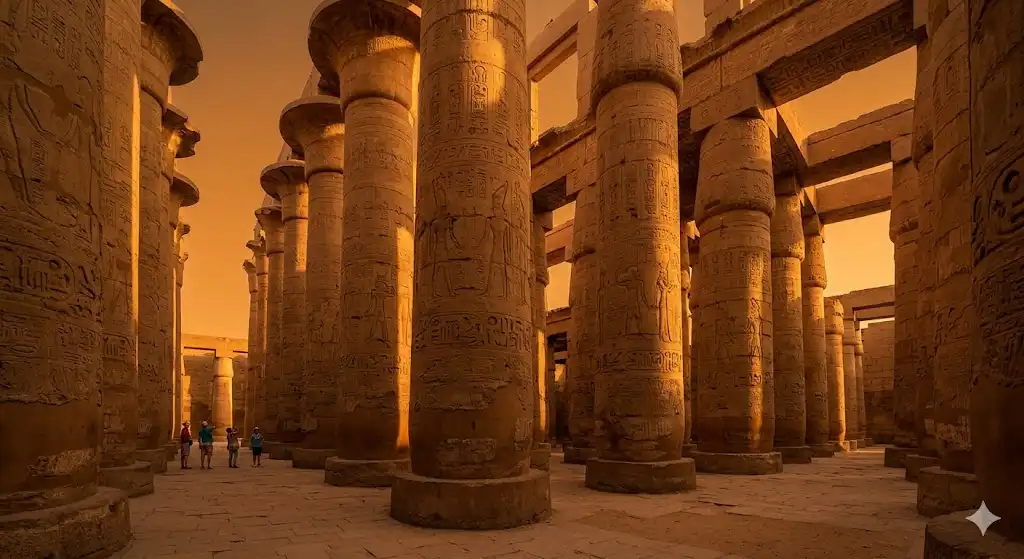
Karnak is not a single temple — it is a sprawling 200-acre complex of sanctuaries, pylons, obelisks, and chapels built, expanded, and rebuilt over roughly 2,000 years, from the Middle Kingdom through the Ptolemaic period. It served as the most important religious center in ancient Egypt, dedicated primarily to the god Amun-Ra. Among the top 10 famous landmarks in Egypt, Karnak stands out for the sheer scale of what remains standing.
The Hypostyle Hall is the architectural highlight. One hundred thirty-four sandstone columns, arranged in 16 rows, support a roof that once blocked out the sky. The 12 central columns rise 21 meters (69 feet) and are wide enough that six adults standing shoulder to shoulder cannot encircle one. Hieroglyphic reliefs cover nearly every surface, recording military campaigns, religious rituals, and offerings to the gods. Many still bear traces of their original paint.
Beyond the Hypostyle Hall, the complex includes the Sacred Lake — 120 meters by 77 meters and still filled with water — the Open Air Museum (separate ticket), the avenue of ram-headed sphinxes, several smaller temples, and the recently restored Sphinx Avenue connecting Karnak to Luxor Temple, 2.7 km to the south.
Visiting Practicalities
Entry costs approximately 450–600 EGP (~$9–$12) for foreign adults. Card payment only. The site opens at 6:00 AM and closes at 5:30 PM in winter (October–April) and 6:00 PM in summer. Early morning visits — before 8:00 AM — offer the best light and the fewest tour groups. Late afternoon, around 4:00 PM, also works well as day-tour buses leave and the stone glows amber.
Karnak sits on the East Bank of Luxor, about 3 km north of Luxor Temple. A taxi from central Luxor costs 50–80 EGP one way. Walking takes roughly 30–40 minutes along the Corniche, a pleasant route in cooler months.
4. Valley of the Kings, Luxor
Sixty-three tombs have been discovered so far in this barren limestone valley on the West Bank of the Nile, opposite Luxor. For nearly 500 years during the New Kingdom (roughly 1539–1075 BCE), pharaohs abandoned the pyramid tradition in favor of hidden underground burial chambers carved deep into the rock. The goal was secrecy — yet nearly every tomb was robbed in antiquity. The one famous exception was the tomb of Tutankhamun (KV62), found largely intact by Howard Carter in 1922.
Standard admission includes access to three tombs, and the selection rotates to manage conservation. Among the most consistently open and rewarding are the tombs of Ramesses III (KV11), Ramesses IV (KV2), and Merenptah (KV8), each with vividly painted corridors depicting the pharaoh’s journey through the underworld. Tutankhamun’s tomb requires a separate ticket and, while historically significant, is small and comparatively undecorated — it’s the treasures (now at the GEM) that made it legendary, not the walls.
Visiting Practicalities
General admission is approximately 600 EGP (~$12) for three tombs. Tutankhamun’s tomb is an extra 500 EGP. The tomb of Seti I (KV17), considered the finest in the valley for its preservation and artistry, requires a premium ticket of around 1,000 EGP. Photography inside the tombs is prohibited unless you buy a photography pass.
The valley opens at 6:00 AM and closes at 5:00 PM (winter) or 6:00 PM (summer). An electric tram runs from the entrance to the tomb area for a small fee (roughly 10 EGP). Temperatures inside the tombs are noticeably warmer than outside — bring water and wear light clothing.
Most visitors reach the West Bank by local ferry from Luxor’s East Bank (roughly 5–10 EGP) and then hire a taxi or bicycle. The includes the Valley of the Kings, Karnak, Hatshepsut’s temple, and other West Bank sites with a private Egyptologist — useful for travelers who want deeper context at each tomb.
5. Abu Simbel Temples
Two massive rock-cut temples stand near the southern border of Egypt, overlooking Lake Nasser. Even among the famous landmarks in Egypt, Abu Simbel feels like a category of its own — remote, monumental, and strikingly well-preserved. Ramesses II commissioned them around 1264 BCE, partly as a display of power to the neighboring Nubians and partly to honor himself and his queen, Nefertari. Four seated colossi of Ramesses II, each standing about 20 meters high, guard the entrance to the Great Temple. Smaller statues of Nefertari and the royal children stand between them at knee height.
The interior of the Great Temple penetrates 56 meters into the cliff. A sequence of halls leads to the innermost sanctuary, where four seated statues represent Ramesses II alongside the gods Amun-Ra, Ra-Horakhty, and Ptah. Twice a year — around February 22 and October 22 — sunlight reaches this chamber and illuminates three of the four statues. The fourth, Ptah (god of the underworld), remains in shadow. These “Sun Festival” dates draw large crowds.
The smaller Temple of Hathor, dedicated to Nefertari, sits nearby with six standing figures carved into its facade — four of Ramesses and two of Nefertari, depicted at the same scale as the king, an unusual honor in ancient Egypt.
The UNESCO Rescue
Between 1964 and 1968, a UNESCO-led international team cut both temples into blocks and reassembled them 65 meters higher and 200 meters further from the river to save them from the rising waters of Lake Nasser after the construction of the Aswan High Dam. The operation remains one of the most ambitious archaeological rescue projects ever undertaken.
Visiting Practicalities
Abu Simbel is 280 km south of Aswan — roughly 3.5 hours by road or 45 minutes by plane. Most visitors fly or join a convoy that departs Aswan around 3:30–4:00 AM to arrive at sunrise. Entry costs approximately 500 EGP (~$10) for foreign adults.
The on pureniletours.com details transport options, convoy schedules, and what to expect on the ground.
6. Luxor Temple
Standing in the center of modern Luxor, this temple is impossible to miss — its floodlit columns and colossal statues are visible from the Corniche and from restaurants across the river. Amenhotep III began construction around 1400 BCE, and Ramesses II later added the entrance pylon, obelisk, and seated colossi. Alexander the Great’s generals, Roman legions, early Christians, and medieval Muslims all left marks on the structure, creating a palimpsest of 3,400 years of continuous use.
The avenue of sphinxes that once connected Luxor Temple to Karnak, 2.7 km to the north, was fully excavated and reopened in recent years. Walking this route at dusk — with hundreds of stone sphinxes lining both sides — is one of Luxor’s most atmospheric experiences.
Visiting Practicalities
Entry costs approximately 300 EGP (~$6). The temple opens at 6:00 AM and closes at 9:00 PM in winter, with the last entry at 8:00 PM. A nighttime visit is strongly recommended: floodlights turn the sandstone columns golden-white against the dark sky, and crowds are substantially thinner than during daytime hours.
The temple sits within walking distance of most Luxor hotels. The only surviving obelisk at the entrance (its twin stands in the Place de la Concorde in Paris) marks the entrance pylon, flanked by two seated colossi of Ramesses II.
7. Philae Temple, Aswan
The Temple of Isis on Philae Island — now technically Agilkia Island, after its own UNESCO-led relocation in the 1970s — is one of the last temples built in the ancient Egyptian tradition. Construction began under Ptolemy II around 280 BCE and continued through the Roman period. The cult of Isis persisted here longer than almost anywhere else in Egypt; the temple was not officially closed until 535 CE under the Byzantine Emperor Justinian.
The approach by motorboat across the blue waters of the Aswan reservoir sets the tone. Columns, pylons, and the Birth House come into view gradually as the boat rounds the island. Inside, reliefs show Isis nursing Horus, Osiris in the underworld, and Roman emperors making offerings in Egyptian style — evidence of how deeply Egypt’s religion influenced its conquerors.
Visiting Practicalities
Entry costs approximately 450 EGP (~$9). The temple is open from 7:00 AM to 4:00 PM in winter. A motorboat ride from the Aswan marina (Shellal dock) takes about 10 minutes; boats typically cost 200–300 EGP for a return trip, shared among passengers. A Sound and Light Show runs most evenings — check locally for schedules and language rotation.
Travelers combining Aswan and Abu Simbel can build in a Philae visit on either end. The tour covers Philae, Abu Simbel, and Cairo’s main sites in a compact itinerary.
8. The Saqqara Necropolis and Step Pyramid of Djoser
Saqqara served as the main burial ground for the ancient capital Memphis for over 3,000 years. The headline attraction is the Step Pyramid of Djoser, built around 2670 BCE by the architect Imhotep — widely considered the first monumental stone structure ever constructed. At six tiers and 62 meters high, it predates the Giza pyramids by roughly a century and represents the architectural leap from mud-brick mastabas to stone pyramids.
After years of restoration, the interior of the Step Pyramid reopened to visitors. A narrow passage descends to the burial chamber, lined with blue faience tiles — some of the oldest decorative tilework in the world.
Beyond Djoser, Saqqara holds hundreds of tombs, many still being excavated. Recent discoveries have unearthed perfectly preserved underground tombs and intact sarcophagi, confirming that Saqqara still has secrets to reveal. The Serapeum — a subterranean labyrinth where sacred Apis bulls were buried in enormous granite sarcophagi, some weighing 70 tonnes — is one of the most atmospheric sites in all of Egypt.
Visiting Practicalities
General entry to Saqqara costs approximately 450 EGP (~$9). The Serapeum requires a separate ticket of around 150 EGP. The site is roughly 30 km south of central Cairo — about 45 minutes by car. Many visitors combine Saqqara with nearby Memphis (the open-air museum housing the colossal Ramesses II statue) and Dahshur (home to the Bent Pyramid and the Red Pyramid, which you can enter free of charge with the Dahshur ticket).
9. The Temples of Edfu and Kom Ombo
These two Ptolemaic-era temples sit on the banks of the Nile between Luxor and Aswan, and nearly every Nile cruise stops at both. They round out this list of famous Egyptian landmarks with a different flavor — younger than the pharaonic sites, yet strikingly well preserved.
Edfu: Temple of Horus
The Temple of Horus at Edfu is the most complete and best-preserved temple in Egypt. Built between 237 and 57 BCE, it stands almost exactly as it did 2,000 years ago — roof, walls, pylons, and much of the original paint intact. The 36-meter-high entrance pylon still bears carvings of Ptolemy XII smiting enemies before Horus. Inside, the dark sanctuary houses a granite naos (shrine) and a replica of the sacred barque that once carried the statue of Horus during festivals.
Entry costs approximately 400 EGP (~$8). The temple sits about 1 km from the Nile bank, reachable by horse-drawn carriage (calèche) from the cruise dock — a quintessential Egyptian experience, if bumpy.
Kom Ombo: The Double Temple
Kom Ombo is unique: it is a perfectly symmetrical double temple dedicated to two gods — Sobek (the crocodile god) on the right half and Horus the Elder on the left. Built between 180 and 47 BCE, the twin entrances, halls, and sanctuaries mirror each other down the center axis.
The most photographed reliefs here show ancient surgical instruments — forceps, scalpels, bone saws — suggesting medical knowledge far more advanced than most visitors expect. A small Crocodile Museum adjacent to the temple displays dozens of mummified crocodiles recovered from the area.
Entry costs approximately 300 EGP (~$6). The temple perches on a low bluff right above the Nile, and most cruise ships dock directly below.
A typically stops at both Edfu and Kom Ombo, along with Karnak, Valley of the Kings, and Philae.
10. Khan el-Khalili and Islamic Cairo
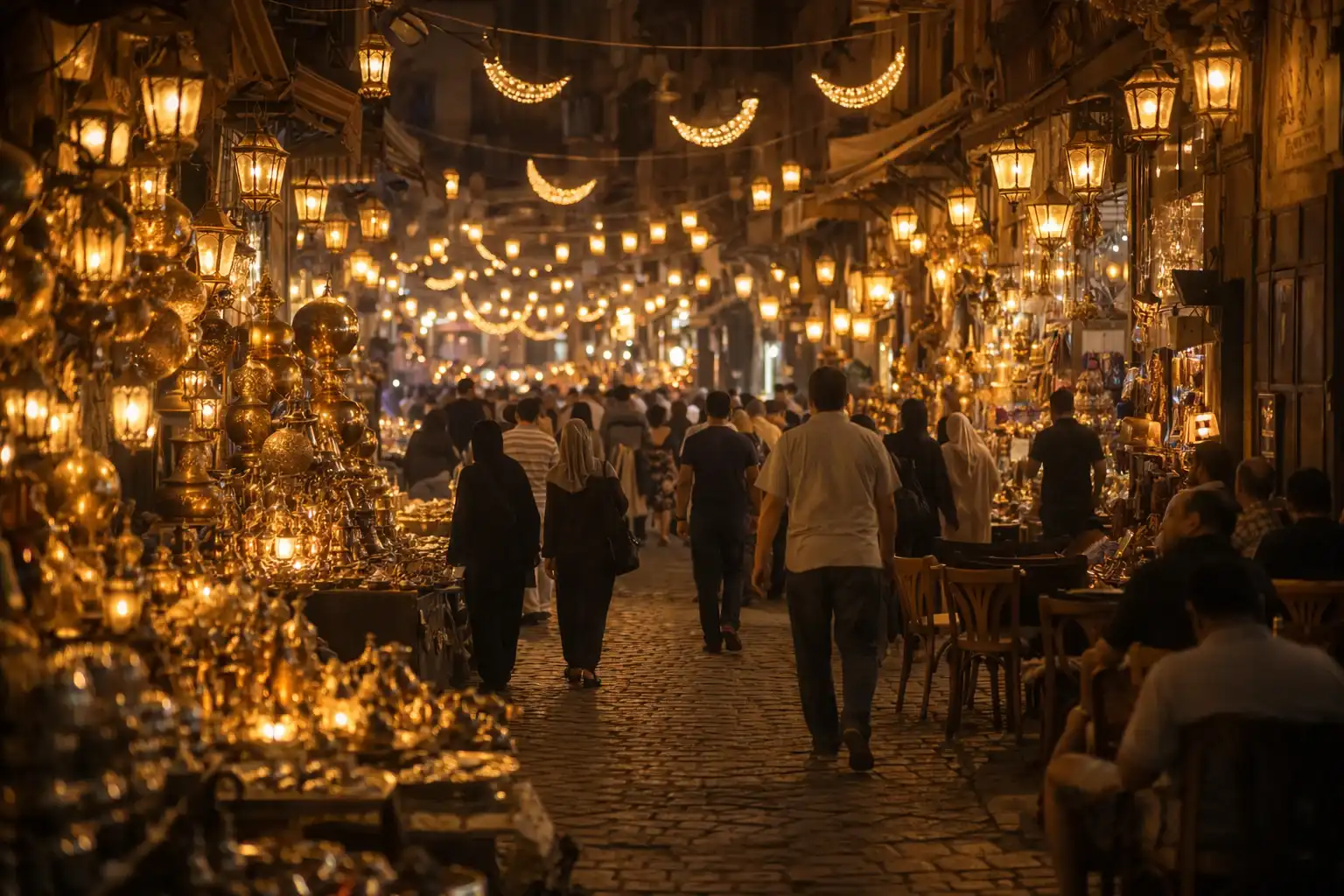
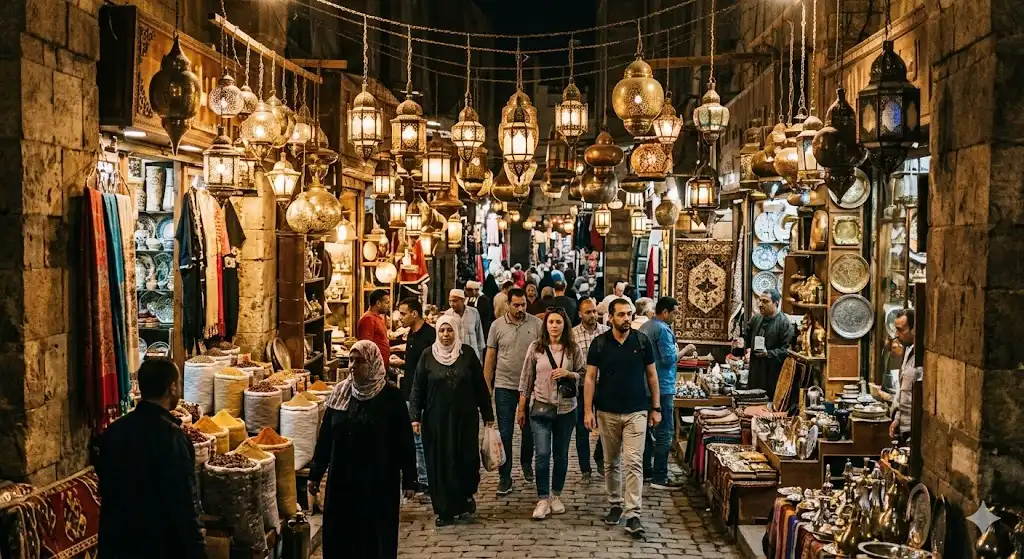
Not every famous landmark in Egypt is pharaonic. Khan el-Khalili, a sprawling bazaar founded in 1382, occupies the heart of Islamic Cairo — a UNESCO-listed district packed with mosques, madrasas, and medieval gates. The market’s narrow lanes sell everything from hand-hammered brass lanterns and silver cartouche necklaces to perfume oils, spices, and cotton textiles.
Beyond the shopping, the surrounding Fatimid-era quarter is home to some of Cairo’s most important Islamic monuments. The Mosque of Sultan Hassan (1356) and the Al-Rifa’i Mosque face each other across a small square below the Saladin Citadel. The Citadel itself, built by Saladin in 1176, crowns the Mokattam hill and offers panoramic views across the city. Inside, the Mosque of Muhammad Ali — sometimes called the Alabaster Mosque for its marble-clad walls — dominates the skyline with twin 84-meter minarets.
A short walk from Khan el-Khalili brings you to Al-Azhar Mosque, founded in 970 CE and still operating as one of the world’s oldest universities. The Mosque of Ibn Tulun (879 CE), a few blocks further, is Cairo’s oldest mosque still in its original form, with a striking Abbasid-style minaret.
Visiting Practicalities
Khan el-Khalili is free to explore. Shops open around 9:00 AM but the real atmosphere builds after 11:00 AM and peaks in the late afternoon and evening. Haggling is expected — a reasonable starting offer is 40–50% of the quoted price.
Tipping is customary in shops that offer tea or a guided explanation of their craft. The area is safe during the day and into the evening hours, though it gets crowded and keeping belongings close is wise. For a broader overview of Cairo activities, the post includes Islamic Cairo alongside pharaonic sites.
How to Plan a Landmarks Tour of Egypt
Covering all top 10 famous landmarks in Egypt requires a minimum of 7 days, though 9–10 days is more comfortable. A practical route moves south from Cairo to Luxor and then to Aswan before flying home (or back to Cairo):
Days 1–3: Cairo and Giza Visit the Pyramids and Sphinx on Day 1, the Grand Egyptian Museum on Day 2, and combine Saqqara, Memphis, and Dahshur on Day 3. Khan el-Khalili and Islamic Cairo can fill an afternoon or evening.
Days 4–6: Luxor Fly Cairo–Luxor (about 1 hour). Spend one full day on the West Bank (Valley of the Kings, Hatshepsut Temple, Colossi of Memnon), one day on the East Bank (Karnak, Luxor Temple at night), and board a Nile cruise on the third evening.
Days 7–9: Nile Cruise — Edfu, Kom Ombo, Aswan A standard 3–4 night cruise sails from Luxor to Aswan with stops at Edfu and Kom Ombo. On arrival in Aswan, visit Philae Temple and the Unfinished Obelisk.
Day 10: Abu Simbel Fly or drive from Aswan to Abu Simbel for a morning visit, then return to Aswan or fly to Cairo.
The post provides a compressed version of this route for travelers with less time.
Best Time to Visit Egypt’s Famous Landmarks
Egypt is a year-round destination, but temperature and crowd levels vary sharply by season — and that matters when you are spending hours outdoors at these famous landmarks in Egypt.
| Season | Months | Temperature (Cairo) | Crowds | Best For |
|---|---|---|---|---|
| Peak / Winter | December–February | 10–20 °C (50–68 °F) | High | Comfortable sightseeing everywhere |
| Shoulder | March–April, October–November | 18–30 °C (64–86 °F) | Moderate | Best balance of weather and crowds |
| Summer | May–September | 35–42 °C (95–108 °F) | Low | Lower prices, quieter sites, but extreme heat in Upper Egypt |
Upper Egypt (Luxor, Aswan, Abu Simbel) is notably hotter than Cairo. Summer temperatures in Luxor routinely exceed 40 °C (104 °F), making outdoor site visits between 10:00 AM and 4:00 PM uncomfortable. If visiting in summer, plan all outdoor sightseeing for early morning or late afternoon.
Ramadan dates shift each year on the Gregorian calendar. During Ramadan, some shops and restaurants close during daylight hours, and operating hours at sites may change. Visiting during Ramadan is manageable with planning — tourist restaurants in hotels remain open, and evenings become festive.
Getting Around Egypt
Between cities: Domestic flights connect Cairo, Luxor, Aswan, and Abu Simbel. Flight time from Cairo to Luxor is roughly one hour, and tickets cost $80–$150 one way depending on season. Overnight sleeper trains run between Cairo and Luxor/Aswan (approximately 10–12 hours) and start around $40–$80 for a first-class cabin.
Within Cairo: The Cairo Metro is clean, cheap (under 20 EGP per ride), and covers central Cairo, though it does not extend to Giza’s pyramids. Uber and Careem operate throughout Cairo and are the most convenient option for point-to-point trips. Expect 100–200 EGP for most cross-city rides.
Within Luxor: The East Bank is walkable for Karnak and Luxor Temple. The West Bank (Valley of the Kings, Hatshepsut Temple) requires a ferry crossing plus taxi or bicycle. Bicycle rental costs 50–100 EGP per day and is popular for independent exploration in cooler months.
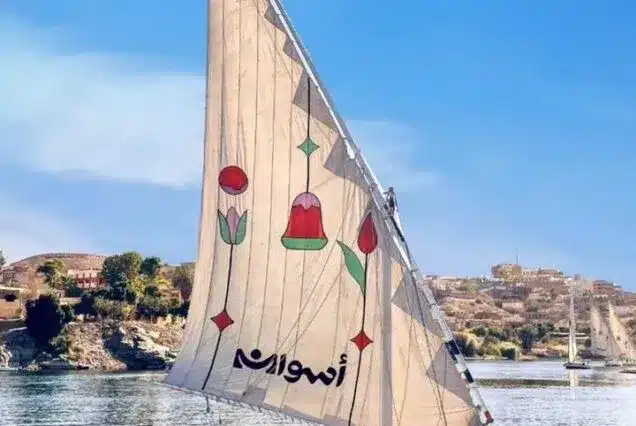
Within Aswan: Feluccas and motorboats handle transport to islands (Philae, Kitchener’s Island, Elephantine). A private felucca sail around Aswan costs roughly 200–400 EGP for an hour.
Budget and Average Costs
Visiting the top 10 famous landmarks in Egypt is remarkably affordable compared to equivalent historical sites in Europe or Asia. A mid-range trip covering Cairo, Luxor, Aswan, and Abu Simbel over 10 days typically costs $1,200–$2,000 per person (excluding international flights), depending on accommodation choices and whether a Nile cruise is included. Here is a breakdown of typical daily costs:
| Category | Budget | Mid-Range | Comfort |
|---|---|---|---|
| Hotel (per night, double) | $15–$30 | $50–$80 | $150–$300 |
| Meals (3 per day) | $5–$10 | $10–$20 | $25–$50 |
| Site entry (per major site) | $6–$12 | $9–$15 | $15–$30 (premium tombs/VIP) |
| Local transport (daily) | $3–$5 | $8–$15 | $20–$40 (private car) |
| Daily total | $29–$57 | $77–$130 | $210–$420 |
Exchange rates fluctuate — verify current rates before travel.
Nile cruises range from about $250–$400 for a 3–4 night cruise on a standard ship to $800+ for luxury vessels with suite cabins.
Culture, Dress Code and Etiquette at Egyptian Landmarks
Egypt is a predominantly Muslim country, and modest dress is expected at religious sites — mosques require covering shoulders, knees, and (for women) hair. At archaeological sites like the Pyramids, Karnak, and the Valley of the Kings, the dress code is more relaxed, but lightweight clothing that covers the shoulders helps with sun protection as much as cultural respect.
Remove shoes before entering any mosque. Photography is usually allowed in mosque courtyards but not always inside prayer halls — ask first.
Egyptians are hospitable and generally patient with tourists. A few norms that make interactions smoother: greet with “as-salamu alaykum” (peace be upon you); accept tea if offered during a shop visit (declining is not rude, but accepting builds goodwill); ask permission before photographing people, especially in rural areas.
Tipping (baksheesh) is part of daily life. Tip 10–15% at restaurants, 50–100 EGP per day for tour guides, 20–50 EGP for drivers, and small amounts (10–20 EGP) to attendants who open tombs or offer unsolicited help at sites.
Practical Tips for Visiting Egypt’s Famous Landmarks
-
Money: ATMs are widely available in Cairo, Luxor, and Aswan. Visa and Mastercard work at hotels, restaurants, and archaeological sites. Carry small EGP notes (10, 20, 50) for tips and minor purchases.
-
Language: Arabic is the official language. English is widely spoken in tourist areas. Learning a few Arabic phrases — “shukran” (thank you), “bikam?” (how much?) — goes a long way.
-
Tipping: See the section above. Pre-plan a daily tipping budget of roughly 200–400 EGP.
-
Plugs: Egypt uses Type C and Type F sockets (European two-pin, 220V). Bring a universal adapter.
-
SIM / eSIM: Vodafone Egypt, Orange, and Etisalat sell tourist SIM cards at Cairo Airport for approximately 300–600 EGP, including a data allowance of 10–20 GB for 30 days. eSIM options (such as Airalo or Holafly) work on compatible phones and can be set up before arrival.
-
Photography: Exterior photography is usually free at all sites. Interior photography in tombs often requires a separate pass (100–300 EGP). Tripods are rarely allowed. Drone photography is banned at all archaeological sites without a government permit.
-
Water: Do not drink tap water. Bottled water costs 5–10 EGP at shops and is provided on most tours and cruises.
-
Public holidays: The Sham el-Nessim festival (spring), Eid al-Fitr, and Eid al-Adha can affect opening hours and availability. Check dates against your travel window.
External Links
These are the questions travelers ask most often when planning a trip around the famous landmarks in Egypt.
Is Egypt safe for tourists in 2026?
At the time of writing, Egypt’s major tourist areas — Cairo, Giza, Luxor, Aswan, the Red Sea resorts, and the Nile cruise route — have a strong security presence and millions of visitors travel through them every year without incident. The UK FCDO, US State Department, and Australian DFAT maintain travel advisory pages specific to Egypt; check your government’s latest guidance before booking. Common-sense precautions apply: keep valuables out of sight, use reputable transport, and stay in well-traveled areas at night. The article covers this topic in more detail.
Is Egypt safe for solo female travelers?
Solo female travelers visit Egypt regularly and enjoy it. Dress modestly (covering shoulders and knees), use ride-hailing apps like Uber rather than unmarked taxis, and consider joining a guided tour for the first few days to build confidence with local navigation and customs. Unwanted verbal attention can occur, particularly in busy tourist areas — a firm “la, shukran” (no, thank you) usually ends it. Many solo travelers find Luxor and Aswan more relaxed than Cairo.
Do I need a visa to visit Egypt?
Most nationalities can obtain a visa on arrival at Egyptian airports or apply for an e-visa in advance through visa2egypt.gov.eg. The standard single-entry tourist visa costs $25 USD and is valid for 30 days. Citizens of certain countries (check the list on the Egyptian Ministry of Foreign Affairs website) may be eligible for visa-free entry for short stays. Processing the e-visa online before you fly avoids the queue at the airport. For full details, see .
What should I wear when visiting Egyptian landmarks?
Lightweight, breathable clothing in natural fabrics (cotton, linen) is most practical. Cover shoulders and knees at mosques and churches; a light scarf doubles as a head covering when needed. At open-air archaeological sites, a wide-brimmed hat, sunglasses, and sunscreen are essential — shade is scarce at places like the Pyramids and Valley of the Kings. Closed-toe shoes with good grip help on uneven stone surfaces.
How many days do I need in Egypt?
Seven days covers the essentials: 2–3 days in Cairo/Giza, then a flight to Luxor and a 3–4 night Nile cruise to Aswan. Ten days adds Abu Simbel and more breathing room. Fourteen days lets you include Alexandria, the Western Desert, or a few days at a Red Sea resort.
Can I use ATMs and credit cards in Egypt?
ATMs dispensing EGP are common in Cairo, Luxor, Aswan, and resort towns. Most accept Visa and Mastercard; check with your bank about foreign transaction fees. Credit cards are accepted at hotels, mid-to-upscale restaurants, and all major archaeological sites (in fact, many sites now require card payment). Small shops, street food vendors, and local taxis still run on cash.
Is it safe to eat street food in Egypt?
Street food is a significant part of Egyptian culture. Koshari, foul medames, and ta’ameya (Egyptian falafel) are available on almost every corner. Choose stalls with high turnover — a busy stall means fresh food. Avoid pre-cut fruit and uncooked salads from street vendors if you have a sensitive stomach. Bottled water is essential; avoid ice in drinks unless at a reputable hotel or restaurant.
Can tourists drink alcohol in Egypt?
Alcohol is legal in Egypt and available at licensed hotels, restaurants, and bars — particularly in Cairo, Luxor, Aswan, and Red Sea resorts. It is not sold in most local shops outside tourist areas, and public drinking is illegal. Duty-free allowances at the airport let tourists purchase a limited quantity upon arrival. For a full rundown of where and how, see .
Do I need a guide at Egyptian landmarks?
Guides are not mandatory at most sites, but having an Egyptologist dramatically improves the experience — hieroglyphic inscriptions, tomb symbolism, and architectural details that appear decorative often tell detailed stories. Licensed guides can be hired at the entrance to most sites for approximately 400–800 EGP per half day, or booked in advance through tour operators.
Can I take photos inside the tombs and temples?
Photography policies vary by site. Exterior photography is free everywhere. Interior photography inside tombs (Valley of the Kings, Valley of the Queens) requires a separate pass, usually 100–300 EGP. Flash is prohibited in all painted tombs. The Grand Egyptian Museum allows photography in most galleries but may restrict it in certain exhibition rooms. Tripods and selfie sticks are generally not allowed inside any enclosed site.