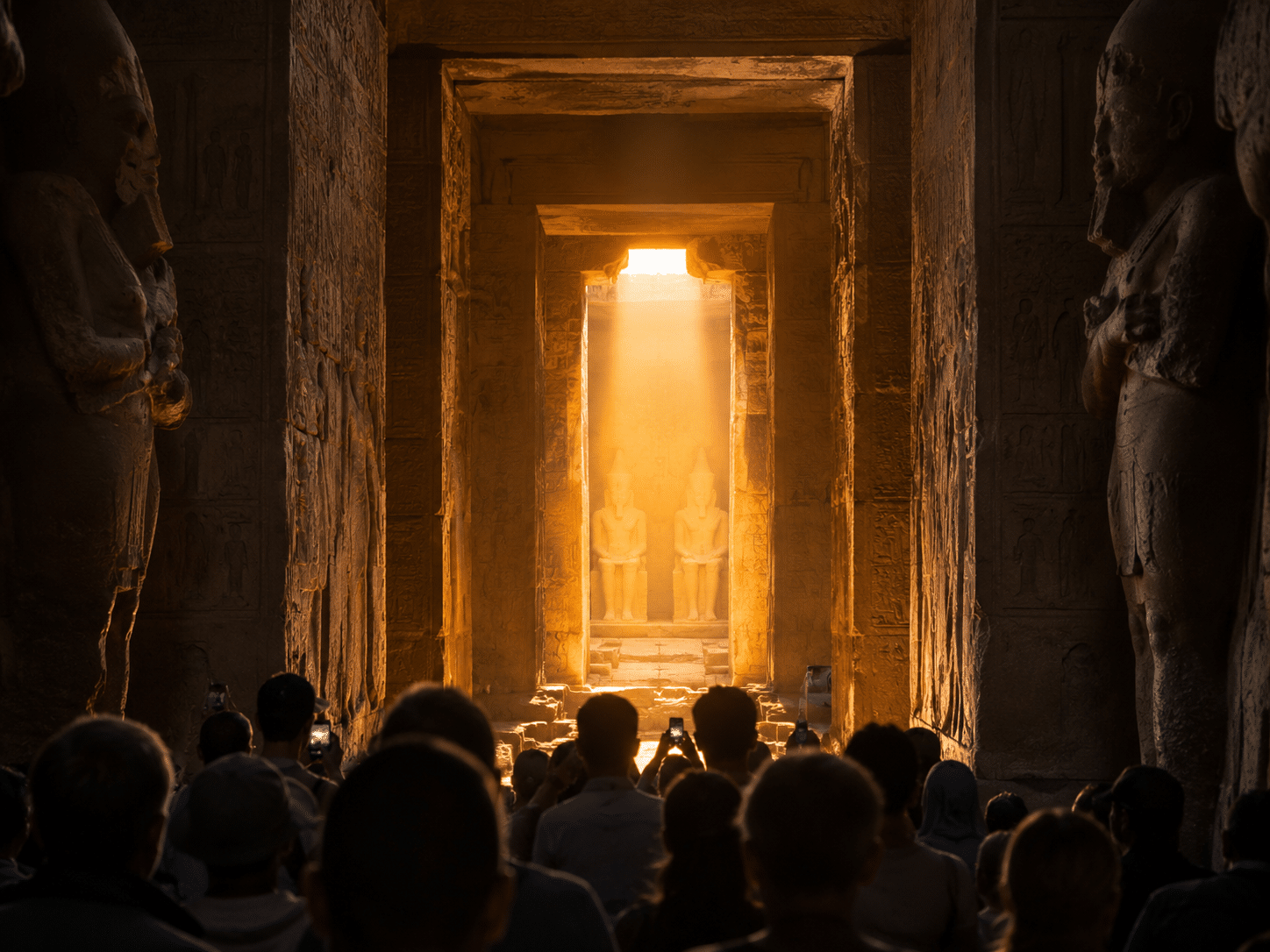
Twice a year, the rising sun reaches through the Great Temple of Abu Simbel and illuminates figures in the sanctuary deep inside the mountain. The modern public dates are February 22 and October 22. On those mornings, visitors gather before dawn to witness a carefully oriented ancient building interact with the horizon more than 3,000 years after it was created.
The event is often described in a single sentence: sunlight illuminates Ramesses II on his birthday and coronation day while Ptah remains in darkness. The reality is more interesting. The illumination is genuine, the present dates are official, and Ptah does remain unlit; however, the birthday-and-coronation explanation is not securely proven. Ancient calendars, disputed royal chronology, the width of the entrance, the changing solar position over millennia, and the temple’s relocation all complicate the story.
This complete Abu Simbel Sun Festival guide explains what happens, how the architecture creates the effect, what scholars debate, how relocation changed the horizon, whether February or October is better, and what travelers should expect on the festival morning itself. For general transport, regular tickets, and year-round planning, use the complete Abu Simbel visitor guide.
Abu Simbel Sun Festival: Quick Facts
What Is the Abu Simbel Sun Festival?
The term “Sun Festival” refers to the modern gathering around the Great Temple’s biannual solar illumination. At dawn, the sun rises in a direction that allows light to enter the doorway, pass through aligned interior spaces, and reach the sanctuary at the rear.
The Egyptian Ministry of Tourism and Antiquities officially recognizes the phenomenon on February 22 and October 22. It states that sunlight illuminates the statues of Amun-Ra, Ramesses II, and Ra-Horakhty while leaving Ptah in shadow.
The event combines two different things:
- An ancient architectural phenomenon created by the temple’s orientation and geometry.
- A modern public festival with crowds, cultural performances, special access arrangements, and increased ticket prices.
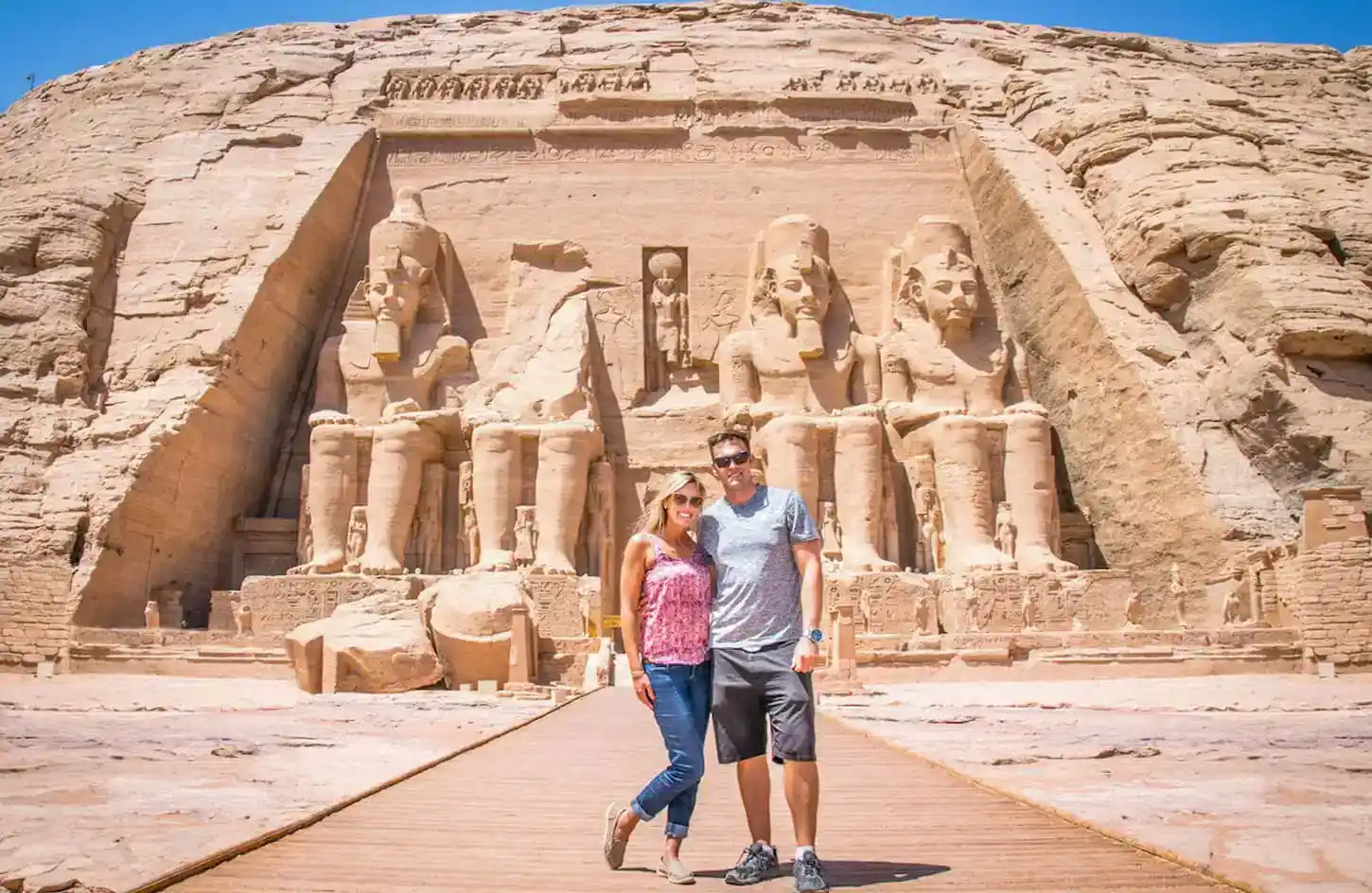
Separating those elements prevents confusion. The solar event belongs to the ancient temple. The exact public dates, crowd system, stage program, ticketing, and visitor management belong to the modern festival and can change from year to year.
How the Solar Alignment Works
A Temple Built on an Axis
The Great Temple is not a random sequence of rooms. Its entrance, halls, doorways, and sanctuary follow a central axis. The building narrows toward the rear, and openings control which parts of the interior receive direct light.
For most of the year, sunlight cannot travel deeply enough along the correct line to illuminate the sanctuary figures in the same way. Around two periods, the rising sun occupies the necessary part of the horizon. Light enters at a shallow angle and follows the temple’s axis.
The effect depends on more than compass direction. The height and shape of the eastern horizon, the sun’s altitude, the entrance width, the length of the corridor, the sanctuary arrangement, and atmospheric conditions all matter. A small change in any one of these variables can alter which figure is illuminated and on which morning the strongest effect appears.
The Journey of the Light
The light begins at the facade and passes through the entrance into the first hall, then through successive doorways toward the sacred rear chamber. The commonly repeated distance is more than 60 meters. By the time the beam reaches the sanctuary, architecture has filtered and directed it.
The effect is not comparable to switching on a spotlight. Illumination changes as the sun rises. A figure may begin in partial light, become brighter, and then lose the direct beam. The geometry creates a moving event rather than a fixed picture.
Why the Entrance Width Matters
An entrance with no depth would admit sunlight across a broad range of days. Abu Simbel’s long internal axis makes the event selective. The doorway and interior openings work together like a sightline: only sunlight arriving from a limited direction can reach the rear.
This is why scholarly discussions distinguish between the day on which sunlight first touches part of a figure, the day on which a particular figure is fully lit, and the day on which the sun rises closest to the exact temple axis. Those are related observations, but they are not necessarily identical.
The Four Sanctuary Figures
At the back of the Great Temple sit four figures usually identified, from left to right, as Ptah, Amun-Ra, the deified Ramesses II, and Ra-Horakhty. Their order matters because the sunlight does not affect each position equally.
Ptah
Ptah was a major creator god closely associated with Memphis, craftsmen, and creative power. Popular travel explanations call him simply “the god of darkness” because his statue remains unlit. That description is too narrow. Ptah’s identity was far richer, although his connections with enclosed sacred space and the underworld make the persistent shadow symbolically compelling.
Amun-Ra
Amun-Ra represented the fusion of Amun with the solar god Ra and held enormous importance in New Kingdom state religion. His presence links the Nubian temple to the religious authority of Thebes and the wider Egyptian state.
The Deified Ramesses II
Placing Ramesses among major gods is central to Abu Simbel’s message. The solar light does not merely reach a king shown making an offering. It reaches his seated divine form within the sanctuary.
Ra-Horakhty
Ra-Horakhty, a solar deity combining aspects of Ra and Horus of the Horizon, makes the sunrise connection explicit. His figure in the sanctuary relates to the solar imagery already visible above the temple entrance.
Was Ptah Deliberately Left in Shadow?
The consistent exclusion of Ptah fits the symbolic program so well that it is widely interpreted as intentional. However, cautious language is appropriate. The surviving temple does not provide a simple inscription saying, “This statue was designed never to receive sunlight because Ptah represents darkness.” Architecture, divine identity, and repeated observation support the interpretation, but the modern phrasing remains an inference.
Why February 22 and October 22?
The short answer is that these are the current official public dates on which the Egyptian authorities celebrate and manage the phenomenon. The longer answer requires separating modern calendar dates from ancient intention.
The Popular Birthday and Coronation Story
Many travel guides state that October 22 was Ramesses II’s birthday and February 22 his coronation day, or reverse the two. The claim is memorable and gives the event an easy narrative. The problem is that direct ancient evidence securely identifying those two Gregorian dates has not been demonstrated.
Ramesses lived in a culture using calendar systems very different from the modern Gregorian calendar. Ancient Egypt’s 365-day civil calendar did not use the same leap-year correction as ours, so its dates shifted relative to the solar seasons. Scholars also debate the exact year in which Ramesses began his reign. Converting a royal anniversary into October 22 or February 22 more than three millennia later is therefore not straightforward.
The responsible conclusion is not that the temple’s orientation was accidental. The precision is clear. The responsible conclusion is that the specific “birthday and coronation” labels should be presented as popular interpretations rather than settled fact.
Was the Alignment Connected to the Equinox?
Some official heritage summaries use the word “equinoxes,” but February 22 and October 22 are roughly a month away from the March and September equinoxes. The modern event is therefore not an equinox sunrise in the ordinary astronomical sense.
The temple may still relate to seasonal cycles, royal jubilees, solar theology, or more than one of those ideas. Ancient designers did not need to target a modern calendar label for the orientation to have religious and political meaning.
A Scholarly Alternative: Jubilee and Seasonal Timing
Astronomical studies have examined pre-relocation photographs, temple measurements, horizon altitude, ancient calendars, and proposed dates for Ramesses II’s reign. One line of research connects the autumn illumination with a royal jubilee and the Egyptian calendar rather than a modern birthday.
These reconstructions are valuable because they test the geometry rather than repeating tourism folklore. They are not universally accepted final answers. Ancient chronology contains competing models, and conclusions depend on assumptions about the date of the reign and the temple’s construction.
Could February Be a Geometric Counterpart?
Solar alignments often occur in pairs because the sun reaches the same rising direction once while moving northward through the year and again while moving southward. If a building faces a particular sunrise azimuth, two dates may satisfy the geometry.
That means one date could have held the primary ritual significance while the second resulted naturally from the sun’s annual path. Alternatively, both could have been meaningful. The architecture alone does not tell us which interpretation the ancient priests and builders emphasized.
This is the most honest answer to the “coincidence or design?” question: the orientation was deliberate, but the exact story attached to both modern dates remains open to interpretation.
How the 1960s Relocation Affected the Alignment
Orientation Was Preserved
When engineers moved Abu Simbel, they reproduced the temple’s direction relative to the cardinal points with extraordinary care. The internal geometry was also reconstructed block by block, allowing sunlight to continue reaching the sanctuary.
UNESCO records that the new temple sits approximately 64 meters higher and 180 meters inland. Even if the compass orientation remains the same, changing elevation changes what an observer sees on the horizon.
The Horizon Became Lower
Astronomical analysis comparing observations and photographs from the original location with the rebuilt temple argues that the apparent horizon is about 1.1 degrees lower at the new position. The sun therefore reaches the same directional relationship on a slightly different modern date.
Research by Göran Henriksson reports that the strongest comparable October illumination shifted from October 21 at the original site in 1961 to October 22 at the reconstructed site. The explanation is not that engineers rotated the temple carelessly; it is that they moved it upward, changing the horizon altitude while preserving the axis.
Why “It Shifted One Day” Is an Oversimplification
The phrase is useful but incomplete. Illumination can occur across several nearby mornings, and different parts of the sanctuary receive light at different stages. The exact “festival date” is a public convention centered on the strongest and most meaningful viewing period.
The relocation preserved the phenomenon remarkably well, but it could not reproduce the original cliff, river level, distant terrain, atmospheric conditions, and ancient calendar all at once. The continuing event should be understood as a close reconstruction of an ancient solar relationship, not a frozen astronomical clock.
Read How Was Abu Simbel Moved? for the block-cutting plan, international teams, domes, and artificial mountain.
February vs October: Which Festival Should You Choose?
Why February Is Usually More Comfortable
The pre-dawn wait can feel cool, but the later visit is generally more pleasant than in October. For older travelers, families, or anyone sensitive to heat, February usually has the advantage.
Why October Can Still Be the Better Choice
October may fit a wider Egypt itinerary more naturally, especially if you want warm weather without planning a winter holiday. It also allows travelers to continue to Aswan, a Nile cruise, Luxor, or the Red Sea during a popular shoulder-season period.
Crowd Levels Are Not a Reliable Tie-Breaker
Both dates attract domestic and international visitors, official delegations, media, and cultural programming. Crowd size depends on the year, day of the week, transport capacity, and event arrangements. Do not assume one date will be quiet.
If your priority is studying the temple rather than witnessing the light, the best choice is neither festival date. Visit on a regular early morning when access is less concentrated.
What to Expect on Festival Morning
A Very Early Start
Visitors coming from Aswan may depart in the middle of the night. Those staying near Abu Simbel still need to reach the site before dawn and follow event access instructions. Exact timing should be confirmed with the operator because crowd-control arrangements can change.
Security and Queues
Expect more security screening, vehicle congestion, and queues than on a regular day. The sanctuary is small relative to the number of people who want to see the event. Authorities may manage visitors in groups or restrict how long individuals remain in sensitive areas.
Cultural Celebrations
Music, dance, and cultural performances are often organized around the festival. These activities are modern celebrations inspired by the ancient phenomenon. They add atmosphere, but the program is not identical every year.
A Short Viewing Window
The light changes quickly. Public descriptions often cite an effect of around 20 minutes, but the visible experience depends on where you stand, how people are moved through the interior, weather, dust, and which stage of illumination is being counted.
The Reality of the View
Do not expect a private beam in a silent chamber. You may be surrounded by visitors and may see the sanctuary for only a limited period. The value lies in witnessing the temple activate in relation to the sunrise, not in obtaining a perfectly unobstructed photograph.
Festival Tickets and Advance Planning
The Ministry of Tourism and Antiquities lists special prices for February 22 and October 22. When checked in August 2026, the foreign adult price was EGP 1,200 and the foreign student price EGP 600, compared with regular-day prices of EGP 750 and EGP 375. Egyptian adult and student rates were also higher on the event dates.
These figures can change before 2027. Check the official platform or confirm through your tour operator rather than copying an old price from a blog. The complete Abu Simbel guide maintains the broader ticket table and general booking information.
Reserve transport and accommodation early. Demand rises not only for temple entry but also for Aswan vehicles, guides, flights, and hotels near Abu Simbel. A confirmed ticket without reliable pre-dawn transport is not a complete plan.
Ask the operator in writing:
- What time is pickup?
- Is the special festival ticket included?
- Is accommodation in Aswan or Abu Simbel better for the chosen arrangement?
- Where will the guide explain the event?
- How is access to the sanctuary managed?
- What happens if weather or crowd controls limit visibility?
No operator can guarantee sunlight or a particular unobstructed viewing position. A responsible booking promises logistics and guidance, not control over nature or site authorities.
Photography Tips Inside the Sanctuary
Check the Rules That Morning
Photography policies can change, and festival-day rules may be stricter than regular access. Follow signs and staff instructions. Do not assume that a camera allowed outside is permitted inside, or that a tripod, flash, or professional setup is acceptable.
Prioritize Low-Light Performance
The sanctuary remains dim except where the sunlight reaches. A phone or camera with good low-light capability will perform better than using digital zoom. If manual control is permitted and you can operate quickly, a wider aperture and higher ISO may help, but the moment is not the time to learn unfamiliar settings.
Avoid Flash
Flash can be prohibited, disruptive, and ineffective across the chamber. It also destroys the visual contrast that makes the event meaningful. If the available light is insufficient, accept some grain rather than overwhelming the scene.
Use a Wide or Normal Lens
Space is tight, and you may not be able to step backward. A wide or normal focal length is generally more practical than a long lens. Keep equipment compact so you can move safely and avoid blocking others.
Stabilize Without a Tripod
Tripods are likely to be impractical in a crowded sanctuary and may be restricted. Brace your elbows, use image stabilization, take short bursts if allowed, and concentrate on holding the camera steady.
Expose for the Lit Figures
The contrast between the bright beam and dark chamber can fool automatic exposure. Tap or meter on the illuminated stone so the highlights do not become a blank white patch. A slightly darker image usually preserves more atmosphere and detail.
Remember That Seeing Comes First
The event lasts minutes, and access may be brief. Take a few deliberate frames, then look directly. Many visitors leave with dozens of hurried images but little memory of the light moving across the sanctuary.
The Festival’s Meaning Today
For ancient builders, orientation joined architecture with divine and royal symbolism. For modern Egypt, the event also celebrates scientific ingenuity, tourism, Nubian heritage, and the successful rescue of the temples.
The festival’s global audience gives Abu Simbel a rare continuity. Ancient rulers used the sunrise to animate a sacred royal image; modern engineers preserved the axis; contemporary visitors gather to watch the relationship repeat.
That continuity should not erase Nubia. Abu Simbel stood in a populated cultural landscape transformed by the High Dam and the displacement of Nubian communities. Celebrating the rescue of the monument is compatible with acknowledging the human and archaeological landscapes that could not be preserved in the same way.
The best interpretation therefore holds several truths together: the temple is an ancient Egyptian masterpiece built in Nubia, the solar design remains partly debated, the modern relocation was extraordinary, and the festival is a contemporary event shaped by heritage management as well as astronomy.
Sun Festival vs a Regular Abu Simbel Visit
Choose the festival if witnessing the solar event is a personal priority. Choose a regular visit if you care more about space, detailed guiding, and photography of the architecture.
Frequently Asked Questions About the Sun Festival
When is the Abu Simbel Sun Festival?
The current official dates are February 22 and October 22 each year. Event schedules and admission arrangements should be reconfirmed before travel.
What time does the solar alignment happen?
It occurs around sunrise. Exact viewing and entry times depend on the date, atmospheric conditions, and event management, so follow the official or operator schedule rather than relying on a generic clock time.
Which statues are illuminated?
The light reaches Amun-Ra, the deified Ramesses II, and Ra-Horakhty. Ptah remains in shadow.
Why does Ptah remain dark?
His position and associations make the shadow symbolically meaningful, and the effect is widely regarded as deliberate. However, the familiar phrase “god of darkness” simplifies Ptah’s much broader role in Egyptian religion.
Do the dates mark Ramesses II’s birthday and coronation?
That is a popular interpretation, not a securely proven fact. The ancient calendar and uncertainty over Ramesses’ chronology make direct conversion to modern Gregorian dates difficult.
Did moving Abu Simbel change the event date?
The temple’s orientation was closely preserved, but the higher location changed the apparent horizon. Research comparing the original and current settings indicates an approximately one-day shift in the strongest comparable October illumination.
Is February or October better?
February is normally more comfortable because temperatures are cooler. October may suit an autumn itinerary better. Both dates are busy and require advance planning.
How long does the light stay on the statues?
The visible pattern evolves over minutes, and roughly 20 minutes is commonly cited for the main public effect. The actual experience varies with weather, crowd access, and how the interval is defined.
Can I photograph the alignment?
Possibly, but interior and festival-day photography rules can change. Flash, tripods, or professional equipment may be restricted. Follow instructions from site staff.
Can I see the same effect on a normal day?
You can still appreciate the temple’s axis and sanctuary, but the celebrated direct illumination occurs around the two festival periods. A regular day offers a quieter experience rather than the same solar event.
Final Thoughts
The Abu Simbel Sun Festival is impressive precisely because it resists a simple explanation. The ancient builders oriented a rock-cut temple so carefully that sunrise could animate its deepest sacred space. Modern engineers preserved that relationship after moving the entire monument uphill. Today’s festival then adds another layer of public celebration.
The birthday-and-coronation story may remain popular, but visitors lose nothing by approaching it critically. The real achievement is larger than a neat anniversary claim: architecture, landscape, kingship, theology, astronomy, and modern conservation all meet in a few minutes of changing light.
For the temple’s original history and symbols, read Abu Simbel Temple Facts. For road, flight, hotel, and ticket planning, use the complete Abu Simbel guide.
☀️ Planning for February 22 or October 22? Pure Nile Tours can coordinate festival transport, guiding, admission planning, and accommodation around the official event schedule. Plan Your Abu Simbel Sun Festival Visit →
Sources and Further Reading
- Egyptian Ministry of Tourism and Antiquities: Abu Simbel
- Egyptian Ministry event record: Biannual Solar Alignment
- UNESCO World Heritage: Nubian Monuments from Abu Simbel to Philae
- Göran Henriksson, “Rameses II and Sunrise at the Great Abu Simbel Temple,” for measurements, pre-relocation photographs, horizon analysis, and chronological interpretation.