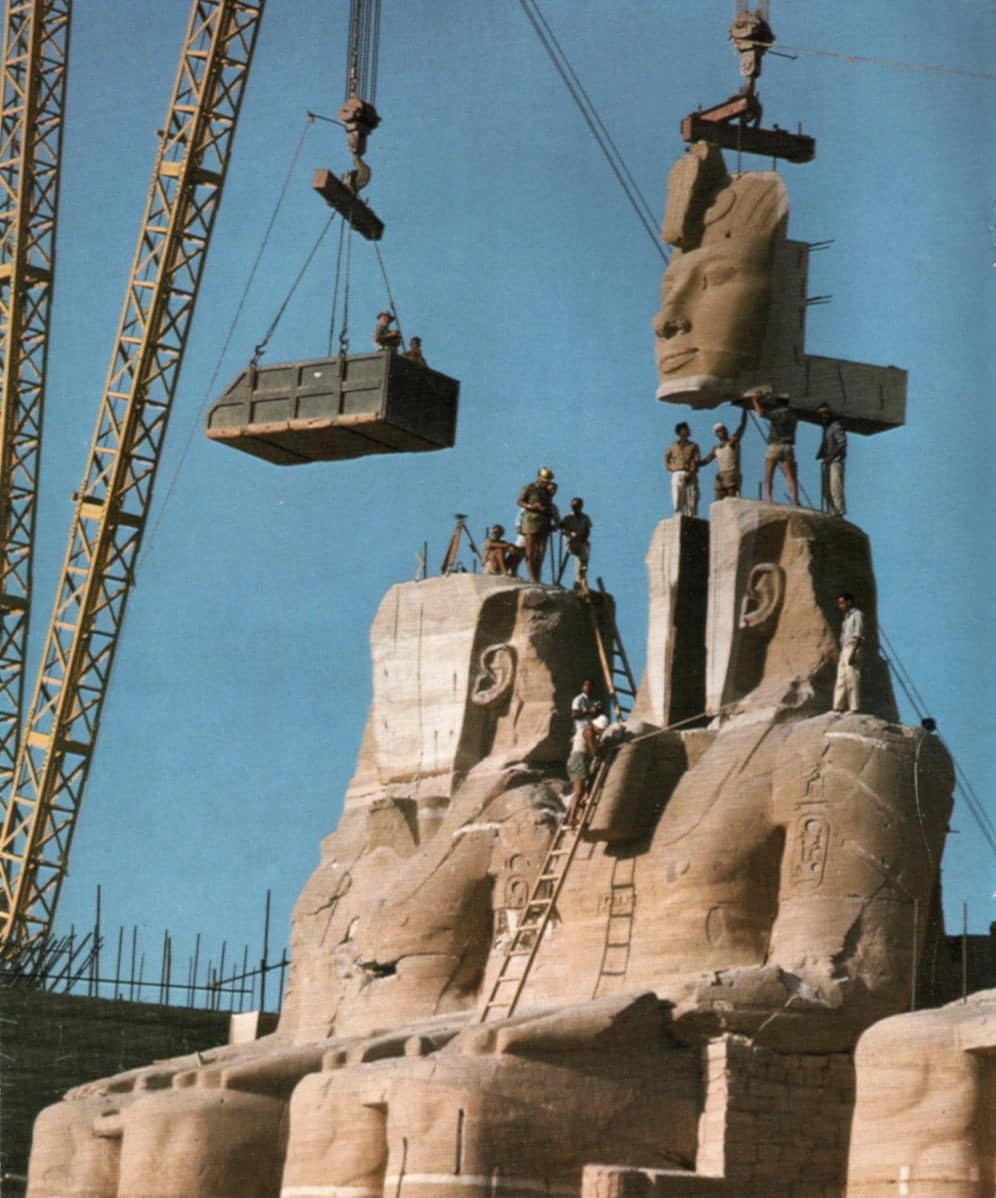
In the early 1960s, Abu Simbel faced a deadline measured not in centuries but in the rising level of a new reservoir. The two temples had been carved into a sandstone cliff more than 3,000 years earlier. They could not be lifted as intact buildings, and leaving them in place would mean losing them beneath Lake Nasser. The solution was radical: document the monument, cut it into more than a thousand pieces, move those pieces uphill, and rebuild the temples inside an artificial mountain.
This is the engineering story of how Abu Simbel was moved, who made the rescue possible, what could have gone wrong, and why the project changed the world’s approach to cultural heritage. For tickets, transport, and visit planning, use our complete Abu Simbel guide.
The Abu Simbel Relocation: Quick Facts
Why Did Abu Simbel Have to Be Moved?
The Aswan High Dam
Egypt decided in 1954 to build the Aswan High Dam. The project promised year-round control of Nile water, expanded irrigation, protection from destructive floods and droughts, and major hydroelectric generation. It was central to Egypt’s modernization strategy.
The dam also created an immense reservoir. Lake Nasser would extend south from Aswan into Sudan through the historic region of Nubia. Settlements had to be relocated, landscapes disappeared, and archaeological sites faced permanent flooding. Abu Simbel stood in the threatened zone.
UNESCO’s record describes temples and monuments endangered across Egyptian and Sudanese Nubia. Some would eventually sit under roughly 50 meters of water. The problem was not limited to two famous facades; it involved an entire cultural landscape containing temples, forts, cemeteries, settlements, inscriptions, and evidence of interaction between Egypt and Nubia.
An Engineering Deadline
The reservoir would not wait for ideal research conditions. Surveyors, archaeologists, engineers, governments, and funders had to work while dam construction advanced and water levels rose. Any rescue plan needed to protect the monument and finish in time.
Abu Simbel was especially difficult because its temples were not assembled buildings that could simply be taken apart at existing joints. Their halls, pillars, statues, and reliefs were carved into living rock. Moving them meant turning part of a mountain into transportable architecture without losing the surfaces that made it significant.
UNESCO’s International Campaign
Egypt and Sudan requested UNESCO’s help in 1959. On March 8, 1960, UNESCO launched the International Campaign to Save the Monuments of Nubia. The appeal framed the endangered sites as heritage whose value extended beyond national borders.
The response was unprecedented. Governments, archaeologists, architects, engineers, museums, companies, and the public contributed funds and expertise. UNESCO says around 30 countries formed national committees, while roughly 50 countries donated half of the broader campaign’s total cost. Forty technical missions from five continents participated, and 22 monuments and complexes were saved.
UNESCO served as coordinator and intermediary between donor states and the Egyptian and Sudanese governments. An executive committee and trust fund helped manage the campaign. The rescue combined excavation, recording, object recovery, architectural dismantling, and complete relocation.
This distinction matters: the often quoted figure of approximately US$80 million refers to the broad Nubian campaign described by UNESCO, not simply to the cutting of Abu Simbel. Contemporary summaries of Abu Simbel alone often cite a figure near US$40 million. Presenting those numbers as if they describe the same scope creates confusion.
Choosing a Rescue Method
Before the block-cutting solution was accepted, specialists explored multiple ideas. Could the temples remain underwater behind a transparent viewing enclosure? Could an enormous dam or protective barrier isolate them? Could the cliff be lifted? Could the monuments be enclosed and raised in giant sections?
Each concept had serious limitations. Underwater preservation introduced questions about visibility, water pressure, leakage, long-term maintenance, and the effect of a submerged environment on sandstone. Large protective walls could be extraordinarily expensive and visually destructive. Lifting the temple in very large masses increased structural risk and demanded equipment at a scale difficult to deploy in remote Nubia.
The selected plan, developed with Swedish engineering involvement, accepted that the temples would be cut. That sounds destructive, but controlled segmentation offered three major advantages:
- The pieces could be kept within lifting capacities available at the time.
- Every section could be documented and placed precisely in the reconstruction.
- The work could proceed quickly enough to beat the rising reservoir.
The decision was still frightening. Sandstone can fracture unpredictably, relief surfaces are irreplaceable, and each cut permanently alters ancient fabric. The chosen method was not risk-free; it was the most workable balance among risk, time, cost, and preservation.
The Engineers and Countries Behind the Project
It is convenient to say “UNESCO moved Abu Simbel,” but UNESCO coordinated a much larger network. Egypt owned and directed the national heritage response, UNESCO mobilized international cooperation, and specialist companies designed and executed the engineering.
The Swedish consulting firm Vattenbyggnadsbyrån, commonly abbreviated VBB, was central to the accepted block-relocation concept and the design work. An international contractor consortium then carried out the site operation. Historical project accounts identify firms and expertise from Egypt, Germany, France, Italy, and Sweden, among others.
The Italian contractor associated with the dismantling records that the temples were divided into 1,030 blocks. Specialized stone cutters, surveyors, crane operators, geologists, structural engineers, architects, photographers, conservators, archaeologists, draftspeople, and laborers all contributed.
This mix of disciplines was essential. An engineer could calculate loads but needed a conservator to define acceptable contact with ancient surfaces. An archaeologist could identify important details but needed surveyors to record their position. Crane teams could lift the pieces only after cutters, bracing crews, and structural specialists made the operation safe.
The project was also logistically international. Heavy equipment, saws, drilling systems, construction materials, technical drawings, and spare parts had to reach a remote desert site. Workers needed housing, water, power, medical support, communication, workshops, and protection from extreme heat.
How Engineers Moved Abu Simbel Step by Step
Step 1: Documenting the Original Temples
Before cutting, the team needed a detailed record of the original site. Surveying and photogrammetry captured dimensions, orientation, surface details, and spatial relationships. Drawings mapped the facade, chambers, pillars, sanctuary, surrounding rock, and individual sections.
Documentation served two purposes. It created an archaeological record in case material was damaged, and it became the instruction manual for reconstruction. A numbering system would be meaningless without an accurate map showing where every piece belonged.
The temple’s solar orientation added another demand. Engineers had to reproduce the axis and relationship to the horizon closely enough for sunlight to continue penetrating the sanctuary.
Step 2: Protecting the Site from Water
Lake Nasser was rising as the work continued. Temporary water-control structures and pumping protected the work zone and bought time. The project had to manage seepage as well as visible surface water.
This stage is easily overlooked because it does not produce iconic photographs of cranes and statues. Yet without dry and stable conditions, cutting and lifting would have been impossible. Water control was the shield behind which the archaeological work could proceed.
Step 3: Stabilizing the Temples
The temples were part of a cliff. Removing surrounding rock changed the forces acting on ceilings, walls, and carved surfaces. Engineers installed temporary supports and protective structures inside and around the monuments.
Loose material above the facades had to be removed carefully. Vibrations from equipment could open cracks or damage reliefs. Teams adjusted methods as they approached ancient surfaces, using increasingly controlled tools and manual work where necessary.
The monumental heads and carved planes were not uniform blocks of perfect stone. Natural layers, ancient fractures, weathering, and previous earthquake damage all had to be understood before a cut or lift.
Step 4: Planning the Cut Lines
Cut lines could not be placed randomly. Wherever possible, engineers avoided faces, hieroglyphs, and visually important details. They balanced conservation with structural logic: a piece too large might crack under its own weight, while too many small pieces would multiply joints and handling.
The cut grid transformed continuous architecture into a controlled set of transportable units. Each block received an identity linked to surveys and reconstruction drawings. Orientation marks ensured that a piece could not be reversed or misplaced.
Step 5: Cutting More Than a Thousand Blocks
UNESCO describes workers using wire saws beginning in late 1963. The two temples were ultimately separated into more than a thousand blocks, commonly around 30 tons each. The contractor Webuild records a total of 1,030 pieces.
Cutting sandstone demanded precision. Tools had to pass through the rock while limiting vibration and avoiding loss along the visible edge. The cut faces were modern interventions, but the ancient decorated surfaces had to remain intact.
The operation included the colossal facade, interior walls, ceilings, pillars, sanctuary figures, and the Small Temple. It was not simply a matter of removing four statues and rebuilding a doorway.
Step 6: Lifting, Transporting, and Storing the Pieces
After separation, blocks were braced and lifted by cranes. Their weight, center of gravity, and fragile surfaces determined how slings and supports were positioned. A lift that rotated unexpectedly could damage an irreplaceable relief.
The pieces were moved to temporary storage and then toward the new location. Storage needed to preserve the numbering system and make the later sequence of reconstruction practical. Managing information was almost as important as moving stone: one lost identification could delay an entire wall.
Step 7: Preparing the New Site
The replacement location was selected above the future water level while remaining near the original landscape. UNESCO gives the new position as roughly 64 meters higher and 180 meters inland. Other sources round those figures to 65 and 200 meters, but the UNESCO measurements are more precise.
Foundations and structural systems had to be constructed before the ancient material could return. Unlike the original temple, which depended on natural rock, the new version would use modern engineering to carry loads and create the internal voids.
Step 8: Reassembling the Temples
Teams reconstructed the facades and interiors block by block according to the survey and numbering system. Joints were treated and visually minimized without pretending the move had never occurred. The process had to reproduce dimensions, align relief scenes, and maintain the progression of rooms.
The broken ancient colossus remained broken. This decision preserved a historical event rather than restoring the facade to an imagined perfect state.
Step 9: Building the Domes and Artificial Mountain
The new temples could not be left as stone shells exposed behind their facades. Large engineered domes created structural enclosures over the reconstructed interiors. Rock and fill then formed artificial hills that reproduced the appearance of monuments cut into a cliff.
This was a philosophical as well as technical choice. The setting was part of Abu Simbel’s meaning. A facade standing in a modern frame would preserve sculpture but lose the experience of architecture carved into a mountain. The artificial cliff protected that relationship as convincingly as the technology allowed.
Step 10: Recreating the Orientation
Surveyors reproduced the temples’ orientation relative to the cardinal directions. The famous solar illumination still occurs, although research comparing photographs from the original location with the rebuilt temple indicates a shift related to the changed horizon altitude.
The essential engineering achievement is not that nothing changed. A relocation of this scale could not reproduce every environmental variable. The achievement is that the axis and interior geometry were preserved closely enough for the phenomenon to continue.
Read the specialist Abu Simbel Sun Festival guide for the one-day-shift evidence and the debate over the event’s ancient dates.
What Could Have Gone Wrong?
Sandstone Fracture
Sandstone is composed of grains bound together rather than a single crystalline mass. Hidden weaknesses could cause a block to split during cutting, lifting, transport, or reassembly. Damage might cross a face, inscription, or irreplaceable scene.
Vibration Damage
Heavy equipment was necessary, but vibration threatened fragile rock. Excavation methods had to become gentler near ancient surfaces, and temporary reinforcement reduced movement inside the temples.
Survey or Numbering Errors
A block installed in the wrong sequence could disrupt reliefs and dimensions. Redundant records, clear numbering, drawings, photographs, and controlled storage were essential defenses against human error.
Water Arriving Too Soon
The project operated against a rising reservoir. Delays in funding, equipment delivery, cutting, or construction could have left the work zone exposed before the temples were safe.
Structural Failure at the New Site
The artificial domes and foundations had to support enormous loads while protecting the reassembled interiors. Settlement or movement could crack joints and ancient surfaces. Modern structure had to remain strong without dominating the visible monument.
Losing the Temple’s Context
Even a technically successful move could have produced a museum-like object detached from its landscape. Recreating the cliff and keeping the complex close to its original location attempted to preserve visual and spiritual context as well as stone.
Altering the Solar Phenomenon
The temple’s axis could be copied, but the horizon from a position 64 meters higher was not identical. The continued illumination demonstrates remarkable accuracy, while its subtle timing difference reveals the limit of reproducing a natural setting.
Abu Simbel Before and After the Move
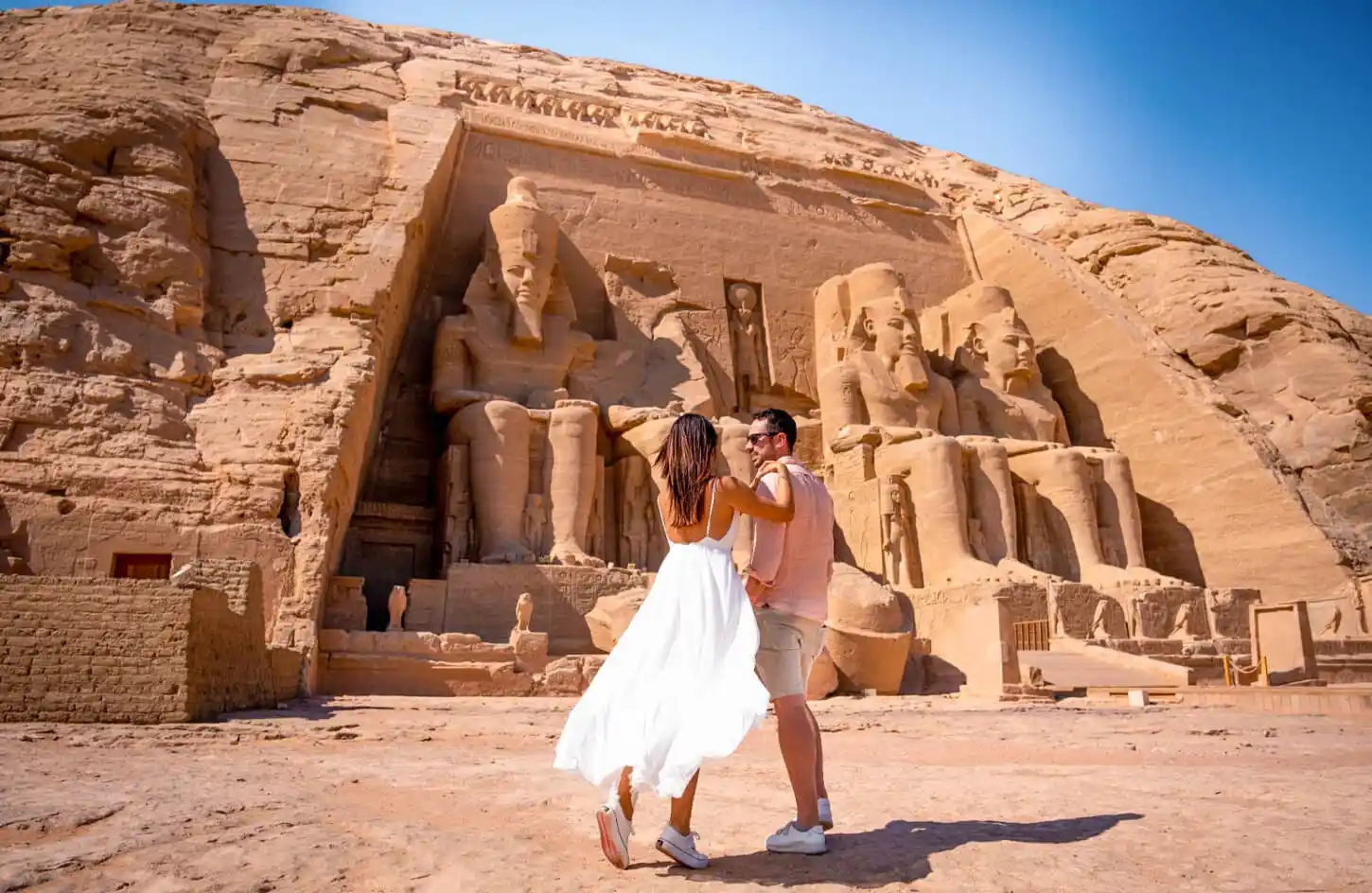
The current site is therefore neither an untouched original location nor a replica. It is an original monument reconstructed in a modern protective landscape.
Other Nubian Monuments Saved
Philae
Philae’s temples, centered on the cult of Isis, were dismantled and moved to higher Agilkia Island. Their rescue continued after Abu Simbel and was completed within the broader UNESCO campaign. The new island was shaped to echo aspects of Philae’s original setting.
Kalabsha, Beit el-Wali, and Qertassi
These monuments were reassembled near the High Dam. Their grouping created a new archaeological setting from structures that had originally occupied separate locations.
Amada, Derr, and Pennut’s Tomb
The temples of Amada and Derr and the tomb of Pennut were moved and grouped near the former site of Amada. Amada required especially careful treatment because of its painted interior decoration.
Wadi es-Sebua, Dakka, and Maharraqa
These temples were reassembled together near the new Wadi es-Sebua site, preserving major examples from different periods.
Temples Given to Contributing Countries
Egypt donated four temples in gratitude for international assistance: Debod to Spain, Taffa to the Netherlands, Dendur to the United States, and Ellesyia to Italy. Their presence in Madrid, Leiden, New York, and Turin extends the story of the Nubian campaign far beyond Egypt.
These projects used different methods because not every monument had the same structure, material, decoration, or site conditions. Abu Simbel became the symbol of the campaign, but it was one chapter in a much larger rescue.
How the Rescue Changed World Heritage
The International Campaign demonstrated that countries could treat threatened heritage as a shared responsibility. It did not erase the difficult questions raised by relocation, development, displacement, or the removal of monuments from their original landscapes. It did, however, create a powerful model for international action.
UNESCO states that the campaign helped spur the development of the World Heritage Convention, adopted in 1972. The Nubian Monuments from Abu Simbel to Philae were inscribed on the World Heritage List in 1979 under criteria recognizing creative achievement, cultural testimony, and association with ancient Egyptian history.
The project also influenced conservation practice. It showed the value of systematic documentation, interdisciplinary teams, international funding, and long-term management. At the same time, it remains a reminder that relocation is an emergency response, not an easy substitute for preserving a monument in place.
Relocation Timeline
Frequently Asked Questions About the Relocation
Why was Abu Simbel relocated?
The reservoir created by the Aswan High Dam would have submerged the original site. Relocation placed the temples permanently above the new water level.
How many pieces was Abu Simbel cut into?
UNESCO describes more than a thousand numbered blocks. Webuild, connected with the dismantling contractor, gives the more specific total of 1,030.
How heavy were the blocks?
UNESCO states that the blocks weighed around 30 tons each. Exact weights varied according to size, shape, material condition, and location.
How far did the temples move?
UNESCO records the new site as approximately 64 meters higher and 180 meters inland from the original location.
Who organized the project?
UNESCO coordinated the international campaign with Egypt, Sudan, contributing countries, committees, technical missions, consultants, and an international contractor consortium.
Are the artificial hills solid rock?
No. Modern structural domes and engineered construction support and enclose the reassembled temple spaces. The exterior was shaped and covered to reproduce the appearance of rock-cut temples within a cliff.
Were the joins hidden completely?
The reconstruction minimized their visual impact, especially from normal viewing distances, but close observation can reveal evidence of segmentation. Conservation aimed to preserve coherence without denying the physical reality of the move.
Was the broken statue damaged during relocation?
No. The colossus had collapsed after an earthquake in antiquity. The rescue team preserved the fallen arrangement as part of the monument’s history.
Was Abu Simbel the only monument saved?
No. The wider campaign saved 22 monuments and complexes, including Philae, Kalabsha, Amada, Derr, Wadi es-Sebua, and others across Egyptian and Sudanese Nubia.
Final Thoughts
Abu Simbel was not moved by a single machine, company, or nation. It was saved through a chain of decisions: recognizing the threat, defining the monuments as shared heritage, raising international funds, rejecting unworkable concepts, documenting every surface, accepting controlled cutting, and rebuilding both architecture and landscape before the water arrived.
The result is not invisible engineering. The artificial mountain, modern supports, reconstructed joints, and altered horizon are part of the site’s story. That honesty makes the achievement more impressive. The project preserved ancient material while creating one of the twentieth century’s most influential monuments to international cooperation.
For the temple’s ancient history and symbolism, read Abu Simbel Temple Facts. For planning a visit from Aswan or Cairo, use the complete Abu Simbel guide.
🏗️ See the engineering achievement in context. Pure Nile Tours arranges private Abu Simbel visits with expert guiding and transport from Aswan. Plan Your Abu Simbel Visit →