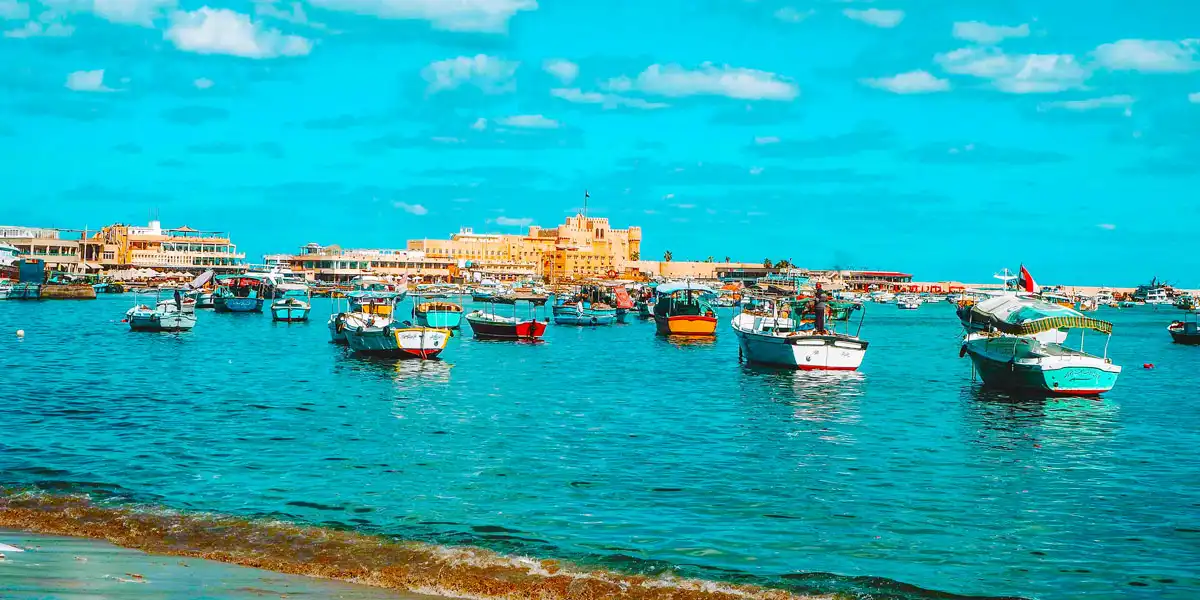
Alexandria things to see span 2,300 years without a gap — underground Roman catacombs, a 15th-century sea fortress built on the ruins of an ancient Wonder of the World, one of the largest modern libraries on Earth, and a 15-kilometer Mediterranean waterfront lined with cafés and fishing boats. Founded by Alexander the Great in 331 BCE, this coastal city feels unlike anywhere else in Egypt: less pharaonic, more Greco-Roman, and cooled by sea breezes that Cairo never gets. This guide covers every major attraction, practical logistics, and honest tips for 2026.
Alexandria at a Glance
- Location: Mediterranean coast, 220 kilometers northwest of Cairo
- Best for: Greco-Roman history, coastal atmosphere, seafood, a break from Cairo’s intensity
- Ideal visit length: 1 day (day trip from Cairo) to 3 days (independent stay)
- Best seasons: March–June and September–November (mild, crowd-free)
- Currency: Egyptian Pound (EGP); cash preferred at most attractions
- Language: Arabic; English spoken at all tourist sites and major hotels
- Top 5 highlights: Bibliotheca Alexandrina, Citadel of Qaitbay, Catacombs of Kom el Shoqafa, the Corniche, Montazah Palace Gardens
Daily budget ranges for Alexandria:
| Budget style | Accommodation (per night) | Food (per day) | Transport & entry fees | Total per day |
|---|---|---|---|---|
| Budget | $20–40 | $10–18 | $10–20 | $40–78 |
| Mid-range | $60–120 | $25–45 | $20–40 | $105–205 |
| Luxury | $150–350+ | $60–120 | $40–80 | $250–550+ |
Exchange rates fluctuate — verify current rates before travel.
⚠️ Safety Notice Alexandria is one of Egypt’s safer cities for tourists, with a strong police presence in all major tourist areas. Standard precautions apply: use Uber or Careem for transport, avoid unmarked taxis, and keep valuables secured in crowded markets. At the time of writing, no specific travel advisories target Alexandria city itself — but always check your government’s official advisory before booking: UK FCDO | US State Department | Australian DFAT.
Why Alexandria Stands Apart from the Rest of Egypt
Every other major Egyptian city is defined by the Nile and the desert. Alexandria faces the Mediterranean. That single geographical fact shapes everything: the light is softer, the air carries salt and humidity, the architecture mixes Ottoman and Italian colonial with art deco, and the food leans heavily on fresh fish.
Alexandria offers an excellent glimpse into the role the Greeks and Romans played in the development of Egypt. Founded by Alexander the Great, it was a major cultural hub during the Hellenistic period between 323 and 31 BC. Today it is a laid-back, sophisticated port city full of historic attractions ranging from Roman ruins to subterranean catacombs. Viator
The city’s ancient reputation rested on two structures: the Great Library, which held the world’s largest collection of knowledge for centuries, and the Lighthouse of Alexandria — one of the Seven Wonders of the Ancient World. Neither survives in its original form, but both have modern successors worth visiting. The contrast with Cairo’s intensity is palpable within minutes of arriving.
Top Alexandria Things to See
The quick-reference table below covers all ten major attractions with entry costs and recommended visit time:
| Attraction | Entry fee (approx.) | Time needed | Best time to visit |
|---|---|---|---|
| Bibliotheca Alexandrina | EGP 60–100 | 2–3 hours | Morning |
| Citadel of Qaitbay | EGP 60 | 1.5–2 hours | Late afternoon |
| Catacombs of Kom el Shoqafa | EGP 180 | 1–1.5 hours | Morning |
| Roman Amphitheatre (Kom el Dikka) | EGP 100 | 1–1.5 hours | Morning |
| Pompey’s Pillar and Serapeum | EGP 100 | 45–60 minutes | Anytime |
| Alexandria National Museum | EGP 100 | 1.5–2 hours | Afternoon |
| Montazah Palace and Gardens | EGP 20 (gardens) | 1.5–2 hours | Late afternoon |
| The Corniche | Free | Open-ended | Sunset |
| Royal Jewelry Museum | EGP 100 | 1–1.5 hours | Afternoon |
| Stanley Bridge and Beaches | Free | Open-ended | Morning or evening |
Prices as of early 2026 — confirm with official sources before visiting as fees change periodically.
1. Bibliotheca Alexandrina
The Bibliotheca Alexandrina is the most architecturally striking building in Egypt after the pyramids themselves. Opened in 2002 on the waterfront site of the ancient Great Library, the building was designed by the Norwegian firm Snøhetta as a giant tilted disc — a rising sun over the Mediterranean. Its outer granite wall is engraved with characters from over 120 of the world’s scripts, a visual statement about Alexandria’s ancient role as a crossroads of civilizations.
Inside, the main reading room descends through eleven terraced levels under a glass-paneled roof that floods the space with natural light. The room can accommodate over 2,000 readers simultaneously. Beyond the library itself, the Bibliotheca houses six permanent museums: the Antiquities Museum (Greco-Roman and early Christian artifacts), the Manuscript Museum (rare ancient texts and scrolls), a Sadat Memories Museum, a History of Science Museum, a Impressionism Art Museum, and a Planetarium Science Center with a full dome theater.
The Manuscript Museum with its magnificent collection of ancient texts and scrolls and the Antiquities Museum with its Greco-Roman antiquities and statuary found during underwater exploration in the harbor are the two prime attractions inside the complex.
Practical details: Entry costs EGP 60 for adults (EGP 30 for students). Opening hours are 09:00–17:00 Saturday through Thursday; closed Fridays. The planetarium dome shows run on a separate schedule — confirm at the ticket desk. Audio guides are available in English, French, and Arabic. Photography is permitted throughout except in some manuscript display areas.
2. Citadel of Qaitbay
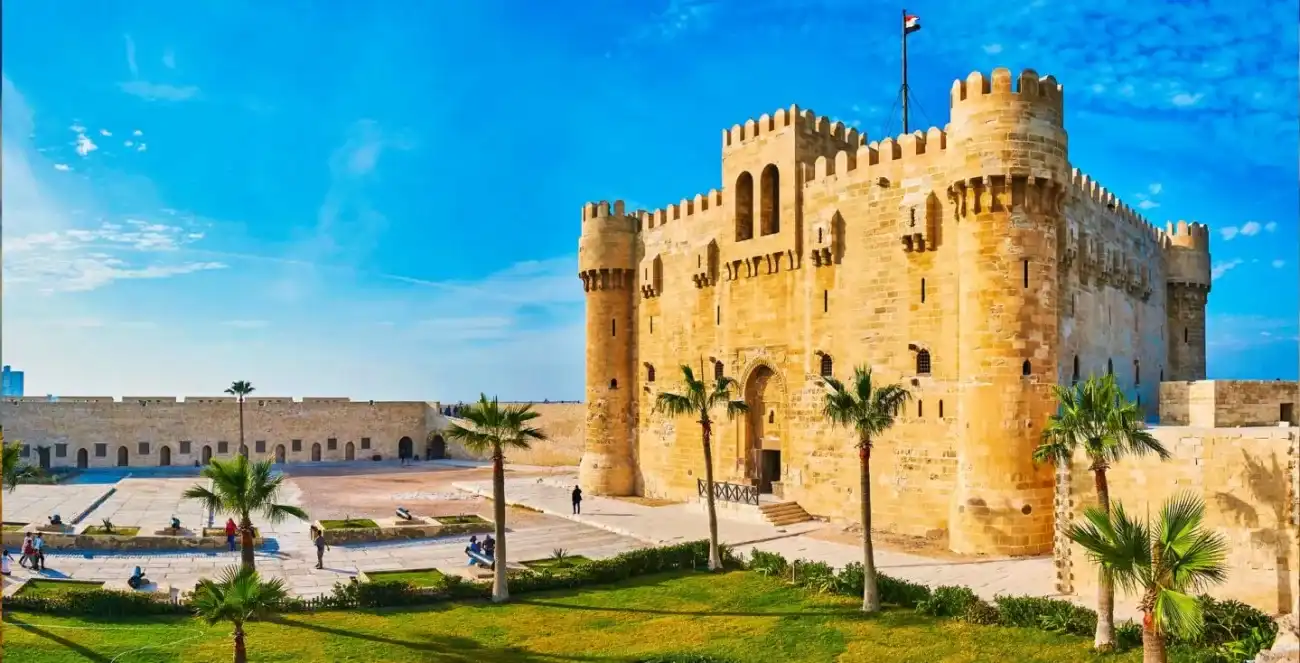
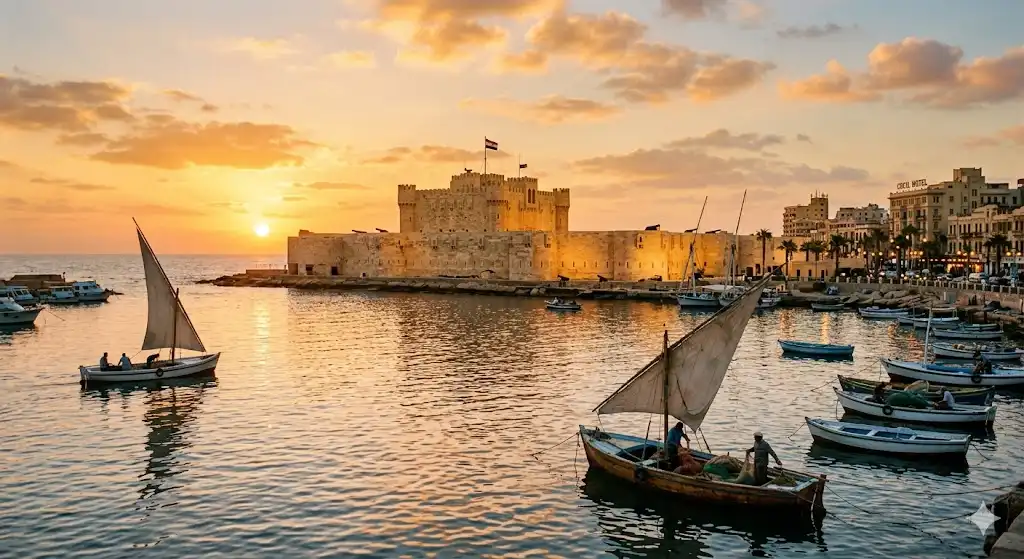
The Citadel of Qaitbay sits at the tip of the Eastern Harbour peninsula, built directly on the ruins of the Lighthouse of Alexandria. Built on the site of the Lighthouse of Alexandria — one of the longest-surviving Seven Wonders of the Ancient World — the 15th-century Citadel offers sweeping city views, a small museum housing maritime relics and aquariums, and three pillars that likely date from the lighthouse itself.
Mamluk Sultan Qaitbay ordered construction between 1477 and 1479 AD using limestone blocks, many of which came from the lighthouse ruins. The result is a compact but imposing sea fortress — three stories of thick walls, corner towers, and a central keep — that has defended Alexandria’s harbor for over 500 years. From the battlements, the view across the Eastern Harbour to the Corniche and the city skyline is one of Alexandria’s best panoramas.
The small museum inside the keep contains anchors, cannons, maritime navigation instruments, and several aquarium tanks with Red Sea and Mediterranean species — an unexpected addition that children find engaging. Three granite columns in the courtyard are believed to be original lighthouse material.
Practical details: Entry is approximately EGP 60. Opening hours are 09:00–17:00 daily. The citadel is at the far western end of the Corniche — Uber from the city center takes about 15 minutes. Afternoon light from around 15:00 onward is the best for photography, with the sun behind the city and the harbor glittering in front.
3. Catacombs of Kom el Shoqafa
The Catacombs of Kom el Shoqafa are the most extraordinary underground monument in Egypt outside the Valley of the Kings. Discovered accidentally in 1900 when a donkey fell through the ground into the upper chamber, the catacombs were carved in the 2nd century AD and served as a private family tomb that expanded into a public necropolis over the following two centuries.
The design fuses ancient Egyptian, Hellenistic, and Roman elements in a way that is pure Alexandria: Anubis, ancient Egypt’s jackal-headed deity of the dead, appears dressed as a Roman soldier and sporting a snakey appendage borrowed from a Greek god.
A spiral staircase descends approximately 30 meters through three levels. The main burial hall on the second level holds a triclinium (a Roman dining room where relatives held commemorative feasts), three rock-cut sarcophagi, and elaborately carved antechambers. The third level is partially flooded but visible through the water’s surface. The carving quality throughout is exceptional — the lion-headed Anubis figures flanking the burial vestibule are among the finest examples of syncretic art from the Roman period.
Practical details: Entry costs approximately EGP 180. The site is open 09:00–17:00 daily. Wear closed shoes — the descent involves wet stone steps. The space is well-lit but narrow in sections; claustrophobic visitors may prefer to limit themselves to the upper two levels. No flash photography on the carved surfaces.
4. Roman Amphitheatre at Kom el Dikka
The Roman Amphitheatre at Kom el Dikka is Alexandria’s only intact ancient theater and one of the best-preserved Roman structures in Egypt. Built in the 2nd century AD, it seats approximately 700 spectators across 13 tiers of white marble, arranged in a semicircle around a central performance space. Unlike most Egyptian ancient monuments, it remained in use for public performances through the Byzantine period before being buried and forgotten.
Excavations beginning in the 1960s revealed not just the theater but an entire urban quarter beneath modern Alexandria: mosaic-floored villas, Roman baths, lecture halls (likely part of ancient Alexandria’s famous school of philosophy), and an elaborate water cistern system. The mosaics, some still in situ, depict geometric patterns and stylized birds in excellent preservation.
The site sits in the middle of the modern city, bordered by apartment buildings on three sides — which makes the excavated space feel genuinely archaeological rather than tourist-packaged. Entry includes access to the entire Kom el Dikka excavation zone. Allow 90 minutes to walk the full site including the villa mosaics.
Practical details: Entry is approximately EGP 100. Open 09:00–17:00 daily. The theater faces southeast; morning visits before 11:00 avoid direct glare on the marble seating. A trained site guide adds significant value here — the chronological layers of the excavation are not obvious from signage alone.
5. Pompey’s Pillar and the Serapeum
Pompey’s Pillar is the largest ancient monolith in Egypt outside Luxor and Aswan — a single red Aswan granite column standing 26.85 meters tall, erected in 297 AD in honor of Emperor Diocletian. The name “Pompey’s Pillar” is a medieval misnomer; the Roman general Pompey was assassinated in Alexandria in 48 BC, long before the column was raised. A carved Greek inscription on the base confirms its dedication to Diocletian.
The pillar stands on the ruins of the ancient Serapeum — a massive temple dedicated to Serapis, the Ptolemaic fusion deity that combined elements of Osiris and the Greek gods. The Serapeum complex once rivaled the Bibliotheca Alexandrina in cultural importance; it was destroyed by Christian mobs in 391 AD. Two pink granite sphinxes flank the base of the pillar, and the underground passageways of the Serapeum — where sacred Apis bulls were buried — are visible through a metal grating.
Practical details: Entry is approximately EGP 100 combined with the Serapeum underground access. Open 09:00–17:00 daily. The site is small — allow 45 to 60 minutes. It combines naturally with the Catacombs of Kom el Shoqafa, located just 500 meters away, into an efficient morning half-day.
6. Alexandria National Museum
The Alexandria National Museum occupies a restored Italian-style palace on Tariq el-Horreya (the main central boulevard), three floors of which display over 1,800 artifacts from all periods of Alexandria’s history — pharaonic, Greco-Roman, Coptic, and Islamic. The museum opened in 2003 and is consistently undervisited relative to its quality.
The basement level focuses on the underwater discoveries from Alexandria’s Eastern Harbour — statues, columns, and architectural fragments recovered from what was once the royal quarter of the Ptolemaic city, now submerged beneath the sea. The colossus of a Ptolemaic queen, recovered from the harbour, is the centerpiece display.
The ground floor covers the Greco-Roman period with coins, jewelry, glassware, and the famous gold Serapis head. The upper floor moves through Coptic and Islamic Alexandria. Unlike Cairo’s Egyptian Museum, the National Museum’s English labeling is clear and informative throughout — a genuinely self-guided experience that works without a separate guide.
Practical details: Entry is approximately EGP 100. Open 09:00–17:00 daily except Tuesdays. Photography is allowed throughout. The museum café in the garden serves decent coffee and light snacks — a practical midday stop if you are covering multiple sites in one day.
7. Montazah Palace and Royal Gardens
Montazah Palace was the summer residence of Egypt’s royal family — primarily King Farouk, Egypt’s last monarch, who used it until the 1952 revolution. The main palace building (not open to the public) sits on a bluff above the Eastern Harbour, a blend of Ottoman and Florentine architecture built in the early 20th century. The royal gardens surrounding it cover 150 acres of manicured lawns, pine forests, walking paths, and private beach access.
The gardens are the main draw for most visitors. Entry costs just EGP 20 — one of the most dramatic value-to-price ratios in Egyptian tourism. The wooded paths, salt air, and relative quiet (compared to the city’s traffic) make Montazah an essential hour of decompression between intensive monument visits. The beach below the gardens is restricted to hotel guests, but the coastal walkways above give clear Mediterranean views.
A smaller palace on the grounds — the Al Salamlek — was converted into a luxury hotel and operates as such today. Dining on the terrace with a view across the Eastern Harbour is one of Alexandria’s better mid-range restaurant experiences, at approximately EGP 400–700 per person for a seafood meal.
Practical details: Gardens open daily from 08:00 to 22:00. Entry EGP 20. Located at the eastern end of the Corniche — about 20 minutes by Uber from the Citadel of Qaitbay. Best visited in the late afternoon when the light is low and the heat of the day has passed.
8. The Corniche: Alexandria’s 15-Kilometer Waterfront
The Corniche is not a single monument but a 15-kilometer coastal promenade stretching from the Eastern Harbour near the Citadel of Qaitbay westward toward Montazah. It is free, always open, and the single most atmospheric experience Alexandria offers.
Walking even a portion of the Corniche gives you the feel of Alexandria that no indoor attraction can: fishing boats bobbing in the harbour, families eating corn from street carts, couples leaning on the railings watching the Mediterranean, and a steady breeze that drops the temperature several degrees below inland Cairo. The stretch between the Bibliotheca Alexandrina and the Citadel is the most photogenic, especially at sunset. 3pyramids-egy-tours
Street-side cafés along the Corniche serve strong Turkish coffee (EGP 20–40), fresh sugarcane juice (EGP 15–25), and shisha at almost any hour. The section in front of the Bibliotheca Alexandrina is pedestrian-friendly and relatively quiet. The section near El Raml (the main tram terminal) is louder and more crowded with local vendors.
An evening walk along the Corniche — after the monuments have closed and the temperature drops — is the best possible end to a day of Alexandria sightseeing. The city transforms at sunset: families occupy every bench, fishing lines drop from the railings, and the harbor lights begin to reflect off the water.
9. Royal Jewelry Museum
The Royal Jewelry Museum is one of Alexandria’s most overlooked attractions and one of the finest small museums in Egypt. Housed in a restored royal villa in the upscale Zizinia district, the museum displays the personal jewelry collection of Egypt’s royal family — from Mohamed Ali Pasha (founder of the royal dynasty) through King Farouk.
The collection includes diamond tiaras, emerald necklaces, ruby-set ceremonial swords, gold chess sets, and Faberge-style personal objects commissioned from European jewelers in the late 19th and early 20th centuries. The villa itself — with painted ceilings, Venetian mosaic floors, and stained-glass windows — is as interesting as the collection it houses.
Most visitors to Alexandria skip this museum entirely, meaning you often have the rooms to yourself. Entry is approximately EGP 100. Open 09:00–17:00 daily except Tuesdays. Located in Zizinia, about 10 minutes by Uber from the city center — not walkable from the main monument cluster, but worth the separate trip if you have a second day in Alexandria.
10. Stanley Bridge and the Mediterranean Beaches
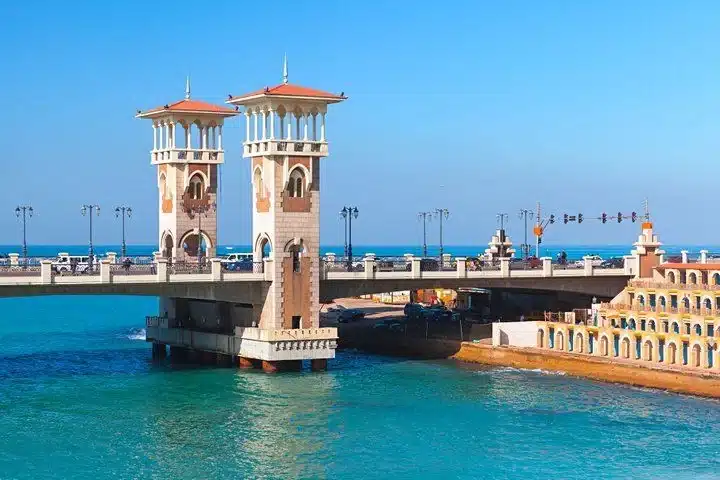
Stanley Bridge is Alexandria’s most photographed modern landmark — a 300-meter pedestrian and road bridge arching over the sea at Stanley Bay, connecting two sections of the coastal Corniche with the Mediterranean churning below. The bridge is at its most dramatic in winter when waves break against its supports. At sunset, the light turns the concrete orange and the fishermen along the railings become silhouettes.
Stanley Bay beach itself is one of the cleanest and most accessible public beaches in Alexandria, with fine sand and calm water. Alexandria is particularly popular with domestic travelers during the summer months, when temperatures along the Mediterranean are cooler than elsewhere in the country. Viator Between October and April, the beaches are uncrowded and the water temperature is 16–20°C.
Other accessible beaches near the city center include Sidi Bishr, Gleem, and Mamoura to the east. All are free public beaches — arrive before 10:00 in summer for a good spot. Marassi Beach, 60 kilometers west of Alexandria near El Alamein, is a private resort beach with significantly cleaner facilities if you are staying multiple days and prioritizing beach time.
Best Time to Visit Alexandria
Alexandria’s Mediterranean climate makes it one of Egypt’s most year-round-friendly destinations. Unlike Luxor and Aswan, where summer temperatures exceed 40°C, Alexandria rarely surpasses 31°C in August, and the sea breeze makes even warm days tolerable.
| Month | Temperature | Crowds | Notes |
|---|---|---|---|
| March–May | 18–26°C | Low-moderate | Ideal — warm enough to swim, few tourists |
| June–August | 26–31°C | Very high (domestic) | Beach season; book accommodation early |
| September–November | 22–28°C | Low | Best combination of weather and quiet |
| December–February | 12–18°C | Moderate (international) | Cool; some rain; off-peak for beaches |
April is consistently cited by experienced Egypt travelers as the single best month for Alexandria — warm, dry, and not yet crowded with the summer domestic rush. For the Best Months to Visit Egypt more broadly, including how Alexandria fits into a multi-city itinerary by season, that guide covers the full picture month by month.
Alexandria Day Trip from Cairo: How to Do It
Alexandria sits 220 kilometers northwest of Cairo — two hours by fast train or about three hours by road. The day trip is one of the most popular excursions in Egypt, and it is entirely practical if managed well.
By train: The fastest option. The Spanish Talgo train (trains 981, 982, 985) departs Cairo Ramses Station and arrives at Alexandria Misr Station in approximately 2 hours and 10 minutes. First-class tickets cost EGP 150–250 each way. Book at least one day in advance at the station or through the Egyptian National Railways app. Trains depart from approximately 07:00 onward.
By private vehicle: Door-to-door from your Cairo hotel, taking the Desert Road (approximately 2.5–3 hours depending on traffic). More flexible than the train but slower in Cairo morning traffic. Most guided day tours from Cairo use this option.
What you can cover in one day: Catacombs of Kom el Shoqafa and Pompey’s Pillar in the morning (2 hours total), Citadel of Qaitbay before lunch (1.5 hours), lunch at a Corniche seafood restaurant, Bibliotheca Alexandrina in the early afternoon (2 hours), and an evening Corniche walk before returning to Cairo. This is a full but achievable day.
For a more relaxed two-day break that includes the National Museum and Montazah Gardens, the 4 Days Cairo and Alexandria — Egypt Short Break package combines both cities in a structured private itinerary — a practical option for travelers who want the sights covered without managing train bookings and intercity logistics independently.
Alexandria Tours and Packages
Three approaches fit Alexandria well depending on trip length and interests:
Day tour from Cairo: A private guided day trip with air-conditioned vehicle, covering the main Alexandria things to see in one long day. This format works well for travelers already based in Cairo who want a coastal contrast without changing hotels. The round trip plus guide typically costs $80–$150 per person for a private arrangement.
Multi-day Egypt packages including Alexandria: Alexandria integrates naturally into longer Egypt itineraries. The 9 Day Tour Cairo, Nile Cruise & Alexandria Highlights combines Cairo’s pyramids, a Nile cruise between Luxor and Aswan, and Alexandria in a single nine-day circuit. For travelers wanting the most comprehensive Egypt coverage, the 12 Day Egypt Highlights Cairo, Alexandria, Nile Cruise & Bahariya Oasis adds the White Desert to the circuit. For just Cairo and Alexandria combined with Abu Simbel, the 10 Day Cairo, Nile Cruise, Alexandria & Abu Simbel Tour covers Egypt’s most celebrated destinations in ten days.
Independent stay: Two to three nights in Alexandria allows a relaxed pace — one day for the main monuments, one day for the museums and beaches, and an evening dedicated entirely to the Corniche. The Discover the Top Attractions in Egypt guide helps contextualize Alexandria within Egypt’s wider attraction landscape for travelers planning their full itinerary.
Sample 2-Day Alexandria Itinerary
Day 1 — The Ancient City:
- 07:30: Arrive from Cairo by Talgo train or private vehicle. Check in or drop bags at hotel.
- 09:00: Catacombs of Kom el Shoqafa — 90 minutes. Start here before heat builds.
- 10:45: Pompey’s Pillar and Serapeum — 45 minutes. Walking distance from the catacombs.
- 12:00: Lunch at a Corniche seafood restaurant. Order Alexandrian grilled fish (EGP 150–300 per person).
- 14:00: Citadel of Qaitbay — 90 minutes. Afternoon light on the Eastern Harbour.
- 16:00: Walk the Corniche from the Citadel toward the Bibliotheca — 30–40 minutes.
- 17:00: Bibliotheca Alexandrina exterior and café. Museum closes at 17:00; arrive earlier if touring inside.
- 19:00: Corniche sunset at the El Raml section. Street-side café for coffee or juice.
- 20:30: Dinner in the downtown area or hotel.
Day 2 — Palaces, Museums, and the Sea:
- 09:00: Alexandria National Museum — 2 hours. Best labeling of any museum in the city.
- 11:30: Roman Amphitheatre at Kom el Dikka — 90 minutes.
- 13:30: Lunch break. Alexandrian liver sandwich (EGP 20–30) from a street vendor near El Raml, or a sit-down restaurant on Tariq el-Horreya.
- 15:00: Royal Jewelry Museum in Zizinia — 75 minutes. Uber required.
- 17:00: Montazah Palace Gardens — 90 minutes. Late afternoon golden light over the sea.
- 18:30: Stanley Bridge and Stanley Bay beach. Sunset walk.
- 20:00: Final seafood dinner before returning to Cairo or onward travel.
Getting Around Alexandria
Uber and Careem operate throughout Alexandria and are the recommended option for tourists. Fares within the city run EGP 30–80 per trip. Both apps work reliably.
The Tram: Alexandria has one of the oldest operating tram networks in Africa, running east–west through the city center. Fares are EGP 5–10. The tram is atmospheric and slow — useful for a single scenic ride but not efficient for covering sites quickly. Avoid during morning and evening rush hours.
Walking: The stretch between the Bibliotheca Alexandrina, the Roman Amphitheatre, and the downtown area is walkable — approximately 20 minutes on foot. The Citadel of Qaitbay is a 15-minute Uber from downtown; Montazah Palace is 20 minutes east.
Avoid: Unmarked taxis at the train station. Drivers frequently approach arriving passengers; walk past them and open the Uber app instead.
Food and Drink: What to Eat in Alexandria
Alexandria’s food identity is defined by the Mediterranean. Fresh fish and seafood, brought in daily from the harbor, form the backbone of the local cuisine. This is a fundamentally different eating experience from Cairo — lighter, more coastal, and built around what arrived on the boats that morning.
Alexandrian grilled fish: Order by weight at any of the Corniche seafood restaurants. A full grilled sea bass (700–900g) costs EGP 150–250. The fish comes with bread, salad, tahini, and pickles. Ask what came in fresh that morning rather than choosing from a fixed menu.
Alexandrian liver sandwich (kebda): Sliced calf liver sautéed with green peppers, cumin, and chili, served in a long roll. Street vendors near El Raml sell these for EGP 20–30. The best ones have a visible queue of locals.
Feteer meshaltet: A flaky, layered pastry sold sweet (with honey or cream) or savory (with cheese or meat). Particularly good in Alexandria’s older neighborhoods near the central market.
Fresh juice: Sugarcane juice pressed to order (EGP 15–20) is sold at carts along the Corniche. Mango season (May–August) produces exceptional fresh juice at similar prices.
For a broader guide to Egyptian cuisine beyond Alexandria’s specialties, the Top 7 Egyptian Cuisines to Try post covers the national dishes you should be seeking in every city.
Budget and Average Costs
A day trip to Alexandria from Cairo — train tickets, entry to four major sites, lunch, and an Uber or two — costs approximately $35–$60 per person at mid-range spending. For visitors staying overnight, add $60–$120 per night for a comfortable hotel with a sea view on the Corniche.
Entry fees for all ten attractions listed in this guide total approximately EGP 900–1,000 (around $18–$20) — making Alexandria one of the most affordable cities in Egypt for attraction access. The main cost variable for a multi-day visit is the hotel: rates vary dramatically between budget guesthouses ($20–$35) and the four-star beachfront hotels ($150–$300+) that line the Montazah and San Stefano areas.
Practical Tips for Visiting Alexandria
Dress code: Alexandria is more cosmopolitan than Upper Egypt but remains a conservative city. Cover shoulders and knees when visiting mosques and the catacombs. At the Corniche, Stanley Bridge, and outdoor sites, casual clothing is fine. Bring a light jacket — the sea breeze cools quickly after sunset, especially October through March.
Money: ATMs are widely available along Tariq el-Horreya and near major attractions. Egyptian pounds are required at most sites. Credit cards work at upscale hotels and restaurants but not at the majority of attractions or street vendors.
Water: Bottled water is available everywhere for EGP 10–20 per 1.5L. The heat at outdoor sites — particularly the Citadel of Qaitbay on a clear summer day — requires at least 2 liters.
Photography: Permitted freely at almost all outdoor sites. Inside the Bibliotheca, flash photography is restricted near manuscripts. Inside the catacombs, photography is allowed but flash on carved surfaces should be avoided.
Language: Arabic is official; English is spoken at all tourist sites, major hotels, and tour-oriented restaurants. Basic Arabic phrases open doors — “shukran” (thank you) and “laa shukran” (no thank you) are your most-used words.
For a full packing list tailored to Egypt’s climate and cultural requirements, the Packing Tips for Egypt guide covers everything from sunscreen SPF requirements to the right footwear for uneven ancient stone.
Frequently Asked Questions
What are the top Alexandria things to see in one day?
One day covers Alexandria’s four essential sites comfortably. Start with the Catacombs of Kom el Shoqafa and Pompey’s Pillar in the morning (allow 2 hours total), move to the Citadel of Qaitbay before lunch (1.5 hours), eat at a Corniche seafood restaurant, then spend the early afternoon at the Bibliotheca Alexandrina (2 hours). End with a Corniche walk at sunset. This sequence follows a logical geographic route from west to east and avoids backtracking.
How do I get from Cairo to Alexandria?
The Talgo train from Cairo Ramses Station to Alexandria Misr Station takes approximately 2 hours and 10 minutes and costs EGP 150–250 first class each way. Trains depart multiple times daily from around 07:00. By private vehicle on the Desert Road, the journey takes 2.5–3 hours. Flying is not practical — there is no domestic air service between Cairo and Alexandria.
How many days do I need in Alexandria?
One day covers the main Alexandria things to see if you start early and move efficiently. Two days allows a relaxed pace that includes the Alexandria National Museum, Montazah Palace Gardens, Royal Jewelry Museum, and time on the beach. Three days suits travelers who want to extend into El Alamein (90 kilometers west) or explore the city’s neighborhood character in depth.
Is Alexandria safe for tourists?
Yes. Alexandria is consistently rated one of Egypt’s safer tourist destinations. Tourist police are present at all major attractions. Uber and Careem operate reliably throughout the city. The main precautions are standard Egypt travel advice: use app-based transport, avoid unmarked taxis at the train station, keep bags secure in crowded market areas, and dress modestly outside resort and beach zones. For the full Egypt-wide safety picture, the Is Egypt Safe for Tourists in 2026? post covers region-by-region conditions.
What visa do I need for Egypt to visit Alexandria?
The same Egyptian tourist visa covers all destinations in Egypt, including Alexandria. Most nationalities can apply for an e-visa at $25 USD through Egypt’s official government portal, or obtain a visa on arrival at Cairo International Airport. At the time of writing, passport validity of at least six months beyond your travel dates is required. For your specific nationality, the Egypt Visa Requirements for Travelers page has current details.
What is the best time of year to visit Alexandria?
March to May and September to November are the optimal windows — warm enough for outdoor sightseeing and beach visits, with significantly fewer domestic tourists than the June–August summer peak. April specifically combines low rainfall, comfortable temperatures (22–26°C), and minimal crowds. December to February is cooler (12–18°C) and sees some rainfall, but international tourist numbers are lower and hotel rates drop.
What is the Bibliotheca Alexandrina and is it worth visiting?
The Bibliotheca Alexandrina is a modern library and cultural complex built near the site of the ancient Great Library of Alexandria. Designed as a giant tilted disc facing the Mediterranean, it houses over eight million books, six museums, an art gallery, and a planetarium. Entry starts at EGP 60. The building’s architecture alone justifies the visit — the reading hall descending through eleven terraced levels under a glass ceiling is one of the most impressive interior spaces in Egypt. Budget two to three hours to cover the main museum floors properly.
What food should I try in Alexandria?
Fresh grilled fish from the Corniche restaurants is the defining Alexandrian food experience. Order by weight — sea bass and red mullet are the most commonly available. The Alexandrian liver sandwich (kebda) from street vendors near El Raml station is EGP 20–30 and worth seeking. Feteer meshaltet (layered flaky pastry) and fresh sugarcane juice round out the local eating picture. Avoid any restaurant that hands you a laminated menu with photographs — the best seafood is found at the simple spots where the catch of the day is displayed on ice at the entrance.
Can I visit Alexandria as a solo female traveler?
Yes, Alexandria is one of Egypt’s more comfortable cities for solo female travelers. The Corniche is lively and well-populated at all hours, the tourist sites are well-staffed, and the city’s cosmopolitan history means international visitors draw less unusual attention than in smaller Egyptian towns. Standard precautions apply: use Uber instead of unmarked taxis, dress modestly outside beach areas, and avoid poorly lit side streets after dark.