Luxor August Heat and Solar Eclipse Viewing Safety
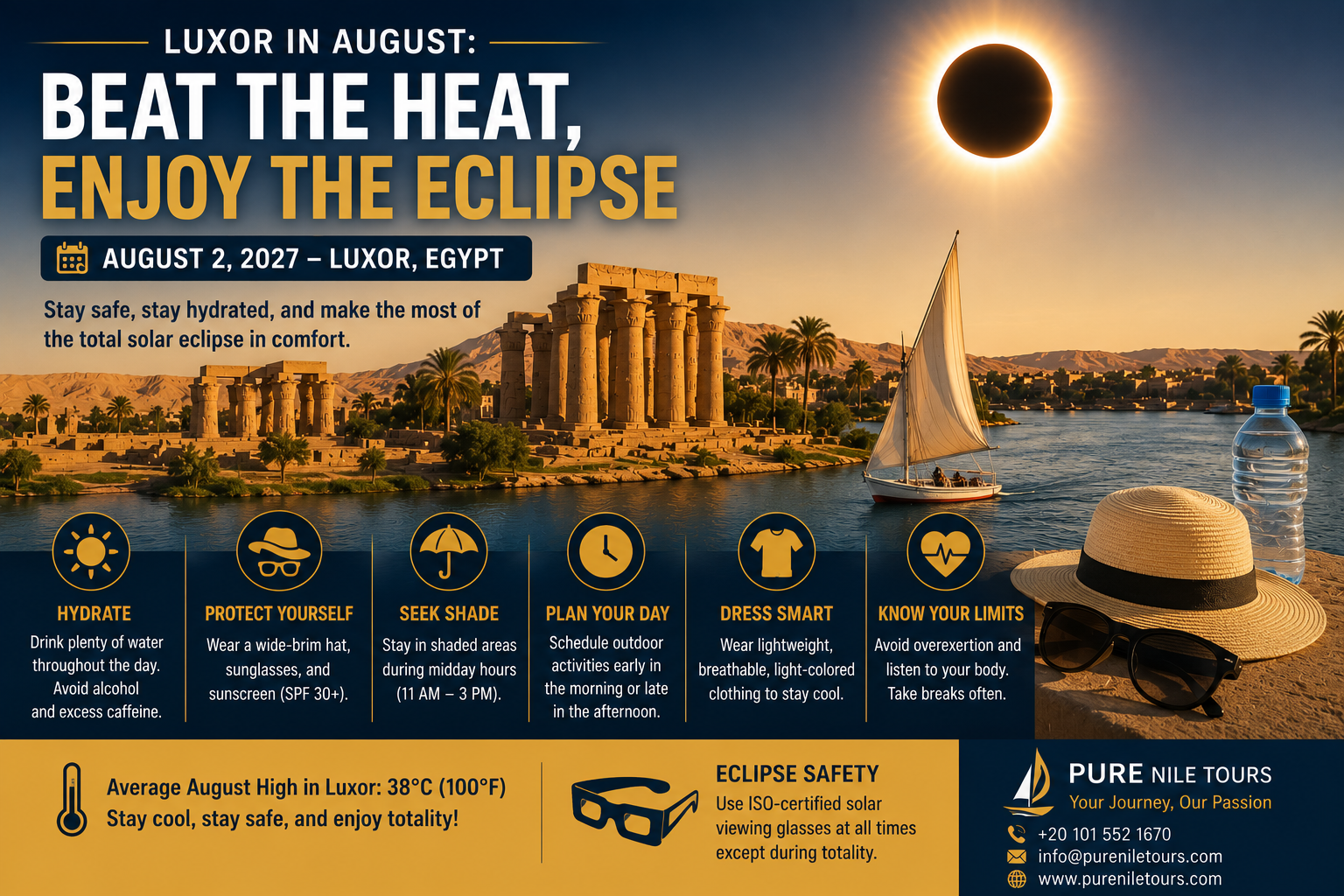
Quick answer: The Luxor eclipse reaches maximum near 13:05 on 2 August 2027, close to the hottest part of the day. A safe plan should minimise time in direct sun, provide continuous water, shaded seating, air-conditioned recovery space, medical support and a clear response to heat-illness symptoms.
This article provides general travel-planning information, not individual medical advice. Travellers with heart, kidney, respiratory or other chronic conditions, pregnant travellers, older adults and people taking medicines that affect hydration or temperature control should consult a qualified clinician before travel.
How hot is Luxor in August?
Historical climate summaries commonly place typical August daytime highs in Luxor above 40°C. Actual conditions on 2 August 2027 cannot be known in advance and may be higher or lower. Direct radiant heat, limited shade, hot surfaces and long standing periods can make the exposure feel more severe than the air-temperature number alone.
The eclipse’s partial phase lasts much longer than totality. Guests may be outside for setup, briefings and observation over several hours, even though the total phase lasts about 6 minutes 22 seconds.
Why eclipse viewing creates a special heat problem
- Maximum eclipse occurs near midday.
- People may focus on the sky and ignore thirst or discomfort.
- Camera users may stand beside heat-absorbing equipment.
- Large groups can delay transfers back to air-conditioning.
- Dark clothing, hats without ventilation and crowded decks can increase discomfort.
- Some travellers may avoid drinking because they worry about toilets.
Heat planning must therefore be built into the event schedule, not added as a last-minute reminder.
Recommended schedule design
Before arrival at the site
- Serve breakfast and allow adequate fluid intake.
- Ask guests to carry required medication.
- Provide a safety briefing in an air-conditioned setting.
- Distribute eclipse glasses before boarding vehicles.
- Confirm that no one is already unwell.
At the viewing site
- Keep guests in shade for as much of the partial phase as practical.
- Move into the open observation zone only for planned viewing intervals.
- Provide seated options.
- Use regular water reminders.
- Assign staff to observe guests, not only the eclipse.
After totality
- Replace solar viewers immediately when the bright Sun returns.
- Avoid a rushed mass departure.
- Move vulnerable guests to air-conditioning first.
- Continue water availability.
- Delay strenuous sightseeing until conditions and guest health are reviewed.
Shade requirements
A small decorative canopy is not enough for a full group. The shaded holding area should accommodate the number of guests who need to wait outside the open observation zone.
Shade structures must be:
- Secure in wind.
- Positioned so they do not block the Sun.
- High enough for air movement.
- Close to the observation area.
- Accessible without crossing tripod zones.
On a cruise, the air-conditioned lounge can function as a recovery space, but movement between the lounge and sundeck must be controlled so guests do not miss critical phases or create stair congestion.
Hydration planning
WHO guidance emphasises drinking regularly and keeping cool. A tour should not rely only on guests bringing one small bottle. It should provide a continuous supply, visible distribution points and staff reminders.
Useful operational practices include:
- Issue water before leaving the hotel or ship.
- Keep reserve water in shade or cooled storage.
- Provide cups or bottles that can be managed safely around camera equipment.
- Track guests who are unable to drink normally.
- Provide toilets so guests do not deliberately reduce fluid intake.
Generic advice to drink a fixed large volume can be inappropriate for some medical conditions. Individual restrictions should be followed.
Clothing and personal protection
- Loose, lightweight clothing.
- Wide-brimmed hat with secure strap.
- Long sleeves made from breathable fabric.
- Sunscreen reapplied according to product directions.
- Comfortable footwear suitable for hot ground and stairs.
- Light-coloured equipment covers.
Ordinary sunglasses are useful for general sun comfort but are not safe for looking directly at the Sun.
Medication and heat
Some medicines require temperature-controlled storage, and some can affect fluid balance, sweating or heat tolerance. Travellers should:
- Keep medication in original packaging.
- Ask a pharmacist about heat storage.
- Carry essential medicines in hand luggage.
- Bring a written list of diagnoses, allergies and medicines.
- Tell the tour leader about assistance that may be needed.
Do not stop prescribed medication because of heat without medical advice.
Warning signs that require action
Possible heat-related warning signs include headache, dizziness, weakness, nausea, heavy sweating, cramps, confusion, unusual behaviour, fainting or very hot skin. Symptoms can overlap with other medical problems.
If a traveller becomes unwell:
- Move the person to shade or air-conditioning.
- Alert trained medical or first-aid staff.
- Cool the person using appropriate methods.
- Follow emergency-service instructions.
- Do not leave the person alone.
Confusion, collapse, seizure or altered consciousness should be treated as an emergency.
Special considerations for photographers
- Set up as much equipment as possible in shade.
- Use a reflective cloth to cover black camera bodies before use.
- Do not leave batteries or phones on hot metal surfaces.
- Keep drinking water separate from electrical equipment but within reach.
- Use a chair if standing for long periods is not necessary.
- Practise the sequence so less time is spent adjusting controls in direct sun.
Special considerations for older travellers
Older adults may not perceive thirst as strongly and may take medicines affecting hydration. The viewing plan should provide:
- Reserved seating.
- Short walking distances.
- Step-free access where possible.
- Early transfer to the site to avoid rushing.
- Priority return to air-conditioning.
- A staff member assigned to the seating zone.
Questions to ask a tour operator
- How many shaded seats are available?
- Is water unlimited during the viewing period?
- How far is the walk from vehicle or cabin to the viewing area?
- Is there an air-conditioned recovery space?
- Are toilets nearby?
- Who provides first aid?
- How quickly can emergency services reach the site?
- What happens if a guest cannot remain outdoors?
Frequently asked questions
Will it be hot during the Luxor eclipse?
Yes. Early August in Luxor is typically very hot, and maximum eclipse occurs near midday. The exact 2027 temperature cannot be forecast until much closer to the date.
Can I remain in shade until totality?
Often yes, if the site is designed properly. Guests can use brief filtered viewing intervals during the partial phase and move to the open zone before totality.
Is a Nile cruise deck safer than a desert site?
A cruise may provide easier access to water, toilets and air-conditioning, but deck heat, stairs and capacity still require planning.
Who is at higher risk from heat?
Older adults, young children, pregnant travellers, people with chronic conditions and people taking certain medicines may be more vulnerable. Individual medical advice is important.
Should sightseeing continue immediately after the eclipse?
The schedule should allow cooling, hydration and health checks before any strenuous activity.
Plan a controlled viewing day
Use the Solar Eclipse Egypt 2027 guide and review how the 8-day eclipse tour handles the viewing day. Pair this article with the detailed packing checklist.