Camera Settings for the 2027 Total Solar Eclipse in Luxor
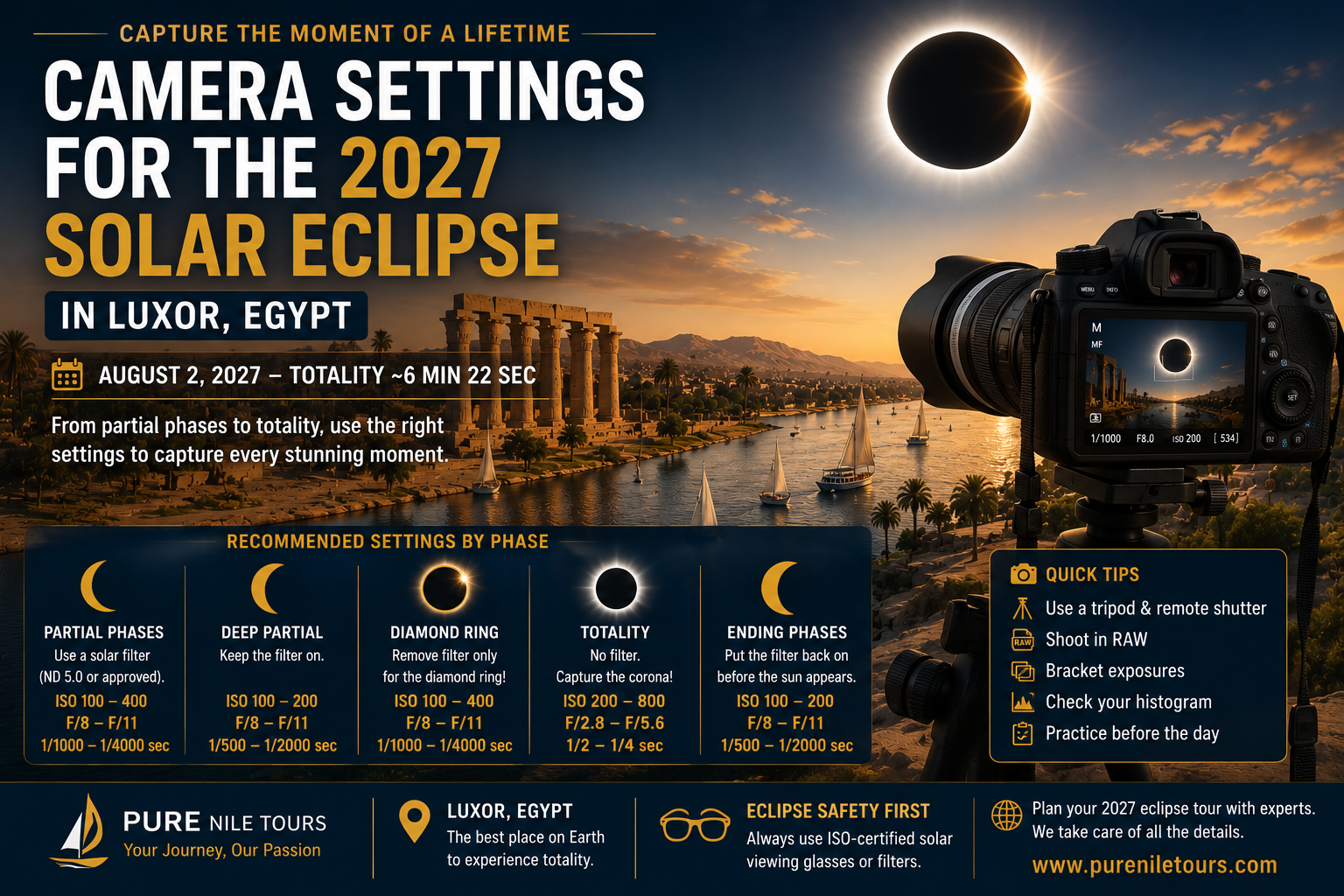
Quick answer: There is no single correct exposure. Use a secure front-mounted solar filter during every partial phase, set manual focus, shoot RAW and bracket exposures. A useful starting point for filtered partial phases is ISO 100, f/8 and a shutter speed around 1/500 second, then adjust after testing with your actual filter. During totality, remove the filter only after the Sun is completely covered and use a wide exposure bracket to capture different parts of the corona.
This guide is a starting workflow, not a substitute for practice. Filters, lenses, camera sensors and atmospheric conditions produce different results. Test the full equipment sequence on the Sun well before travelling.
Safety comes before settings
NASA and the American Astronomical Society state that cameras, binoculars and telescopes require appropriate solar filters during the partial phases. The filter must be secured over the front of the optics. Looking through an unfiltered optical viewfinder at the Sun can injure the eye, and unfiltered sunlight can damage equipment.
Eclipse glasses worn by the photographer do not make an unfiltered camera safe. Optical equipment concentrates sunlight and requires its own filter.
Recommended equipment
- Interchangeable-lens camera or advanced bridge camera.
- Telephoto lens selected for the desired Sun size.
- Secure front-mounted solar filter.
- Stable tripod.
- Remote release or intervalometer.
- Fully charged batteries and spares.
- Multiple memory cards.
- Lens shade if compatible with the solar-filter system.
- White cloth to cover equipment before use.
- Accurate eclipse contact-time app downloaded for offline use.
Choosing a focal length
Focal length determines how large the Sun appears in the frame.
- 100–200 mm: small Sun with more environmental context.
- 300–500 mm: larger solar disc while retaining manageable framing.
- 600 mm and above: detailed Sun and corona, but tracking and vibration become more demanding.
Luxor’s eclipse occurs high in the midday sky. A telephoto landscape composition with a nearby temple may not be geometrically possible from an ordinary visitor location. Use a planning app and verified coordinates before promising a monument alignment.
Partial-phase starting settings
With the solar filter securely installed:
| Setting | Starting point | Reason |
|---|---|---|
| File type | RAW | Maximum latitude for exposure and colour correction |
| Mode | Manual | Prevents exposure changes caused by a dark frame |
| ISO | 100 | Preserves highlight detail and reduces noise |
| Aperture | f/8 | Common sharp range for many lenses |
| Shutter | About 1/500 second | Starting point only; adjust for the actual filter |
| Focus | Manual | Prevents autofocus hunting |
| White balance | Daylight or fixed Kelvin | Keeps sequence colour consistent |
Take test images and inspect the histogram. The Sun should retain a clean edge and visible sunspot detail if present. If it is clipped, increase shutter speed or close the aperture. If it is too dark, reduce shutter speed while maintaining a safe filter.
Focusing accurately
- Install the solar filter before pointing toward the Sun.
- Use live view or the electronic viewfinder, not an unfiltered optical viewfinder.
- Magnify the live-view image.
- Focus on the solar limb or a sunspot.
- Switch to manual focus.
- Secure the focus ring gently if needed.
- Recheck after major temperature changes or lens movement.
Heat can alter focus slightly, particularly with long lenses. Recheck during the partial phase.
Exposure bracketing during totality
The corona has an enormous brightness range. One exposure cannot record the bright inner corona, prominences and faint outer streamers equally well.
A practical totality sequence uses:
- Manual exposure.
- Wide shutter-speed bracketing.
- Fixed aperture, commonly around f/8.
- Low to moderate ISO, adjusted for lens speed and stability.
- Rapid repeated sequences rather than constant setting changes.
For example, a photographer may test brackets ranging from very fast exposures for the inner corona and prominences to slower exposures for outer structure. The exact range depends on focal length, tracking, wind, deck stability and camera performance. Practise an automated bracket that can be completed without looking away from the eclipse for long.
Filter removal and replacement
The filter is removed only after the Sun’s bright photosphere is completely covered and totality has begun. Remove it carefully without shifting focus or composition.
As totality ends, the first bright point of direct sunlight requires immediate filter replacement. Use an audible contact-time alert and assign one person to call the sequence if photographing in a group.
Outside the path of totality, the filter is never removed.
Capturing the diamond ring and Baily’s beads
These phases occur close to the contacts and contain direct sunlight. They require precise timing, appropriate exposure and a rehearsed filter procedure. Inexperienced photographers should prioritise eye safety and a reliable totality sequence rather than attempting every phenomenon.
Do not remove a filter early to chase a diamond-ring image.
Settings for a Nile cruise deck
A moored cruise deck may still move. Adapt by:
- Using faster shutter speeds where possible.
- Keeping the tripod low and avoiding an extended centre column.
- Turning off stabilisation only if the lens manufacturer recommends it for tripod use; some modern systems handle tripod detection differently.
- Standing clear of heavy foot traffic.
- Testing for engine vibration.
- Using a remote release.
- Limiting extremely slow exposures unless the deck proves stable.
Settings for a land site
Firm ground supports slower exposures and more complex brackets. Still account for wind, heat shimmer and accidental tripod contact. Mark the tripod legs and keep the area clear.
Phone photography
A phone can record the changing light, crowd reaction and wide environmental scene. The solar disc will usually be small without additional optics. Do not point a phone through unfiltered binoculars or a telescope.
Useful phone strategy:
- Record a wide locked-off video of the landscape and group.
- Disable flash.
- Lock exposure and focus if the app allows.
- Keep enough storage free.
- Put the phone down for part of totality.
Pre-trip practice plan
- Assemble the exact camera, lens, filter and tripod.
- Practise safe solar framing.
- Record the filtered exposure that works with your filter.
- Build and save an exposure bracket.
- Practise filter removal without changing focus.
- Practise filter replacement quickly.
- Simulate the full six-minute totality sequence with a timer.
- Prepare a written checklist.
Common mistakes
- Buying an unverified filter shortly before travel.
- Testing settings for the first time on eclipse day.
- Using autofocus throughout the event.
- Forgetting to remove the filter during totality.
- Forgetting to replace the filter at the end.
- Changing too many settings manually.
- Using a long lens on an unstable deck without testing.
- Spending all of totality looking at the camera screen.
Frequently asked questions
What is the best shutter speed for the partial phase?
There is no universal value. ISO 100, f/8 and about 1/500 second is a reasonable test starting point with a proper solar filter, but the filter density and lens determine the final exposure.
Can I use eclipse glasses over the camera lens?
No. Use a filter designed and mounted for the camera lens. Eclipse glasses are intended for direct visual use, not as improvised lens filters.
When can the camera filter be removed?
Only during totality, after the Sun’s bright face is completely covered, and only from a location inside the path of totality.
Is a tripod necessary?
It is highly useful for telephoto work and repeatable brackets. Handheld wide-angle images are possible, but long focal lengths become difficult.
Should I photograph from the cruise deck or land?
Land is usually more stable. A moored deck can work if vibration, capacity and tripod placement are tested.
Plan the photography trip
Use the Solar Eclipse Egypt 2027 guide for location context and review the planned viewing format on the 8-day Nile cruise eclipse tour.