grand egyptian museum tour guide After more than two decades of construction, the Grand Egyptian Museum (GEM) opened fully to the public in November 2025, and it has fundamentally changed what a Cairo trip looks like. This is now the largest archaeological museum in the world dedicated to a single civilization — home to over 100,000 artifacts, the complete Tutankhamun collection displayed together for the first time in history, and the full-size Khufu Solar Boat, all set against pyramid views from its upper galleries.
This guide covers everything you need to plan your visit: what to actually see if your time is limited, current ticket prices and booking requirements, opening hours, and the practical tips that make the difference between a rushed visit and a genuinely memorable one.
What Is the Grand Egyptian Museum?
The GEM sits on the edge of the Giza Plateau, roughly 2 kilometers from the Pyramids and Sphinx, and was purpose-built to finally give Egypt’s vast archaeological collection a home worthy of its scale — moving many artifacts previously housed in the older, more crowded Egyptian Museum in Tahrir Square (downtown Cairo), which remains open but now displays a smaller portion of the national collection.
The museum spans Egypt’s entire ancient history, from the Predynastic period through the Greco-Roman era, organized across 12 main chronological galleries, alongside dedicated halls for its two signature attractions: the complete Tutankhamun collection and the Khufu Solar Boat.
What to See: The Essential Highlights
If you only have a few hours, prioritize these four experiences in this order:
1. The Grand Staircase
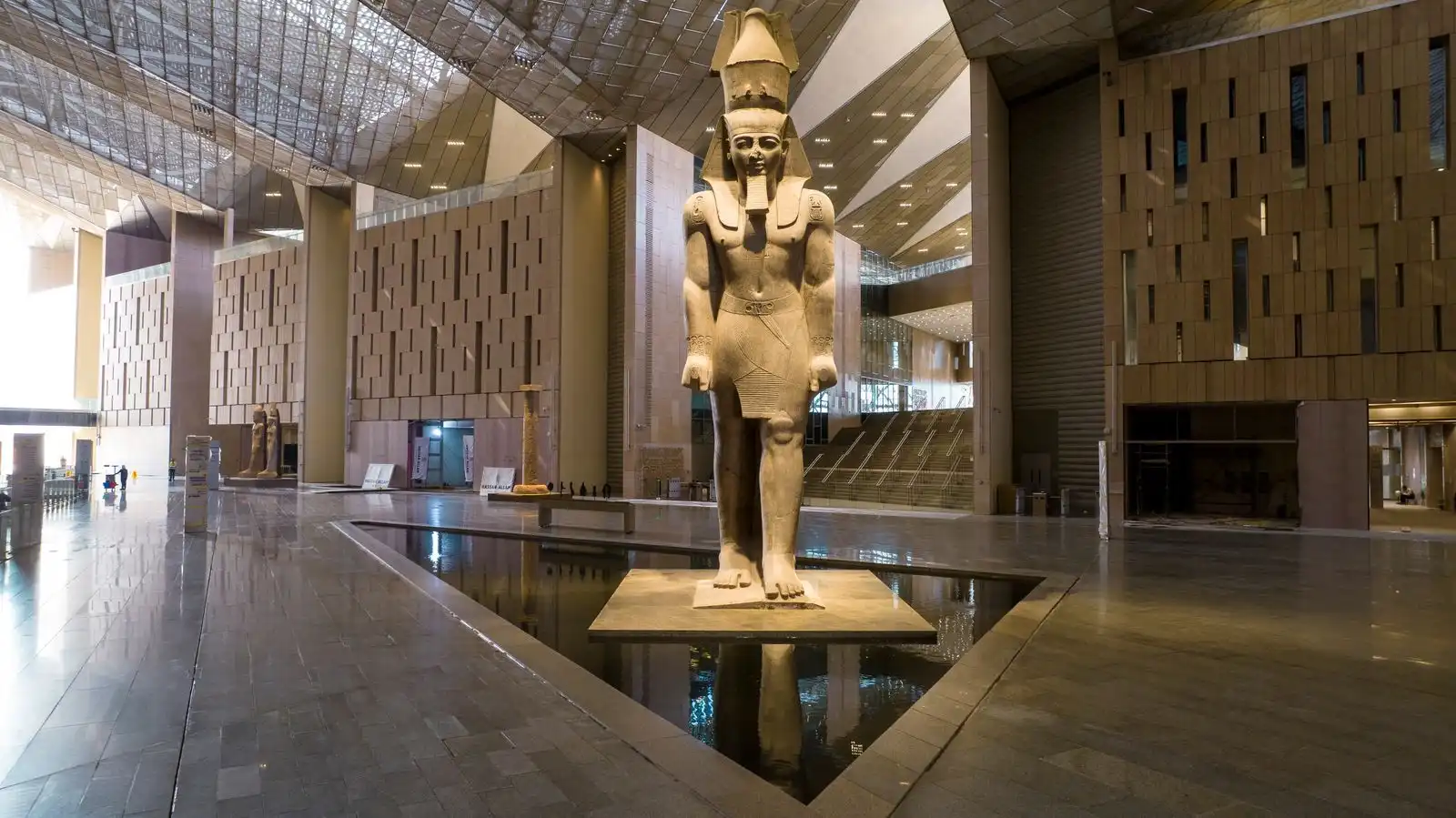
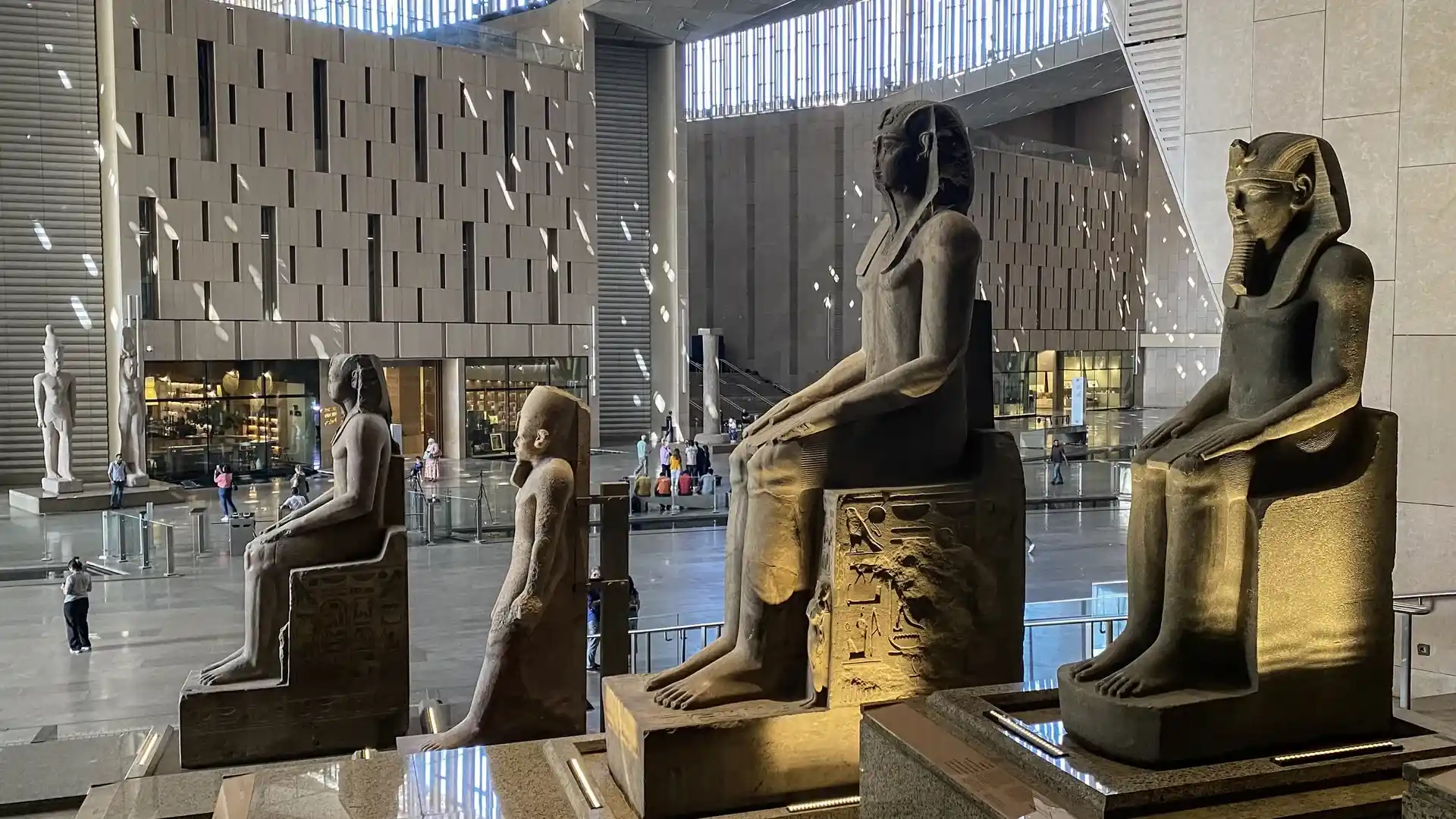
Your visit begins with an ascent up the museum’s dramatic central staircase, lined with colossal statues spanning roughly 3,000 years of Egyptian history — a striking introduction before you even reach the main galleries. The staircase culminates at a viewing point where, on clear days, you can see the Giza Pyramids directly through floor-to-ceiling windows — widely considered one of the best photo opportunities in the entire museum. Budget 30–45 minutes here.
2. The Tutankhamun Galleries
This is the museum’s centerpiece, and arguably its single greatest draw: for the first time in history, the complete collection of more than 5,000 objects recovered from Tutankhamun’s intact tomb is displayed together in one place, rather than split between different institutions as in previous decades. The collection alone justifies a minimum of 1.5–2 hours, covering everything from the iconic golden mask to lesser-known funerary objects, jewelry, furniture, and ritual items that rarely received public display before.
Mobile phone photography is generally permitted within the Tutankhamun galleries, though cameras (and flash photography anywhere in the museum) are typically prohibited — confirm current rules at entry, as policy can be updated.
3. The Khufu Solar Boat
Discovered buried in a sealed pit beside the Great Pyramid, this 4,600-year-old wooden vessel — built to carry the pharaoh’s soul alongside the sun god Ra across the sky in the afterlife — is the oldest intact large vessel ever found, at approximately 43 meters long. Painstakingly reconstructed from its original disassembled timbers, it’s now displayed in a purpose-built hall within the GEM, having been relocated here from its previous site beside the pyramid in 2021.
4. The 12 Themed Galleries
Beyond the headline attractions, twelve permanent galleries trace Egyptian history chronologically, from the Predynastic period through the Greco-Roman era. These galleries provide the broader historical context that makes the Tutankhamun collection and Solar Boat genuinely meaningful, rather than isolated highlights. If you have four or more hours available, working through these galleries — particularly the New Kingdom section, home to additional treasures beyond Tutankhamun’s collection — substantially deepens the visit.
Why the Grand Egyptian Museum Matters
The GEM’s opening represents more than a new tourist attraction — it marks a significant shift in how Egypt’s ancient heritage is presented and preserved. For over a century, the country’s most important artifacts were split across multiple, often overcrowded institutions, with many objects from Tutankhamun’s tomb displayed in conditions that made it difficult for visitors to appreciate the collection’s full scope and significance.
Bringing the complete Tutankhamun collection together in one purpose-built space — alongside artifacts that had never been publicly displayed at all — represents a genuinely new chapter for how the world experiences this material. Early visitor numbers reflect this significance: the museum drew nearly 19,000 visitors per day during its opening week alone, according to Egypt’s State Information Services, underscoring the scale of global interest in finally seeing this collection presented as intended.
For Cairo specifically, the GEM has also reshaped the practical logistics of an ancient Egypt-focused visit, effectively creating a new “must-see triangle” alongside the Pyramids and Sphinx — meaning most thoughtfully planned Cairo itineraries in 2026 now build their day around this three-site combination rather than treating the Pyramids as a standalone half-day excursion.
What’s NOT at the Grand Egyptian Museum
One common point of confusion: the GEM does not currently hold the Royal Mummies collection — the preserved remains of pharaohs including Ramesses II, Seti I, and Hatshepsut. These are displayed separately at the National Museum of Egyptian Civilization (NMEC) in Old Cairo (Fustat), which requires a separate visit and ticket. If seeing the royal mummies is a priority for your trip, plan NMEC as an additional half-day excursion rather than assuming it’s included at GEM.
Tickets: What You Need to Know for 2026
Mandatory Online Booking
As of December 2025, the Grand Egyptian Museum introduced a mandatory online-only ticketing system. Tickets are no longer sold at the entrance — every visitor must reserve a timed entry slot in advance through the official GEM booking portal before arriving.
Ticket Prices (2026)
- Foreign adult: approximately $25 USD for standard general admission to the main galleries
- Foreign child (ages 6–12): typically a 50% discount; ID may be requested at entry to confirm age
- Tutankhamun collection access: may be bundled into the base ticket or sold as a separate add-on depending on current museum policy — confirm at the time of booking, since this has changed since opening
- Prices are subject to periodic revision; always confirm current rates when booking
Booking Process
Tickets are booked in a straightforward online process: select a date and a two-hour entry time slot (typically offered at 9 AM, 11 AM, 1 PM, 3 PM, 5 PM, and 7 PM), choose your ticket type and quantity, enter passenger details, pay online, and receive a confirmation QR code to present at entry.
Opening Hours
Note that the complex opening time and gallery entry time are not identical — the building opens before the exhibition galleries themselves do, so plan your visit around gallery hours rather than general complex access. Last ticket purchase is typically around 5:00 PM on standard days (8:00 PM on extended Wednesday/Saturday hours).
Best Time to Visit
Time of Day
The clear consensus among guides and frequent visitors: arrive right at opening (9:00 AM). The museum is quietest during its first one to two hours. Large organized tour groups typically begin arriving between 10:30 AM and noon, and by midday, the Tutankhamun galleries in particular can become quite crowded. A second, quieter window opens in the late afternoon, roughly from 5:00 PM onward, once day-tour groups have departed — particularly useful on the extended Wednesday and Saturday evening hours.
Time of Year
Ramadan (which falls around February 18 – March 19 in 2026) offers a genuinely different experience: shorter operating hours, but dramatically smaller crowds, making it possible to photograph the Tutankhamun galleries with few or no other visitors present — a rare opportunity at a museum that drew nearly 19,000 visitors per day during its opening week.
How Much Time Should You Budget?
If your schedule only allows for the minimum, prioritize the Grand Staircase, the Tutankhamun galleries, and the Solar Boat — these three experiences alone deliver the museum’s core value even on a tight schedule.
Practical Visitor Tips
Wear comfortable shoes. The GEM is genuinely vast — covering significant ground between galleries involves considerable walking, more than most visitors expect from a museum visit.
The quietest restrooms tend to be located on the lower level near the Tutankhamun gallery; restrooms closer to the main entrance and Grand Staircase often have longer queues.
Photography rules vary by area. Mobile phone photography is generally allowed in most public galleries, but cameras and flash photography face restrictions, particularly within the Tutankhamun halls — confirm current policy at entry, since rules have been refined since the museum’s opening.
Climate control means weather isn’t a factor inside, though it’s worth planning your pre- or post-museum activities (such as the Giza Plateau itself) around Cairo’s outdoor temperatures.
Consider combining your visit with the Giza Plateau itself, given the museum’s proximity — many guided itineraries pair a morning at the pyramids and Sphinx with an afternoon at GEM, often finishing with the Giza Sound & Light Show in the evening for a complete day covering ancient Egypt’s two greatest modern and ancient landmarks side by side.
The Museum’s Architecture and Design
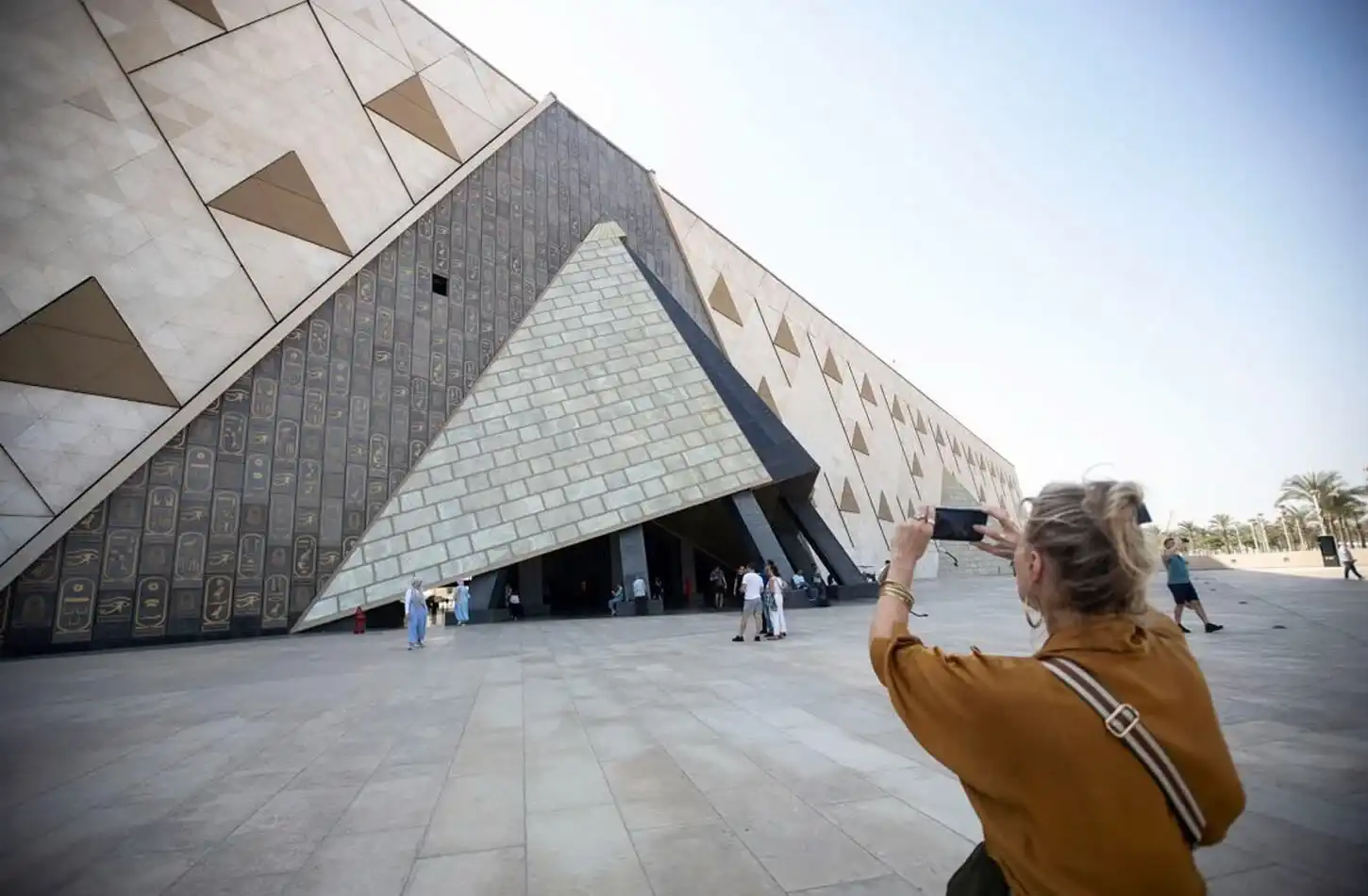
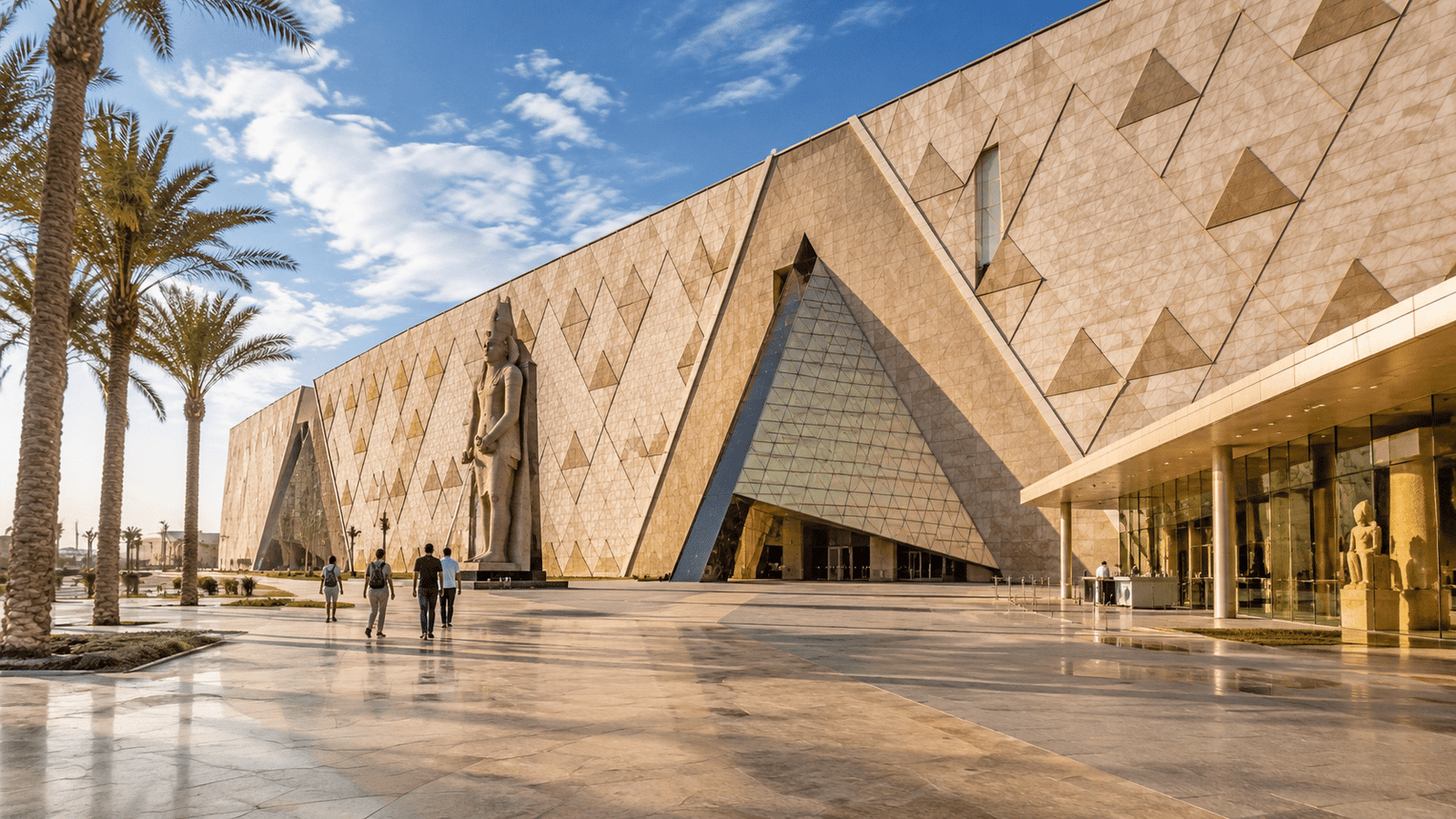
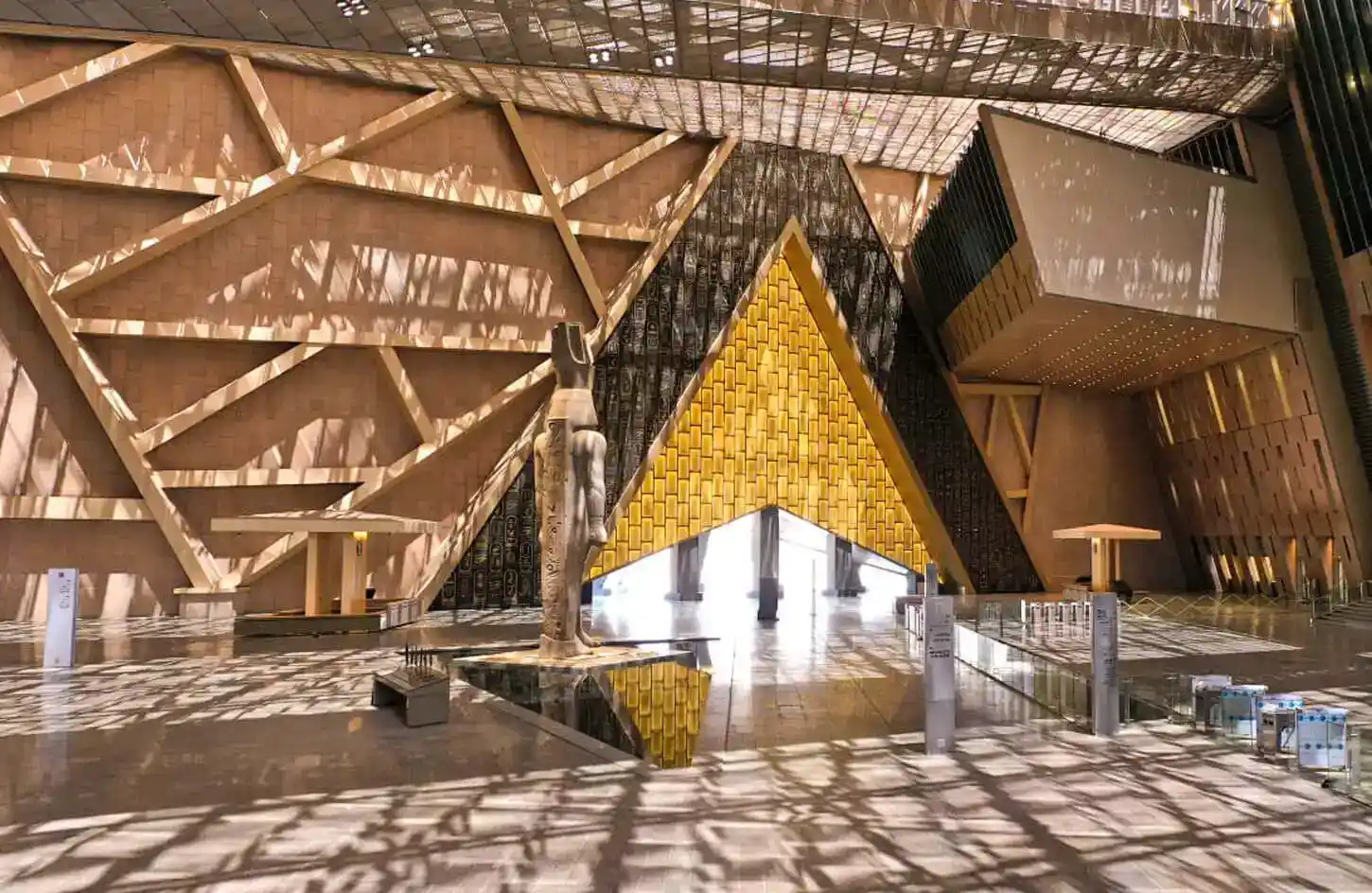
Beyond its collection, the GEM building itself is a significant attraction. Designed through an international architectural competition won by the Irish firm Heneghan Peng, the museum was conceived to create a visual and symbolic dialogue with the Giza Plateau it sits beside.
The building’s triangulated, translucent stone facade echoes the angular geometry of the pyramids themselves, while its orientation deliberately frames sightlines toward the monuments — most dramatically from the Grand Staircase’s upper landing, where floor-to-ceiling windows align with the pyramids on the horizon. At an estimated cost exceeding $1 billion and after more than two decades of planning and construction, the GEM was conceived not merely as a museum but as a piece of architecture intended to stand alongside the ancient structures it honors.
The scale is genuinely difficult to grasp without visiting: the complex covers approximately 500,000 square meters, making it, by floor area, the largest archaeological museum in the world dedicated to a single civilization — a scale reflected in the multi-hour (or multi-day) visit times recommended above.
Getting to the Grand Egyptian Museum
The GEM sits on the edge of the Giza Plateau, approximately 2 kilometers from the Pyramids and Sphinx, and roughly 30–45 minutes from central Cairo by car, depending on traffic.
By private car or guided tour: The most straightforward option, particularly if you’re combining your visit with the Giza Plateau itself — most private tour operators offer direct transfers between the two sites, often as part of a single combined-day itinerary.
By taxi or rideshare: Readily available from most parts of Cairo, though confirm the exact GEM entrance location with your driver in advance, since the complex is large and has multiple access points.
By organized group tour: Many day-tour operators bundle GEM entry with Giza Plateau visits and transport, though group tours can mean less flexibility around timing your visit to avoid the busiest midday hours.
For travelers without a private guide, it’s worth noting that the sheer scale of the GEM — 12 galleries, multiple specialized halls, and over 100,000 artifacts — can be genuinely disorienting on a first visit without some planning or guidance, which is part of why many visitors choose a guided option specifically for this site even if they’re independently exploring other parts of Cairo.
A Sample One-Day Itinerary: Giza Plateau + GEM
9:00 AM — Arrive at the Giza Plateau; explore the Pyramids and Great Sphinx in the cooler morning hours
12:30 PM — Lunch near Giza
1:00 PM — Arrive at the Grand Egyptian Museum (book your timed entry slot accordingly)
1:00–5:00 PM — Explore the Grand Staircase, Tutankhamun galleries, Solar Boat, and as many of the 12 themed galleries as time allows
7:00 PM — Return to the Giza Plateau for the evening Sound & Light Show, illuminating the pyramids against the night sky
This itinerary pairs naturally with our complete guides to the Pyramids of Giza, the Great Sphinx, and Tutankhamun’s treasures for deeper background before your visit.
🏛️ Want a seamless Giza Plateau and Grand Egyptian Museum day, without the booking complexity? Pure Nile Tours arranges timed GEM entry, skip-the-line access, and an expert Egyptologist guide who brings the Tutankhamun collection and Solar Boat to life. Book a Private Cairo & GEM Tour →
Frequently Asked Questions
Do I need to book Grand Egyptian Museum tickets in advance?
Yes — as of December 2025, GEM operates on a mandatory online-only ticketing system. Tickets are not sold at the entrance, and every visitor needs a timed entry slot booked in advance.
How much does it cost to visit the Grand Egyptian Museum?
As of 2026, standard foreign adult admission runs approximately $25 USD, with discounted rates for children. The Tutankhamun collection may be included in the base ticket or sold separately, depending on current policy — confirm at booking.
Is the Grand Egyptian Museum the same as the Egyptian Museum in Tahrir Square?
No, they are separate institutions. The older Egyptian Museum in downtown Cairo’s Tahrir Square remains open with a reduced collection, while the GEM, located near the Giza Plateau, now houses the majority of the national collection, including the complete Tutankhamun treasures.
Are the Royal Mummies displayed at the Grand Egyptian Museum?
No. The Royal Mummies collection is displayed at the National Museum of Egyptian Civilization (NMEC) in Old Cairo, a separate site requiring its own ticket and visit.
How long should I spend at the Grand Egyptian Museum?
A minimum of 2.5–3 hours covers the essential highlights. Most guided visits recommend 3–4 hours, while serious history enthusiasts could productively spend a full day or more.
What is the best time of day to visit?
Arrive right at opening (9:00 AM) for the quietest experience. Crowds build significantly from around 10:30 AM as organized tour groups arrive, with a second quieter window in the late afternoon.
Can I take photos inside the museum?
Mobile phone photography is generally permitted in most public galleries, including the Tutankhamun halls, though cameras and flash photography face restrictions in various areas. Confirm current rules at entry.
Is the Grand Egyptian Museum close to the Pyramids of Giza?
Yes — it sits approximately 2 kilometers from the Giza Plateau, making it easy to combine both in a single day, with pyramid views even visible from some of the museum’s upper galleries.
Final Thoughts
The Grand Egyptian Museum represents more than two decades of work and genuinely lives up to its scale — this is now one of the essential modern landmarks of any Cairo visit, standing alongside the ancient Pyramids it sits beside. Seeing Tutankhamun’s complete collection displayed together for the first time, walking past the 4,600-year-old Khufu Solar Boat, and looking out at the pyramids through the Grand Staircase’s windows together create an experience that connects Egypt’s ancient past with a genuinely impressive piece of 21st-century architecture and museum design.
🏛️ Planning your Cairo and Giza itinerary? Pure Nile Tours’ private guided tours combine the Pyramids, the Sphinx, and the Grand Egyptian Museum into a seamless, skip-the-line day with expert Egyptologist commentary throughout. Explore Private Cairo Tours →