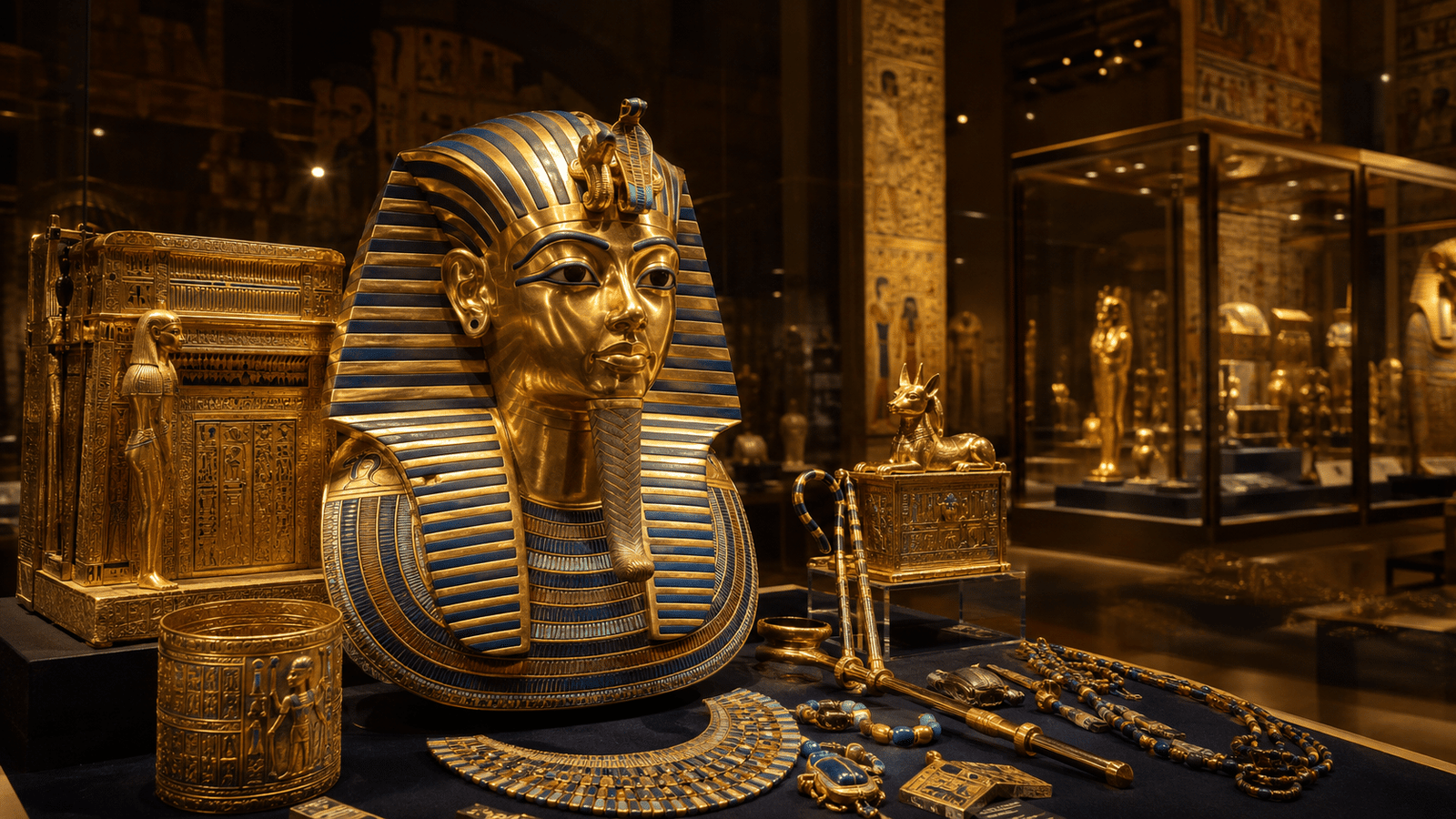
tutankhamun treasures For over a century, Tutankhamun’s treasures have been scattered — some on display in Cairo’s old Egyptian Museum, others in storage, never publicly exhibited, since Howard Carter first opened the boy king’s tomb in November 1922. That changed in 2025. For the first time in history, all 5,398 objects discovered in Tutankhamun’s tomb are displayed together in a single space, at the Grand Egyptian Museum (GEM) in Giza.
This guide covers what’s actually in the collection, the most significant individual treasures, the story of their discovery, and exactly where and how to see them today.
Where to See Tutankhamun’s Treasures Today
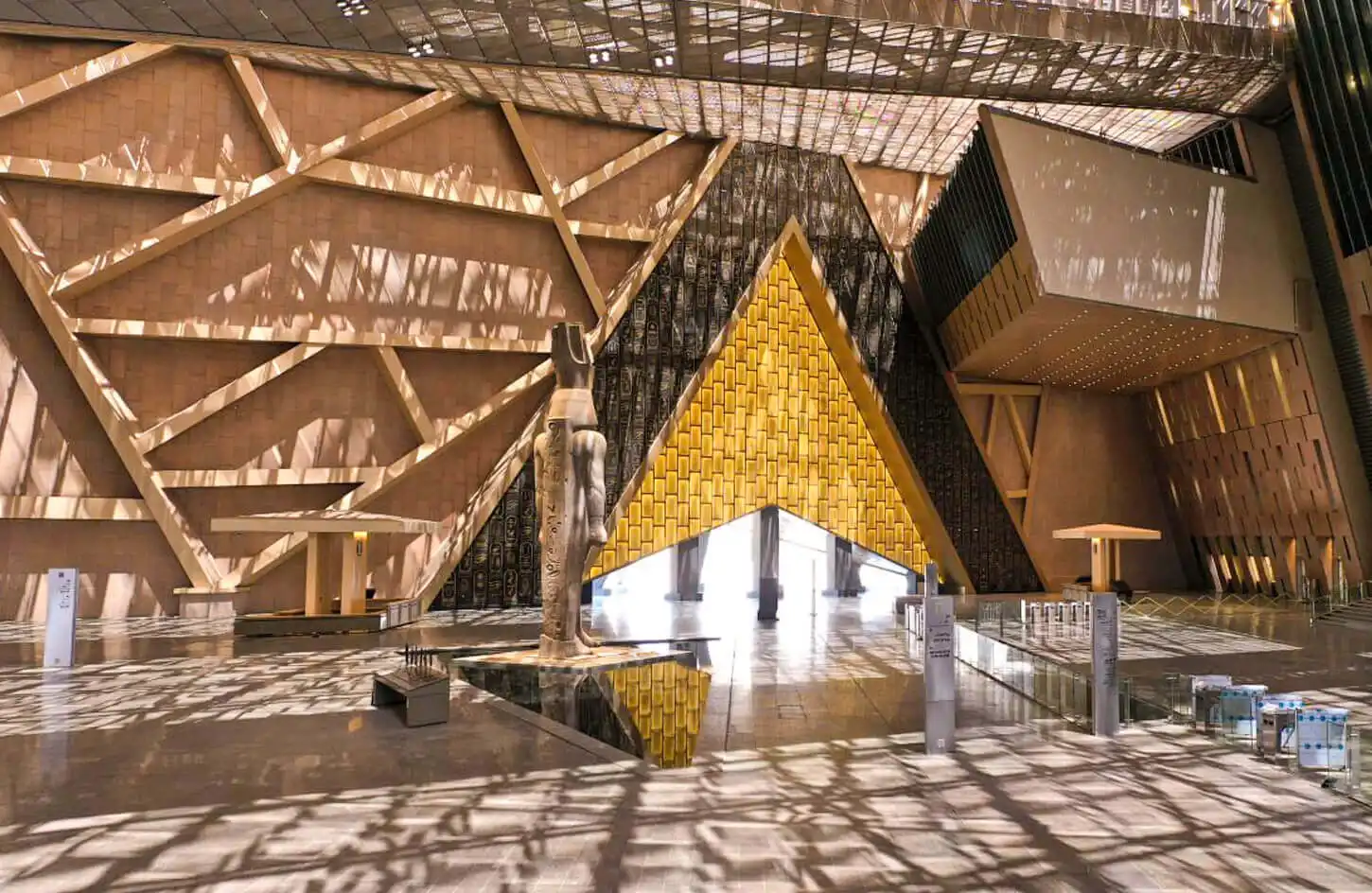
This is the single most important practical fact for visitors planning a trip: the complete Tutankhamun collection is now displayed at the Grand Egyptian Museum (GEM) in Giza, not at the older Egyptian Museum in Tahrir Square, downtown Cairo. The collection relocated as part of the GEM’s 2024–2025 opening process, moving the complete KV62 find (KV62 being the official designation for Tutankhamun’s tomb) out of the old museum’s storage and display rooms for the first time.
Previously, the Tahrir Square museum displayed only a portion of the collection — roughly 1,700 of the 5,398 catalogued objects at any given time, with the remainder kept in storage and rarely, if ever, shown to the public. The Tutankhamun galleries at the GEM occupy approximately 7,000 square meters on the museum’s upper floor, with the layout organized chronologically by Howard Carter’s original excavation sequence — allowing visitors to walk through a recreation of the tomb’s antechamber, annex, burial chamber, and treasury arrangements roughly as they were originally discovered.
Tutankhamun’s mummy itself remains in his original tomb (KV62) in the Valley of the Kings near Luxor — it has not moved to the GEM. Only the funerary objects and treasures accompanying the burial are displayed in Cairo. Travelers wanting to see both the mummy in its original tomb context and the complete treasures collection typically need to combine a Cairo/Giza visit with a separate trip to Luxor’s Valley of the Kings.
The Discovery: Howard Carter, 1922
British archaeologist Howard Carter, funded by Lord Carnarvon, discovered Tutankhamun’s nearly intact tomb in the Valley of the Kings on November 4, 1922 — arguably the single most significant archaeological discovery of the 20th century. Unlike most pharaonic tombs, which had been looted in antiquity, Tutankhamun’s burial remained remarkably (though not entirely) intact, preserving an extraordinary cross-section of royal funerary objects, jewelry, furniture, and personal possessions.
News of the discovery spread globally within weeks, sparking what became known as “Tutmania” — a wave of international fascination with ancient Egypt that influenced fashion, architecture, and popular culture throughout the 1920s. The scale of the find presented Carter with an unprecedented challenge: cataloguing, conserving, and safely removing thousands of fragile artifacts from a cramped tomb space while the world’s press watched closely. The painstaking clearance process took approximately a decade to complete.
The Most Significant Treasures in the Collection
The Golden Funerary Mask
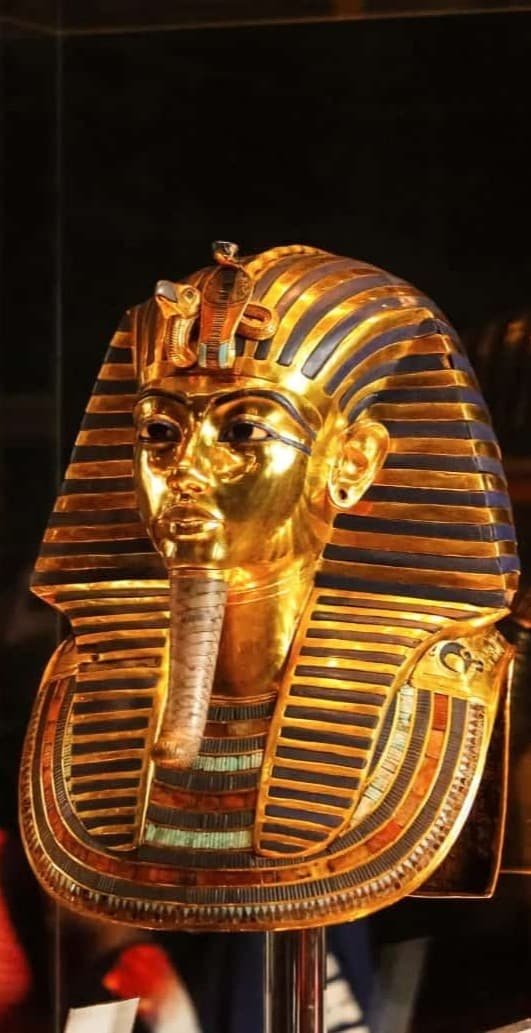
The single most iconic object not just in the Tutankhamun collection, but arguably in all of Egyptian archaeology. Crafted from approximately 11 kilograms (24 pounds) of solid gold, inlaid with lapis lazuli, turquoise, carnelian, quartz, obsidian, and colored glass paste, the mask was placed directly over the mummy’s head and shoulders within the innermost coffin. It depicts the young king wearing the royal nemes headdress, with the protective cobra (Wadjet) and vulture (Nekhbet) emblems of the dual crown of Upper and Lower Egypt across the brow.
The mask was beaten from two separate sheets of gold, joined with remarkable precision through hammering, then embellished with detailed inlay work — a technical achievement widely regarded as one of the finest surviving examples of ancient goldsmithing anywhere in the world.
Interestingly, some Egyptologists have noted stylistic inconsistencies in the mask — including a damaged cartouche (the oval name-plate) and variations in gold coloring — that have led to a debated theory that the mask may have originally been crafted for a different royal figure, possibly Tutankhamun’s stepmother or close relative Nefertiti, and later repurposed for Tutankhamun’s burial. This remains a minority theory rather than an established consensus.
The Solid Gold Inner Coffin
Tutankhamun’s mummy was housed within a set of three nested coffins. The innermost coffin is made from solid gold and weighs approximately 110 kilograms (242 pounds), while the outer two coffins are gilded wood. The coffins fit together with such extraordinary precision that, as later conservators noted, it was reportedly impossible to insert even a finger between them when nested.
The Golden Throne
A richly decorated ceremonial chair, carved from wood and covered in gold leaf, silver, and colored glass inlay, depicting an intimate scene of Tutankhamun and his wife, Ankhesenamun. The throne is considered one of the finest surviving examples of New Kingdom decorative art and provides rare insight into the personal, human side of royal life during this period.
The “Ecclesiastical Throne” / Ceremonial Chair
A separate ceremonial chair, carved from wood inlaid with ebony, ivory, and semi-precious stones and partly gilded, found in the tomb’s annex. Howard Carter himself compared its design to the fold-stools used by bishops in European cathedrals, giving rise to its informal nickname.
The Golden Chariot
Among the objects undergoing restoration and display preparation at the GEM is one of several golden ceremonial chariots found in the tomb — ornately decorated vehicles that, alongside more functional examples, reflect both Tutankhamun’s status and the period’s craftsmanship in wood, leather, and gold leaf.
Canopic Equipment
Tutankhamun’s internal organs, removed during mummification according to standard ancient Egyptian funerary practice, were preserved separately in a set of miniature gold coffins housed within an alabaster canopic chest — among the most delicately crafted objects in the entire collection.
Personal and Everyday Objects
Beyond the famous golden treasures, the tomb contained an extraordinary range of everyday and personal items reflecting the young king’s actual life: game boards, musical instruments, clothing, food provisions (including trussed duck and preserved meat intended to sustain the king in the afterlife), and a wooden chest filled with childhood items — anklets, toys, slings, and a fire-lighting kit — offering a uniquely human glimpse into Tutankhamun’s life as a child king who died young.
Carter also noted an unusually large number of walking sticks and ceremonial staves buried with the king — around 130 in total — leading him to speculate, with evident amusement, that the young pharaoh “must have been an amateur collector of walking sticks and staves.” Some showed clear signs of practical use, suggesting Tutankhamun, whose remains show evidence of physical disability, may genuinely have relied on some of them during his life.
The “Curse of the Pharaohs” Myth
No discussion of Tutankhamun’s discovery is complete without addressing one of the most persistent legends in popular archaeology: the so-called “Curse of the Pharaohs.” The myth gained traction after Lord Carnarvon, who funded Carter’s excavation, died in Cairo in April 1923 — just months after the tomb’s opening — reportedly from an infected mosquito bite complicated by blood poisoning. Newspapers at the time seized on the timing, and a sensationalized narrative of an ancient curse striking down those who disturbed the boy king’s rest quickly took hold in public imagination, fueled further by sporadic deaths among other individuals loosely connected to the excavation team over subsequent years.
Modern statistical analysis of the actual mortality rates among everyone present at the tomb’s opening shows no unusual pattern of early death compared to the general population of the era — researchers who’ve studied the claim have found the “curse” deaths are explained by ordinary causes (disease, age, accident) at rates entirely consistent with early-20th-century life expectancy. Howard Carter himself, who spent more time in direct contact with the tomb and its contents than anyone else involved, lived for another 17 years after the discovery, dying in 1939 at age 64 — a detail rarely mentioned in popular retellings of the curse legend.
Conserving a Century-Old Collection for a New Museum
Moving and redisplaying 5,398 fragile, irreplaceable objects — some not exhibited publicly in decades — required one of the most extensive conservation efforts in modern Egyptological history. Specialist teams at the GEM’s dedicated conservation center spent years carefully assessing, cleaning, and stabilizing objects before their move to the new galleries, in some cases addressing damage from earlier, less careful restoration attempts.
One widely reported example: the golden mask itself underwent a delicate restoration in 2015 after a poorly executed repair (sometimes referred to as the “glue beard incident”) had used inappropriate adhesive to reattach the mask’s ceremonial beard, which had become detached during routine cleaning. German and Egyptian conservators subsequently worked together to properly remove the incorrect adhesive and correctly reattach the beard using reversible, conservation-appropriate methods — a process documented in the first new high-resolution photographs of the restored mask released in 2015.
This kind of careful, specialized conservation work underlies the entire collection now on display at the GEM, ensuring that objects which have already survived more than 3,300 years remain protected for future generations of visitors.
Who Was Tutankhamun?
Tutankhamun ruled Egypt during the late 18th Dynasty, ascending to the throne as a child — likely around age 9 — and dying at approximately age 18 or 19, after a reign of roughly a decade. Historically, he was a relatively minor pharaoh in terms of political accomplishment, largely overshadowed in the broader sweep of Egyptian history by more militarily and politically significant rulers. His global fame today rests almost entirely on the extraordinary preservation of his tomb and treasures, discovered intact at a moment when most other pharaonic burials had already been looted centuries or millennia earlier.
Modern forensic and genetic analysis of his mummy has revealed evidence of significant health problems, including a club foot, bone necrosis, and signs of malaria — findings that have informed ongoing scholarly debate about the cause of his early death, alongside long-disputed theories involving accident or foul play.
The Cultural Impact of “Tutmania”
The 1922 discovery’s influence extended far beyond archaeology. The wave of public fascination that followed — dubbed “Tutmania” by contemporary observers — reshaped 1920s fashion, jewelry design, architecture, and even film, introducing Egyptian motifs into mainstream Western design in a way that persisted for decades. Art Deco architecture and design from the period frequently incorporated Egyptian-inspired imagery directly traceable to public excitement over Carter’s discovery, and the visual language of the golden mask in particular became one of the most widely recognized images of ancient history anywhere in the world.
A century later, the reunification of the complete collection at the GEM has reignited a similar scale of global attention, with early visitor figures suggesting the museum drew comparable levels of public interest in its opening weeks as the original 1920s discovery generated in newspapers worldwide — a rare case of an archaeological story captivating two entirely different centuries of audiences.
A Century of Touring and Display
Before the complete collection found its permanent home at the GEM, selections of Tutankhamun’s treasures toured internationally on multiple occasions, drawing enormous crowds. A landmark touring exhibition in the early 1970s, marking the 50th anniversary of the tomb’s discovery, drew approximately 1.6 million visitors during its run, displaying around 50 objects from the tomb including the golden mask. A later touring exhibition, “Tutankhamun: Treasures of the Golden Pharaoh,” which traveled to multiple cities including Paris, Los Angeles, and London beginning in 2019, was explicitly billed as the final touring exhibition before the complete collection would be permanently reunited and displayed at the GEM — a promise now fulfilled.
Visiting the Tutankhamun Galleries Today
Tickets
Depending on current museum pricing policy, the Tutankhamun galleries may be included within the GEM’s standard general admission ticket, or available as a small supplementary add-on — this has changed since the museum’s initial opening, so confirm current policy when booking. For complete, up-to-date ticket information, opening hours, and visitor tips for the museum as a whole, see our Grand Egyptian Museum tour guide.
What to Expect
The galleries are arranged at eye level, with the golden mask displayed in a dedicated, carefully lit setting designed to showcase its full detail. Mobile phone photography is generally permitted within the Tutankhamun halls, though cameras and flash photography typically face restrictions — confirm current rules at entry.
Pairing With Luxor
Because Tutankhamun’s mummy remains in its original tomb in the Valley of the Kings near Luxor, travelers wanting the complete experience — seeing both the treasures in Cairo and the tomb itself in Luxor — typically need a multi-day Egypt itinerary covering both cities. Many private tour operators, including Pure Nile Tours, offer combined Cairo and Luxor packages designed specifically around this pairing.
🏛️ Want to see Tutankhamun’s complete treasures with expert context? Pure Nile Tours’ private Egyptologist-guided tours of the Grand Egyptian Museum bring the full story of Howard Carter’s discovery and the boy king’s life to the galleries. Book a Private Cairo & GEM Tour →
Frequently Asked Questions
Where can I see Tutankhamun’s treasures today?
The complete collection of 5,398 objects is now displayed at the Grand Egyptian Museum (GEM) in Giza, having relocated from the older Egyptian Museum in Tahrir Square as part of the GEM’s 2024–2025 opening.
Is Tutankhamun’s mummy at the Grand Egyptian Museum?
No. Tutankhamun’s mummy remains in his original tomb (KV62) in the Valley of the Kings near Luxor. Only the funerary objects and treasures are displayed at the GEM in Cairo.
How many objects were found in Tutankhamun’s tomb?
Howard Carter catalogued 5,398 objects in total, discovered in the tomb in 1922. For the first time in history, all of these objects are now displayed together at the GEM.
What is the most famous object in the collection?
The golden funerary mask, crafted from approximately 11 kilograms of solid gold and inlaid with semi-precious stones, is the single most iconic and recognizable object in the entire collection.
Who discovered Tutankhamun’s tomb?
British archaeologist Howard Carter, funded by Lord Carnarvon, discovered the nearly intact tomb in the Valley of the Kings on November 4, 1922.
Was the golden mask actually made for someone else?
A minority theory among some Egyptologists, based on stylistic inconsistencies including a damaged cartouche, suggests the mask may have originally been intended for a different royal figure, possibly Nefertiti, before being adapted for Tutankhamun’s burial. This remains debated rather than confirmed.
Do I need a separate ticket to see the Tutankhamun galleries?
Depending on current museum policy, access may be included in the standard GEM admission ticket or sold as a small supplement. Confirm current pricing when booking, as policy has changed since the museum’s 2025 opening.
How old was Tutankhamun when he died?
Tutankhamun is generally believed to have died at approximately 18–19 years old, after a reign of roughly a decade beginning when he ascended the throne as a child around age 9.
Final Thoughts
A century after Howard Carter first peered into Tutankhamun’s tomb by candlelight and famously described seeing “wonderful things,” the complete collection has finally found a permanent home where every visitor can see it as a unified whole — not fragments scattered across storage rooms and rotating displays, but the full, extraordinary record of one young pharaoh’s burial. Few archaeological discoveries in history have captured public imagination so completely, and seeing the golden mask, the nested coffins, and the deeply personal objects of a boy king’s short life together, in one place, for the first time in over a century, is an experience that genuinely lives up to its reputation.
🏛️ Ready to see Tutankhamun’s complete treasures in person? Pure Nile Tours arranges private, expert-guided visits to the Grand Egyptian Museum, pairing seamlessly with a Luxor extension to see the tomb itself in the Valley of the Kings. Explore Private Egypt Tours →