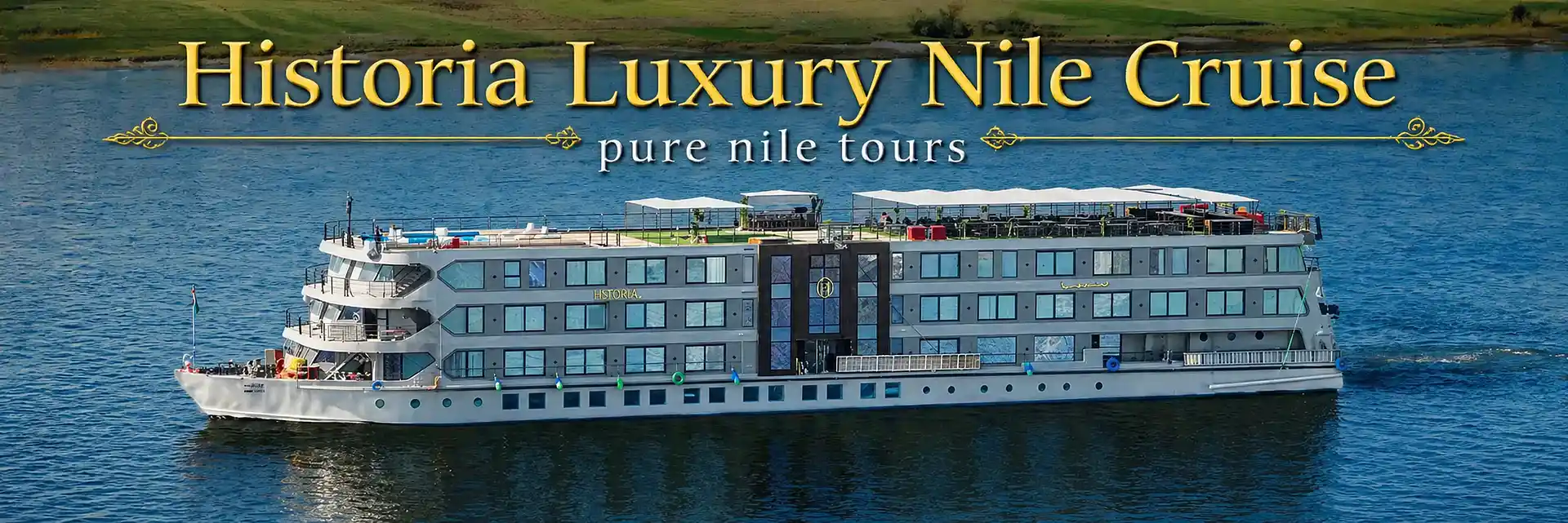
The Historia Luxury Nile Cruise is a 5-star boutique ship sailing between Luxor and Aswan, launched in December 2022 and now regarded as one of the finest vessels on the Nile. With Art Deco interiors, only around 50 cabins, and a private licensed Egyptologist on every itinerary, the Historia delivers a quieter, more personal experience than the larger 80–100 cabin cruisers. This guide covers everything a first-time traveller needs: itineraries, cabin categories, prices from $1,339, dress code, what is included, and how to book the Historia for 2026 with confidence.
Historia Luxury Nile Cruise at a Glance
The Historia Luxury Nile Cruise operates two fixed weekly itineraries: a 4-day route from Aswan every Friday and a 5-day route from Luxor every Monday, with prices starting from $1,339 per person.
| Detail | Information |
|---|---|
| Ship type | 5-star boutique luxury Nile cruiser |
| Year launched | December 2022 |
| Capacity | Approximately 50 cabins and suites |
| Length / decks | 72 metres / 5 passenger decks |
| Itineraries | 4 days / 3 nights from Aswan and 5 days / 4 nights from Luxor |
| Departure days | Every Friday from Aswan, every Monday from Luxor |
| Starting price | From $1,339 (3 nights) and from $1,719 (4 nights) per person |
| Sites visited | Karnak, Luxor Temple, Valley of the Kings, Hatshepsut, Edfu, Kom Ombo, Philae, High Dam |
| Meals | Full board — breakfast, lunch, dinner included |
| Languages | English, French, Spanish guides on request |
Exchange rates fluctuate — verify current rates before travel. Prices above are quoted in USD per person in a double-occupancy cabin and are subject to seasonal adjustment around Christmas, New Year, and Easter.
What this Historia cruise delivers in practical terms:
- Boutique scale — fewer guests, shorter buffet queues, faster service, more private sundeck space.
- Refined design — earth-tone palette with jewel accents, Art Deco geometry, perforated rattan screens.
- Full guided programme — private Egyptologist, all entrance fees, air-conditioned transfers included.
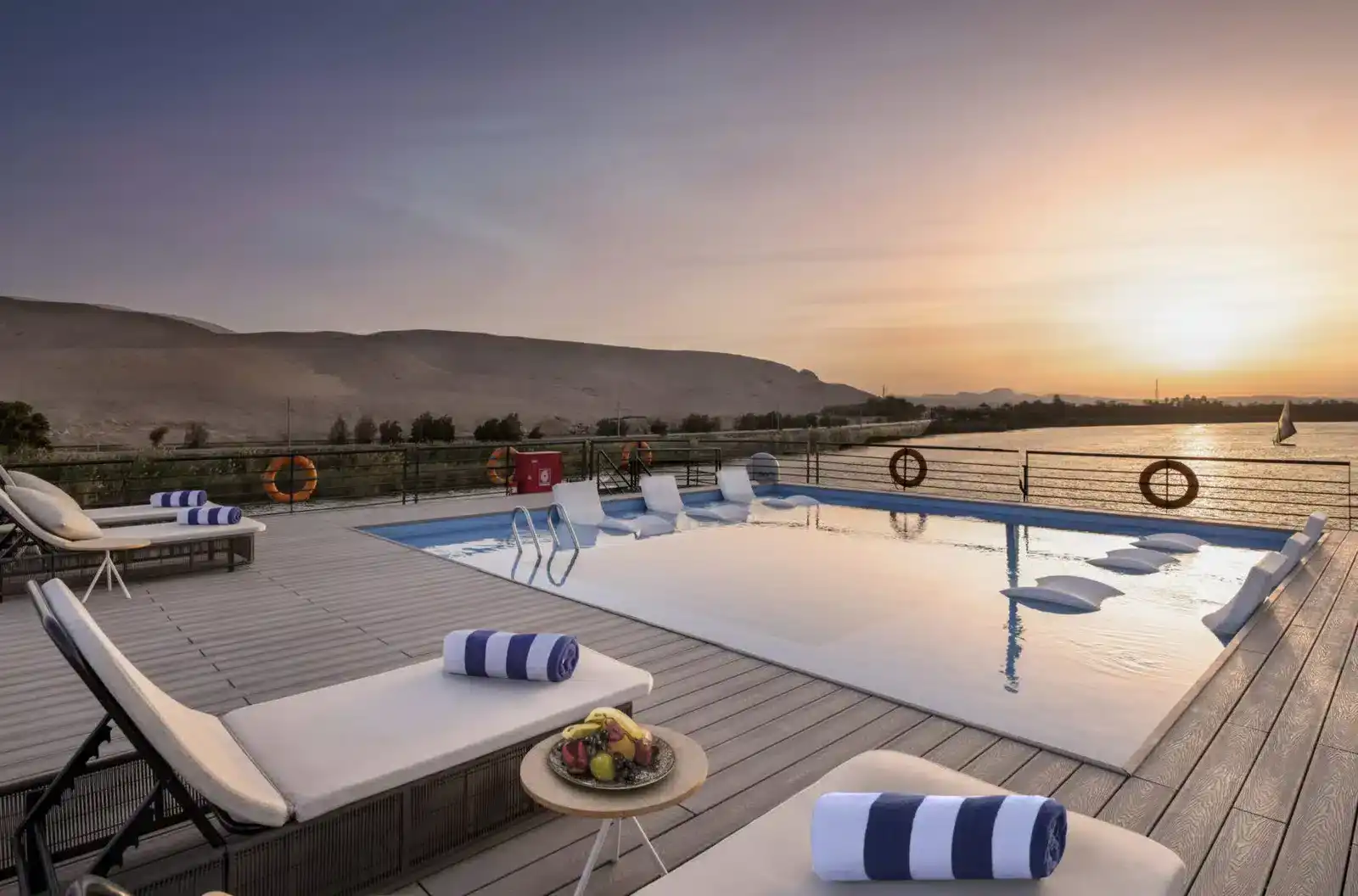
- Modern amenities — pool with swim-up bar, Seneb Spa, gym, lounge bar, library, free Wi-Fi.
Why the Historia Stands Out Among 5-Star Nile Cruises
The Historia Luxury Nile Cruise stands out because of three combined factors: boutique passenger numbers, a coherent Art Deco design identity, and consistently high service ratings on independent review platforms.
The size of the ship is the first thing returning Nile cruisers notice on the Historia. Where typical luxury cruisers carry 140–180 passengers across 70–90 cabins, the Historia carries roughly 100 guests at full capacity. That single design choice changes everything. The dining room never feels rushed. The sundeck always has a free lounger. The crew remembers your name by day two.
Independent reviews on Tripadvisor and Booking.com rate the Historia among the highest-scoring vessels currently sailing between Luxor and Aswan, with particular praise for service and food quality. The ship sits within a 15-minute walk of Karnak and Luxor Museum, putting two of Luxor’s most important sites in easy reach when moored on the East Bank.
The Art Deco design language is the second differentiator on the Historia. The interiors blend Egyptian-inspired furniture, perforated rattan screens that diffuse light into a soft glow, and a colour palette of earth shades grounded by jewel tones — rubies and lapis — to mirror Ancient Egyptian jewellery. Most Nile cruisers default to a generic five-star hotel aesthetic. The Historia commits to one design idea and follows it through every cabin and corridor.
Service is the third reason guests rebook the Historia. Recent traveller reviews describe a 10/10 experience, with attentive front-office staff, restaurant teams who learn dietary preferences quickly, and a chef who personally recommends dishes at the buffet. A boutique-sized crew can deliver this level of attention; a 200-passenger ship structurally cannot.
Onboard facilities are comprehensive without crossing into overkill. The sundeck pool with swim-up bar, the Seneb Spa with Egyptian aromatherapy treatments, a small library, a boutique selling handpicked Egyptian crafts, a clinic with on-call doctor, and the Nora dining room form the daily rhythm. For travellers comparing 5-star options on the same route, see our Nile cruise comparison by category, or compare the Historia directly with the Le Fayan Nile Cruise for another design-led luxury option.
Cabin Categories on the Historia Luxury Nile Cruise
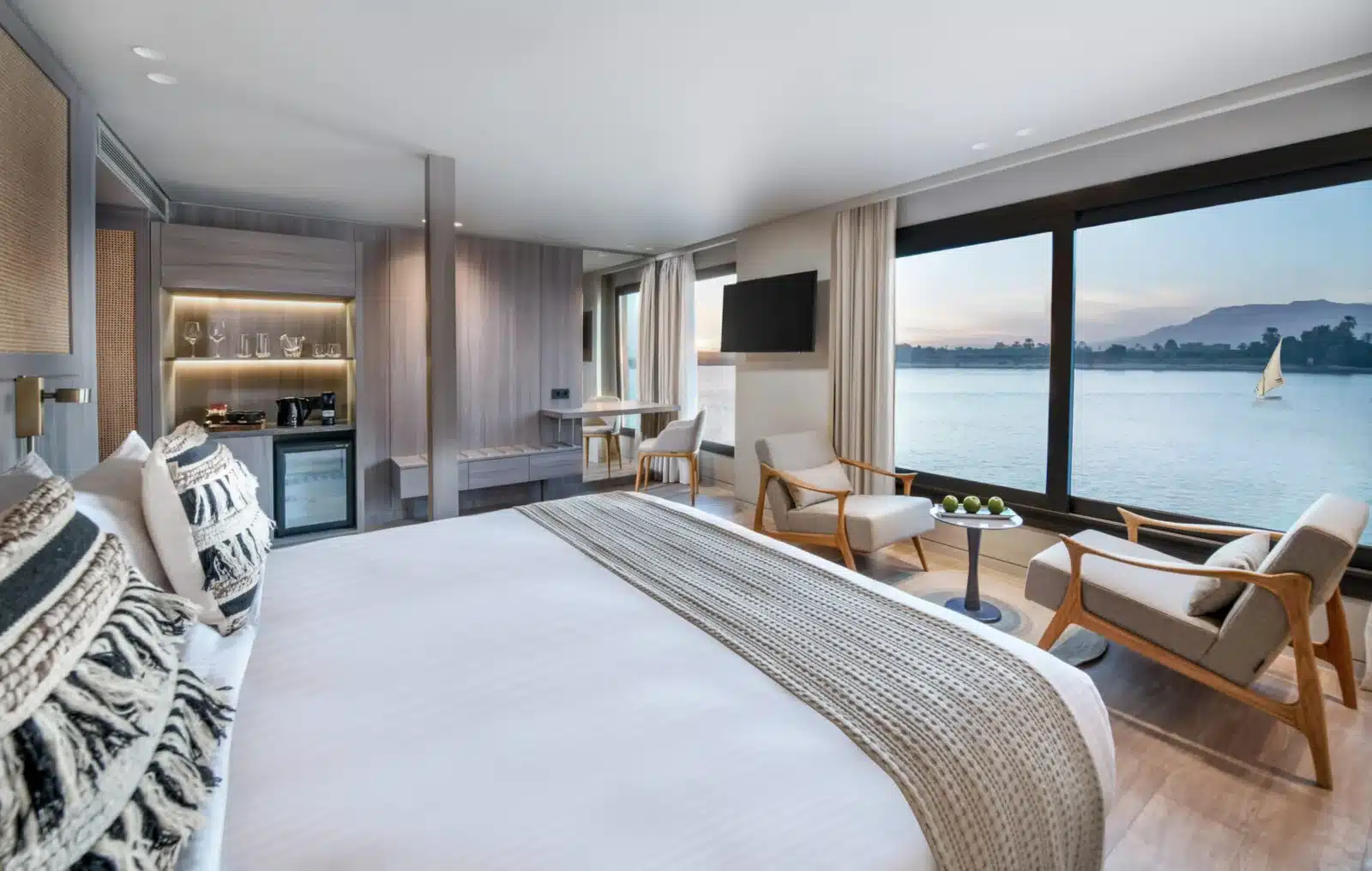
The Historia Luxury Nile Cruise offers four cabin tiers across five passenger decks: Luxury Cabins (22 sqm), Historia Suites (33 sqm), Presidential Suites (40 sqm), and Royal Suites (46 sqm). Every cabin and suite faces outward with a panoramic window — there are no inside cabins.
| Category | Approximate size | Best for | Notable features |
|---|---|---|---|
| Luxury Cabin | 22 sqm | Couples, solo travellers | Picture window, walk-in shower or bathtub, smart TV, mini-bar |
| Historia Suite | 33 sqm | Couples wanting more space | Separate seating area, larger bathroom, premium toiletries |
| Presidential Suite | 40 sqm | Special occasions | Named after Umm Kulthum and Naguib Mahfouz, expanded living area |
| Royal Suite | 46 sqm | Honeymoons, anniversaries | Inspired by King Farouk and Princess Fawzia, full lounge and dining nook |
Standard amenities across every Historia cabin include individually controlled air conditioning, a 42-inch smart TV, sound-insulated walls, an in-room safe, complimentary tea and coffee facilities, a hairdryer, free Wi-Fi, and a telephone. All rooms also carry 24-hour room service. The mini-bar is stocked but charged separately.
A baby cot is available on request, and connecting cabins make the Historia practical for families travelling with older children. Note that children under seven are not accepted on board because of safety considerations on the open sundeck and the demanding pace of the temple itinerary. Cribs are not provided.
The Royal and Presidential suites add bathtubs, expanded picture windows, and a dedicated living area that turns the cabin into a small private apartment. Honeymooners often choose these tiers specifically because the cabin itself becomes part of the experience — having tea on a private sofa as the riverbank slides past is a different memory from doing the same thing in the ship’s lounge.
Public spaces on the Historia are organised vertically. The lower deck holds the Nora restaurant, where assigned tables and dedicated waiters create a club-like dining feel. The middle decks hold the cabins. The sundeck on top houses the outdoor pool, swim-up bar, sun loungers, and the open-air bar where most evenings end. The Seneb Spa, gym, library, and boutique are arranged for easy access without crossing busy areas.
The accessible Historia Suite is available on request — useful for guests with reduced mobility, though the temple sites themselves involve uneven ground and steps. The lift connects all decks. Smoking is permitted only on the sundeck; all cabins and indoor public spaces are non-smoking by policy. Pets are not allowed.
Onboard Facilities, Dining & Service Standards
Dining on the Historia centres on the Nora restaurant, which serves three full-board meals a day in a continental fine-dining style. Breakfast runs as a buffet from approximately 07:00 to 09:30 with cooked-to-order eggs, fresh fruit, pastries, Egyptian breakfast staples like ful and falafel, and a strong espresso-based coffee station.
Lunch and dinner alternate between buffet service and plated set menus depending on the sailing schedule. Food quality is repeatedly cited in guest reviews as a highlight rather than an afterthought. Recent traveller feedback describes the food as delicious and varied, with the chef personally involved in recommending what to try.
Themed nights on the Historia include the Egyptian galabeya buffet on the sundeck, where guests are encouraged to wear traditional dress for an evening of folkloric music, sufi tanoura dancing, and grilled meats served outdoors with the riverbank lit up beyond. These evenings are a highlight for first-time visitors and worth the small effort of buying or borrowing a galabeya.
Drinks are charged separately from the cruise package. Local Egyptian beer, wine, and spirits sit at moderate prices, while imported wines and premium spirits are priced significantly higher because of Egypt’s import duties on alcohol. Recent guest reviews note local cocktails at around 400 EGP and international cocktails at around 1,000 EGP. Egyptian wines have improved noticeably in the last five years and offer better value than imports.
The Aura Bar & Lounge on the Historia runs from late morning until midnight, with live entertainment in the evenings — usually a pianist, an oud player, or a small ensemble. The pool bar serves cocktails and snacks during the day and tends to be the busiest social spot when the ship is moored. Reservations for spa treatments are recommended on day one because slots fill quickly on shorter cruises.
Service standards reflect the Historia’s boutique scale. The crew-to-guest ratio sits well above the Nile cruise average, which translates into housekeeping that turns a room within twenty minutes, restaurant staff who learn coffee preferences after the first morning, and front-desk staff who notice when a guest looks unwell and quietly offer assistance. The on-call doctor is a reassuring detail for older travellers and anyone managing a chronic condition.
Free Wi-Fi covers cabins and public spaces on the Historia. Signal strength dips in the more remote stretches of the river between Edfu and Kom Ombo, where shore-based mobile coverage thins out, but stabilises again in Luxor and Aswan.
Itinerary 1: 4 Days / 3 Nights from Aswan to Luxor
The shorter Historia Luxury Nile Cruise itinerary departs Aswan every Friday and arrives in Luxor the following Monday morning, with prices starting from $1,339 per person in a double-occupancy luxury cabin. This is the route most travellers choose when combining the cruise with a Cairo extension.
Day 1 (Friday) — Embark in Aswan, Philae & High Dam. The day begins with a private air-conditioned transfer from Aswan airport or train station to the ship. Embarkation is from noon, with a welcome drink served on the sundeck. Lunch is on board. The afternoon programme covers the Aswan High Dam and the Philae Temple complex, dedicated to the goddess Isis and accessible only by boat across the reservoir. Guests return to the ship for dinner and overnight moored in Aswan.
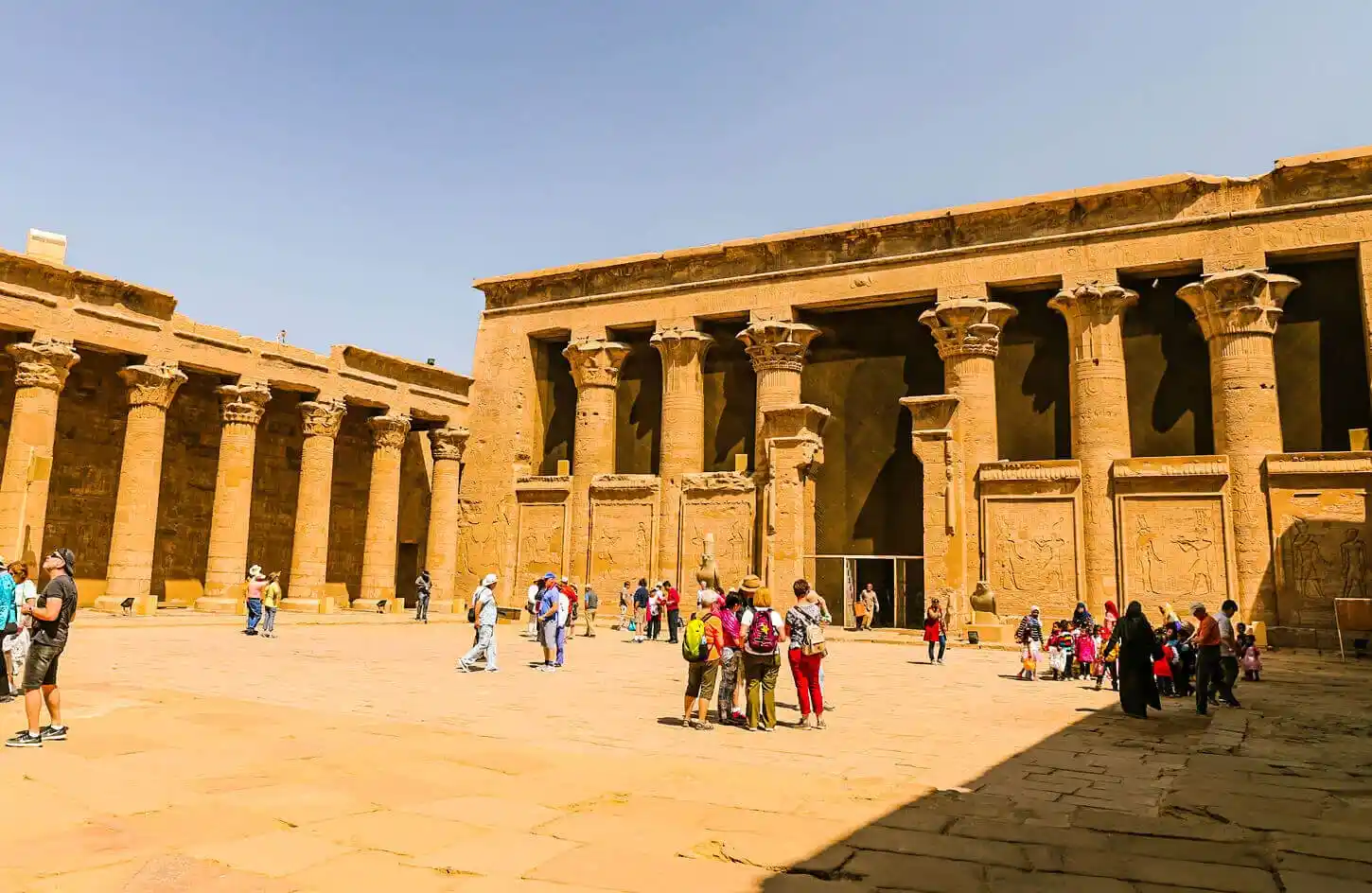
Day 2 (Saturday) — Sail to Kom Ombo & Edfu. Breakfast on board while the Historia pushes north. The morning visit is to Kom Ombo, the unusual dual temple shared between Sobek the crocodile god and Horus the elder. Its symmetry is unique in Egyptian architecture and the small mummification museum next door is a quick but rewarding addition. Lunch is served as the ship continues to Edfu, where horse-drawn carriages take guests from the riverbank to the Temple of Horus.
Edfu is the best-preserved Ptolemaic temple in Egypt and the carved battle scenes between Horus and Seth on the inner walls reward an unhurried visit. Dinner and overnight as the ship sails north toward Luxor.
Day 3 (Sunday) — West Bank of Luxor. The most demanding day in terms of walking on the Historia itinerary. After early breakfast, the programme covers the Valley of the Kings (entrance includes three tombs from the standard rotation, with optional supplements for Tutankhamun, Seti I, or Ramses VI), the Temple of Hatshepsut at Deir el-Bahari with its three-tiered façade, and the Colossi of Memnon.
The afternoon is at leisure on board with optional spa treatments. The evening is the galabeya party — Egyptian-themed buffet on the sundeck, dress-up encouraged, tanoura and folk dance performances. Dinner and overnight in Luxor.
Day 4 (Monday) — East Bank of Luxor & disembarkation. Breakfast on board, then disembarkation around 08:00. The morning is spent at the Karnak Temple complex — the largest religious building of the ancient world by area — and the smaller but more intimate Luxor Temple linked to Karnak by the recently restored Avenue of Sphinxes. A private transfer then delivers guests to Luxor airport, train station, or onward hotel.
For a deeper view of how the Historia Luxury Nile Cruise routing fits with the rest of Egypt, the Nile cruise itinerary planning guide walks through how to slot the cruise into a 7- to 12-day national itinerary.
Itinerary 2: 5 Days / 4 Nights from Luxor to Aswan
The longer Historia Luxury Nile Cruise itinerary departs Luxor every Monday and arrives in Aswan on Friday morning, with prices starting from $1,719 per person in a double-occupancy luxury cabin. Most travellers find this version the better value because the extra night allows the schedule to breathe.
Day 1 (Monday) — Embark in Luxor, East Bank temples. Private transfer from Luxor airport, train station, or hotel to the Historia. Embarkation from noon, welcome drink, and lunch on board. The afternoon covers Karnak Temple, the Avenue of Sphinxes, and Luxor Temple. Karnak alone deserves at least two hours; the hypostyle hall with its 134 columns is one of the truly overwhelming spaces in world architecture. Sunset light on the obelisks is worth lingering for. Dinner and overnight on board moored in Luxor.
Day 2 (Tuesday) — West Bank, then sail toward Edfu. Early breakfast, then the West Bank programme: Valley of the Kings with three tombs included, Hatshepsut Temple, and the Colossi of Memnon. An optional sunrise hot-air balloon ride is offered before this programme — bookable on board for around $120–150 per person and worth the early start for a full panoramic view of the Theban necropolis at first light.
Lunch on board the Historia as the ship begins sailing south toward Edfu, passing through the Esna Lock — itself an experience as the ship descends through the chamber. Dinner and overnight while sailing.
Day 3 (Wednesday) — Edfu & Kom Ombo. Breakfast as the Historia moors at Edfu. The morning visit is the Temple of Horus, reached by a short horse-carriage ride. Lunch on board as the ship sails to Kom Ombo. The temple of Sobek and Horus the Elder is best visited in late afternoon when the heat eases and the light turns gold across the carved reliefs.
The crocodile mummification museum next door takes about thirty minutes and displays mummified crocodiles, sacred jars, and excavation finds in a compact, well-curated layout. Dinner and overnight on board sailing toward Aswan.
Day 4 (Thursday) — Aswan: High Dam, Philae & Felucca. Breakfast on board moored in Aswan. The morning programme covers the High Dam and the unfinished obelisk in the granite quarries — the obelisk shows the ancient Egyptian quarrying method in detail and is often skipped on shorter itineraries.
Lunch on board the Historia. The afternoon visits Philae Temple, accessed by motorboat. The day closes with a felucca sailing trip around Elephantine Island and past the Aga Khan Mausoleum. Dinner on board, optional Nubian show in the evening.
Day 5 (Friday) — Optional Abu Simbel & disembark. Breakfast on board, then disembarkation. Many guests use this day for the optional Abu Simbel excursion before flying out. Otherwise, transfer to Aswan airport or train station for onward travel.
This 5-day Historia itinerary aligns well with travellers who want to also include Cairo and the pyramids — the 8-Day Cairo and Nile Cruise with Abu Simbel shows how the longer cruise integrates with the rest of Egypt’s must-see destinations.
Optional Excursions: Abu Simbel, Hot Air Balloon, Cairo Add-On
Three optional add-ons consistently come up in pre-cruise planning for the Historia. None is included in the base price, but each is worth understanding before booking.
Abu Simbel — the twin rock temples of Ramses II and Nefertari sit roughly 280 km southwest of Aswan, near the Sudanese border. Visiting requires either a 3.5-hour road convoy each way (typically a 03:30 hotel pickup) or a domestic flight from Aswan. The flight option costs around $250–320 per person all-in and gets travellers back on board in time for a normal lunch.
The road option costs around $90–130 per person and rewards the early start with a full half-day at the site. Either way, Abu Simbel is the single most photographed monument in Egypt for a reason — the four 20-metre seated colossi cut directly into the cliff dwarf every visitor standing at the entrance, a scale that photographs flatten. The Abu Simbel temples visitor guide from Aswan covers timing, costs, and what to expect at the site itself.
Hot air balloon over Luxor’s West Bank — runs at sunrise, typically a 04:30 hotel or ship pickup. The flight itself lasts 45–60 minutes, drifting over the Valley of the Kings, Hatshepsut Temple, and the green farming strip along the Nile. Cost is around $120–150 per person and includes pickup, light refreshments, and a flight certificate. Bookings are easiest to confirm on day one of the Historia cruise.
Weather cancellations occur — Luxor’s morning visibility is mostly reliable but winter mist and summer heat haze can ground flights. If a cancellation happens, the operator usually offers a refund or rebooking the next morning if the schedule allows.
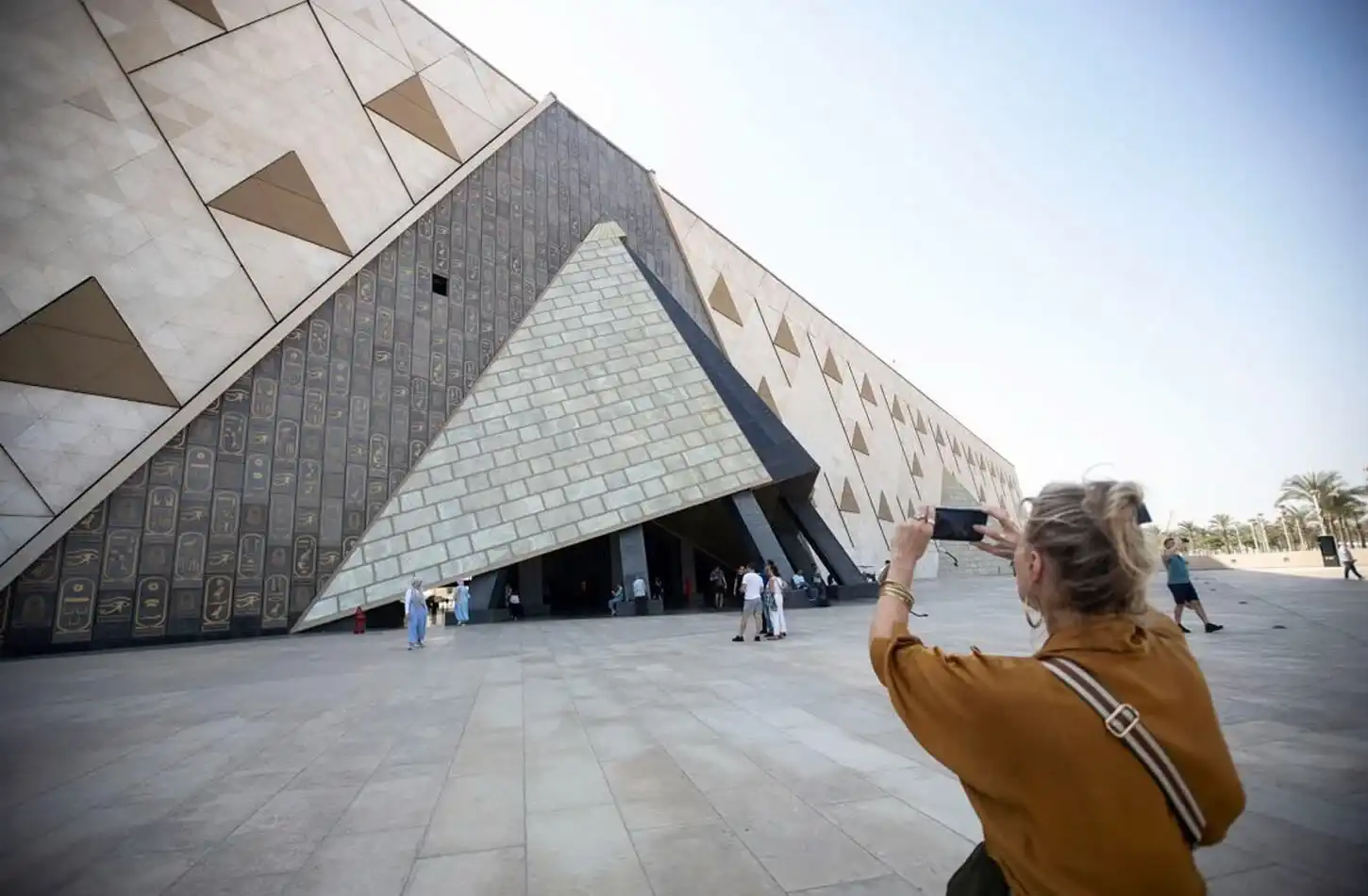
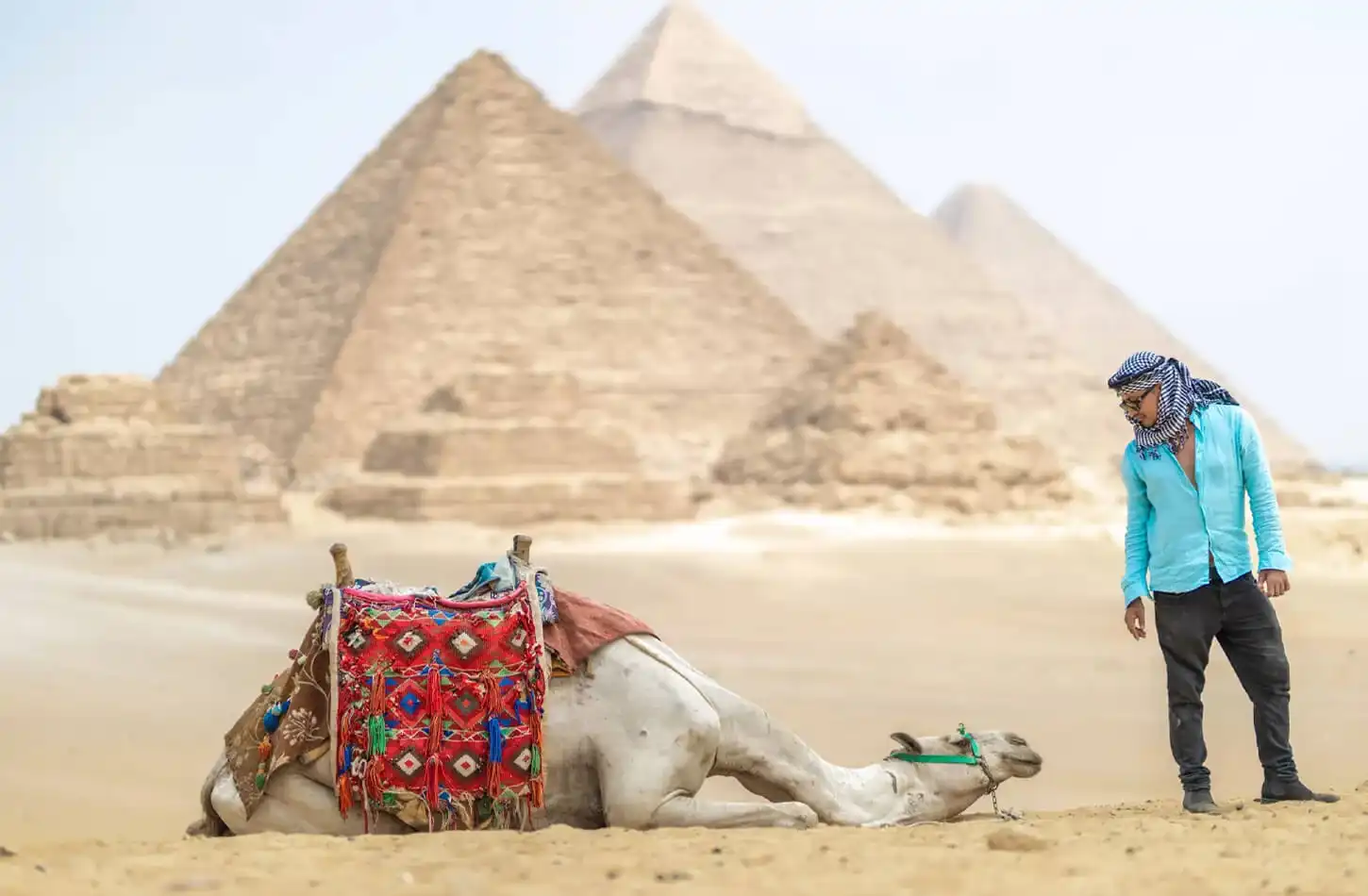
Cairo and pyramids extension — most international travellers pair the Historia cruise with two to three nights in Cairo to cover the Giza pyramids, the Sphinx, the Egyptian Museum or the new Grand Egyptian Museum, and ideally Old Cairo or Khan el-Khalili bazaar. The Historia itself does not include Cairo, but transfers and the extension itinerary can be arranged before arrival.
Nubian village visit — sometimes included in the longer Historia itinerary, sometimes optional. The villages on Elephantine Island offer a glimpse of Nubian architecture, music, and daily life that contrasts sharply with mainstream Egyptian culture. Worth doing once.
Best Time of Year to Sail on the Historia
The best time to sail on the Historia Luxury Nile Cruise is October through April, when daytime temperatures sit between 20°C and 32°C and outdoor temple visits remain comfortable. Summer cruises run year-round but require early starts and a different mindset.
| Month | Average daytime high | Cruise experience |
|---|---|---|
| October | 32–35°C | Ideal — warm, dry, light evening breeze on deck |
| November | 27–30°C | Excellent — peak comfort, busy season begins |
| December | 22–25°C | Cool — sweater needed at night, popular for Christmas |
| January | 20–24°C | Coolest — bright sunny days, cold mornings |
| February | 23–27°C | Excellent — comfortable for full day touring |
| March | 27–30°C | Excellent — last comfortable month before heat begins |
| April | 32–36°C | Warm — manageable with morning starts |
| May | 36–40°C | Hot — afternoons demanding, deck cooling crucial |
| June–August | 40–45°C+ | Very hot — early starts essential, lower prices |
| September | 36–40°C | Hot but easing — shoulder pricing returns |
The peak booking window for the Historia is mid-October through mid-April. Christmas and New Year sailings sell out months ahead and carry a 20–35% premium. February and March are the sweet spot — clear days, manageable nights, and prices below the December peak.
Summer sailings are not unsafe but require a different mindset on the Historia. Temple visits start at 05:30, the pool deck becomes essential rather than optional, and the savings can reach 30–40% off shoulder pricing. Travellers who handle heat well can find genuine value in May or September departures.
A detailed breakdown by month is available in the best months to visit Egypt guide, which covers both Upper Egypt and Cairo conditions side by side.
At the time of writing, the published 2026 Historia schedule runs Friday departures from Aswan and Monday departures from Luxor without seasonal interruption — details can change, so confirm current departure days when booking.
What’s Included vs What’s Not
The Historia Luxury Nile Cruise package as offered through Pure Nile Tours includes full-board accommodation, all sightseeing with a private licensed Egyptologist, every entrance fee, and all transfers. International airfare, the Egypt entry visa, drinks outside meals, tipping, and optional excursions sit outside the base price.
| Included | Not included |
|---|---|
| Meet-and-greet at airport or train station | International airfare |
| Full-board accommodation (breakfast, lunch, dinner) | Egypt entry visa (~$25 on arrival or e-visa) |
| All sightseeing with private licensed Egyptologist | Drinks outside meals (alcohol, soft drinks) |
| All temple and site entrance fees | Tipping for guide, driver, and ship crew |
| Private air-conditioned transfers throughout | Optional excursions (Abu Simbel, hot air balloon) |
| Bottled water during all excursions | Personal expenses (laundry, spa, boutique) |
| Welcome drink on embarkation | Travel insurance |
| Complimentary tea and coffee at all meals | Premium tomb tickets at Valley of the Kings |
| All service charges and local taxes | International phone calls and roaming |
Tipping is structurally expected in Egypt, more so than in mainland Europe. Plan a tipping budget of approximately $40–60 per couple for the guide over a 4-day Historia cruise, $20–30 for the driver, and a pooled ship-crew envelope of $50–80 per couple delivered at disembarkation. The Historia front desk can advise on local etiquette.
Premium tomb tickets at the Valley of the Kings cost approximately 200–600 EGP each depending on the tomb, paid in cash at the entrance. Tutankhamun’s tomb is the most expensive and the smallest, but seeing the actual mummy in situ has its own significance. Seti I is widely regarded as the most spectacular tomb art in the entire necropolis.
Drinks add up quickly on any Nile cruise. A standard bottle of local wine on the Historia runs around 600–900 EGP, a local beer around 100–150 EGP, soft drinks around 60–80 EGP. Plan a daily drinks budget of $25–40 per person if you intend to enjoy wine with dinner.
Historia Luxury Nile Cruise Price 2026
The Historia Luxury Nile Cruise price for 2026 starts from $1,339 per person in a double-occupancy luxury cabin for the 3-night cruise, and from $1,719 per person for the 4-night cruise. Prices climb meaningfully for higher cabin tiers and during peak dates.
A realistic per-person budget for a couple booking the 4-night Luxor-to-Aswan Historia cruise in shoulder season looks roughly like this:
- Luxury cabin (4 nights, double occupancy): from $1,719 per person
- Tipping (guide, driver, crew): approximately $80–120 per person
- Optional Abu Simbel by flight: approximately $280 per person
- Optional hot air balloon: approximately $135 per person
- Drinks (4 days, moderate consumption): approximately $80–140 per person
- Premium Valley of the Kings tomb tickets: approximately $20–30 per person
- Single supplement (if travelling solo): typically 50–80% of the cabin rate
A complete Historia cruise with optional excursions and reasonable extras lands somewhere between $2,300 and $2,800 per person before international flights. Solo travellers should budget meaningfully more because cabin pricing assumes double occupancy across the industry.
Higher cabin tiers on the Historia — Historia Suite, Presidential Suite, Royal Suite — add roughly $400–1,800 per person on top of the base luxury cabin rate, depending on category and date. Honeymooners and special-occasion travellers usually find the Historia Suite the strongest balance of space and value.
For a deeper price comparison across multiple cruise tiers on the same Luxor–Aswan route, the Nile Cruise Luxor to Aswan Prices 2026 post compares the Historia against other 5-star and ultra-luxury vessels with current rates and seasonal multipliers.
Exchange rates fluctuate — verify current rates before travel. Egyptian Pound rates against the USD have moved sharply over the last 24 months, which affects on-board drinks and gratuity values. Most cruise rates remain quoted in USD and stay stable across that period.
Booking Tips: How to Reserve & What to Confirm
Booking the Historia Luxury Nile Cruise smoothly comes down to three steps: locking the departure date early, choosing the right cabin tier honestly, and confirming exactly what is included before paying the deposit. When you are ready to compare live booking options, view the Historia Luxury Nile Cruise trip page.
Lock the departure date first. Friday-from-Aswan and Monday-from-Luxor Historia departures fill on different cycles. Christmas, New Year, and Easter weeks book out 4–6 months in advance. February and March book about 8–12 weeks ahead. Summer departures are usually available within 2–4 weeks. International flight prices into Cairo also swing with these windows, so coordinate the cruise dates with airfare research.
Decide on cabin tier honestly. A luxury cabin at 22 sqm on the Historia is comfortable for a couple — it is larger than most European hotel rooms — and the picture window means natural light fills the space. Upgrading to a Historia Suite makes sense if the trip is a special occasion or if guests plan to spend more time in the cabin.
Royal Suites are worth the supplement only for honeymoons, anniversaries, or travellers who specifically want the cabin to function as a private living space. For most couples, the standard luxury cabin delivers excellent value.
Confirm what is in the package. Some operators sell the cruise without sightseeing inclusions, leaving guests to pay site entrance fees and Egyptologist services at each stop. The Historia package as offered through Pure Nile Tours bundles all entrance fees, the private Egyptologist guide, and all transfers — this is the version most international visitors expect, but worth confirming explicitly in the booking confirmation. Ask for a written breakdown before paying the deposit.
Other practical confirmations. Verify the cabin category and deck position on the Historia. Cabins at the rear of the ship can transmit faint engine vibration when moored or sailing slowly, while cabins at the bow and middle stay quietest. Verify the Egyptologist’s working language matches the group. Confirm the airport pickup time, vehicle type, and contact number for the Cairo or Aswan representative. Ask whether Ramadan dates affect the planned schedule if travelling in February or March 2026.
Dress Code, Etiquette & Onboard Atmosphere
The dress code on the Historia is smart-casual rather than formal. Light cotton trousers, linen shirts, and modest summer dresses fit the daytime atmosphere. The galabeya themed evening invites guests to wear traditional Egyptian-style robes — most guests buy one in advance at Khan el-Khalili in Cairo or borrow from the cruise’s small dressing-up collection.
Dinner does not require jacket and tie, but most guests dress neatly out of respect for the room and the Historia’s service standard. A linen shirt or a summer dress feels right; gym wear or beach attire feels out of place after dark.
Off the ship, modesty is the operating principle. At every temple site, shoulders should be covered and shorts should reach close to the knee. Inside active mosques (a possibility on a Cairo extension rather than the cruise itself), women cover their hair, everyone removes shoes, and modest dress applies regardless of gender. Coptic churches in Old Cairo are slightly more relaxed but still expect covered shoulders.
Photography is permitted at most sites visited on the Historia, but flash is prohibited inside tombs in the Valley of the Kings to protect the painted reliefs. Some tombs charge an additional photography permit fee. Tutankhamun’s tomb prohibits photography entirely. Drone photography is illegal in Egypt without specific written government permission and is not worth the risk.
Tipping etiquette deserves its own paragraph. Egypt operates on a small-cash culture for service: 20–50 EGP for hotel porters, similar for waiters in non-cruise restaurants, larger amounts for guides and drivers measured per day rather than per service. On the Historia, the front desk can change USD into Egyptian Pounds for tipping convenience.
Alcohol is served on board the Historia and at most international hotels but is restricted in public spaces in Egypt as a country. Drinking in public — outside licensed venues or hotels — is illegal. The cruise environment is fully licensed and there is no need for any anxiety on this point. The deeper Egypt cultural etiquette guide covers the broader picture for travellers extending the trip beyond the cruise.
Tipping, Money & Payments on the Historia
Egypt uses the Egyptian Pound (EGP). At the time of writing the rate sits at approximately 47–50 EGP to 1 USD, though this has moved considerably over the past two years. ATMs in Aswan and Luxor dispense Egyptian Pounds in 100, 200, and 500 EGP notes, with daily withdrawal limits typically around 5,000–10,000 EGP per transaction.
On the Historia itself, USD and EUR are accepted for most charges, with credit cards (Visa, Mastercard) accepted at the front desk for cabin extras like the bar tab, spa treatments, and boutique purchases. American Express is accepted less consistently across Egypt — bring a Visa or Mastercard as the primary card on the Historia.
Tipping is best done in cash. Bringing approximately $200–300 in small US bills covers tipping, optional excursion supplements, and small purchases at temple sites without dependence on ATMs. Carrying a stack of $1, $5, and $10 bills before arrival saves friction throughout the trip.
Outside the cruise, cash is more important than cards for small purchases — temple parking, tea at a riverside café, taxi fares, tips, market shopping. Credit cards work reliably at international hotels, fuel stations, and large restaurants but fail unpredictably at small establishments. Carry enough cash for one to two days at any time.
A typical daily on-board cash flow on the Historia looks like this: $20 in tips for the guide and driver, $10–20 in tips for ship crew at meal time (optional, the pooled tip at the end is the main one), $10–30 for drinks if you don’t run a tab, $5–10 for bottled water and snacks beyond what is included.
ATMs in Luxor are reliable. ATMs in Aswan are reliable. ATMs at Abu Simbel are limited — withdraw before the day trip if possible.
Wi-Fi, Phones & Staying Connected
Free Wi-Fi covers all cabins and public spaces on the Historia. Speeds are adequate for messaging, email, and standard browsing but vary with the ship’s location — moored in Luxor or Aswan, the connection is strong; sailing through more remote stretches, it slows or drops momentarily. Video calls work most of the time with patience.
For travellers who want a dedicated mobile data plan during the Historia cruise, Egyptian e-SIMs and physical SIM cards are widely available. Vodafone Egypt, Orange, and Etisalat Misr all sell tourist SIM packages at Cairo airport and most central city stores. A typical 30-day tourist SIM costs around 200–400 EGP and includes 15–25 GB of data.
Coverage on the Nile between Edfu and Kom Ombo is patchy regardless of provider; coverage in Luxor and Aswan is strong. WhatsApp is the dominant messaging app in Egypt — the Egyptologist, Historia crew, and ground operator all communicate by WhatsApp. Installing it before arrival saves friction.
Voice and video over WhatsApp are not blocked in Egypt, unlike in some neighbouring countries. International roaming on most US, UK, and European carriers works in Egypt but can be expensive — check the daily passport-style roaming fees before relying on it. For most travellers, the Historia Wi-Fi plus a cheap local SIM covers everything needed.
Power outlets on the Historia are European two-pin (Type C/F). A simple universal travel adapter handles US, UK, and Australian plug shapes. Voltage is 220V/50Hz — most modern phone, laptop, and camera chargers handle this without an additional transformer.
Health, Safety & Comfort on Board
Egypt’s safety profile for tourists travelling on organised cruise itineraries like the Historia is solid in 2026. The temple sites and the cruise corridor between Luxor and Aswan are heavily protected and tourist-focused.
The wider conversation about safety in Egypt — practical advice, what to watch for, and how to handle common scams — is covered in detail in the Is Egypt Safe for Tourists in 2026 guide, which includes recent advisory updates from the UK FCDO and US State Department.
On the Historia specifically, the ship has an on-call doctor and a small clinic for minor issues. Cabin first-aid kits are available on request. Travellers with chronic conditions — diabetes, blood pressure, heart conditions — should bring more than enough of any prescription medication for the trip duration plus several days of buffer, in original packaging with the prescription.
Stomach issues are the most common tourist complaint in Egypt. The Historia serves filtered water, but the safe rule across the country is to drink only sealed bottled water and to avoid raw vegetables that may have been washed in tap water at less careful establishments. On the cruise itself, food hygiene standards are high — guest reviews consistently note no issues with food.
Sun exposure is the second risk on any Nile cruise. Upper Egypt’s UV index runs at 8–11 even in winter. A wide-brimmed hat, SPF 30–50 sunscreen, and sunglasses are essential. Heat exhaustion on summer Historia itineraries is real — drink water continuously, take advantage of the early morning starts at temple sites, and use the pool deck in the heat of the afternoon.
Travel insurance should cover medical evacuation. The nearest top-tier hospital for serious conditions sits in Cairo, several hours of travel from Aswan or Luxor. A policy that covers medical evacuation removes the financial uncertainty of the rare worst-case scenario.
Solo female travellers report Egypt as broadly safe on organised cruises, with the boutique scale and high crew-to-guest ratio of the Historia adding an extra layer of comfort. Verbal harassment outside the cruise is occasional, particularly at busy markets — a polite firm “no, thank you” and continued walking handles most of it.
What to Pack for the Historia Cruise
Pack for two distinct environments on the Historia: the air-conditioned cruise interior and the hot, dusty outdoor temple sites. Layering is the operative principle. The full Egypt packing essentials checklist covers this in granular detail; the cruise-specific essentials are below.
Clothing for the temples and outdoor sights:
- Light, loose-fitting cotton or linen trousers — cooler than they look and modest enough for temples and mosques
- Long-sleeved cotton shirts (better than short sleeves for sun protection at sites)
- A long lightweight scarf or shawl — useful for shoulders, dust storms, and modesty inside religious sites
- A wide-brimmed hat or cap — non-negotiable for the West Bank visits
- Closed-toe walking shoes or sandals with grip — temple ground is uneven, dusty, and sometimes slippery
- A small daypack for water, sunscreen, hat, and camera
Clothing for on board the Historia:
- Smart-casual evening wear — neat trousers and a shirt for men, a summer dress or trousers for women
- Swimwear and a cover-up for the pool deck
- A light cardigan or sweater — air conditioning runs strong, and winter evenings on deck cool down quickly
- Optional: a galabeya for the themed Egyptian evening, often available to buy in Cairo or Luxor markets
Practical kit:
- Reef-safe sunscreen SPF 30–50
- Sunglasses with UV protection
- Lip balm with SPF — the dry air dehydrates lips quickly
- A reusable water bottle (the Historia can refill it)
- Hand sanitiser and travel-size tissues
- A basic first-aid kit including rehydration salts, paracetamol, and an anti-diarrhoeal
- Adapter for European two-pin plugs (Type C/F)
- A small headlamp or phone-torch for tomb interiors
- Spare camera batteries and memory cards — the temple-and-cruise circuit is photo-heavy
- Small cash in USD for tipping, ideally in $1, $5, and $10 bills
What not to pack: heavy clothing (winter exception aside), a hairdryer (provided), a travel kettle (provided), formalwear (overdressed for the cruise’s smart-casual atmosphere).
Combining the Historia with the Rest of Egypt
A standalone Historia Luxury Nile Cruise covers Upper Egypt brilliantly but leaves out the country’s other essentials — the Giza pyramids, the Sphinx, the new Grand Egyptian Museum, and Old Cairo. Most international travellers extend the trip to cover these as well.
Two structures dominate. The first adds 2–3 nights in Cairo before or after the Historia cruise: one full day for the Giza plateau and the Grand Egyptian Museum, one full day for Old Cairo and Khan el-Khalili, and a flexible third day for either Memphis-Saqqara-Dahshur or a slower second museum visit.
Cairo has direct domestic flights to both Aswan and Luxor multiple times daily, so the Historia cruise slots in either before or after the Cairo days without difficulty. The flight time is about 80 minutes each way.
The second structure adds Red Sea time after the Historia cruise — typically Hurghada or Marsa Alam — for snorkelling and beach decompression. Hurghada is roughly four hours by road from Luxor and well connected by domestic flights to most European hubs.
Abu Simbel deserves a mention as a category of its own. Travellers on the 5-day Historia cruise can squeeze it in on day five before flying out. Travellers on the 4-day cruise generally need a separate half-day extension from Aswan after disembarkation. The flight option from Aswan makes either approach manageable.
For travellers wanting a single comprehensive package that bundles Cairo, the cruise, and Abu Simbel into one logistical unit, the all-inclusive 8-day option covers all three with internal flights handled. Pricing for these multi-stop packages typically runs $300–600 per person above the cruise-only base rate once internal flights and Cairo hotel nights are factored in.
A 9–10 day trip is the sweet spot for first-time visitors combining the Historia: 2–3 nights Cairo, 4–5 nights cruise, 1 day Abu Simbel, and a buffer for jet lag. Compressing this into 7 days is possible but rushed. Extending to 12+ days adds Alexandria, the White Desert, or an extended Red Sea component without breaking the budget proportionally.
Frequently Asked Questions
How old is the Historia Luxury Nile Cruise?
The Historia launched in December 2022, making it one of the newest 5-star vessels currently sailing between Luxor and Aswan. Some sources reference the vessel’s design lineage going back further, but the operational launch as the boutique-style ship guests sail today began at the end of 2022.
How many cabins does the Historia have?
The Historia carries approximately 50 cabins and suites in total, distributed across four categories: Luxury Cabins (22 sqm), Historia Suites (33 sqm), Presidential Suites (40 sqm), and Royal Suites (46 sqm). The boutique scale — well below the typical 70–90 cabin range of standard luxury Nile cruisers — is one of the ship’s defining features.
What does the Historia Luxury Nile Cruise cost in 2026?
Published rates start from $1,339 per person in a double-occupancy luxury cabin for the 3-night Aswan-to-Luxor cruise, and from $1,719 per person for the 4-night Luxor-to-Aswan cruise. Higher cabin categories add between $400 and $1,800 per person on top of the base rate. Christmas, New Year, and Easter weeks carry a 20–35% premium. At the time of writing, these are the published 2026 rates — verify current pricing with the operator before booking.
What sites does the Historia itinerary cover?
The Historia itineraries cover the major temple sites between Luxor and Aswan: Karnak Temple, Luxor Temple, Valley of the Kings, Hatshepsut Temple, Colossi of Memnon, Edfu Temple, Kom Ombo Temple, the High Dam, Philae Temple, and the unfinished obelisk. Optional excursions add Abu Simbel and the sunrise hot air balloon over the West Bank.
Do I need a visa for the Historia Nile cruise?
Yes. Most international visitors need an Egyptian entry visa, available either as a $25 visa-on-arrival sticker at major airports or as an e-visa applied for online before travel. The e-visa is generally the smoother option and prevents queuing at immigration. The detailed Egypt visa requirements for tourism post covers nationality-specific rules and the e-visa application steps.
Is the Historia suitable for solo travellers?
Yes, with one financial caveat. The boutique scale and high service standard make the Historia comfortable for solo travel — the dining room’s assigned seating system means a solo guest gets the same attention as a couple, and the small passenger count makes meeting other guests easy if desired. The financial caveat is the single supplement, which typically adds 50–80% to the per-person cabin rate because cruise pricing assumes double occupancy. Confirm the supplement when booking.
Are children allowed on the Historia?
Children over the age of seven are accepted on the Historia. Below that age the ship’s policy excludes guests because of safety considerations on the open decks and the demanding pace of the temple itinerary. Connecting cabins are available for families travelling with older children. Cribs are not provided.
Is alcohol available on board the Historia?
Yes. The Historia is fully licensed and serves Egyptian and imported wines, spirits, beers, and cocktails at the lounge bar, pool bar, and restaurant. Local Egyptian labels are reasonably priced; imported wines and premium spirits are noticeably more expensive because of Egypt’s import duties. Drinks are charged separately from the cruise package.
What is the Wi-Fi like on the Historia?
Free Wi-Fi covers cabins and public areas on the Historia. Speeds are adequate for messaging, email, and standard browsing. Connection strength dips in the more remote stretches of the river but stabilises when moored in Luxor or Aswan. Travellers who need reliable mobile data should buy a local Egyptian SIM card on arrival in Cairo for around 200–400 EGP.
Can I combine the Historia cruise with Cairo and the pyramids?
Yes, and this is the structure most international visitors choose. The Historia covers Upper Egypt thoroughly but does not include Cairo. Adding 2–3 nights in Cairo before or after the cruise covers the Giza pyramids, the Sphinx, the Grand Egyptian Museum, and Old Cairo. Domestic flights between Cairo and Aswan or Luxor run multiple times daily and slot into the schedule cleanly.
Is Egypt safe for tourists in 2026?
The cruise corridor between Luxor and Aswan is heavily protected and considered safe for organised tourism. Tourist-related incidents on supervised cruise itineraries are rare. Standard travel sense applies: keep valuables secure, dress respectfully outside the cruise, and follow the guide’s instructions at busy sites. Government travel advisories from the UK FCDO and US State Department maintain general guidance worth checking before travel — at the time of writing, Egypt is rated open for tourism with standard advisory caveats around specific border areas not on the cruise route.
External Links
Egypt Ministry of Tourism and Antiquities
official Egyptian e-visa portal
UK FCDO Egypt travel advice
US State Department Egypt advisory