
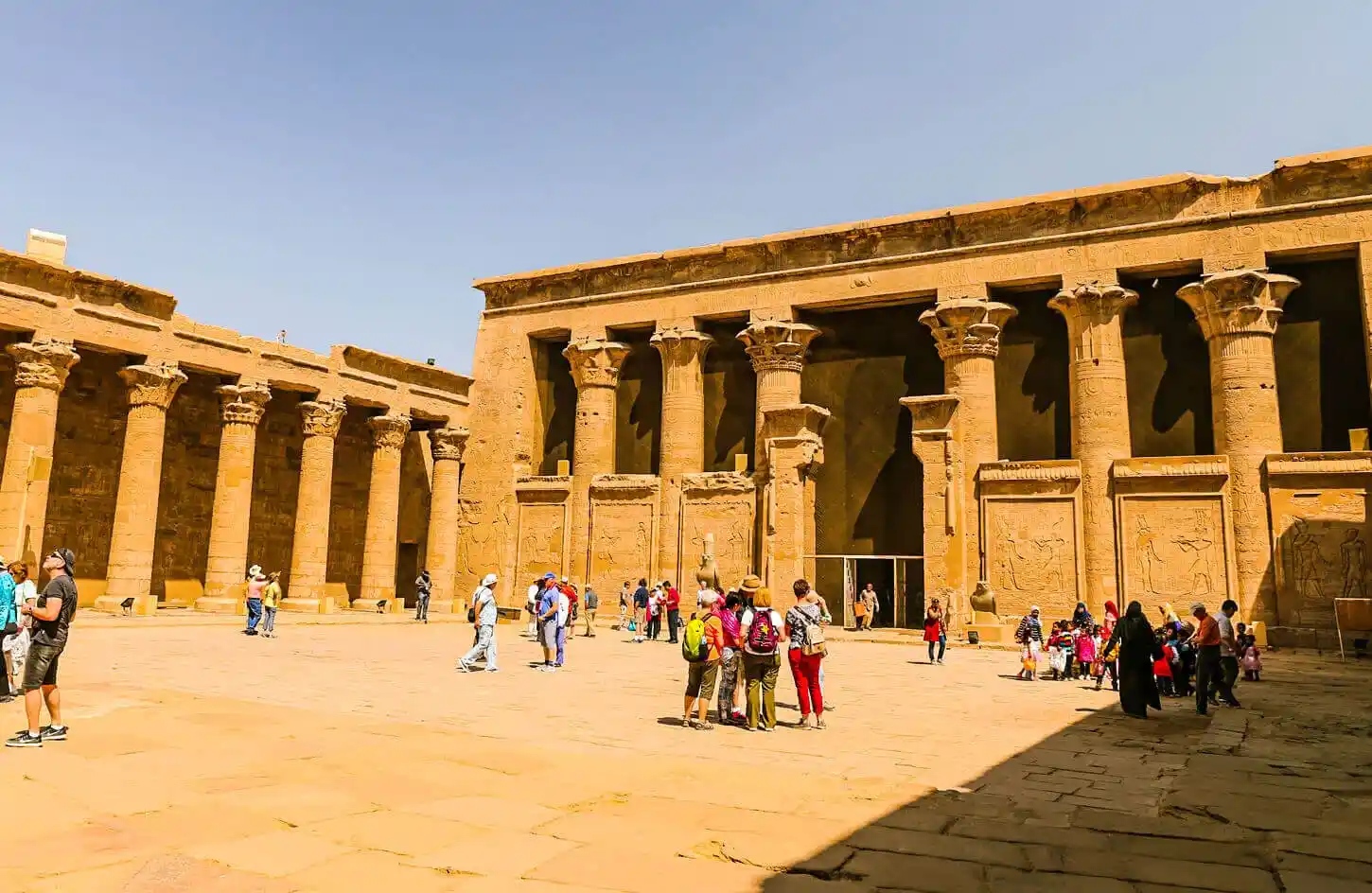
The Temple of Horus at Edfu is the best-preserved temple in Egypt. Its towering entrance pylon, roofed halls and dark sanctuary give you a better idea than anywhere else of what an Egyptian temple actually felt like when it was in use. For most visitors it is a stop on a Nile cruise between Luxor and Aswan, but it deserves more than a quick look. This guide explains the temple’s history, what to see, ticket prices and how to visit.
Edfu Temple at a Glance
- Dedicated to: Horus, the falcon-headed god of kingship.
- Built: between 237 and 57 BC, under the Ptolemaic kings.
- Location: the town of Edfu on the west bank of the Nile, roughly halfway between Luxor and Aswan.
- Time needed: about 1–1.5 hours.
- Ticket: around EGP 450 for foreign adults (2026; check locally).
A Short History of the Temple of Horus
Edfu was an important religious centre long before the present temple was built. According to Egyptian myth, it was here that Horus fought his uncle Seth to avenge the death of his father, Osiris. The temple you see today was begun in 237 BC under Ptolemy III and completed around 57 BC under Ptolemy XII, the father of Cleopatra VII. Although the Ptolemies were Macedonian Greeks, they built in the traditional Egyptian style and presented themselves as pharaohs on the temple walls.
After the temple fell out of use, it was gradually buried by sand and river silt, and houses were built on its roof. That burial is the main reason it survived so well. In the 1860s the French archaeologist Auguste Mariette cleared the temple, revealing an almost complete building.
What to See at Edfu Temple
The great pylon
The entrance pylon is about 36 metres high, among the largest in Egypt. Its reliefs show Ptolemy XII smiting his enemies before Horus, a traditional image of royal power. Two granite statues of Horus as a falcon guard the entrance.
The courtyard
Inside the pylon is a large open court surrounded by columns with varied floral capitals. Here, a famous granite statue of Horus as a falcon wearing the double crown of Egypt stands in front of the hypostyle hall, one of the most photographed spots in the temple.
The hypostyle halls
Two columned halls lead deeper into the temple. As you walk through them, the floor rises and the ceiling lowers, and the light becomes dimmer. This was deliberate: the temple was designed to lead from the bright everyday world towards the dark, sacred home of the god.
The sanctuary
At the heart of the temple is the sanctuary, which still contains a polished granite shrine from the reign of Nectanebo II, older than the Ptolemaic temple around it. In front of it stands a modern replica of the sacred boat that carried the god’s statue in processions.
The corridor of the Horus myth
Along the outer corridor, on the inner face of the enclosure wall, reliefs tell the story of Horus’s battle with Seth, who is shown as a small hippopotamus. It is one of the clearest illustrated versions of the myth anywhere.
The building texts
Edfu’s walls are covered with inscriptions describing the temple itself: its dimensions, rituals, festivals and even its mythical origins. These “building texts” are one of the richest sources Egyptologists have for understanding how temples worked.
The birth house and the Nilometer
Outside the main temple stands the mammisi, or birth house, which celebrated the divine birth of Horus. Near the enclosure wall is a Nilometer, used to measure the height of the annual flood.
The Festival of the Beautiful Meeting
Every year, the statue of the goddess Hathor travelled by boat from her temple at Dendera to Edfu to be reunited with Horus, her husband. The celebrations lasted about two weeks, with processions, offerings and feasting, and they are recorded on the temple walls. Read about Hathor’s temple in our Dendera Temple guide.
How to Visit Edfu Temple
On a Nile cruise
Almost every cruise between Luxor and Aswan stops at Edfu. Ships moor on the riverbank, and the temple is reached by horse-drawn carriage (caleche) or minibus, about 10–15 minutes away. Visits are often early in the morning or in the evening to avoid the heat. If you take a carriage, agree the price and tip first and look for horses in good condition. Compare cruise options in our Nile cruise price guide.
By road
Edfu is about 110 km south of Luxor and a similar distance north of Aswan. It is often combined with Kom Ombo on a road trip between the two cities.
Tickets and Opening Hours
- Ticket: around EGP 450 for foreign adults; students with an ISIC card pay less. Prices change, so confirm on the day.
- Opening hours: usually from about 7 am to 5 pm, with some evening opening linked to cruise schedules.
Tips for Your Visit
- Arrive early: Edfu is on every cruise schedule, and the courtyard fills up quickly when several ships arrive at once.
- Walk the outer corridor; many visitors miss the Horus and Seth reliefs.
- Bring small notes for the toilet attendant and carriage tip.
- Expect persistent sellers at the entrance and on the way back to the boat; a polite “la, shukran” works.
- Wear comfortable shoes and a hat; the courtyard has little shade.
After Edfu, most cruises continue to Kom Ombo Temple, the unusual double temple dedicated to Sobek and Horus.
Edfu Temple Layout: Walking the Route of the Priests
Understanding the plan of the temple makes your visit more rewarding. Egyptian temples followed a set sequence of spaces, and Edfu is the clearest surviving example:
- The pylon: a monumental gateway symbolising the horizon, where the sun rises.
- The open court: where ordinary people could gather on festival days.
- The outer and inner hypostyle halls: forests of columns representing the primeval marsh from which creation emerged.
- The offering halls and vestibules: where priests prepared offerings and incense.
- The sanctuary: the god’s “house”, entered only by the high priest and the king.
As you walk, notice how the ceiling lowers, the floor rises and the light fades, all designed to create a sense of moving closer to the divine.
Look Out For
- The library room in the hypostyle hall, where the temple’s sacred texts were listed.
- The laboratory, whose walls record recipes for incense and perfumes used in rituals.
- The staircases to the roof (often closed to visitors), decorated with priests carrying the god’s statue.
- Traces of soot on some ceilings from people who later lived inside the temple.
- Defaced figures, the result of later damage to images of the gods.
Edfu and the Other Ptolemaic Temples
Edfu is one of four great Ptolemaic temples along the Nile, together with Dendera, Kom Ombo and Philae. Each has its own character: Dendera for its painted ceilings, Kom Ombo for its double plan and riverside setting, Philae for its island location and Edfu for its completeness. Seeing them together gives you a full picture of how Egyptian religion continued and flourished under Greek and Roman rule.
Frequently Asked Questions
Why is Edfu Temple so well preserved?
It is relatively young by Egyptian standards (completed around 57 BC) and was buried by sand and silt for centuries, which protected it until it was excavated in the 1860s.
Who is Edfu Temple dedicated to?
Horus, the falcon-headed god of kingship, who was also honoured here as the husband of the goddess Hathor of Dendera.
How long do you need at Edfu Temple?
About one to one and a half hours, including the outer corridor and the birth house.
How much is the ticket to Edfu Temple?
Around EGP 450 for foreign adults in 2026. Prices change, so check locally.
How do you get from the Nile cruise to Edfu Temple?
Usually by horse-drawn carriage or minibus, about 10–15 minutes from where the ships moor.