Luxor Temple History : Standing on the east bank of the Nile in the heart of modern Luxor, the ancient temple complex known simply as Luxor Temple has been continuously visible — and continuously significant — for over 3,300 years. Unlike most ancient Egyptian temples, which were built in remote desert locations and rediscovered by archaeologists centuries after their abandonment, Luxor Temple never disappeared. The city of Luxor grew up around it. A mosque was built inside it. The Roman army camped within its walls. And today, tourists walk its colonnaded courts just meters from busy cafes and souvenir shops.
That unbroken thread of human presence makes Luxor Temple one of the most remarkable historical sites not just in Egypt, but in the world. Understanding its history transforms what might otherwise seem like an impressive pile of ancient stones into a living record of 3,000 years of human civilization.
This complete guide covers everything you need to know about Luxor Temple — its history from foundation to present, its architecture and what to see, the mythology behind it, practical visitor information, and how to combine it with other Luxor sites on a Nile Cruise or private tour.
What Is Luxor Temple?
Luxor Temple — known in ancient Egyptian as Ipet-resyt, meaning “the southern sanctuary” — is a large ancient Egyptian temple complex located on the east bank of the Nile River in the city of Luxor, which was known in antiquity as Waset or Thebes. It stands approximately 3 kilometers south of the larger and older Karnak Temple, to which it was once connected by the magnificent Avenue of Sphinxes.
Unlike Karnak, which was primarily the home of the state cult of Amun-Ra and the center of Egyptian religious life, Luxor Temple served a specific and extraordinary purpose: it was the site of the annual Opet Festival, one of ancient Egypt’s most important religious ceremonies, in which the divine power of the pharaoh was renewed and legitimized each year. Understanding the Opet Festival is essential to understanding what Luxor Temple was built to do.
History of Luxor Temple
The Middle Kingdom Foundations
The site of Luxor Temple was sacred long before the grand structures we see today were built. Archaeological evidence suggests that a smaller sanctuary existed here as early as the Middle Kingdom period (2055–1650 BCE), likely dedicated to the Theban form of Amun. By the time the New Kingdom pharaohs began their great building programs in the 16th century BCE, the site had accumulated centuries of religious significance.
Amenhotep III: The Main Builder (1390–1352 BCE)
The core of Luxor Temple as it stands today was built by Amenhotep III of the 18th Dynasty, one of ancient Egypt’s most prolific builders and arguably its greatest patron of architecture and art. His reign was a period of extraordinary wealth, stability, and artistic achievement — and Luxor Temple is among its finest expressions.
Amenhotep III built the inner sanctuary, the large peristyle court, and the great colonnade of 14 enormous papyrus columns that forms one of Luxor Temple’s most recognizable features. The colonnade’s columns stand 19 meters tall and are decorated with some of the finest relief carvings in Egyptian art, depicting scenes from the Opet Festival procession.
The inner sanctuary — the Holy of Holies — contained a golden barque shrine where the statue of Amun was housed during the festival. This space was so sacred that only the highest-ranking priests and the pharaoh himself were permitted to enter.
Amenhotep III’s building program at Luxor was part of a broader religious vision centered on the concept of divine kingship. The temple was not merely a place of worship — it was a machine for manufacturing royal legitimacy. Through the Opet Festival rites performed within its walls, the pharaoh’s power was understood to be renewed and his connection to the divine confirmed each year.
Tutankhamun and Horemheb: Completing the Colonnade
Amenhotep III’s colonnade was decorated — its walls carved with the great Opet Festival reliefs — not during his own reign but during the reigns of his successors Tutankhamun (1332–1323 BCE) and Horemheb (1319–1292 BCE). This is a fascinating historical detail: the most famous pharaoh in popular culture, whose tomb yielded the most spectacular archaeological treasure ever found, left his mark not at Karnak or the Valley of the Kings, but in the colonnade reliefs at Luxor Temple.
The Opet Festival reliefs in the colonnade are extraordinary works of historical and artistic documentation, showing the festival procession in exquisite detail: priests carrying the sacred barques on their shoulders, musicians playing instruments, crowds of civilians celebrating, soldiers marching, and the pharaoh performing rituals before the gods.
Ramesses II: The Grand Entrance (1279–1213 BCE)
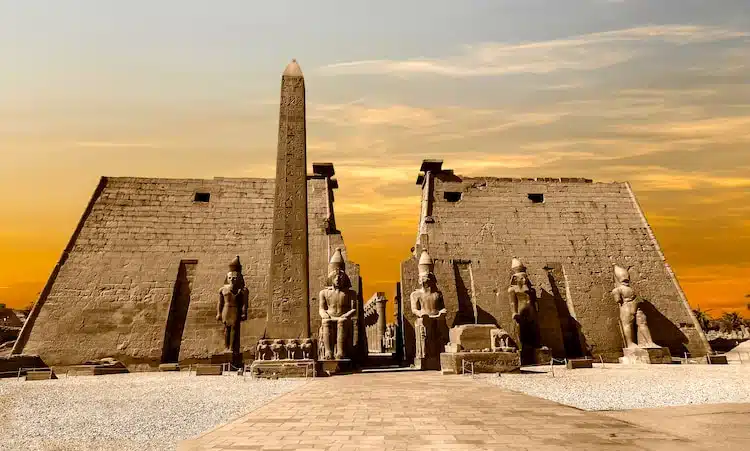
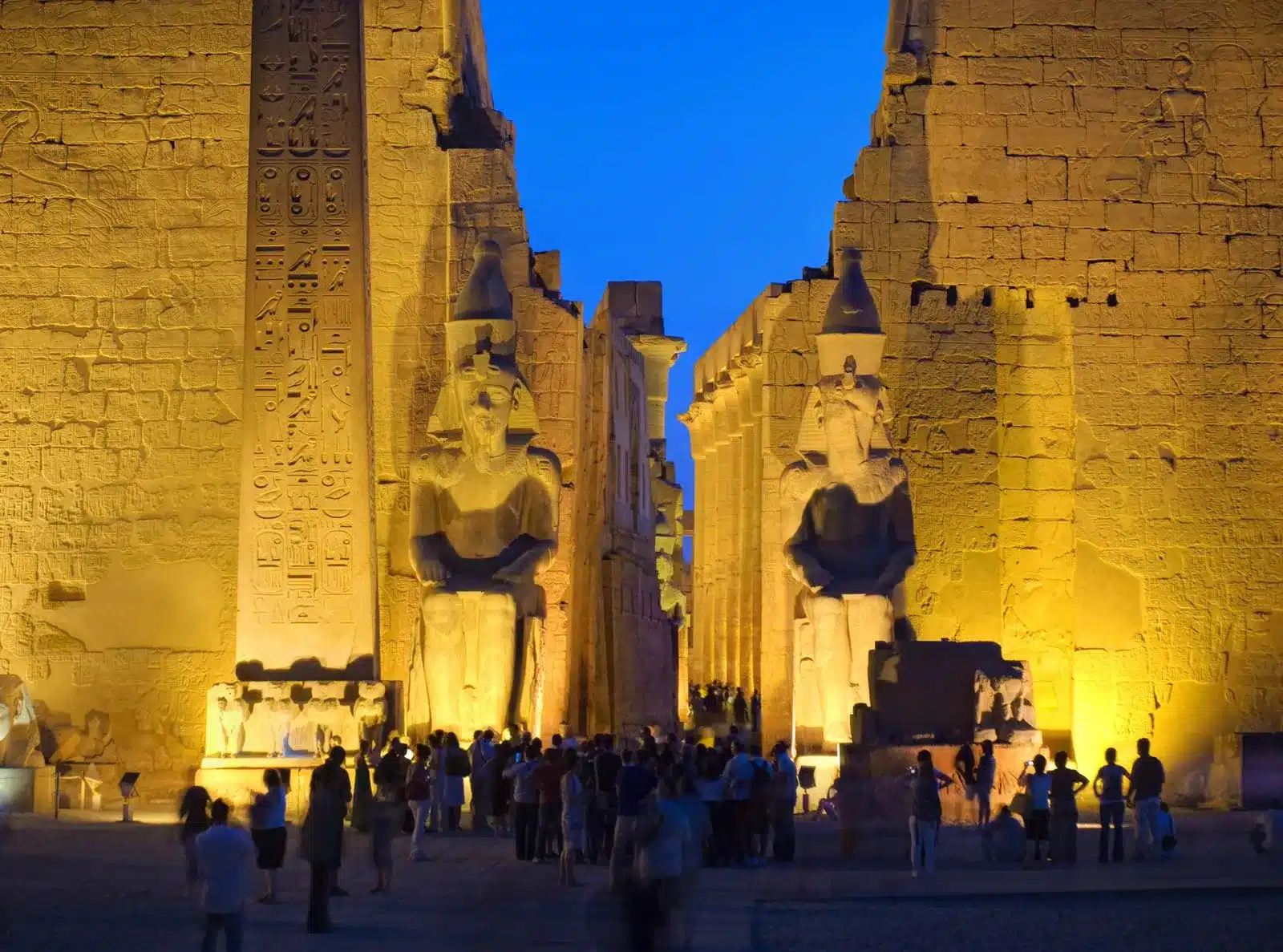
The most visible addition to Luxor Temple — and the one that most tourists photograph first — was made by Ramesses II, perhaps ancient Egypt’s most self-promoting pharaoh, who added the grand entrance forecourt and pylon (gateway towers) that now form the temple’s main approach.
Ramesses II’s pylon is one of the largest in Egypt, its twin towers originally soaring to approximately 24 meters. In front of the pylon, he placed:
- Six colossal statues of himself — four seated and two standing — though only three of the seated statues and both standing statues survive today
- Two obelisks — originally a matching pair. One still stands in front of the pylon (about 25 meters tall). The other was given by Egypt’s Khedive Muhammad Ali to France in 1833 and today stands in the Place de la Concorde in Paris
- Scenes of his military victories, including his famous depiction of the Battle of Kadesh against the Hittites — scenes that appear on temple walls across Egypt but are particularly detailed here
Ramesses II also carved his name over many of Amenhotep III’s inscriptions throughout the temple — a practice known as usurpation that was common among ambitious pharaohs who wished to claim credit for earlier building work.
The Opet Festival: Why Luxor Temple Exists
To truly understand Luxor Temple, you need to understand the Opet Festival, the ceremony for which the temple was specifically designed and built.
The Opet Festival was one of the most important religious events in the ancient Egyptian calendar. Held annually during the second month of the Nile flood season (roughly July–August in our calendar), it lasted between 11 and 27 days and involved the ceremonial transfer of the divine statues of Amun, his consort Mut, and their son Khonsu from Karnak Temple in the north to Luxor Temple in the south.
The statues were transported in golden barques — ceremonial boats — carried on the shoulders of priests. The procession moved either overland along the Avenue of Sphinxes or by river, with the royal barques towed upstream by ropes pulled by cheering crowds.
The purpose of the festival was the renewal of royal power. Within the inner sanctuary of Luxor Temple, a secret ceremony took place in which the pharaoh’s divine nature was symbolically renewed. The theological concept was complex: the pharaoh’s human “ka” (life force) was united or fused with the divine ka of Amun, confirming that the ruler was truly the son of god and possessed of divine authority to govern Egypt.
The festival was also a major public event. Records describe the Egyptian people lining the procession route, receiving bread, beer, and food distributed by royal officials. For ordinary Egyptians, the Opet Festival was one of the great spectacles of the year — a combination of religious ceremony, royal propaganda, and popular celebration.
Alexander the Great and the Macedonian Addition
In 332 BCE, Alexander the Great conquered Egypt without resistance, presenting himself as the legitimate successor to the pharaohs. One of his first acts was to visit the great temples of Thebes, and at Luxor Temple he made a significant addition: he rebuilt the inner sanctuary (the barque shrine) and had himself depicted on its walls in the traditional pose of an Egyptian pharaoh making offerings to Amun.
The chapel of Alexander the Great within Luxor Temple is one of the earliest examples of Macedonian Greek rulers adopting the full iconographic vocabulary of ancient Egyptian kingship. It is also remarkably well-preserved, and the reliefs showing Alexander in pharaonic regalia are among the most intriguing artifacts in the temple.
The Roman Period: A Military Fortress
After Egypt became a Roman province in 30 BCE following the defeat of Cleopatra VII and Mark Antony, Luxor Temple underwent a dramatic transformation. The Romans converted the temple precinct into a military fortress — the castrum — to serve as the headquarters of one of their legions stationed in Upper Egypt.
The Romans adapted the temple courts into barracks and administrative buildings, built their own structures within the ancient walls, and created a new entrance into the temple from the east (perpendicular to the original axis). They also plastered over many of the ancient Egyptian reliefs, which — ironically — preserved some of the finest Opet Festival paintings beneath the plaster, where they remained protected until modern excavation.
In the late Roman period (3rd–4th centuries CE), a group of four rooms within the temple were decorated with extraordinary paintings showing Roman imperial ceremonies and cult worship — providing a fascinating glimpse of how Roman soldiers adapted and used these ancient spaces. These Roman paintings are preserved in what is now called the Roman Sanctuary and are among the unique elements that set Luxor Temple apart from other Egyptian sites.
The Mosque of Abu Haggag
One of the most visually striking aspects of Luxor Temple today is the Mosque of Abu Haggag, which sits inside the temple precinct at the level of the second court — literally built into and on top of the ancient structure. The mosque was constructed in the 13th century CE in honor of Sheikh Abu Haggag al-Uqsori, a local Islamic holy man whose tomb is within the mosque and who remains the patron saint of Luxor today.
When the temple was excavated in the 19th and 20th centuries, the mosque was found to be structurally integrated with the ancient walls and could not be removed without risking collapse of both structures. The decision was made to preserve the mosque in place — a decision that has turned an archaeological compromise into one of the most fascinating examples of layered history anywhere in the world.
Standing in the second court of Luxor Temple, you can look up and see the minaret of the Abu Haggag Mosque projecting above the ancient pylons — Christian painted crosses on the Roman-era plaster on one wall, hieroglyphics on the wall beside them, and the sound of the Islamic call to prayer drifting down from above. It is an experience that compresses centuries into a single moment.
Architecture: What to See at Luxor Temple
The Avenue of Sphinxes
The approach to Luxor Temple from the north begins with the recently restored Avenue of Sphinxes — a 3-kilometer processional road lined with over 1,000 human-headed sphinxes that once connected Luxor Temple to Karnak. The avenue was built primarily by Nectanebo I (380–362 BCE) and was recently excavated and partially restored, allowing visitors to walk the ancient processional route for the first time in centuries.
Walking the Avenue of Sphinxes in the early morning, with the sphinxes stretching into the distance and the temple pylon rising ahead, is one of the great atmospheric experiences in Luxor.
The First Pylon of Ramesses II
The entrance to the temple is through the massive First Pylon of Ramesses II. Although one obelisk has departed for Paris, the remaining obelisk — at approximately 25 meters — is still an imposing presence. The pylon towers are carved with scenes from Ramesses II’s military campaigns, particularly the Battle of Kadesh.
Visitors with a guide or a good eye can spot the remarkable detail in these reliefs: the Egyptian army organized in military formations, the fortified Hittite camp at Kadesh, the pharaoh in his chariot firing arrows, and the famous inscription of the Poem of Pentaur, one of the world’s earliest known literary accounts of a military campaign.
The Court of Ramesses II
Beyond the pylon lies the Court of Ramesses II — a large colonnaded court surrounded by double rows of papyrus-bud columns. The court contains several colossal standing and seated statues of Ramesses II, and its walls are decorated with scenes of religious rituals and festival processions.
In the northwest corner of this court stands the Chapel of the Theban Triad — three small shrines to Amun, Mut, and Khonsu built by Ramesses II. In the northeast corner stands the Mosque of Abu Haggag, whose floor level indicates where the ground surface was before 19th-century excavations removed centuries of accumulated debris and revealed the ancient courts below.
The Great Colonnade of Amenhotep III
Passing through the court of Ramesses II, visitors enter the Great Colonnade — the magnificent hall built by Amenhotep III and decorated by Tutankhamun and Horemheb. Fourteen enormous papyrus columns line both sides of this processional corridor, their capitals in the open-flower form, their shafts carved with the names and titles of the pharaohs who built them.
The lower walls of the colonnade are decorated with the famous Opet Festival reliefs — one of the most complete and detailed representations of an ancient Egyptian religious ceremony anywhere in existence. The southern wall shows the outward journey (Karnak to Luxor); the northern wall shows the return journey. The reliefs are extraordinary in their detail: you can see individual musicians, the names inscribed on the sacred barques, the expressions on the faces of priests, and the decorated boats moving through the Nile.
The Court of Amenhotep III
Beyond the colonnade lies the large Court of Amenhotep III, surrounded by a double colonnade of 64 papyrus-bud columns. This court is particularly beautiful in the early morning and late afternoon when the sun creates dramatic shadows between the columns.
At the far end of the court stands a hypostyle hall of 32 columns — the transition between the public spaces of the temple and the sacred inner areas accessible only to priests.
The Inner Sanctuary and Alexander’s Chapel
The innermost sections of the temple include several sanctuary rooms, the most important of which is the barque shrine rebuilt by Alexander the Great. The reliefs here show Alexander in full pharaonic regalia — wearing the double crown of Egypt, performing ritual offerings to Amun, and receiving the divine blessing of the god. The fact that a Macedonian Greek conqueror chose to present himself in this way tells you everything you need to know about the power and endurance of Egyptian religious culture.
Adjacent spaces include the Roman Sanctuary, where the extraordinary Roman-era paintings of imperial cult ceremonies can be seen — some of the best-preserved Roman paintings in Egypt.
The Sound and Light Show
Luxor Temple hosts a celebrated Sound and Light Show every evening, typically beginning around 8:00 PM. The show is much more atmospheric than most in Egypt because the temple sits in the heart of the city — visitors walk through illuminated courts with the sounds of the modern city around them, and the contrast between ancient and modern becomes almost surreal.
The show lasts approximately 45–60 minutes and runs in multiple languages. Tickets cost approximately 200–300 EGP per person. Given Luxor Temple’s relatively compact layout, this is one of the more intimate sound and light experiences in Egypt.
Practical Visitor Information
Getting There
Luxor Temple is located in the center of modern Luxor city, on the Corniche (riverside promenade), approximately 3 kilometers south of Karnak Temple. It is easily walkable from most hotels in central Luxor.
Tickets
- Foreign Adults: 360 EGP (approximately $12 USD)
- Foreign Students (with valid ID): 180 EGP
- Egyptian Adults: 80 EGP
Opening Hours
- Winter (October–April): 6:00 AM – 10:00 PM
- Summer (May–September): 6:00 AM – 10:00 PM
Luxor Temple is one of the few Egyptian temples open late into the evening, which means you can visit both in daytime and return for the evening illumination. The temple at night — lit with warm gold and amber lights against a dark sky — is one of the most beautiful sights in Egypt.
Best Time to Visit
- Best time of day: Sunset through early evening (5:00–8:00 PM) for the most atmospheric experience. The temple transitions from golden afternoon light to full illumination as darkness falls.
- Early morning (6:00–8:00 AM) is excellent for photography without crowds.
- Best season: October through April. The temple is open late year-round, but summer evenings in Luxor are still warm (30°C+) even after dark.
Combining Luxor Temple with Other Sites
Luxor East Bank Day
Luxor Temple and Karnak Temple are the two great east bank monuments, and most visitors combine them in a single day:
- Morning: Karnak Temple (3–4 hours, early start recommended)
- Afternoon: Rest, hotel pool, or the Luxor Museum
- Sunset/Evening: Luxor Temple (1.5–2 hours, staying for the illumination)
The Luxor Museum, located between the two temples on the Corniche, is one of Egypt’s finest smaller museums and well worth 1–2 hours. Its collection focuses on objects found in the Theban area and includes several masterpieces of New Kingdom art.
West Bank Combination
The west bank of Luxor — Valley of the Kings, Temple of Hatshepsut, Colossi of Memnon — is typically a separate full day. A complete Luxor experience therefore requires at minimum two days: one for the east bank, one for the west bank.
As Part of a Nile Cruise
For travelers on a Nile Cruise, Luxor Temple is typically visited on the first or last day in Luxor. The temple’s evening hours make it an ideal post-dinner outing after arriving from Aswan, or a sunset finale before your departure the following morning.
🛥️ Pure Nile Tours includes private guided visits to Luxor Temple and Karnak as part of all Nile Cruise packages. Our Egyptologist guides illuminate the Opet Festival reliefs and the layered history of the site in a way that transforms the experience entirely. View Nile Cruise Packages → | Book a Luxor Private Tour →
Frequently Asked Questions
How old is Luxor Temple?
The core of the temple was built by Amenhotep III around 1390–1352 BCE, making it approximately 3,370 years old. However, additions were made by successive rulers from the reign of Tutankhamun through the Roman period (ending around 300 CE), giving the temple a construction history spanning nearly 1,700 years.
Who built Luxor Temple?
The main structure was built by Amenhotep III. The grand entrance pylon and forecourt were added by Ramesses II. Tutankhamun and Horemheb decorated the Great Colonnade. Alexander the Great rebuilt the inner barque shrine. Roman emperors added the imperial sanctuary. The Abu Haggag Mosque was built in the 13th century CE. In a very real sense, Luxor Temple was built by three thousand years of history.
What was Luxor Temple used for?
Primarily as the venue for the annual Opet Festival — a celebration in which the pharaoh’s divine power was symbolically renewed by uniting his human nature with the divine ka of Amun. It was also used for other religious rituals connected to the royal cult and the Theban divine triad of Amun, Mut, and Khonsu.
Why is there a mosque inside Luxor Temple?
The Mosque of Abu Haggag was built in the 13th century CE on top of the accumulated debris that had buried much of the temple over centuries. When the temple was excavated in the 19th century, the mosque was found to be structurally integrated with the ancient walls and was preserved in place as an act of religious and cultural respect.
What is the difference between Luxor Temple and Karnak Temple?
Karnak is larger, more complex, and served as the main cult center of Amun — essentially the Vatican of ancient Egypt. Luxor Temple was specifically built for the Opet Festival and the renewal of royal power. The two temples were connected by the Avenue of Sphinxes and functioned together as complementary parts of the ancient Theban religious landscape.
Can I visit Luxor Temple at night?
Yes — Luxor Temple is open until 10:00 PM and is one of the most beautiful temples in Egypt when illuminated at night. The evening Sound and Light Show is a separate ticketed experience, but even without it, visiting in the hours after sunset is highly recommended.
Final Thoughts
Luxor Temple is not the largest temple in Egypt, nor the most complex. But it may be the most layered — a place where pharaonic, Greek, Roman, Christian, and Islamic history are physically stacked on top of each other, visible simultaneously in a single glance. That layering is not accidental. It reflects the extraordinary centrality of this site to human civilization across three millennia: every culture that came to Egypt recognized that this place on the east bank of the Nile in Thebes was important, sacred, and worth adding to.
To visit Luxor Temple properly is to visit three thousand years of history in two hours. That is a remarkable return on investment.
🏛️ Planning a visit to Luxor Temple? Pure Nile Tours offers private guided tours of Luxor’s east bank monuments — Luxor Temple, Karnak, and the Luxor Museum — with expert Egyptologist guides who bring the history alive. We also include Luxor Temple in all Nile Cruise itineraries. Book a Luxor Private Tour →