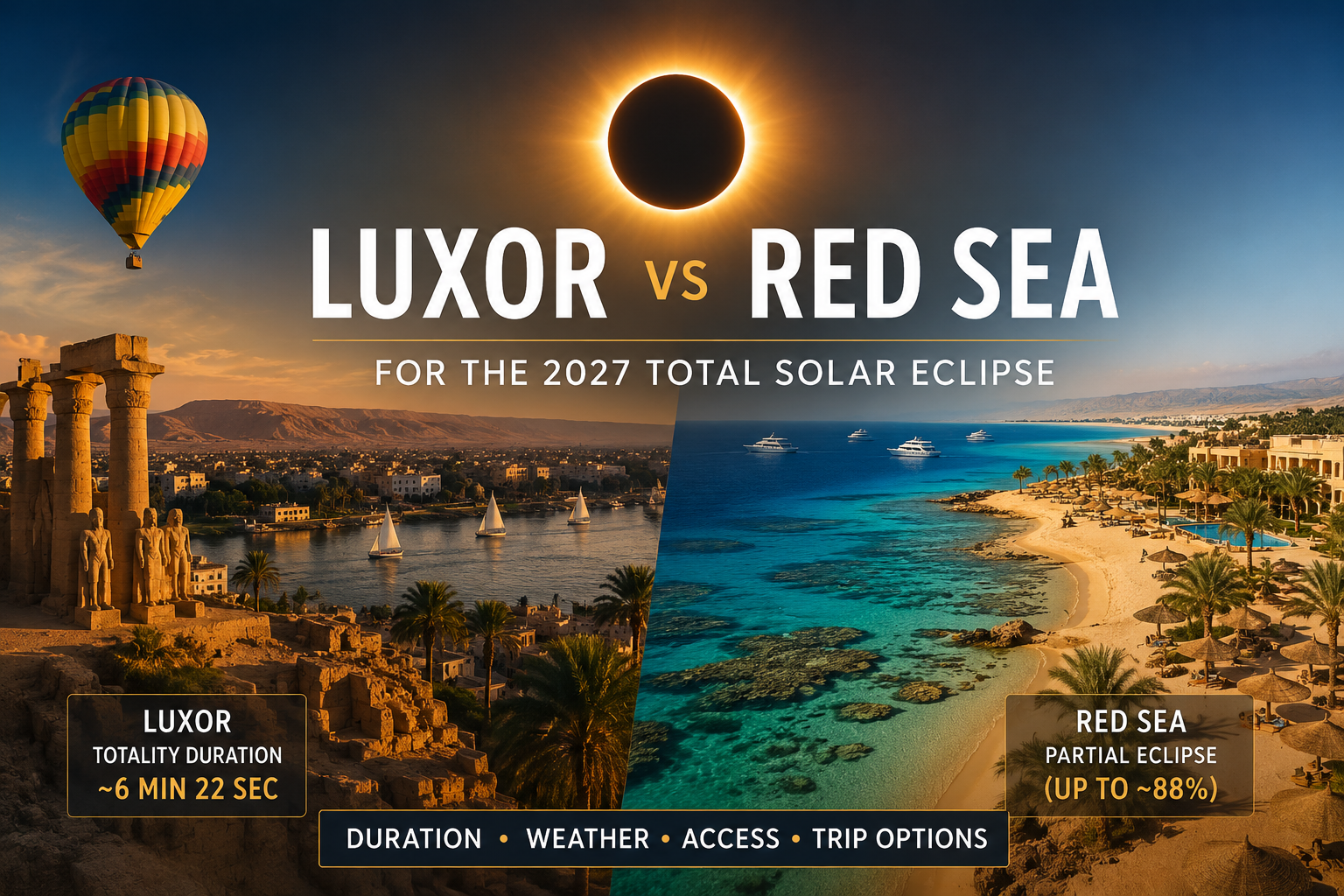
Luxor vs Red Sea solar eclipse 2027
Quick answer: Luxor is the more straightforward choice for travellers whose priority is seeing totality for about 6 minutes 22 seconds from a well-connected tourism centre. The Red Sea is not a single eclipse location: Hurghada will experience a deep partial eclipse, while parts of the southern Red Sea coast lie within the path of totality. A traveller comparing “Luxor vs Red Sea” must therefore compare Luxor with a specific coastal town, not with the entire coastline.
The total solar eclipse on 2 August 2027 crosses Egypt from west to east. Luxor lies close to the central line and is one of the most discussed viewing bases because it combines long totality with hotels, an airport, Nile cruise operations and established archaeological itineraries. The Red Sea offers a different environment, but totality duration and access change substantially from north to south.
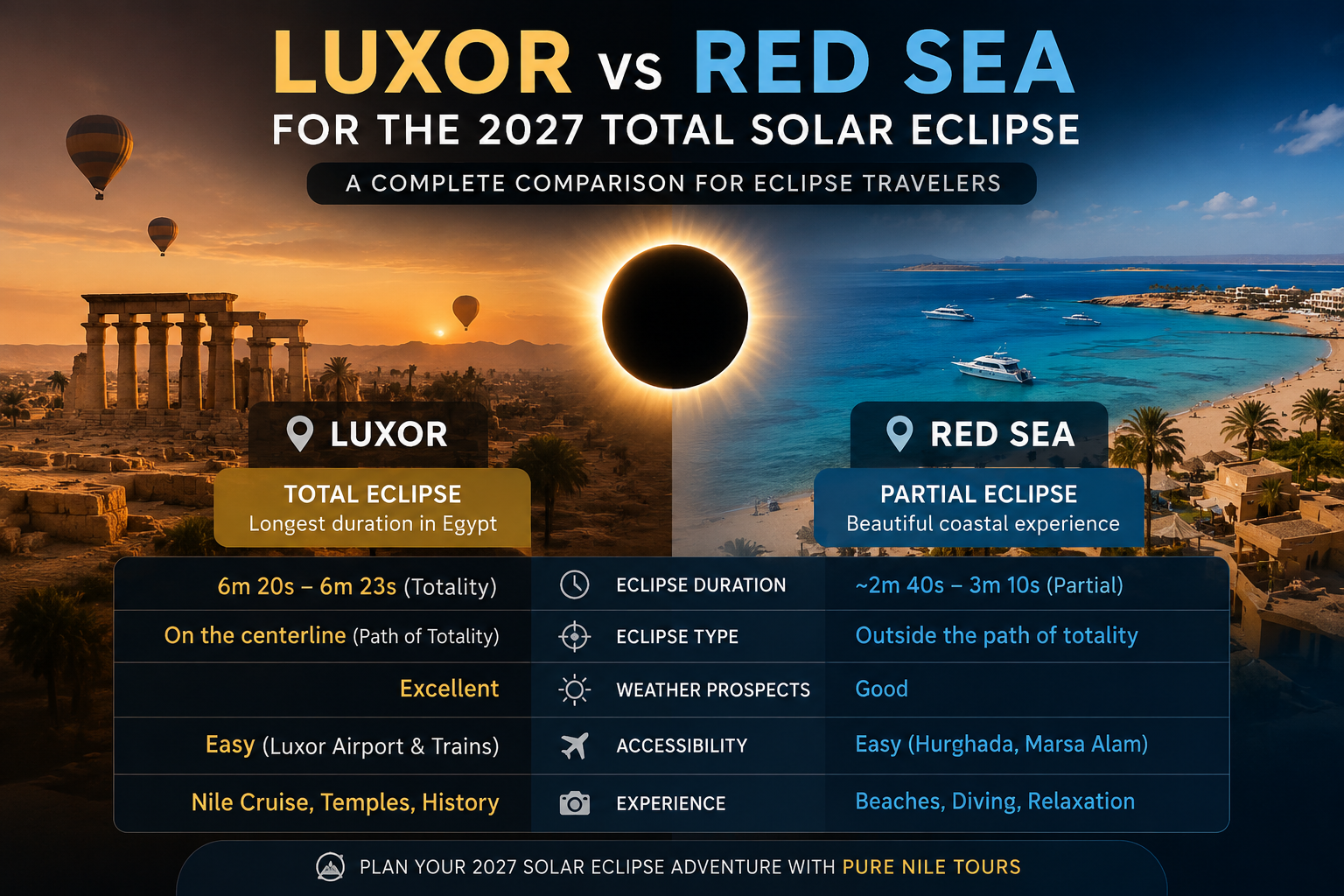
Luxor vs Red Sea: key differences
| Factor | Luxor | Red Sea coast |
|---|---|---|
| Eclipse type | Total eclipse in Luxor | Depends on location; Hurghada is partial, while some southern coastal areas are in totality |
| Approximate totality | About 6 minutes 22 seconds | Location-specific; verify the exact town and coordinates |
| Travel infrastructure | International tourism base, domestic airport, hotels and Nile cruises | Strong resort infrastructure in major towns, but remote southern sites require more planning |
| Typical landscape | Nile Valley, farmland, desert edge and historic city | Coastline, desert and resort zones |
| Heat conditions | Very hot inland conditions around midday | Also hot; coastal wind may improve comfort but does not remove heat risk |
| Cultural itinerary | Karnak, Luxor Temple, West Bank and Nile cruises | Beach, diving and marine activities; cultural touring usually requires transfers |
| Best fit | Travellers prioritising totality duration and a complete Upper Egypt itinerary | Travellers prioritising a coastal stay, provided the exact viewing town is verified |
Why Luxor is the simpler totality base
Timeanddate lists Luxor as experiencing a total solar eclipse, with the partial phase beginning at approximately 11:40 local time, maximum eclipse near 13:05 and totality lasting about 6 minutes 22 seconds. Exact contact times should always be checked again closer to the event because published calculations may be refined.
For travel planning, Luxor’s main advantage is not only duration. The city already supports large numbers of cultural travellers. It has an airport, hotels on both sides of the Nile, cruise moorings, licensed guides, established transport routes and access to major archaeological sites. This makes it easier to build a multi-day itinerary around the eclipse rather than treating the eclipse as an isolated day trip.
Luxor also allows several viewing formats: a designated land site, a hotel property with a suitable open area, or a Nile cruise sundeck if the vessel is correctly positioned and stationary. Each option needs a confirmed plan for capacity, shade, water, toilets, emergency support and an unobstructed view of the Sun.
The Red Sea must be evaluated town by town
“Red Sea eclipse viewing” can be misleading because Egypt’s Red Sea coast extends for hundreds of kilometres. Hurghada, one of the best-known resort cities, is outside the path of totality. Timeanddate classifies the 2027 event in Hurghada as a partial solar eclipse with a magnitude of about 0.980. That is a major partial eclipse, but it is not the same experience as totality: the solar corona is not revealed and the sky does not undergo the complete transition associated with the total phase.
Farther south, parts of the Red Sea coast enter the path of totality. However, travellers should not assume that a hotel described as being in “Marsa Alam” or the “southern Red Sea” automatically has the same eclipse duration as Luxor. Resort names are often used broadly, and two properties marketed under the same destination can be many kilometres apart. The exact latitude and longitude of the proposed viewing site should be checked against an authoritative eclipse map.
Is the Red Sea cooler than Luxor?
The coast may feel different because of wind and maritime influence, but early August remains hot. A sea breeze can improve comfort, yet direct sun exposure, dehydration and equipment heat remain important. Travellers should evaluate the actual site rather than assuming that a coastal location will be comfortable at midday.
Luxor is an inland desert city where typical August daytime highs can exceed 40°C. The eclipse reaches maximum close to midday, so a viewing plan should include shade before and after totality, regular water access, seating where possible and an air-conditioned recovery area. Coastal viewing plans should include the same controls.
Access and contingency planning
Luxor
- Multiple hotel and cruise options within the tourism zone.
- Established road access on both the East Bank and West Bank.
- Medical facilities and airport access within the city.
- Potential crowding and traffic pressure as the event approaches.
- Any archaeological-site viewing claim requires formal permission.
Southern Red Sea
- Potential access to totality at selected southern locations.
- Long road transfers may be required from major airports or resort centres.
- Remote sites can have limited shade, toilets, medical support and communications.
- Exact hotel or beach coordinates matter for whether totality is visible.
- Coastal wind can affect tripods, long lenses and lightweight equipment.
Which location is better for photography?
Luxor offers historic landscape context, but the Sun will be high in the sky, so many familiar monuments may not fit naturally into a telephoto eclipse composition. A photographer wanting a wide environmental image should scout foregrounds and sightlines in advance rather than assuming a temple will align with the Sun.
The Red Sea may provide a simpler horizon and an open coastal setting. It can also introduce wind, salt spray and limited access to stable platforms. For either location, the safest and most productive approach is to separate the technical eclipse sequence from the scenic sequence: secure the filtered partial-phase images and bracketed totality images first, then create wider contextual photographs before or after the critical contacts.
How a Luxor and Hurghada itinerary can work
A combined itinerary does not require the eclipse to be viewed in Hurghada. One practical structure is to observe totality in Luxor and travel to the Red Sea afterward. Pure Nile Tours’ 7-day Luxor and Hurghada eclipse itinerary follows this logic: eclipse viewing is organised in Luxor, followed by a Red Sea stay in Hurghada.
Travellers who prefer a Nile-focused journey can instead use an Aswan-to-Luxor cruise that reaches Luxor before eclipse day. The 8-day Solar Eclipse Egypt Tour is structured around a Nile cruise and planned sundeck viewing in Luxor.
What about the White Desert?
Luxor and the Red Sea are not the only ways to experience the event. Egypt’s Western Desert offers wide-open horizons and a more remote atmosphere. Travellers who prefer a managed camp-based journey can compare the White Desert solar eclipse tours for 2027, with packages built around totality on 2 August 2027 and organised transport from Cairo or Giza.
Decision guide
Choose Luxor when:
- Seeing totality is the primary objective.
- You want the longest practical duration near a major tourism centre.
- You want to combine the eclipse with Nile cruising and Upper Egypt sites.
- You prefer established hotels, transport and guide services.
Consider a southern Red Sea site when:
- The exact site is confirmed inside the path of totality.
- You prefer a coastal setting and can accept more complex ground logistics.
- The operator provides exact coordinates, duration and backup arrangements.
- Medical, shade, water and transport provisions are clearly documented.
Choose Hurghada as a post-eclipse stay when:
- You want to observe totality in Luxor and then spend several days at the Red Sea.
- You do not want to rely on a partial eclipse from Hurghada as the main event.
Questions to ask before booking
- What are the exact coordinates of the viewing site?
- Is the site inside the path of totality or only the partial-eclipse zone?
- What duration of totality is calculated for those coordinates?
- Is the viewing area confirmed, or still subject to permits?
- How many guests share the space?
- What shade, seating, water, toilets and medical support are available?
- What is the transport plan if roads are congested?
- Are compliant solar viewers provided?
Frequently asked questions
Is Hurghada in the path of totality in 2027?
No. Hurghada will experience a deep partial solar eclipse on 2 August 2027, not totality. Travellers based in Hurghada who want the total phase need an organised transfer to a verified location inside the path.
Is Luxor the best place in Egypt for the 2027 eclipse?
Luxor is one of the strongest practical choices because it combines about 6 minutes 22 seconds of totality with mature tourism infrastructure. “Best” still depends on crowd tolerance, itinerary, viewing-site quality and personal priorities.
Can I combine Luxor eclipse viewing with a Red Sea holiday?
Yes. A common structure is to observe totality in Luxor and transfer to Hurghada or another Red Sea resort afterward.
Does every Marsa Alam hotel see totality?
No assumption should be made from the destination label alone. Obtain the property or viewing-site coordinates and check them on a detailed eclipse map.
Will a sea breeze make the Red Sea safe from heat?
No. Wind may improve comfort, but direct solar exposure and dehydration remain significant risks in August. Shade, water and heat planning are still required.
Further planning
Use the Pure Nile Tours Solar Eclipse Egypt 2027 guide for the event overview, then compare the two eclipse itineraries according to whether you prefer a Nile cruise or a Luxor-and-Hurghada route.