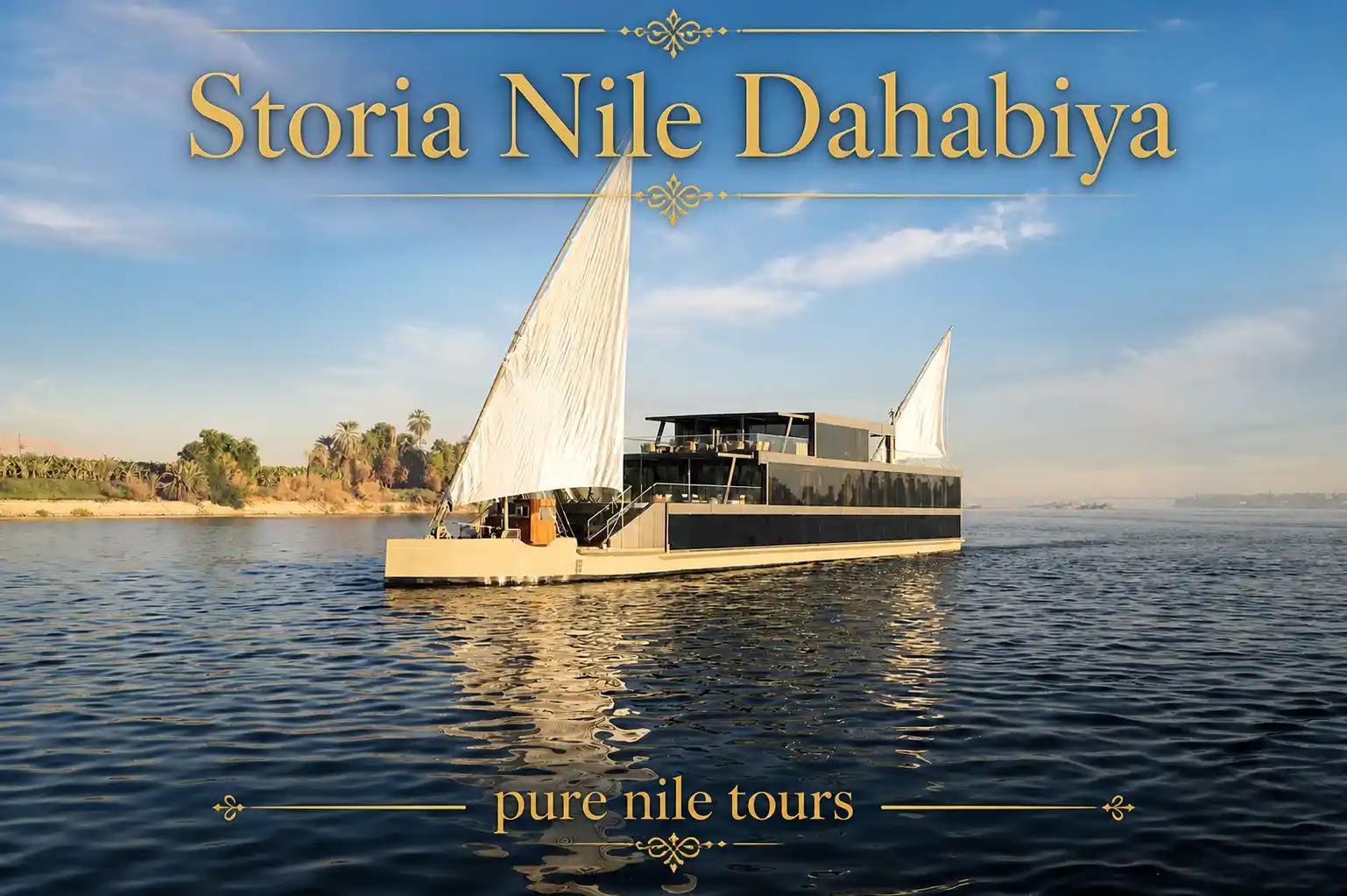
The Storia Nile Dahabiya is a luxury small-boat sailing experience between Luxor and Aswan, designed for travellers seeking privacy, intimacy, and authentic slow travel away from the crowds of standard 5-star cruise ships. Unlike traditional Nile cruisers, the Storia Dahabiya carries only a handful of guests, sails at a wind-powered pace, and accesses hidden Nile islands and quiet temple stops larger ships cannot reach. Pricing starts from $1,400 per person for the 4-day route and $1,850 for the 5-day Luxor-to-Aswan itinerary. This guide covers cabins, full itineraries, prices, and how to book the Storia Nile Dahabiya for 2026. (99 words)
Storia Nile Dahabiya at a Glance
The Storia Nile Dahabiya operates two fixed weekly itineraries between Luxor and Aswan, with prices starting from $1,400 per person for the 3-night Aswan-to-Luxor route and from $1,850 per person for the 4-night Luxor-to-Aswan route.
| Detail | Information |
|---|---|
| Vessel type | Luxury small-boat Dahabiya (traditional sailing yacht) |
| Sailing style | Wind-powered slow sailing — quiet, no engine vibration |
| Capacity | Limited number of guests for an exclusive private experience |
| Itineraries | 4 days / 3 nights and 5 days / 4 nights between Luxor and Aswan |
| Departure days | Every Friday from Luxor (3-night), every Monday from Aswan (4-night) |
| Starting price | From $1,400 (3 nights) and from $1,850 (4 nights) per person |
| Sites visited | Karnak, Luxor Temple, Valley of the Kings, Hatshepsut, Edfu, Kom Ombo, Philae, High Dam, plus hidden islands inaccessible to large cruises |
| Meals | Full board — gourmet dining freshly prepared by the master chef |
| Drinks | Tea, coffee, and soft drinks included on board |
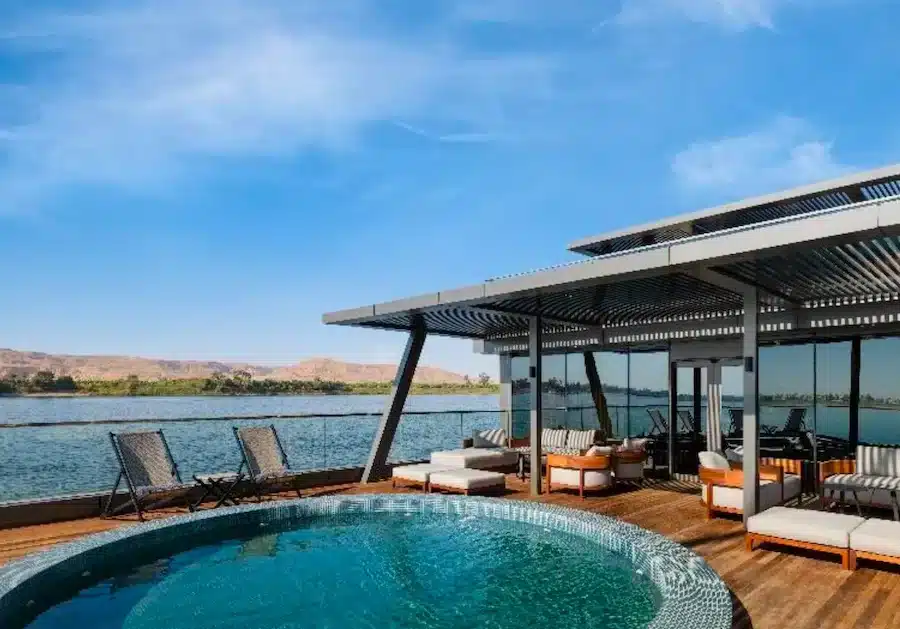
| Decks | Three decks with elegant dining space, terrace, solarium, plunge pool, spa, and gym |
Exchange rates fluctuate — verify current rates before travel. All Storia Nile Dahabiya prices are quoted in USD per person, double-occupancy cabin, and are subject to seasonal adjustment around Christmas, New Year, and Easter peaks.
What the Storia Nile Dahabiya delivers in practical terms:
- Privacy and exclusivity — limited guests means personalised service from the very first day, with crew learning your name and preferences within hours
- Authentic slow sailing — wind-powered movement creates a quiet, vibration-free experience impossible on engine-driven cruisers
- Hidden Nile access — the Dahabiya can anchor at quiet islands and ancient sites unreachable by larger ships
- Gourmet dining — fresh, locally sourced ingredients prepared by an executive chef with menus rotating between authentic Egyptian and international cuisine
- Onboard wellness — plunge pool, spa, and gym across three decks — plus an elegant salon and open terrace for relaxation
What is a Dahabiya & Why the Storia Stands Apart from Standard Cruises
A Dahabiya is a traditional Egyptian wooden sailing boat that dates back to the 19th century — originally used by Egyptian royalty and European explorers travelling the Nile in privacy and elegance. The word “Dahabiya” comes from the Arabic dahab meaning gold, reflecting the gilded boats once reserved for nobility.
The Storia Nile Dahabiya stands apart from standard 5-star Nile cruisers in three concrete ways: limited guest capacity, wind-powered slow sailing, and access to hidden sites that large ships physically cannot reach.
Limited capacity changes the entire experience. Where 5-star cruisers like the Sonesta Sun Goddess or Movenpick Hamees carry 60–120 passengers, a Dahabiya like the Storia carries only a handful of guests. The crew-to-guest ratio supports genuinely personalised service — recent Dahabiya guest reviews consistently describe staff knowing names and preferences from day one, an experience structurally impossible on a 200-passenger ship.
Wind-powered slow sailing creates a different kind of quiet. Standard Nile cruisers run on diesel engines, which means continuous low-frequency vibration through the hull and constant background noise. The Storia Dahabiya sails primarily by wind, which means silence — only the sound of water against the hull and wind in the lateen sails. This is the closest modern travellers can get to how Egyptian royalty and 19th-century explorers experienced the Nile.
Access to hidden sites is the third differentiator. Large cruisers are limited to 2–3 fixed docking points along the Nile. The Storia Dahabiya can anchor at quiet islands, sandstone quarries at Gebel el-Silsila (where the stones for ancient temples were cut), and small Nubian villages that mass tourism has not reached.
The Storia approach to luxury also differs from contemporary cruise design. Where new-build ships emphasise modern minimalism, the Storia commits to bespoke sophistication with a contemporary feel — Egyptian cotton linens, freestanding bathtubs in the suites, elegant dining spaces, and spa-like bathrooms. The vessel feels closer to a private yacht than a hotel.
Cabins & Suites on the Storia Nile Dahabiya
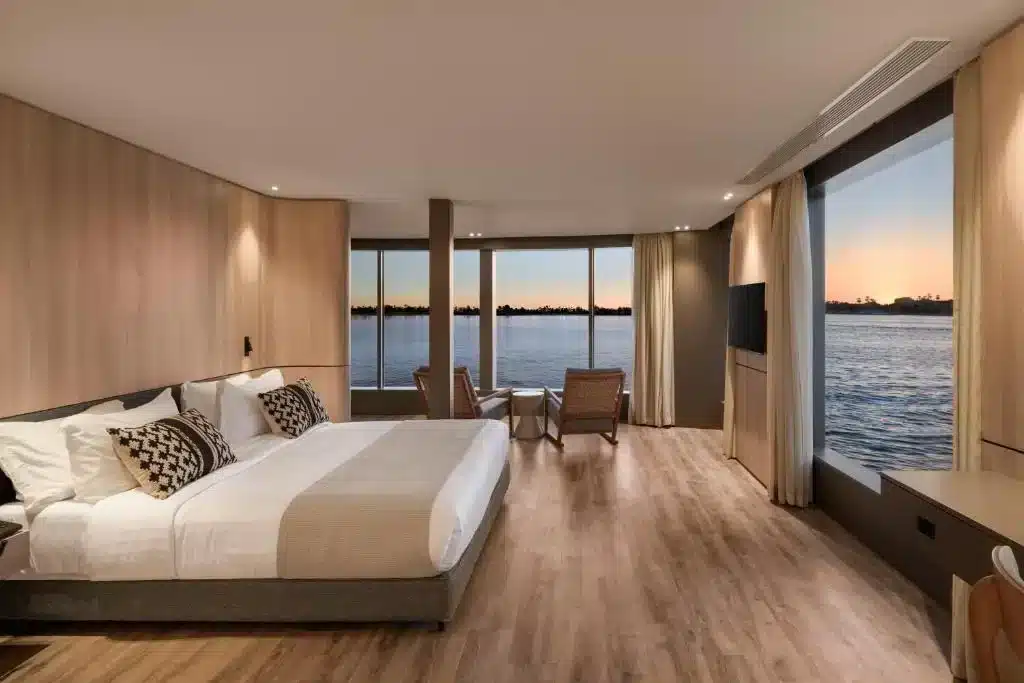
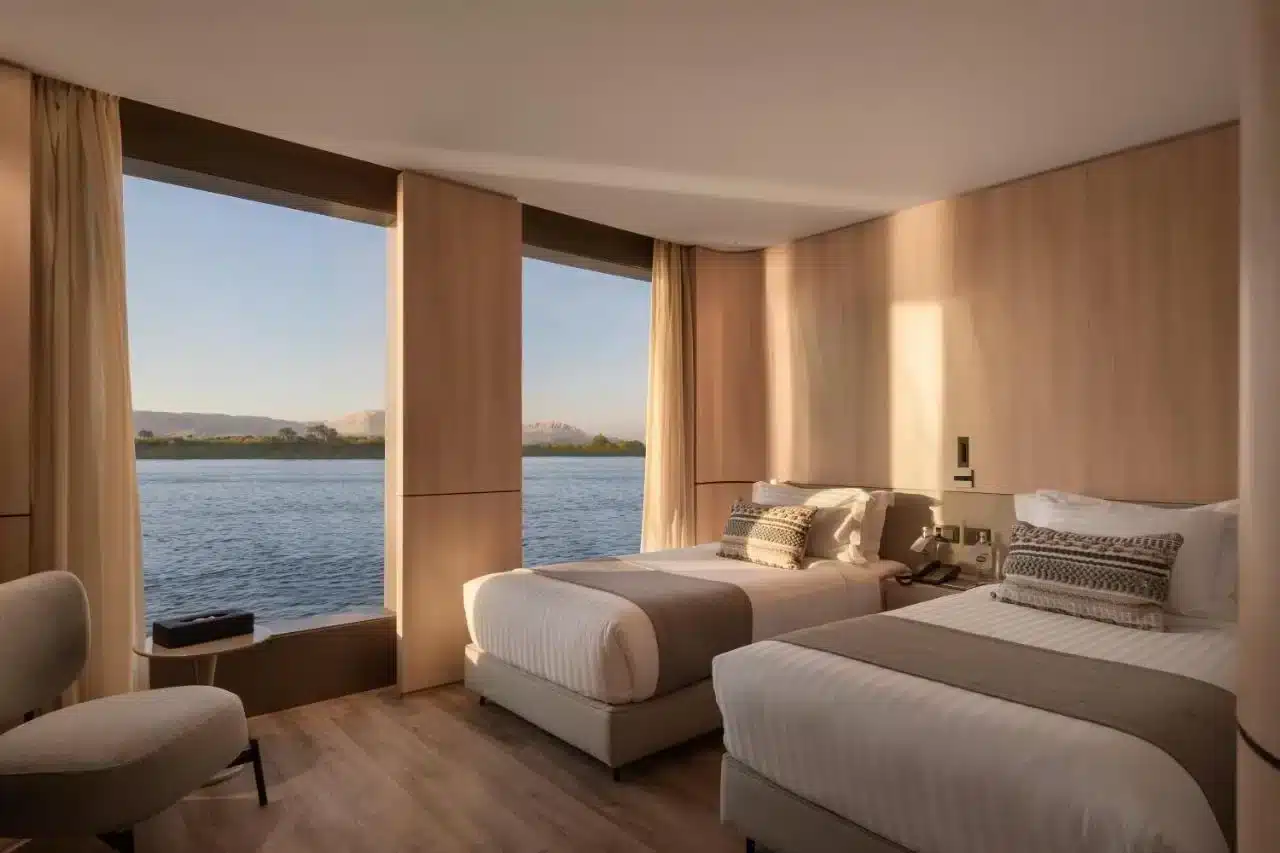
The Storia Nile Dahabiya offers a small number of carefully designed cabins and suites across three decks, with elegant fixtures, expansive windows for serene river views, and Egyptian cotton linens throughout. The two suites feature freestanding luxurious bathtubs.
| Category | Configuration | Best for | Notable features |
|---|---|---|---|
| Standard Cabin | Double or twin beds | Couples, individual travellers | Expansive windows with Nile views, ensuite bathroom, Egyptian cotton linens |
| Suite | Larger footprint | Honeymooners, anniversaries, special occasions | Freestanding bathtub, expanded living space, premium toiletries |
Standard Cabins on the Storia Dahabiya — designed for serene river views with expansive windows that frame the Nile from bed level. Each cabin features Egyptian cotton linens, an ensuite bathroom with full amenities, individual climate control, and the kind of bespoke detailing more often associated with land-based boutique hotels than cruise vessels.
The two suites are the flagship accommodations on the Storia. Each suite offers expanded living space, a freestanding luxurious bathtub for in-suite relaxation, and premium toiletries. Honeymooners and milestone-anniversary travellers often choose a suite specifically because the cabin itself becomes part of the experience — soaking in the freestanding tub as the riverbank slides past quietly is a memory the standard cruise environment cannot deliver.
Standard amenities across every Storia Nile Dahabiya cabin include individual air conditioning, expansive panoramic windows facing the Nile, premium Egyptian cotton bedding, ensuite bathrooms with rainfall showers (and bathtubs in the suites), elegant locally-crafted furnishings, complimentary Wi-Fi, and 24-hour attentive service from the small crew.
The Storia is arranged across three decks: the lower deck holds cabins, the middle deck contains the elegant Salon dining space and additional cabins, and the upper deck (the Veranda or Terrace) holds the solarium, plunge pool, and outdoor lounge area where most evenings end.
The overall design philosophy on the Storia Dahabiya prioritises authentic style over scale. Where new-build cruisers fill cabins with smart TVs and automated lighting, the Storia emphasises craftsmanship — handmade wooden furniture, traditional textiles, soft natural lighting, and the kind of timeless elegance that fits the heritage of the vessel itself.
The booking strategy for couples on the Storia: a Standard Cabin already delivers excellent intimacy and elegance. Upgrading to a Suite makes sense for special occasions, longer 7-night charters, or when the cabin itself is meant to be a destination — honeymoons, anniversaries, or milestone trips.
Onboard Facilities, Dining & Wellness
The Storia Nile Dahabiya offers facilities rarely found on traditional Dahabiyas: an elegant Salon dining space, a Terrace with solarium, a plunge pool for swimming refreshment, an onboard spa, a fully equipped gym, and gourmet dining prepared by a master chef.
Dining on the Storia
Dining is one of the strongest features of the Storia Nile Dahabiya. The executive chef and culinary team source fresh, hand-picked seasonal ingredients to create authentic Egyptian dishes alongside international signatures. Three full-board meals are served daily — breakfast on the deck, lunch and dinner alternating between the elegant Salon and the open Terrace under the stars.
Special dining experiences are part of the journey: candlelit dinners on the riverbank as the sun sets, themed Egyptian Nights with traditional cuisine and music, BBQ evenings on a quiet island when weather allows, and a farewell gala dinner on the final night. Tea, coffee, and soft drinks are included throughout the cruise. Dietary requirements — vegetarian, vegan, gluten-free, religious-observance — are accommodated when notified at booking.
The Salon and Terrace
The Salon on the Storia Dahabiya combines bespoke sophistication with a contemporary feel. Curated cocktails, light bites, and aperitifs are served against the backdrop of majestic Nile views and gentle melodies, creating a serene refined ambiance. This is the ship’s interior heart — equally suited to long conversations over wine and quiet reading on cooler afternoons.
The Veranda (upper deck Terrace) is where guests gather under the stars. Expertly crafted mixology cocktails, culinary perfection, and starlit BBQ dinners are served here against unobstructed views of the night sky over the Nile — the kind of view that includes a clearly visible Milky Way far from urban light pollution.
Wellness — spa, gym, and plunge pool
The Storia includes a plunge pool on the upper deck for instant refreshment between temple visits — a feature that becomes essential on summer sailings. The onboard spa offers massage and aromatherapy treatments, and the gym provides cardio and weight equipment for guests who want to maintain a routine on the trip. Spa appointments are best confirmed on day one because slots are limited given the small guest count.
Tailored experiences and entertainment
The Storia Nile Dahabiya offers experiences that the standard cruise format rarely matches: enlightening Egyptology sessions onboard, gourmet cooking classes with the executive chef, mesmerising star-gazing evenings led by knowledgeable crew, and the option to join local Nubian musicians on certain evenings. The crew arranges these activities flexibly based on guest preferences rather than a fixed entertainment schedule.
Storia Nile Dahabiya Itineraries & Pricing
The Storia Nile Dahabiya offers two main itinerary options in 2026: a 4-day / 3-night cruise from Aswan starting from $1,400 per person, and a 5-day / 4-night cruise from Luxor starting from $1,850 per person. Both include full sightseeing with a private Egyptologist.
4-Day / 3-Night Itinerary (Aswan → Luxor) — From $1,400 per person
The shorter Storia Nile Dahabiya route departs every Friday from Luxor (returning travellers from Aswan) and covers Philae Temple, the High Dam, the Unfinished Obelisk, Kom Ombo, Edfu, the sandstone quarries of Gebel el-Silsila, and the Luxor temples on disembarkation day.
This option suits travellers combining the Storia with a Cairo extension and tighter on time. The pace is unhurried by Dahabiya standards — sailing remains the centrepiece — and covers all major Upper Egypt highlights with the authentic slow-sailing experience.
5-Day / 4-Night Itinerary (Luxor → Aswan) — From $1,850 per person
The longer Storia route departs every Monday from Aswan and covers Karnak, Luxor Temple, Valley of the Kings, Hatshepsut, Esna Lock crossing, Edfu, Kom Ombo, Philae, the High Dam, and the Unfinished Obelisk. The extra night allows the Dahabiya pace to fully unfold — longer sailing stretches, more time anchored at quiet islands, and unhurried temple visits.
This is the more authentic Dahabiya experience and the better value for travellers who specifically want the slow sailing as the core of the trip rather than just a transport between temples. Most repeat Dahabiya travellers recommend the 5-day option over the 3-day for first-timers.
Private Charter Options
The Storia Nile Dahabiya is also available for private charter — booking the entire vessel for a family group, anniversary celebration, or close friend group. Charter pricing varies by season and length but typically starts from approximately 6–8 times the per-person rate. Charter bookings unlock fully customised itineraries, departure dates outside the standard schedule, and complete privacy on board.
Day-by-Day: 4 Days / 3 Nights from Aswan to Luxor
The 3-night Storia Nile Dahabiya itinerary (Aswan → Kom Ombo → Edfu → Luxor) covers the major Upper Egypt sites with the authentic slow sailing experience. Pricing starts from $1,400 per person.
Day 1 — Aswan: Embark, Philae, High Dam & Unfinished Obelisk
The day begins with a private meet-and-greet at Aswan Airport or hotel and a transfer to the Storia Dahabiya. The morning programme covers the sightseeing in Aswan: a small motorboat ride to Agilkia Island to see the famous Temple of Isis (Philae), saved from the rising waters of the Nile during the UNESCO rescue project.
The High Dam visit follows — Aswan’s modern engineering wonder that created Lake Nasser. Check-in to your luxury cabin on the Storia. Lunch is served on The Terrace (the sundeck) with views of the Nile. The evening features the first dinner on board, prepared by the master chef. Overnight on board moored in Aswan.
Day 2 — Sail to Kom Ombo, then North toward Edfu
Breakfast on board the Storia Dahabiya as the boat leaves for Kom Ombo. The guided morning visit covers the unique double temple at Kom Ombo, dedicated to Sobek (the crocodile god) and Horus (the falcon god). The temple’s perfect symmetry is unique in Egyptian architecture.
Return to the Storia and start the slow sail north toward Luxor — the best part of the Dahabiya experience is sailing quietly without the noise of large engines. The afternoon often passes the ancient sandstone quarries of Gebel el-Silsila and rock-cut shrines that big cruise ships cannot access (subject to wind and river conditions).
A formal dinner is served in The Salon or outside on the deck. Overnight docked close to Edfu.
Day 3 — Edfu Temple, Sailing Day & Esna Lock
Morning visit with your Egyptologist guide to the Temple of Horus in Edfu — one of the best-preserved temples in Egypt — reached by horse-drawn carriage from the riverbank. Return to the Storia Dahabiya to spend the day relaxing on the sundeck, swimming in the plunge pool, or watching farming villages and palm groves drift past in silence as the boat sails toward Esna.
Lunch is served on board while sailing. As the boat approaches Esna, a special Egyptian-themed dinner or BBQ is served on the deck. The famous Esna Lock crossing follows, fun to watch from the deck. Arrival in Luxor with overnight on board.
Day 4 — Luxor Sightseeing & Disembarkation
Final breakfast on board the Storia Nile Dahabiya. Disembarkation in Luxor and transfer by private vehicle to start the guided Luxor sightseeing programme: Valley of the Kings (royal tombs of the Pharaohs), Hatshepsut Temple (the magnificent terraced temple at Deir el-Bahari), and the Colossi of Memnon. If the schedule allows, drive to the East Bank to visit Karnak and Luxor Temples. Departure transfer to Luxor Airport or your local hotel.
Day-by-Day: 5 Days / 4 Nights from Luxor to Aswan
The 4-night Storia Nile Dahabiya itinerary (Luxor → Esna → Edfu → Kom Ombo → Aswan) covers the same major sites with one additional night for a more authentic slow-sailing experience. Pricing starts from $1,850 per person.
Day 1 — Luxor: Embark, Karnak & Luxor Temples
Pickup at your hotel or Luxor Airport and transfer to the Storia Dahabiya. Lunch is served on board (in The Salon or outside on The Terrace) while docked in Luxor.
The afternoon programme covers Karnak Temple — the largest religious complex ever built on the ground, famous for its Hypostyle Hall of 134 columns — followed by Luxor Temple in the city centre, best seen as the sun sets over the colossal Ramses II statues. Dinner on board, overnight docked on the East Bank in Luxor.
Day 2 — West Bank, Sail to Esna & Cocktail Reception
Breakfast served on the deck of the luxury Dahabiya. Cross the Nile with your guide to see the Valley of the Kings (royal tombs), the Temple of Hatshepsut at Deir el-Bahari, and the Colossi of Memnon on the West Bank tour.
In the afternoon, sailing begins toward Aswan via Esna. This is the time to relax by the plunge pool or have tea on the deck while the Storia Dahabiya glides quietly past farming villages. The famous Esna Lock crossing follows (afternoon or evening depending on the queue).
The evening features a Cocktail Reception — a welcome drink to formally kick off the trip — followed by fine dining on board. Overnight docked near Esna or on a quiet island nearby.
Day 3 — Edfu Temple, Slow Sailing & Kom Ombo
Early morning sailing toward Edfu. The guided visit covers the Edfu Temple — the Temple of Horus, one of the best-preserved temples in Egypt — reached by horse-drawn carriage. Return to the Storia for sailing toward Kom Ombo, spending the day on the water. The best part of the Dahabiya experience is seeing farmers, water buffalo, and palm groves go by in silence.
Depending on wind and the captain’s schedule, the boat may pass the old sandstone quarries of Gebel el-Silsila where ancient stones for the temples were cut. The evening trip covers the unique double temple at Kom Ombo at night — a dramatic experience under low light.
A themed dinner follows — usually an “Egyptian Night” or a BBQ on the deck or on a nearby island if weather permits. Overnight docked near Kom Ombo or sailing toward Aswan.
Day 4 — Aswan: Philae, High Dam & Felucca
Wake up in Aswan to views of sandy banks and granite rocks. Sightseeing begins with sailing to Agilkia Island for the Temple of Isis (Philae), saved from rising Nile waters. The High Dam visit follows — the modern engineering wonder that created Lake Nasser. The Unfinished Obelisk visit explores the ancient granite quarries.
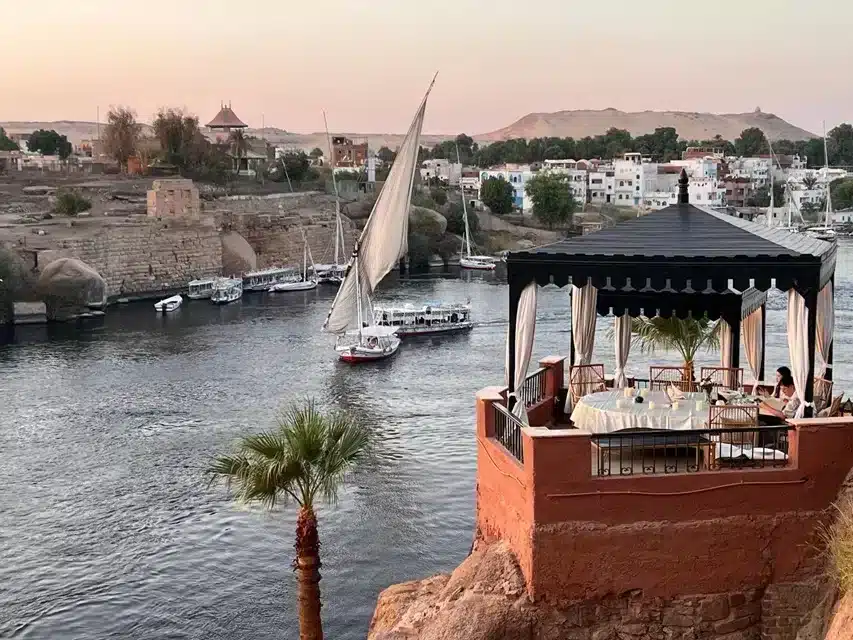
Lunch on board the Storia Nile Dahabiya. The afternoon felucca ride covers the islands of Aswan and the mountain of the Nobles. The day closes with a goodbye gala dinner and optional Nubian show or traditional music. Overnight docked in Aswan.
Day 5 — Disembarkation in Aswan
Final breakfast on board the Storia Dahabiya. Check-out, disembarkation, and transfer to Aswan Airport or your hotel. End of services.
Storia Nile Dahabiya Price Breakdown for 2026
A realistic Storia Nile Dahabiya cost for a couple booking the 4-night itinerary in shoulder season totals approximately $2,200–2,800 per person, including the cruise, supplementary expenses, and one optional excursion.
Per-person breakdown for the 4-night Luxor-to-Aswan Storia itinerary:
- Standard cabin (4 nights, double occupancy): From $1,850 per person
- Suite upgrade: Add approximately $400–800 per person
- Egypt entry visa: $25 per person
- Tipping budget (guide, driver, pooled crew): $100–150 per person (Dahabiya tipping runs higher than standard cruises because of the small crew)
- Alcoholic beverages on board (4 days, moderate consumption): $100–180 per person (alcohol not included in package)
- Optional Abu Simbel by flight: $250–320 per person
- Optional Hot Air Balloon over Luxor West Bank: $120–150 per person
- Premium Valley of the Kings tomb tickets: $20–50 per person
- Single supplement: typically 50–80% of the per-person rate
Adding tipping, alcohol, visa, and one optional excursion to the base price gives a realistic total Storia Nile Dahabiya cost of approximately $2,250–2,500 per person for the 4-night itinerary. Both optional excursions push the total to $2,500–2,800 per person.
International airfare from Europe sits roughly $400–900 per person; from North America $700–1,400 per person. A 9-night trip combining the Storia with 2–3 nights in Cairo lands roughly $300–600 per person above the cruise-only base.
The Storia Nile Dahabiya sits in the upper-luxury bracket of Nile cruising. The price reflects the small-boat experience, wind-powered sailing, gourmet dining, and bespoke service quality that simply cannot be replicated on standard 5-star cruisers regardless of their service level.
Exchange rates fluctuate — verify current rates before travel. Egyptian Pound rates against the USD have moved sharply over the past 24 months. Cruise rates remain quoted in USD and stay stable across that period.
What’s Included vs Excluded
The Storia Nile Dahabiya package includes full-board accommodation, all sightseeing tours with a professional Egyptologist, every entrance fee, all transfers, tea/coffee/soft drinks on board, and all service charges and taxes. International airfare, the Egypt visa, alcohol, tipping, and optional excursions are not included.
| Included | Excluded |
|---|---|
| Accommodation on board the Storia Nile Dahabiya | International flights |
| Full-board meals (breakfast, lunch, dinner daily) | Egypt entry visa (~$25 on arrival or e-visa) |
| Guided tours with professional Egyptologist | Tipping (crew & guide) |
| Entrance fees to all mentioned sightseeing | Alcoholic beverages |
| All transfers (airport / hotel / cruise) | Optional tours (Abu Simbel) |
| Tea, coffee & soft drinks on board | Personal expenses |
| Service charges and taxes | Travel insurance (recommended) |
| Welcome cocktail reception | Premium tomb tickets at Valley of the Kings |
| Onboard cultural experiences (Egyptology sessions) | Spa treatments and laundry |
The all-inclusive sightseeing on the Storia Dahabiya deserves attention. Some Dahabiya operators sell the boat without the Egyptologist or entrance fees and bill these separately — adding $300–500 per person across the trip. The Storia package as offered through Pure Nile Tours bundles all of this into the published price.
Soft drinks, tea, and coffee included is a notable difference from standard 5-star cruisers, where these are typically charged separately. On the Storia, only alcohol is charged outside the package — local Egyptian wines and beers are reasonably priced; imported wines and premium spirits cost noticeably more because of Egypt’s import duties.
Premium tomb supplements at the Valley of the Kings: Tutankhamun’s tomb (~$25), Seti I tomb (~$50), Ramses VI tomb (~$15). Cash payment in EGP at the entrance.
Best Time to Sail on the Storia Nile Dahabiya
The best time to sail on the Storia Nile Dahabiya is October through April, when daytime temperatures sit between 20°C and 32°C and outdoor temple visits remain comfortable. Dahabiya sailings run year-round but the season is more concentrated than standard cruisers.
| Month | Average daytime high | Storia sailing experience |
|---|---|---|
| October | 32–35°C | Ideal — warm, dry, perfect sailing winds |
| November | 27–30°C | Excellent — peak comfort, busy season opens |
| December | 22–25°C | Cool — sweater needed at night, popular for Christmas |
| January | 20–24°C | Coolest — bright sunny days, cold mornings |
| February | 23–27°C | Excellent — comfortable for full day touring |
| March | 27–30°C | Excellent — last comfortable month before heat |
| April | 32–36°C | Warm — manageable with morning starts |
| May–September | 36–45°C+ | Hot — limited sailings, deep summer pricing |
The booking sweet spot for the Storia Nile Dahabiya is February and early March: clear weather, optimal sailing winds, no holiday premium, and standard pricing. November is also excellent value before the December holiday surge starts.
Christmas, New Year, and Easter weeks command a 25–40% premium over standard rates and often book out 6–9 months in advance — Dahabiyas have very limited cabin counts so peak weeks fill faster than 5-star cruisers. Last-minute attempts during these weeks usually fail entirely.
May through September Storia sailings are reduced. The Dahabiya experience depends on time on the open Terrace and slow sailing in pleasant conditions — daytime temperatures of 38°C+ make this less enjoyable. Travellers wanting a cheaper Nile experience in summer are usually better matched to standard 5-star cruisers with full air conditioning across enclosed public spaces.
Wind conditions also matter for the Storia. The slow sailing experience depends on consistent breezes, which are most reliable from October through March. Summer months can have stretches of calm air requiring more motor assistance — diluting the authentic Dahabiya experience.
Optional Excursions: Abu Simbel & Premium Add-Ons
Two optional excursions add the most to the final Storia Nile Dahabiya cost: Abu Simbel ($250–320 per person by flight) and the sunrise hot air balloon over Luxor West Bank ($120–150 per person). Both are worth the supplement for first-time visitors.
Abu Simbel — $250–320 per person (flight) or $90–130 (road)
The twin rock temples of Ramses II and Nefertari sit roughly 280 km southwest of Aswan, near the Sudanese border. The flight option from Aswan Airport takes about 45 minutes each way and gets travellers back on board the Storia for normal lunch. The road convoy option requires a 03:30 hotel pickup and takes 3.5 hours each way, but saves significant cost and gives more time at the site.
The four 20-metre seated colossi of Ramses II carved directly into the cliff are the most photographed monument in Egypt. Most first-time Storia guests regret skipping Abu Simbel more than they regret the cost. Worth booking on day one of the cruise to lock the slot.
Hot Air Balloon over Luxor West Bank — $120–150 per person
A sunrise balloon flight over the Valley of the Kings, Hatshepsut Temple, and the green farming strip along the Nile. Pickup is around 04:30, the flight itself lasts 45–60 minutes, and the experience includes pickup, light refreshments, and a flight certificate.
Bookings are easiest to confirm on day one of the Storia cruise. Weather cancellations happen — Luxor’s morning visibility is mostly reliable, but winter mist and summer haze can ground flights. Operators usually offer a refund or rebooking the next morning if the schedule allows.
Sandboarding in Aswan — an unusual add-on offered specifically because of the Storia’s flexibility. An afternoon sandboarding down Aswan’s formidable dunes promises excitement and adrenalin — a different kind of memory from the temple visits.
Kayaking around Philae Temple — another flexible add-on the Storia Nile Dahabiya can arrange that mass-tourism cruisers cannot. Kayaking past the temple from the water gives a perspective most visitors never see.
Onboard cooking classes with the Executive Chef — included in the cruise package on certain sailings. Worth requesting at booking if the experience interests the traveller.
Storia Nile Dahabiya vs Standard 5-Star Cruises
The Storia Nile Dahabiya delivers a fundamentally different experience from standard 5-star cruisers — small-boat intimacy and wind-powered sailing rather than large-ship facilities and engine-driven schedules. The choice depends on what the traveller values most.
vs Historia Luxury Nile Cruise
The Historia Luxury Nile Cruise is one of the closest 5-star peers in service quality but represents a different philosophy entirely. The Historia carries about 50 cabins with Art Deco design, full hotel-style facilities including a swim-up bar and Seneb Spa, and engine-driven sailing on a fixed schedule. Pricing starts from $1,339 (3N).
The Historia is the better choice for travellers who want full 5-star hotel facilities afloat, social interaction with other guests at meals and evening events, and a contemporary boutique-luxury aesthetic. The Storia is the better choice for travellers who specifically want privacy, slow sailing, hidden island access, and intimate small-boat service. For deeper detail on the Historia option, the Historia Luxury Nile Cruise article covers cabins, itineraries, and pricing in full.
vs Movenpick Sunray Nile Cruise
The Movenpick Sunray Nile Cruise sits in a different price tier entirely — 5-star Swiss hospitality starting from $890 (3N), with 66 cabins, full restaurant, swimming pool, lounge bar with discotheque, and the Mövenpick brand standards.
The Sunray is the right choice for travellers who want consistent 5-star hospitality at strong value, families with children who benefit from the reading and play room, and groups who want the social atmosphere of a larger ship. The Storia is the right choice for couples and small groups specifically seeking privacy, authentic sailing, and the ultra-luxury Dahabiya experience without the large-ship social environment.
vs Movenpick Hamees Nile Cruise
The Movenpick Hamees is another 5-star option in the Movenpick family at similar pricing to the Sunray. The detailed Movenpick Hamees Nile Cruise article compares cabins, facilities, and pricing for travellers weighing this brand against the Storia.
The pattern across all these comparisons: standard 5-star cruisers deliver larger ships, more facilities, structured social programmes, and lower entry pricing. The Storia Nile Dahabiya delivers smaller scale, authentic sailing, hidden access, gourmet personalised dining, and an intimate experience that scale-driven cruisers cannot replicate at any price.
Who Should Book the Storia Nile Dahabiya
The Storia Nile Dahabiya is best suited to honeymooners, anniversary couples, mature travellers seeking privacy, and small groups of friends or family who specifically value slow travel, intimate service, and authentic Nile experiences over large-ship facilities.
Honeymooners and anniversary travellers — the small guest count, freestanding bathtubs in suites, candlelit dinners on the riverbank, star-gazing evenings, and structurally personalised service make the Storia one of the strongest honeymoon-tier picks on the Nile. The investment in a Suite upgrade pays off across these milestone trips.
Mature couples in their 50s–80s — the unhurried pace, attentive small crew, gourmet dining, wellness facilities (spa, plunge pool, gym), and absence of the noise and crowds typical of large cruisers suit travellers who want comfort, refinement, and authentic experience together.
Privacy-focused luxury travellers — guests who have already experienced standard cruises and now want something fundamentally different. The Storia delivers the authentic 19th-century explorer experience updated with modern luxury — what mass tourism replaced and what discerning travellers now seek again.
Cultural-immersion travellers — guests who value time at ancient quarries, quiet villages, hidden Nile islands, and authentic local interactions over rushed temple checklists. The Storia’s flexibility to anchor where large ships cannot is the differentiator here.
Small private groups — families of 4–8 booking together, friend groups celebrating milestones, and corporate retreats can charter the Storia for fully customised itineraries with complete privacy on board.
Less suitable for: budget-conscious travellers (the Movenpick Hamees or Sunray deliver better budget value), travellers wanting a structured social cruise atmosphere with lots of new faces (the Sonesta Sun Goddess or Historia provide this better), families with very young children (the Dahabiya pace and lack of children’s facilities don’t suit guests under 8 well), and travellers wanting maximum onboard facilities like multiple restaurants and casino-style entertainment.
How to Book the Storia Nile Dahabiya
The best way to book the Storia Nile Dahabiya at the lowest 2026 price is to book directly through Pure Nile Tours 4–6 months ahead for shoulder season, or 6–9 months ahead for Christmas, New Year, and Easter peaks — Dahabiyas have very limited cabin counts so booking windows are longer than standard 5-star cruisers.
Direct booking ensures the package includes the professional Egyptologist, all transfers, every temple entrance fee, full-board gourmet meals, and onboard tea/coffee/soft drinks — bundled into the published price without hidden add-ons later.
Booking checklist for the Storia Nile Dahabiya:
- Book significantly earlier than standard cruises. The Storia carries only a handful of guests, which means peak weeks (Christmas, New Year, Easter) book out 6–9 months ahead. February and March book 4–6 months ahead. Last-minute availability is extremely rare on Dahabiyas — the inventory is too small.
- Decide between cabin and suite honestly. A standard cabin already delivers the core Storia Dahabiya experience — slow sailing, gourmet dining, hidden island access. The Suite upgrade with the freestanding bathtub adds genuine value for honeymoons, anniversaries, and special-occasion travellers who want the cabin itself as part of the memory.
- Confirm what is included. Some operators sell Dahabiya cruises at boat-only pricing and bill the Egyptologist, transport, and entrance fees separately — adding $300–500 per person. Pure Nile Tours bundles everything into the published Storia price. Ask for a written breakdown before paying the deposit.
- Consider the private charter option. For groups of 6–10 travellers, chartering the entire Storia Nile Dahabiya delivers exceptional value — full privacy, custom itinerary, and per-person costs that often work out lower than booking individual cabins on a fixed-departure date.
- Coordinate with Cairo extension early. Most international travellers combine the Storia with 2–3 nights in Cairo. The Storia’s Friday-from-Luxor and Monday-from-Aswan schedule offers flexibility to slot Cairo days before or after.
- Tipping budget should run higher than standard cruises. Plan $100–150 per person across the small Storia crew. Personalised service from a small crew warrants meaningful gratuity at the end of the cruise.
- Verify wind-season conditions. October through March is the peak Dahabiya season for consistent sailing winds. April and especially May onwards see calmer air that requires more motor assistance — diluting the authentic sailing experience.
Cancellation & Payment Terms
The standard cancellation policy on the Storia Nile Dahabiya applies a 10% fee for cancellations made 61+ days before arrival, escalating to 100% within 14 days. A 25% deposit secures the booking outside holiday weeks, rising to 50% during Christmas and New Year.
| Cancellation timing | Fee |
|---|---|
| From booking until 61 days before arrival | 10% of total |
| 60 to 31 days before arrival | 20% of total |
| 30 to 15 days before arrival | 50% of total |
| 14 to 1 days before arrival | 100% of total |
| No-show on arrival day | 100% of total |
Payment terms:
- 25% deposit at booking (50% during Christmas / New Year holidays)
- Remaining balance due up to one week before arrival
- Currencies accepted: USD, EUR, GBP
- Force majeure cases (war, strike, epidemic, sudden legal changes) may waive cancellation fees
Travel insurance with cancellation cover is the single most cost-effective protection against the 50–100% cancellation fee bracket. A typical policy costs $40–80 per person and removes the financial risk if illness, family emergency, or visa issues force a last-minute change. Especially worth it for high-value Storia bookings, holiday weeks, and private charters where cancellation exposure runs into thousands of dollars.
If domestic Egypt airfare is included in a wider tour package combined with the Storia Nile Dahabiya, separate airline cancellation rules apply on top of the cruise terms.
Dress Code, Etiquette & Onboard Atmosphere
The dress code on the Storia Nile Dahabiya is smart-casual with a slight lean toward refined evening wear given the boutique scale. Light cotton trousers, linen shirts, and modest summer dresses fit the daytime atmosphere on temple visits and the deck.
Dinner on the Storia is more elegant than on standard cruisers without becoming formal. Most guests choose neat trousers with a linen shirt for men or a summer dress for women. The candlelit dinners and starlit BBQ evenings on the Terrace warrant slightly more thought than gym-wear-meets-buffet feel of larger ships.
Off the ship, modesty is the operating principle. At every temple site, shoulders should be covered and shorts should reach close to the knee. Inside active mosques (a possibility on a Cairo extension rather than the cruise itself), women cover their hair, everyone removes shoes, and modest dress applies regardless of gender. Coptic churches in Old Cairo are slightly more relaxed but still expect covered shoulders.
Photography is permitted at most sites visited on the Storia, but flash is prohibited inside tombs in the Valley of the Kings to protect the painted reliefs. Some tombs charge an additional photography permit fee. Tutankhamun’s tomb prohibits photography entirely. Drone photography is illegal in Egypt without specific written government permission.
Tipping on the Storia Nile Dahabiya runs higher than on standard cruisers because of the small crew size and personalised service. Plan $100–150 per person across the cruise — distributed at the end via a pooled crew envelope plus separate amounts for the guide and driver. The front desk can change USD into Egyptian Pounds for tipping convenience.
The onboard atmosphere on the Storia is intentionally quiet, intimate, and refined. Guests who book this cruise specifically seek the calm — early-evening conversation in The Salon, slow dinners under the stars, and unhurried mornings on the Terrace are the rhythm. This is not the place for raucous group entertainment or large-scale themed parties.
What to Pack for the Storia Nile Dahabiya
Pack for two distinct environments on the Storia: the elegant boutique interior and the hot, dusty outdoor temple sites. The packing approach leans slightly more refined than for standard cruisers given the Storia’s intimate luxury atmosphere.
Clothing for the temples and outdoor sights:
- Light, loose-fitting cotton or linen trousers — cooler than they look and modest enough for temples
- Long-sleeved cotton shirts (better than short sleeves for sun protection)
- A long lightweight scarf or shawl — useful for shoulders, dust storms, and modesty inside religious sites
- A wide-brimmed hat — non-negotiable for the West Bank visits
- Closed-toe walking shoes or sandals with grip — temple ground is uneven and dusty
- A small daypack for water, sunscreen, hat, and camera
Clothing for on board the Storia:
- Smart-casual evening wear with a slight refinement edge — neat trousers and a button-down shirt for men, a summer dress or refined separates for women
- Swimwear and a cover-up for the plunge pool and Terrace
- A light cardigan or sweater — air conditioning runs cool in the Salon, and winter evenings on the Terrace cool down quickly
- Optional galabeya for the Egyptian themed evening
- Comfortable loungewear for relaxed afternoons on deck
Practical kit:
- Reef-safe sunscreen SPF 30–50
- Sunglasses with UV protection
- Lip balm with SPF — the dry air dehydrates lips quickly
- A reusable water bottle (the Storia can refill it)
- Hand sanitiser and travel-size tissues
- A basic first-aid kit including rehydration salts, paracetamol, and an anti-diarrhoeal
- Adapter for European two-pin plugs (Type C/F)
- A small headlamp or phone-torch for tomb interiors
- Spare camera batteries and memory cards
- Small cash in USD for tipping, ideally in $1, $5, $10, and $20 bills (more than for standard cruises)
What not to pack: heavy clothing (winter exception aside), formal black-tie evening wear (overdressed even for the Storia’s refined atmosphere), excessive luggage (Dahabiya cabins are intimate). The Storia provides hairdryers, full toiletries, plush bathrobes, slippers, and Egyptian cotton bedding in every cabin.
Combining the Storia Nile Dahabiya with the Rest of Egypt
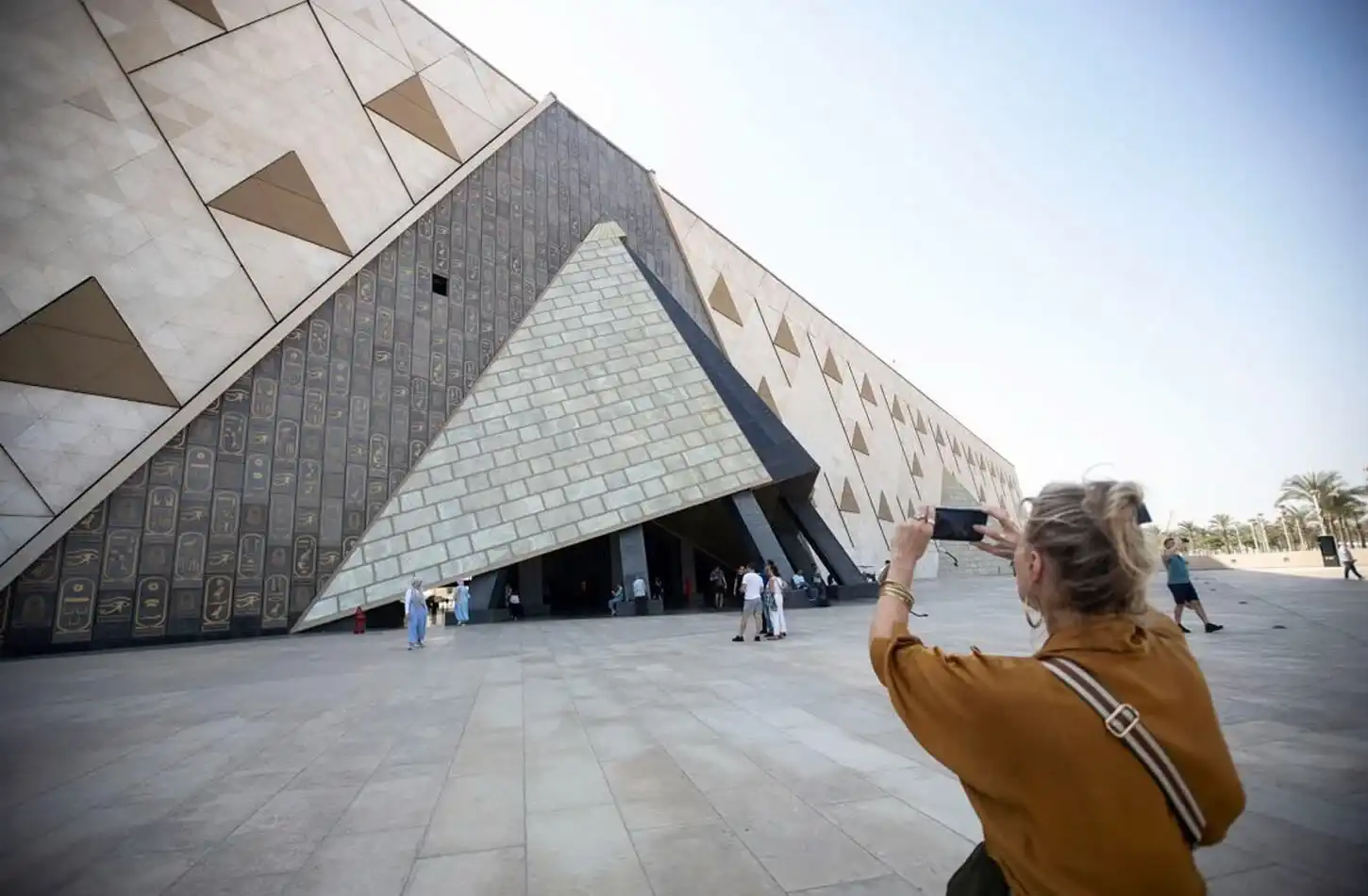
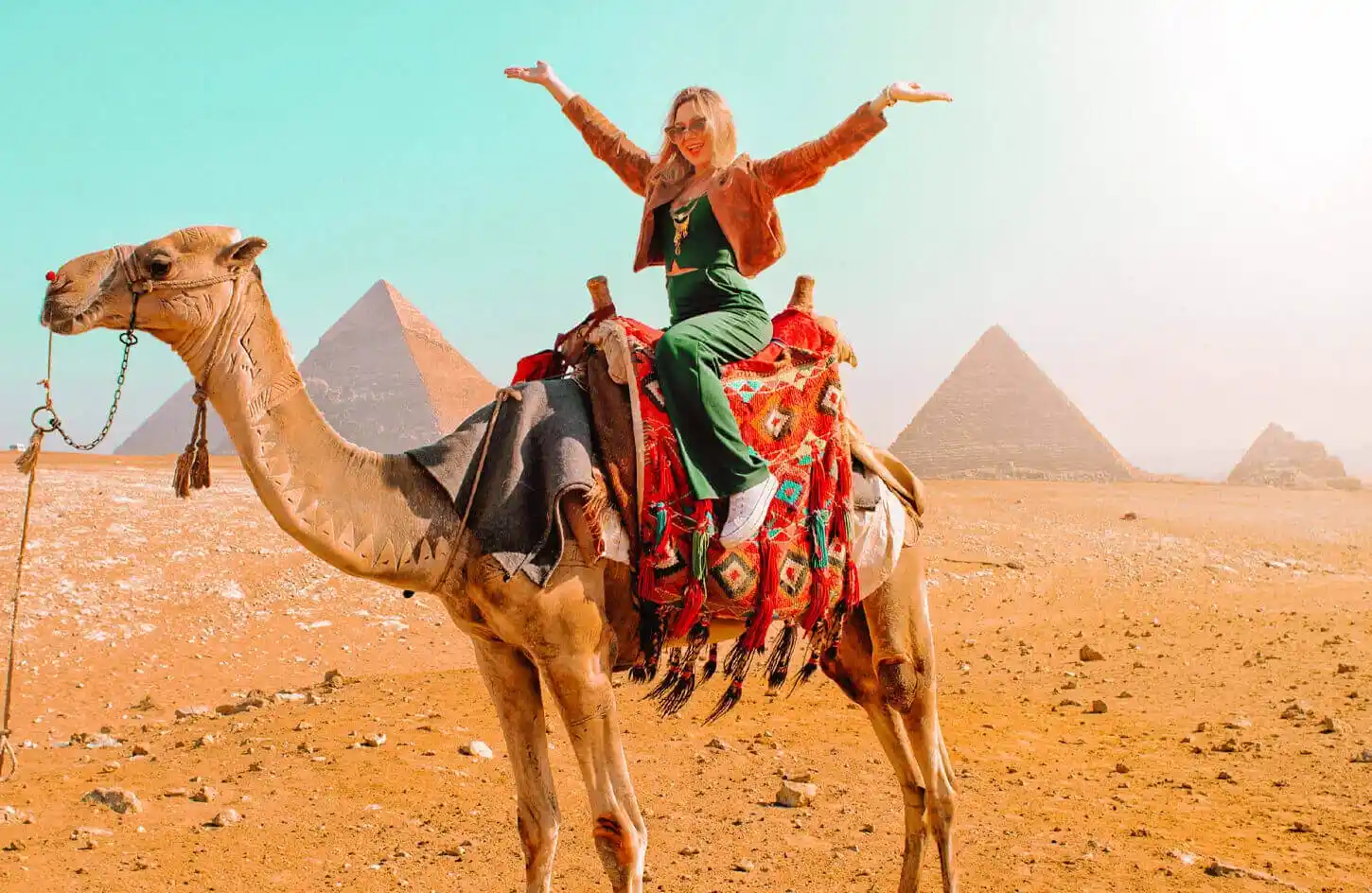
A standalone Storia cruise covers Upper Egypt brilliantly but leaves out the country’s other essentials — the Giza pyramids, the Sphinx, the new Grand Egyptian Museum, and Old Cairo. Most international travellers booking the Storia extend the trip to cover these as well.
The standard structure: 2–3 nights in Cairo before or after the Storia Nile Dahabiya. Day one in Cairo covers the Giza plateau and the Grand Egyptian Museum. Day two covers Old Cairo and Khan el-Khalili. A flexible third day handles Memphis-Saqqara-Dahshur or a slower second museum visit.
Cairo has direct domestic flights to both Aswan and Luxor multiple times daily, so the Storia slots in either before or after the Cairo days without difficulty. Flight time is about 80 minutes each way. The Storia’s Friday-from-Luxor and Monday-from-Aswan schedule fits flexibly with most Cairo extension structures.
The Red Sea extension adds beach time after the Storia — typically Hurghada or Marsa Alam for snorkelling and decompression. Hurghada is roughly four hours by road from Luxor and well connected by domestic flights to most European hubs. The contrast between the slow Dahabiya pace and Red Sea relaxation works well as a trip arc.
Abu Simbel can be added on the final cruise morning or as a separate half-day extension from Aswan after disembarkation. The flight option from Aswan makes either approach manageable.
Lake Nasser cruise extension is a unique pairing that fits well with the Storia. A few small ships sail Lake Nasser south of the High Dam to Abu Simbel and other Nubian monuments, completing the Nile experience. This adds 3–4 days to the trip and works particularly well for travellers who specifically value slow sailing.
A 10–12 day trip is the sweet spot for first-time visitors combining the Storia: 2–3 nights Cairo, 4–5 nights Storia Dahabiya, 1–2 days Abu Simbel and Lake Nasser, and a buffer for jet lag. Compressing this into 7 days is possible but rushed and undermines the slow-sailing philosophy of the Storia.
Frequently Asked Questions
What is the Storia Nile Dahabiya price for 2026?
The Storia Nile Dahabiya price for 2026 starts from $1,400 per person for the 4-day / 3-night cruise from Aswan to Luxor, and from $1,850 per person for the 5-day / 4-night cruise from Luxor to Aswan, in a double-occupancy standard cabin. Christmas, New Year, and Easter weeks carry a 25–40% premium. At the time of writing, these are the published 2026 rates — verify current pricing with the operator before booking.
What is a Dahabiya Nile Cruise?
A Dahabiya is a traditional Egyptian wooden sailing boat that dates back to the 19th century — originally used by Egyptian royalty and European explorers to travel the Nile in privacy and elegance. Modern Dahabiyas like the Storia preserve the classic sailing design while adding contemporary luxury amenities — air-conditioned cabins, gourmet dining, spa, plunge pool, and attentive small-crew service.
How is the Storia Dahabiya different from a regular Nile cruise?
The Storia Nile Dahabiya differs from regular cruises in three ways: limited guest capacity (a handful of guests rather than 60–120 on standard 5-stars), wind-powered slow sailing (quiet, no engine vibration), and access to hidden Nile islands and ancient sites that big cruise ships physically cannot reach. The experience prioritises intimacy and authenticity over scale and structured entertainment.
What is included in the Storia Nile Dahabiya cruise?
The Storia Nile Dahabiya cruise includes accommodation on board, full-board meals (breakfast, lunch, dinner), guided tours with a professional Egyptologist, entrance fees to all mentioned sightseeing, all transfers (airport / hotel / cruise), tea/coffee/soft drinks on board, and all service charges and taxes. International airfare, the Egypt entry visa, alcohol, tipping, and optional excursions are not included.
How long is the Storia Nile Dahabiya cruise?
The Storia Nile Dahabiya offers two main durations: a 4-day / 3-night cruise from Aswan to Luxor (departing Friday from Luxor) and a 5-day / 4-night cruise from Luxor to Aswan (departing Monday from Aswan). Private charter bookings allow custom durations of 7+ nights for groups wanting more time on the river.
Is the Storia Nile Dahabiya suitable for couples and families?
The Storia is exceptionally suited to couples — honeymooners, anniversary travellers, and mature couples specifically choose it for the intimate atmosphere. For families, the Storia works well with older children (ages 10+) who can appreciate the unhurried pace and cultural focus. Very young children are less suited to the Dahabiya environment because the experience is built around quiet refined moments rather than activity programmes.
Do I need a visa for the Storia Nile Dahabiya?
Yes. Most international visitors need an Egyptian entry visa, available either as a $25 visa-on-arrival sticker at major airports or as an e-visa applied for online before travel. The e-visa is generally the smoother option and prevents queuing at immigration.
Is alcohol available on board the Storia Nile Dahabiya?
Yes. The Storia is fully licensed and serves Egyptian and imported wines, spirits, beers, and cocktails at the Salon, Terrace, and during meals. Alcohol is charged separately from the cruise package — local Egyptian labels are reasonably priced; imported wines and premium spirits cost noticeably more because of Egypt’s import duties.
Is Wi-Fi free on the Storia Nile Dahabiya?
Yes. Wi-Fi covers cabins and public spaces on the Storia. Speeds are adequate for messaging, email, and standard browsing. Connection drops slightly in remote sailing stretches but stabilises when moored. Travellers needing reliable mobile data for video calls or streaming should buy a local Egyptian SIM card on arrival.
Can I charter the entire Storia Nile Dahabiya privately?
Yes. The Storia is available for private charter — booking the entire vessel for a family group, anniversary celebration, or close friend group. Charter pricing varies by season and length but typically starts from approximately 6–8 times the per-person rate. Charter bookings unlock fully customised itineraries, departure dates outside the standard schedule, and complete privacy on board.
Can I combine the Storia Nile Dahabiya with Cairo and the pyramids?
Yes, and this is the structure most international visitors choose. The Storia covers Upper Egypt with the slow-sailing experience but does not include Cairo. Adding 2–3 nights in Cairo before or after the cruise covers the Giza pyramids, the Sphinx, the Grand Egyptian Museum, and Old Cairo. Domestic flights between Cairo and Aswan or Luxor run multiple times daily.
How do I book the Storia Nile Dahabiya?
The best way to book the Storia Nile Dahabiya at the lowest 2026 price is to book directly through Pure Nile Tours 4–6 months ahead for shoulder season, or 6–9 months ahead for Christmas, New Year, and Easter weeks. Dahabiyas have very limited cabin counts, so booking windows are significantly longer than for standard 5-star cruisers. Direct booking ensures the package includes the Egyptologist, all transfers, and every entrance fee — without hidden add-ons later.
External Links
Egypt Ministry of Tourism and Antiquities
official Egyptian e-visa portal
UK FCDO Egypt travel advice