What to Pack for an Egypt Solar Eclipse Tour in 2027
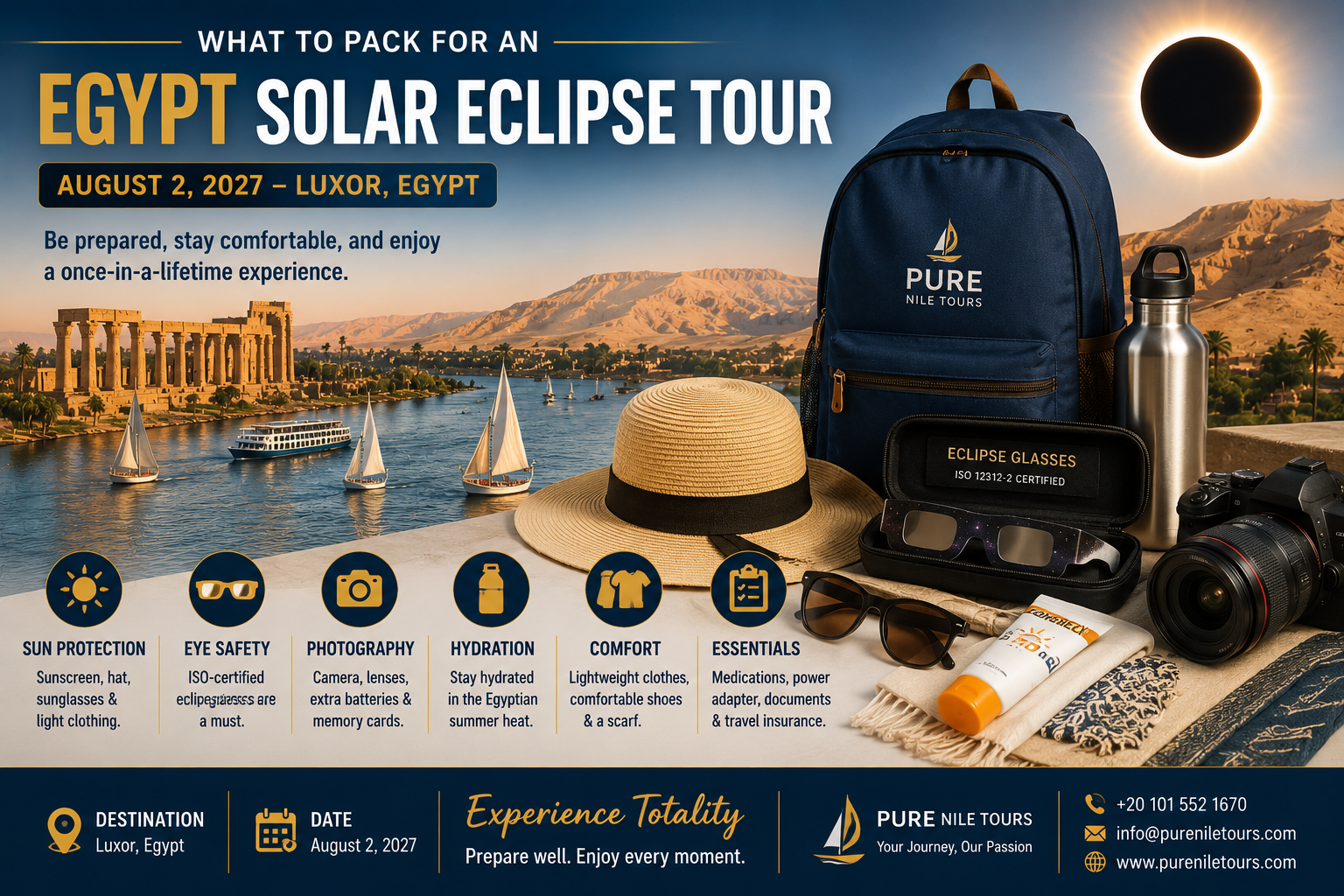
Quick answer: Pack for three separate needs: safe eclipse viewing, severe midday heat and normal Egypt travel. The essential items are verified eclipse glasses, lightweight sun-protective clothing, a hat, refillable water bottle, prescribed medication, comfortable footwear and any camera solar filter required for your equipment.
The total eclipse in Luxor occurs on 2 August 2027 near midday. Typical August conditions are very hot, and guests may spend significant time outside before and after totality. A compact, organised kit is more useful than a large amount of general travel gear.
Essential eclipse items
Verified eclipse glasses
Bring solar viewers from a supplier whose products have been tested to the ISO 12312-2 requirements for direct solar viewing. A printed ISO claim alone is not enough to establish quality. The American Astronomical Society maintains guidance on recognised suppliers.
Pack at least one primary pair and one protected backup pair. Keep them flat in a rigid envelope or case so the lenses are not scratched or punctured.
Equipment-specific solar filter
If you plan to use a camera, binoculars or a telescope, bring a filter designed to fit securely over the front of the optics. Eclipse glasses are not a substitute for an optical solar filter.
Simple timing device
A phone with an offline eclipse-timing application can help, but do not rely on a mobile connection. Download data before travel, enable local time and carry a small power bank.
Printed safety sequence
Keep a short printed card with the filter-removal and filter-replacement sequence. Totality is brief and excitement can make verbal instructions easy to miss.
Heat and sun protection
- Wide-brimmed hat with a secure strap.
- Lightweight, loose-fitting, breathable clothing.
- Long sleeves or a sun-protective overshirt.
- High-SPF sunscreen suitable for your skin.
- UV-protective sunglasses for ordinary use, but never as eclipse viewers.
- Refillable water bottle.
- Electrolyte product if appropriate for you and permitted by your clinician.
- Cooling towel or small clean cloth.
- Compact umbrella only if the viewing organiser permits it and it can be lowered before the eclipse.
WHO heat guidance recommends staying out of direct heat where possible, using shade, wearing light loose clothing and drinking regularly. Travellers with heart, kidney or other medical conditions should ask their clinician for personalised hydration advice rather than following a generic volume target.
Clothing for Cairo, Luxor and a Nile cruise
Egypt itineraries often combine city sightseeing, archaeological sites, flights and cruise dining. Choose clothing that can be layered and reused.
Daytime
- Light trousers or long skirt.
- Breathable shirts covering shoulders.
- Comfortable walking shoes with secure soles.
- Thin socks that reduce friction.
- Light scarf for sun, dust or visits requiring modest dress.
Evening and cruise use
- Smart-casual outfit for dinner.
- Light layer for strong air-conditioning.
- Non-slip footwear for decks and stairs.
Heavy denim and dark, tightly fitted clothing are less practical for midday outdoor waiting in Luxor.
Medication and health documents
- Prescription medicines in original labelled packaging.
- Enough medication for the trip plus a delay allowance.
- Copy of prescriptions and a brief medical summary.
- Travel insurance details.
- Emergency contact list.
- Small personal first-aid kit.
- Oral rehydration salts if appropriate.
- Any required allergy or diabetes supplies.
Some medicines are sensitive to heat. Ask a pharmacist how they should be stored and carry an insulated medication pouch when recommended. Do not place essential medication in checked luggage.
Camera packing list
Basic traveller
- Phone or compact camera.
- Power bank and charging cable.
- Lens cloth.
- Enough storage for photos and video.
Serious photographer
- Camera body and tested backup if available.
- Telephoto lens appropriate to the desired Sun size.
- Secure front-mounted solar filter.
- Stable tripod with a head that can point steeply upward.
- Remote release or intervalometer.
- Spare batteries stored out of direct sun.
- Multiple memory cards.
- White or reflective cover for equipment waiting in the Sun.
- Gaffer tape and labels for organisation, not for attaching unsafe filters.
- Small tool kit permitted by airline rules.
Test the complete setup at home on the uneclipsed Sun using safe procedures. Eclipse day is not the time to discover that the filter does not fit or the tripod cannot reach the required angle.
Power and electronics
- Egypt-compatible plug adapter appropriate to your home-country plugs.
- Compact multi-port USB charger.
- Power bank within airline capacity rules.
- Downloaded copies of tickets, itinerary and insurance.
- Offline maps.
- Protective phone case.
- Resealable bags for dust protection.
Keep electronics shaded. Vehicle dashboards, closed bags in direct sun and exposed metal surfaces can become extremely hot.
Nile cruise items
- Small day bag for excursions.
- Non-slip shoes.
- Light layer for air-conditioned interiors.
- Swimwear if the vessel has a pool.
- Compact binoculars only if you also have the correct solar filter and understand safe use; otherwise keep them stored during the eclipse.
- Earplugs if sensitive to engine or docking noise.
- Luggage tags with phone and email.
Documents and money
- Passport with required validity.
- Egypt visa or e-visa documentation where applicable.
- Travel insurance certificate.
- Flight and hotel confirmations.
- Printed tour emergency number.
- Payment cards and a modest amount of cash.
- Copies stored separately from originals.
Entry rules and visa eligibility can change. Check the official Egyptian visa source and your airline before departure.
What not to pack for eclipse viewing
- Ordinary sunglasses as solar protection.
- Homemade dark glass, exposed film or unverified filters.
- Loose filter sheets that cannot be secured to optics.
- Large umbrellas that block other guests during the event.
- Heavy equipment you have never tested.
- Bulky cases that obstruct deck or walkway access.
- Drone equipment unless permits are confirmed; drone rules are restrictive and should not be assumed.
Carry-on vs checked luggage
Keep these in carry-on luggage:
- Eclipse glasses and camera solar filter.
- Camera bodies and lenses.
- Medication.
- Passport and documents.
- One change of lightweight clothing.
- Charging cable and compliant power bank.
A lost checked bag should not remove your ability to view the eclipse safely.
One-day eclipse bag checklist
- Eclipse glasses plus backup.
- Water bottle.
- Hat and sunscreen.
- Medication.
- Phone and power bank.
- Camera and filter if used.
- Small towel or cloth.
- Printed emergency contact and viewing instructions.
- Light snack if permitted by the operator.
- Thin layer for indoor air-conditioning.
Frequently asked questions
Will the tour provide eclipse glasses?
Pure Nile Tours currently lists eclipse safety glasses as included on its eclipse itineraries. Travellers should still carry a protected backup pair from a verified supplier.
Can I use normal sunglasses?
No. Normal sunglasses are not safe for direct solar viewing.
Should I bring a tripod?
Bring one only if you intend to use it, have practised with it and the viewing site permits it. Confirm deck or land-space rules before travel.
How much water should I carry?
Carry enough to begin the viewing period and confirm that the operator provides continuous resupply. People with medical conditions should seek personalised advice.
Do I need warm clothing?
Outdoor weather will be hot, but a light layer can be useful in heavily air-conditioned vehicles, hotels and cruise lounges.
Review the itinerary
Compare the Nile cruise eclipse tour and the Luxor and Hurghada eclipse tour, then use the main eclipse guide for timing and location context.