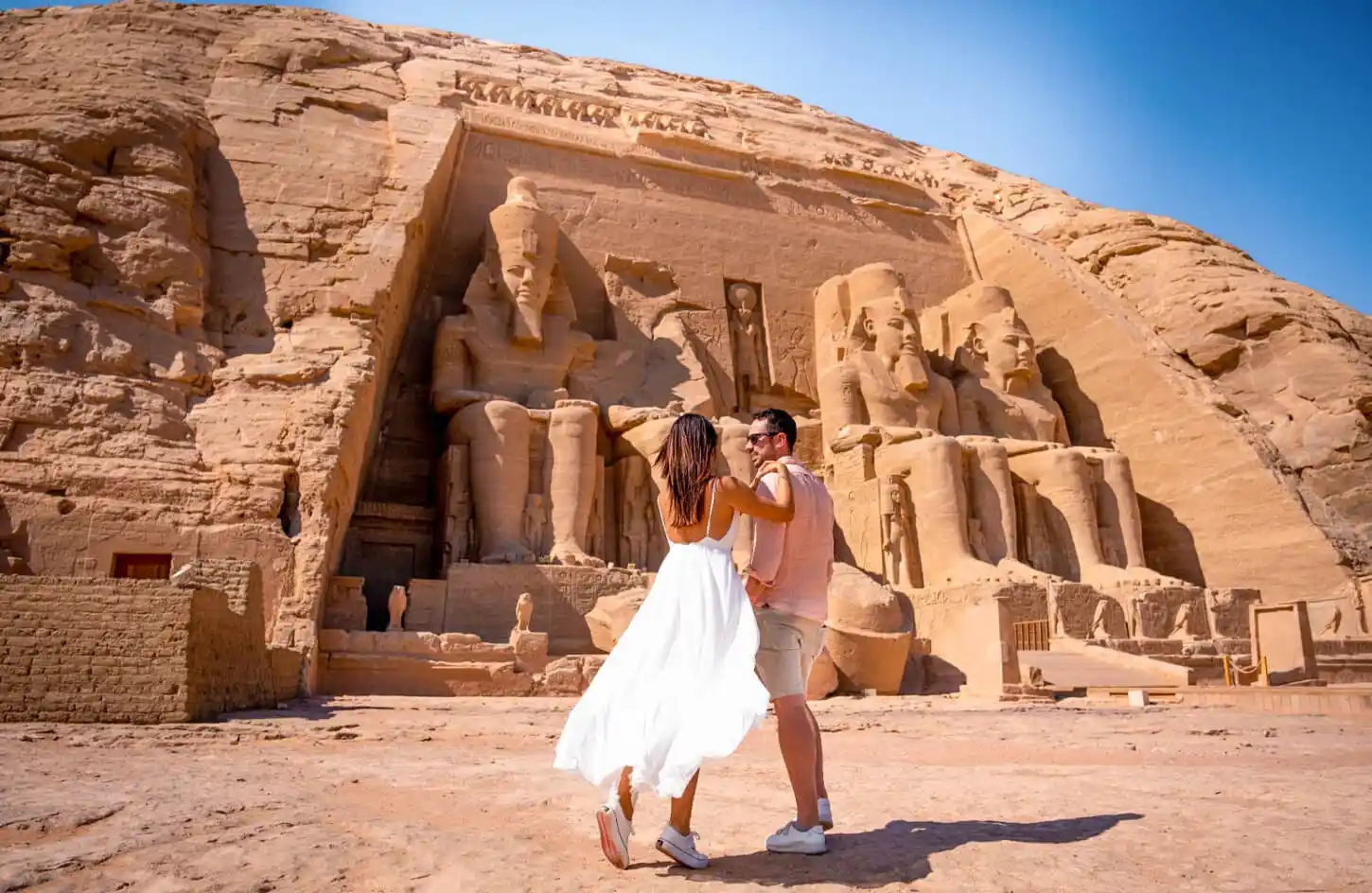
Abu Simbel is not simply another stop on an Egypt itinerary. It is a destination in its own right: two colossal temples cut into a Nubian cliff by Ramesses II, rescued from the rising waters of Lake Nasser, and rebuilt high above their original location. The scale is monumental, but so is the journey. Abu Simbel lies about 280 kilometers south of Aswan, close to Egypt’s border with Sudan, so travelers need to choose between a road trip, a domestic flight, or an overnight stay.
This complete Abu Simbel guide focuses on the practical decisions that shape the visit: how to get there, how much time to allow, current ticket prices, the best season, whether to visit on a day trip or stay overnight, and how the February and October solar-alignment dates change the experience. For the site’s deeper history, astronomical design, and relocation engineering, follow the specialist guides linked throughout this page.
Abu Simbel: Quick Facts for Visitors
What Is Abu Simbel and Why Does It Matter?
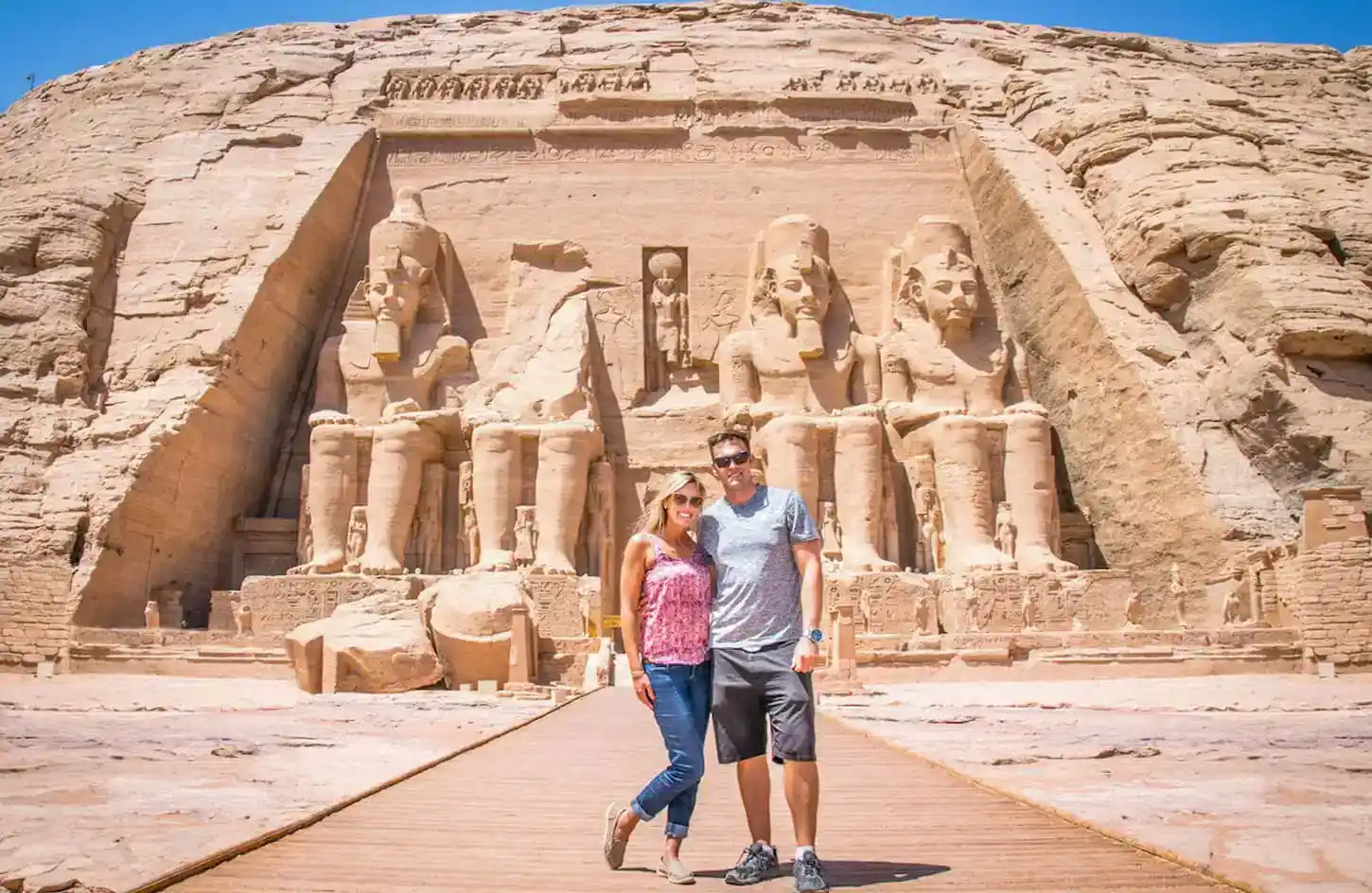
Abu Simbel is a pair of rock-cut temples commissioned by Ramesses II of Egypt’s Nineteenth Dynasty in the 13th century BCE. The Great Temple presents the king on an almost superhuman scale. Four seated colossi dominate the facade, while the interior combines religious ritual, royal ideology, and scenes of military victory. The neighboring Small Temple honors the goddess Hathor and Ramesses’ Great Royal Wife, Queen Nefertari.
The site stood in ancient Nubia, a region of enormous strategic and economic importance. Routes through Nubia connected Egypt with lands farther south and carried gold, ivory, livestock, luxury materials, and military influence. A royal monument visible from the Nile was therefore more than a place of worship. It announced Egyptian power at the empire’s southern frontier and presented Ramesses as both ruler and divine figure.
Inside the Great Temple, the visitor passes through an avenue of Osiride figures and decorated halls toward a sanctuary containing Amun-Ra, Ra-Horakhty, the deified Ramesses II, and Ptah. The military reliefs include the Battle of Kadesh, transformed from a complicated historical encounter into a carefully staged image of the king’s courage and control. At the Small Temple, Nefertari appears at the same monumental height as Ramesses on the facade, an unusually prominent visual honor for an Egyptian queen.
The surviving complex tells more than an ancient story. In the 1960s, an international campaign dismantled the temples into more than a thousand numbered blocks and rebuilt them inside an engineered artificial cliff. The operation saved Abu Simbel from the reservoir created by the Aswan High Dam and became a defining moment in global heritage preservation.
For a detailed reading of the statues, reliefs, Nubian context, Nefertari’s temple, and the site’s nineteenth-century rediscovery, read Abu Simbel Temple Facts.
The Abu Simbel Sun Festival in Brief
Twice each year, the rising sun penetrates deep into the Great Temple and reaches the sanctuary at its rear. The current public festival dates are February 22 and October 22. Light reaches the figures of Amun-Ra, Ramesses II, and Ra-Horakhty, while Ptah remains in shadow. The effect is one of the best-known examples of solar orientation in ancient Egyptian architecture.
Popular accounts often identify the dates as Ramesses II’s birthday and coronation day. That interpretation is repeated widely, but it should not be presented as proven fact. Ancient Egyptian calendars, long-term solar change, the temple’s relocation, and uncertainty over Ramesses’ exact chronology make the original intention more complicated than a simple modern anniversary claim.
Festival day is very different from an ordinary visit. Crowds arrive before dawn, transport and nearby rooms sell earlier, and the official monument ticket is more expensive. The alignment itself is brief, and the experience depends on crowd management and access to the inner temple. Travelers who care most about quiet observation of the reliefs may prefer a regular morning. Travelers fascinated by ancient astronomy may consider the larger crowd worth it.
Read the dedicated Abu Simbel Sun Festival guide for the astronomical debate, February-versus-October comparison, festival-day planning, and photography advice.
How Abu Simbel Was Saved in the 1960s
Construction of the Aswan High Dam created a reservoir that would submerge a vast part of historic Nubia. Egypt and Sudan requested UNESCO’s assistance in 1959, and UNESCO launched the International Campaign to Save the Monuments of Nubia in 1960. Abu Simbel was the most visually famous and technically intimidating challenge.
Workers used wire saws to divide the two temples into more than a thousand blocks. The pieces, typically around 30 tons, were documented, numbered, stored, and then reassembled inside a specially constructed artificial cliff. UNESCO records the new position as approximately 64 meters above the old site and 180 meters inland. The rebuilt temples were inaugurated on September 22, 1968.
The broader Nubian campaign continued until 1980. UNESCO reports that 22 monuments and complexes were saved by 40 technical missions from five continents. The success of the campaign helped inspire the 1972 World Heritage Convention; Abu Simbel and the other Nubian monuments were inscribed on the World Heritage List in 1979.
The relocation deserves its own story because its engineering was far more complex than merely moving carved stones. Surveyors had to document surfaces and orientation, engineers had to protect fragile sandstone, and designers had to recreate the feeling of temples cut into a mountain rather than displayed as detached museum pieces.
Explore the complete engineering sequence in How Was Abu Simbel Moved?.
How to Get to Abu Simbel from Aswan
Aswan is the main gateway to Abu Simbel. Most travelers reach the temples by private vehicle, organized group tour, or domestic flight. Each option produces a noticeably different day.
Option 1: Private Road Trip
A private vehicle offers the most control. Road journeys commonly begin very early so visitors can reach the temples during the cooler part of the morning and return to Aswan later the same day. The drive normally takes about three to four hours each way, but travelers should treat that as a planning range rather than a promise. Departure permissions, security arrangements, road conditions, rest stops, and traffic can all affect the schedule.
The greatest advantage is flexibility. A private trip can coordinate hotel pickup, comfort stops, the time spent at the temples, and the pace of the return. It is particularly useful for families, older travelers, photographers carrying equipment, and anyone who dislikes the rigid timing of a large coach.
The disadvantage is the length of the day. Six to eight hours may be spent in the vehicle. A comfortable air-conditioned car, a professional driver, water, and a realistic schedule matter more here than they do on a short urban excursion.
Option 2: Shared Coach or Group Tour
Shared road tours are often the lowest-cost option. They normally collect guests from several hotels, travel south in a group, allow a fixed period at the site, and return to Aswan. This can work well for travelers prioritizing price, but pickup can be extremely early and the visit may feel rushed.
Before booking, ask for the actual pickup window, vehicle size, whether an Egyptologist accompanies the group or meets it at the site, whether entrance tickets are included, and how much independent time is allowed. A cheap headline price can exclude tickets, breakfast, guide service, or hotel transfers outside the operator’s standard zone.
Option 3: Flying from Aswan
When scheduled, the short domestic flight from Aswan dramatically reduces road time. The airport at Abu Simbel is close to the archaeological site, and ground transfers are generally coordinated around the flight. This makes flying attractive for travelers with limited time or those who find a long desert drive uncomfortable.
The tradeoffs are cost and schedule dependence. Flight times may change, availability can be limited, and the total time saved is smaller once airport transfers, check-in, and waiting are considered. Always build the day around the confirmed flight schedule rather than assuming a fixed departure.
Road vs Flight from Aswan
Can You Visit Abu Simbel from Cairo?
Abu Simbel can be reached from Cairo, but it should be planned as a flight-based journey rather than a same-day road excursion. A direct Cairo–Abu Simbel service may operate on selected schedules, while other itineraries connect through Aswan. Airline schedules are seasonal and can change, so the sensible approach is to confirm the exact flights before locking in hotels or onward transport.
If no workable direct flight is available, fly from Cairo to Aswan, spend at least one night in Aswan, and visit Abu Simbel by road or air from there. This arrangement is usually more resilient and creates time for Philae Temple, the Nubian Museum, the High Dam, a felucca trip, or an onward Nile cruise.
Trying to combine Cairo, two flights, Abu Simbel, and a return on the same day can produce a fragile itinerary with little room for delays. It may be technically possible on a particular schedule, but it is not always the best use of a vacation day.
Abu Simbel Tickets and Entrance Fees
As of the official prices checked in August 2026, the Ministry of Tourism and Antiquities lists the following entrance fees:
The official page also lists separate vehicle-entry charges. These are generally relevant to drivers and tour operators rather than the core visitor ticket, but confirm what your tour price includes.
Tickets can be purchased through Egypt’s official monuments ticketing platform when online inventory is offered. A tour operator may also arrange tickets as part of a package. Never assume admission is included simply because transport is described as an “Abu Simbel tour.” Check the inclusions for entrance fees, guide services, hotel transfers, meals, and any festival-day supplement.
Students should carry valid identification that meets the ticket authority’s requirements. Eligibility rules can change or be interpreted at the ticket office, so obtain confirmation before relying on a student rate.
Abu Simbel Opening Hours and the Best Time of Day
The official Ministry page listed daily opening from 6:00 a.m. to 5:00 p.m. when checked in August 2026. Seasonal or operational changes are possible, particularly around major events, so reconfirm the schedule shortly before travel.
For most visitors, early morning is the best period. Temperatures are lower, the stone takes on warmer color, and the site is more comfortable before the desert sun becomes intense. However, the first wave of road groups from Aswan can create a concentrated busy period. An overnight stay offers a useful alternative: visit after the largest morning groups begin leaving or arrive at opening without completing a three-hour drive first.
Midday can be harsh, especially from late spring through early autumn. There is limited shade around the open approaches, and the heat can make even a short walk tiring. Carry water, wear sun protection, and do not underestimate the reflected heat from rock and paved surfaces.
Late afternoon can be visually attractive and quieter, but it is practical only if you are staying nearby. Day-trip drivers must account for the long return to Aswan and the site’s last-entry policy.
Best Time of Year to Visit Abu Simbel
October to April: The Most Comfortable Season
Cooler months are generally best for Abu Simbel. Daytime temperatures are more manageable, and the long road journey is less exhausting. November through February are usually the most comfortable, though the period around Christmas and New Year can be busy across Egypt.
February 22 and October 22 attract festival crowds and special ticket prices. Choose those dates only if the solar event is a central reason for the trip. If you want quieter temples, avoid the festival itself and visit on a nearby regular day.
May to September: Heat Requires Planning
Abu Simbel remains open in summer, but the desert heat is serious. A very early visit, strong sun protection, water, light breathable clothing, and an air-conditioned vehicle are essential. Travelers with heart, respiratory, mobility, or heat-sensitivity concerns should discuss the schedule with their guide and avoid an unnecessarily long exposed visit.
Summer can bring fewer visitors, but lower crowd levels do not automatically make it the better choice. Comfort and safety should come first.
February or October for the Solar Alignment?
February normally offers cooler conditions, making the pre-dawn wait and daytime visit more comfortable. October is warmer but can fit naturally into an autumn Egypt itinerary. Both dates are popular and require advance planning. The dedicated festival guide compares them in detail.
Abu Simbel Day Trip vs Overnight Stay
Most travelers visit Abu Simbel as a day trip from Aswan, but an overnight stay changes the pace significantly.
Choose the day trip if Abu Simbel is one part of a larger Cairo–Aswan–Luxor itinerary and you are comfortable with a long travel day. Choose overnight if the site is a major personal interest, you want to photograph it in softer light, you are attending the Sun Festival, or you prefer not to spend most of one day on the road.
An overnight stay can also pair with a Lake Nasser cruise or local Nubian cultural experiences, subject to the operator and schedule. The key is not to add a night merely for its own sake; use it to gain a better visit window or create a more relaxed route.
What to Expect at the Site
Vehicles stop outside the main archaeological area, after which visitors walk toward the temples along Lake Nasser. The approach initially hides much of the facade, allowing the four colossal figures to appear gradually as you curve around the artificial hill. This is part of the drama of the visit and worth experiencing without rushing.
The Great Temple is the larger and more visually intense interior. Reliefs, Osiride figures, side chambers, and the sanctuary reward a guided explanation. The Small Temple is quieter in scale but essential, especially for understanding Nefertari’s status and the cult of Hathor.
Allow time for both exteriors as well as the interiors. Many rushed groups focus almost entirely on the Great Temple and overlook the relationship between the pair. The lakeside setting also reveals why the twentieth-century rescue had to reconstruct not just walls, but the temples’ landscape and visual presence.
Interior photography policies may change, and special rules can apply during the solar event. Follow posted instructions and the directions of site staff. Flash, tripods, or professional equipment may be restricted even when handheld photography is allowed.
Facilities at a remote desert monument are more limited than at a major city museum. Carry essentials, but avoid oversized bags that slow security checks or become uncomfortable in narrow interior spaces.
What to Bring and Wear
- Passport or a secure copy, plus any identification needed for a student ticket.
- Confirmed ticket or booking details, available offline in case mobile service is weak.
- Water, especially for a road journey and warm-weather visit.
- Hat, sunglasses, and high-SPF sunscreen.
- Light, breathable clothing with a layer for an air-conditioned vehicle or cool winter dawn.
- Comfortable walking shoes with reliable grip.
- Small amount of cash for incidental purchases, while avoiding reliance on a single payment method.
- Any required medication kept with you rather than in inaccessible luggage.
Dress for a desert archaeological site rather than a resort. There is no need for formal clothing, but modest, sun-protective garments are practical and respectful. During winter, the pre-sunrise hours can feel cool even when the afternoon becomes warm.
Is a Guide Worth It at Abu Simbel?
A guide is not required simply to appreciate the scale, but a knowledgeable Egyptologist makes the interior significantly easier to read. Without context, the Battle of Kadesh reliefs can look like a dense field of figures; with explanation, they become a structured piece of royal storytelling. The same applies to the sanctuary, the divine identities, Nefertari’s unusual prominence, and the visible traces of the relocation.
Ask whether guiding is permitted inside each temple at the time of your visit. Site procedures can change, and some guides explain the interior before guests enter or use diagrams outside. A good guide should prepare you for what to look for rather than merely recite dates.
Private guiding is especially valuable if you have a specific interest in military history, ancient religion, architecture, conservation engineering, photography, or accessibility. Tell the operator in advance so the visit can be paced and framed accordingly.
Abu Simbel and Other Ramesses II Sites
Abu Simbel gives the most concentrated image of Ramesses II as ruler, warrior, and divine figure, but it becomes more meaningful when compared with his monuments in Luxor.
- At Luxor Temple, Ramesses expanded an older sacred complex with a new pylon, courtyard, and colossal royal imagery.
- At Karnak Temple, his inscriptions and additions sit within a vast ceremonial landscape created by generations of rulers.
- At the Ramesseum on Luxor’s West Bank, his mortuary cult and the remains of a fallen colossal statue present a different version of royal memory.
- At Abu Simbel, the king’s image is fused with the Nubian frontier, solar architecture, and a living twentieth-century preservation story.
Travelers particularly interested in Ramesses II should combine Abu Simbel with Luxor rather than treating the southern temples as an isolated excursion.
Frequently Asked Questions About Visiting Abu Simbel
How far is Abu Simbel from Aswan?
UNESCO lists Abu Simbel approximately 280 kilometers south of Aswan. By road, travelers commonly allow about three to four hours each way, although actual timing depends on transport arrangements and conditions.
How long do you need at the temples?
Allow roughly 1.5 to 2.5 hours for a balanced first visit. Travelers studying reliefs or photographing the site may want longer, while group tours often operate on a tighter timetable.
Can I book Abu Simbel tickets online?
Egypt operates an official monuments ticketing platform, and Abu Simbel tickets may be offered there. Availability and procedures can change, so confirm on the official platform or ask your operator shortly before visiting.
Are entrance tickets included in an Abu Simbel tour?
Not always. Some prices cover transport only, while others include admission, guiding, pickup, and refreshments. Request a written inclusion list before booking.
Do I need an organized tour?
You do not need a group tour, but transport must be planned carefully because of the remote location. A private car with a licensed driver and guide is often the most flexible arrangement.
Is Abu Simbel suitable for children?
Yes, but the very early start and long drive can be tiring. Bring water, snacks, sun protection, and plan comfort stops. An overnight stay or flight can reduce road fatigue.
Is Abu Simbel accessible for travelers with limited mobility?
The exterior area involves walking, heat exposure, and some uneven surfaces, while the rock-cut interiors have confined spaces. Accessibility can vary, so discuss exact mobility needs with the operator before booking and request the shortest practical route and assistance.
Can I visit Abu Simbel and board a Nile cruise on the same day?
Sometimes, but the schedule must be coordinated with the ship’s embarkation and sailing time. A private road trip provides more control than a shared coach, yet delays are still possible. Build a buffer rather than relying on a tight connection.
Final Thoughts
Abu Simbel rewards preparation. The temples are remote, the day can be long, and festival dates require extra planning, but the experience is unlike anything else in Egypt. The practical choice is usually straightforward: travel from Aswan by private road trip for flexibility, fly when the schedule and budget make sense, or stay overnight when photography, slower travel, or the solar alignment is the priority.
Once those logistics are settled, the site can be experienced for what it is: a carefully staged ancient statement of power, devotion, and kingship, preserved by one of the most ambitious international conservation projects ever attempted.
🏛️ Ready to plan Abu Simbel without the guesswork? Pure Nile Tours can arrange private transport from Aswan, an expert Egyptologist guide, tickets, and a schedule matched to your cruise or wider Egypt itinerary. Plan Your Abu Simbel Visit →