
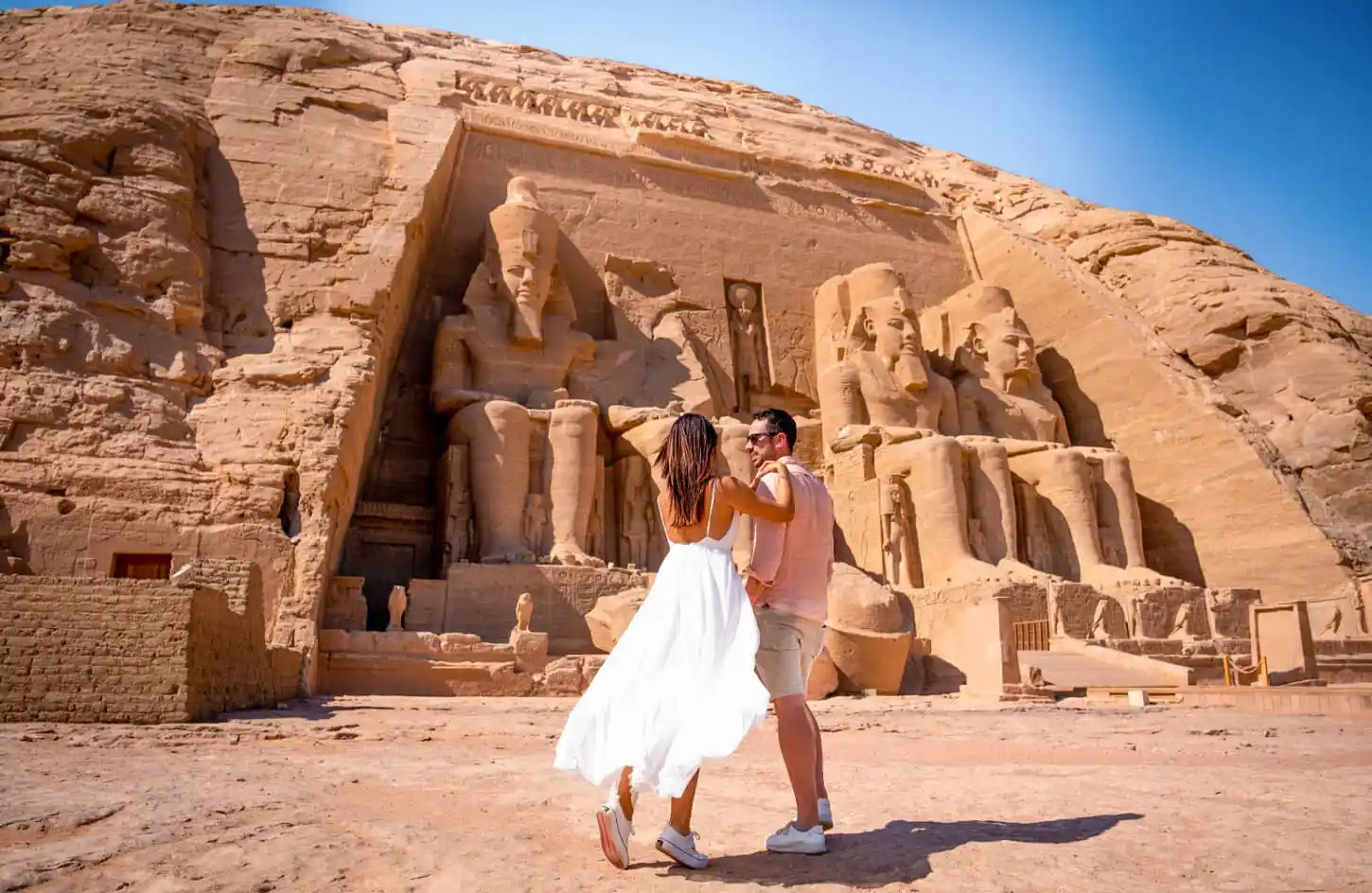
Abu
If you would like a guide, driver and tickets arranged, see our private Abu Simbel day trip from Aswan.
Simbel is not simply another stop on an Egypt itinerary. It is a destination in its own right: two colossal temples cut into a Nubian cliff by Ramesses II, rescued from the rising waters of Lake Nasser, and rebuilt high above their original location. The scale is monumental, but so is the journey. Abu Simbel lies about 280 kilometers south of Aswan, close to Egypt’s border with Sudan, so travelers need to choose between a road trip, a domestic flight, or an overnight stay.
This complete Abu Simbel guide focuses on the practical decisions that shape the visit: how to get there, how much time to allow, current ticket prices, the best season, whether to visit on a day trip or stay overnight, and how the February and October solar-alignment dates change the experience. For the site’s deeper history, astronomical design, and relocation engineering, follow the specialist guides linked throughout this page.
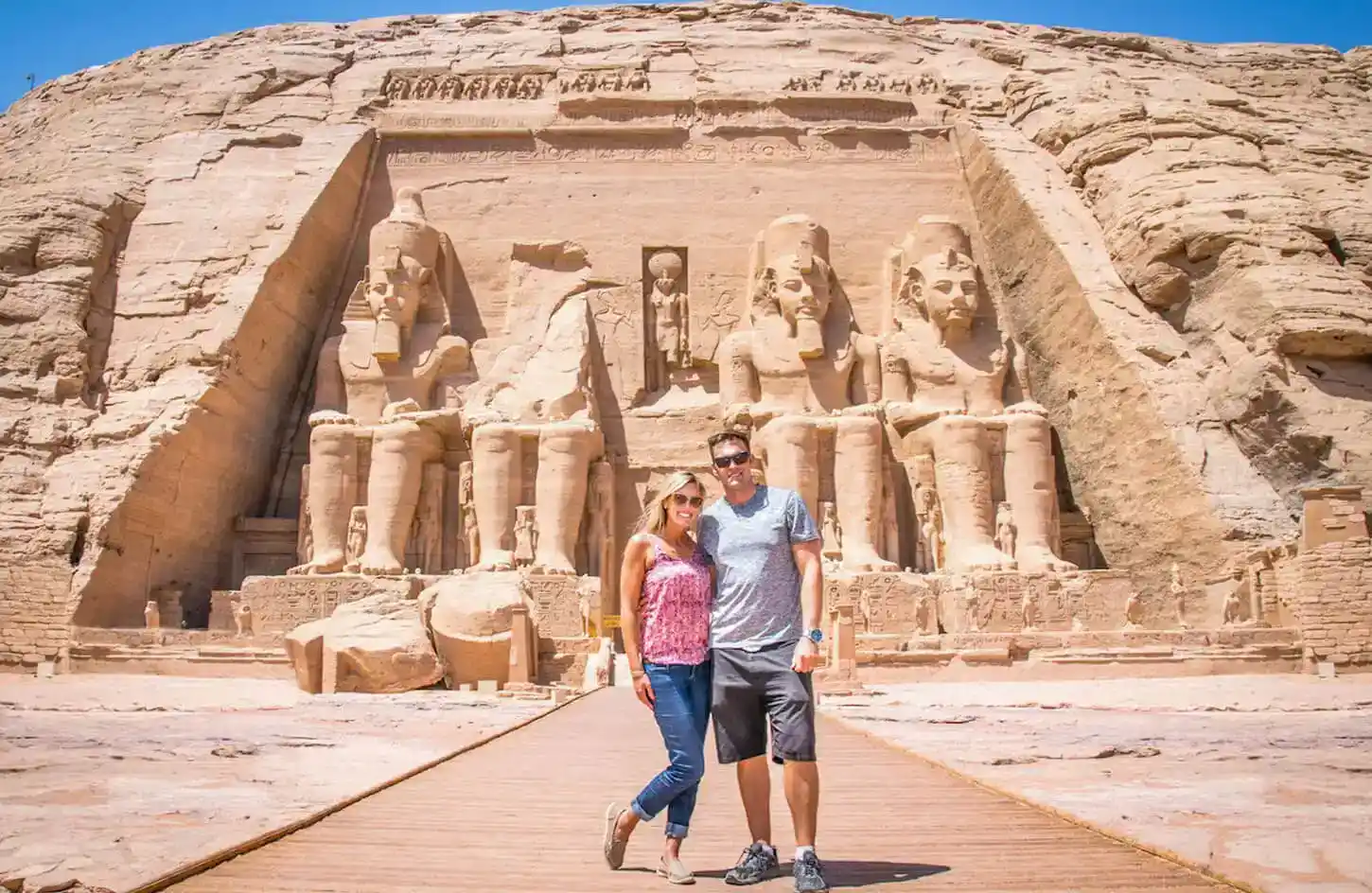
Abu Simbel: Quick Facts for Visitors
What Is Abu Simbel and Why Does It Matter?
Abu Simbel is a pair of rock-cut temples commissioned by Ramesses II of Egypt’s Nineteenth Dynasty in the 13th century BCE. The Great Temple presents the king on an almost superhuman scale. Four seated colossi dominate the facade, while the interior combines religious ritual, royal ideology, and scenes of military victory. The neighboring Small Temple honors the goddess Hathor and Ramesses’ Great Royal Wife, Queen Nefertari.
The site stood in ancient Nubia, a region of enormous strategic and economic importance. Routes through Nubia connected Egypt with lands farther south and carried gold, ivory, livestock, luxury materials, and military influence. A royal monument visible from the Nile was therefore more than a place of worship. It announced Egyptian power at the empire’s southern frontier and presented Ramesses as both ruler and divine figure.
Inside the Great Temple, the visitor passes through an avenue of Osiride figures and decorated halls toward a sanctuary containing Amun-Ra, Ra-Horakhty, the deified Ramesses II, and Ptah. The military reliefs include the Battle of Kadesh, transformed from a complicated historical encounter into a carefully staged image of the king’s courage and control. At the Small Temple, Nefertari appears at the same monumental height as Ramesses on the facade, an unusually prominent visual honor for an Egyptian queen.
The surviving complex tells more than an ancient story. In the 1960s, an international campaign dismantled the temples into more than a thousand numbered blocks and rebuilt them inside an engineered artificial cliff. The operation saved Abu Simbel from the reservoir created by the Aswan High Dam and became a defining moment in global heritage preservation.
For a detailed reading of the statues, reliefs, Nubian context, Nefertari’s temple, and the site’s nineteenth-century rediscovery, read Abu Simbel Temple Facts.
Ramesses II, Nubia, and the Politics Behind the Temple
Ramesses II’s Monumental Program
Ramesses II ruled for more than six decades and left his name across Egypt on new monuments, additions, restorations, and reused inscriptions. Architecture was central to his image. Colossal statues, military narratives, divine scenes, and repeated royal names made his presence difficult to ignore, even for people living generations after his death.
Abu Simbel represents this strategy at its most concentrated. Rather than being a temple where the king appears only as an intermediary before the gods, the Great Temple places his colossal image outside and his deified form in the sanctuary itself. The building collapses the distance between king and god.
Why Build in Nubia?
Nubia was not an empty frontier. It had its own communities, traditions, political histories, and religious landscapes. It was also essential to Egyptian interests because of trade routes and resources, especially gold. Egyptian rulers repeatedly campaigned, built forts, established administrative centers, and created temples in the region.
UNESCO describes Aswan and the territory to its south as a strategic zone for commerce and military activity. Abu Simbel stood far beyond Egypt’s traditional heartland and close to a route used by travelers moving along the Nile. The monument therefore communicated in several directions at once. To Egyptian officials and soldiers, it affirmed royal control. To Nubian communities and elites, it displayed the wealth and supernatural protection of the pharaoh. To the gods, it provided a permanent ritual setting.
A Temple of Power and Worship
It is tempting to describe Abu Simbel only as political propaganda, but that is too narrow. Ancient Egyptian temple architecture joined political authority, cosmic order, and worship. Ramesses’ power was presented as legitimate because it operated within divine order. Military scenes showed him defeating chaos; offering scenes showed him maintaining relationships with the gods; solar orientation connected the sanctuary to the cycles of the natural world.
The Great Temple could therefore be both a border monument and a sacred place. Its political force depended on its religious meaning, and its religious meaning reinforced the king’s political position.
The Great Temple Facade
Four Colossal Images of One King
The facade is approximately 30 meters high and is dominated by four seated colossi of Ramesses II, each around 20–21 meters tall. The repetition is deliberate. Instead of showing four different rulers, the monument multiplies the same sovereign until he becomes the architecture.
The figures wear the double crown, symbolizing rule over Upper and Lower Egypt. Their scale creates a hierarchy visible before any inscription is read. Smaller figures beside and between the legs represent members of the royal family, including Queen Nefertari, the king’s mother, princes, and princesses. Their reduced scale is not an attempt at realistic perspective; it expresses status.
Above the entrance, a figure of Ra-Horakhty occupies a niche. The king’s relationship with the solar deity is encoded visually and linguistically into the facade. A line of baboons along the upper edge raises its arms toward the rising sun, reinforcing the solar symbolism before the visitor enters.
Why Is One Colossus Broken?
The upper part of one seated colossus collapsed in antiquity, most likely after an earthquake. Its head and torso remain on the ground near the figure’s feet. During the modern rescue, conservators did not reconstruct it into an idealized complete statue. Preserving the fallen pieces retained evidence of the monument’s long history and the ancient damage it had endured.
The broken colossus is therefore not a failure of the 1960s relocation. It was already damaged centuries earlier and was rebuilt in its historically ruined condition.
Scale as a Message
Travel writing often treats the figures’ height as a spectacular statistic, but their scale had a specific purpose. Anyone approaching along the river would meet an image of the Egyptian king far larger than life. The facade acted like a permanent royal audience: the ruler was seated, immovable, multiplied, crowned, and embedded in the landscape itself.
Inside the Great Temple
The First Hall and Osiride Figures
The entrance leads into a pillared hall where large standing figures of Ramesses are attached to the supports. They are often described as Osiride statues because the king adopts the tightly wrapped form associated with Osiris. The imagery links royal authority with death, regeneration, and divine permanence.
The arrangement transforms movement through the building. Visitors do not simply walk between columns; they pass through repeated royal bodies. Architecture and sculpture become inseparable.
From Public Grandeur to Sacred Restriction
Like many Egyptian temples, the building narrows and becomes more sacred toward the rear. Broad halls give way to smaller chambers and finally the sanctuary. This progression moves from the public declaration of the facade toward the restricted divine core.
Side rooms may have stored ritual equipment and offerings. Walls throughout the complex carry scenes of the king before deities, ritual actions, and military subjects. The temple is not a single story but a network of images in which Ramesses repeatedly demonstrates the qualities of an ideal ruler.
The Four Sanctuary Figures
At the rear sit four figures: Ptah, Amun-Ra, the deified Ramesses II, and Ra-Horakhty. Their placement is one of the most striking facts about the temple. Ramesses does not merely stand before the gods as a mortal king; his own divine image sits among them.
On two periods each year, sunlight penetrates the temple and reaches three of the figures while Ptah remains in shadow. The modern public dates are February 22 and October 22. The popular birthday-and-coronation explanation is not securely proven, and the astronomical interpretation deserves more care than a short fact list can provide. Read our full Abu Simbel Sun Festival guide for the evidence and debate.
The Battle of Kadesh Reliefs
What Was the Battle of Kadesh?
The Battle of Kadesh was fought between the forces of Ramesses II and the Hittite king Muwatalli II near the city of Kadesh in Syria. It was a major confrontation between two powerful states competing for influence in the eastern Mediterranean and Near East.
The surviving evidence does not support a simple Egyptian victory in the modern military sense. Ramesses’ army was surprised, fighting was intense, and the political struggle continued. Egyptian monumental accounts, however, frame the king as the decisive hero who stands firm when others fail.
What the Temple Shows
The relief cycle depicts camps, chariots, troops, enemies, and a king larger than everyone around him. Ramesses charges into combat and overwhelms opponents. Texts emphasize his personal courage and the divine support he receives.
The scene is structured communication rather than neutral reporting. Scale, repetition, and composition guide the viewer toward one conclusion: order is restored because the king is uniquely powerful. The defeated enemy becomes a visual symbol of chaos, while the pharaoh embodies control.
Why Put Kadesh at Abu Simbel?
The subject linked military success with rule at the southern frontier. Even though Kadesh was fought far to the northeast, its message traveled anywhere the relief was displayed. At Abu Simbel, it told viewers in Nubia that Ramesses had faced the great powers of his age and remained the central figure in Egypt’s world order.
The reliefs also connect the temple to other Ramesside monuments where versions of the Kadesh narrative appear. Comparing them shows how the same royal event could be adapted to different architectural settings and audiences.
The Small Temple of Hathor and Nefertari
A Rare Monument to a Queen
The Small Temple stands north of the Great Temple and is dedicated to Hathor and Queen Nefertari, Ramesses II’s Great Royal Wife. Its facade has six standing colossi: four of Ramesses and two of Nefertari.
The remarkable detail is that the queen’s figures are approximately the same height as the king’s. Egyptian art normally uses scale to express hierarchy, and royal wives are often shown much smaller than pharaohs. Nefertari’s equality of scale on this facade gives her an exceptional visual status.
This does not mean that Ramesses and Nefertari held identical political office. It means the monument deliberately elevated her within this sacred program, connecting the queen with Hathor and presenting the royal couple as a coordinated divine image.
Why Hathor?
Hathor carried associations with music, love, motherhood, kingship, the sky, and distant lands. Queens could be closely connected to her cult. At Abu Simbel, Nefertari’s relationship with Hathor gave religious structure to the honor displayed on the facade.
Inside, scenes show the royal couple interacting with deities. The sanctuary contains imagery related to Hathor, and the temple’s rock-cut form creates an intimate counterpart to the overwhelming scale of the Great Temple.
“For Whom the Sun Shines”
Nefertari’s titles and the affectionate language associated with her have made the temple central to modern ideas about the royal marriage. Popular retellings can become romanticized, but the material evidence is genuinely unusual: Ramesses dedicated a major Nubian temple to Hathor and his queen, and represented Nefertari on the facade at a scale normally reserved for the king.
How the Temples Were Carved
Abu Simbel was excavated directly into sandstone rather than assembled as a freestanding building from quarried blocks. Ancient teams had to plan a facade, halls, pillars, side chambers, relief surfaces, and sanctuary along a controlled axis. Removing too much rock or introducing structural weakness could not be easily reversed.
Work likely proceeded through teams with different responsibilities: quarrying and rough excavation, leveling, measuring, smoothing, relief carving, inscription, and painting. The surviving monument reveals both centralized design and the labor of many specialists.
The facade required converting a natural cliff into architectural geometry while leaving enough living rock to support the enormous seated figures. Inside, the diminishing sequence of spaces had to remain aligned. The solar effect added another layer of orientation, although scholars continue to debate precisely how its ancient timing and meaning should be reconstructed.
Traces of color survive in protected areas, reminding visitors that Egyptian temple reliefs were not intended as bare stone. Painted surfaces would have made clothing, skin, divine attributes, hieroglyphs, and battle scenes more legible and vivid.
Symbols Hidden in Plain Sight
The Double Crown
The double crown worn by the colossi combines the traditional crowns of Upper and Lower Egypt. At a southern frontier monument, it reinforces the idea that the king represents the whole Egyptian state.
The Smiter Image
Across Egyptian royal art, the king may be shown striking defeated enemies. This is more than a record of violence. It is a ritual image of the ruler defeating disorder and protecting cosmic balance. At Abu Simbel, military reliefs and divine scenes belong to the same ideological system.
Royal Cartouches
The names and titles of Ramesses appear repeatedly in cartouches. Repetition ensures identification, but it also activates the king’s presence throughout the building. In Egyptian thought, the name was a fundamental part of identity and survival.
Solar Imagery
The eastern orientation, Ra-Horakhty above the entrance, the baboons greeting sunrise, and the sanctuary illumination create a coordinated solar program. The temple does not depend on one spectacular event; solar meaning begins on the facade and continues inward.
Family Figures
Smaller royal figures around the colossi communicate dynasty. They identify the king not as an isolated individual but as the center of a continuing royal household. Their scale preserves hierarchy while their presence supports legitimacy.
The Modern Rediscovery of Abu Simbel
Burckhardt and the Sand-Covered Facade
By the early nineteenth century, accumulated sand concealed much of the Great Temple. In 1813, the Swiss traveler Johann Ludwig Burckhardt identified the site, with only the upper portions of the colossal figures visible. His account drew further European attention to the monument.
The word “discovery” needs qualification. Local Nubian communities knew the landscape; the temple was not discovered in the absolute sense of being unknown to everyone. The term usually refers to its documentation and entry within nineteenth-century European exploration and archaeology.
Belzoni Enters the Great Temple
Giovanni Battista Belzoni reached the site and, after efforts to clear the obstructing sand, entered the Great Temple in 1817. Early exploration combined curiosity, documentation, competition, and collecting practices that would not meet modern archaeological standards.
The episodes surrounding Burckhardt and Belzoni became part of Abu Simbel’s modern mythology: a monumental facade emerging from dunes and an interior sealed by sand. Historical images from the nineteenth century preserve a landscape very different from the lakeside setting visitors see today.
Documentation Before Relocation
The greatest modern change came more than a century later, when surveys recorded the temples before they were cut and moved. Photography, measurement, mapping, and architectural study became essential because engineers needed to reconstruct not simply individual stones, but entire spatial relationships.
For the engineering process, international teams, risks, block system, artificial domes, and the broader Nubian campaign, continue to How Was Abu Simbel Moved?.
For dates, timings and how to plan a visit on 22 February or 22 October, read our full guide to the Abu Simbel Sun Festival and the solar alignment.
>The Abu Simbel Sun Festival in Brief
Twice each year, the rising sun penetrates deep into the Great Temple and reaches the sanctuary at its rear. The current public festival dates are February 22 and October 22. Light reaches the figures of Amun-Ra, Ramesses II, and Ra-Horakhty, while Ptah remains in shadow. The effect is one of the best-known examples of solar orientation in ancient Egyptian architecture.
Popular accounts often identify the dates as Ramesses II’s birthday and coronation day. That interpretation is repeated widely, but it should not be presented as proven fact. Ancient Egyptian calendars, long-term solar change, the temple’s relocation, and uncertainty over Ramesses’ exact chronology make the original intention more complicated than a simple modern anniversary claim.
Festival day is very different from an ordinary visit. Crowds arrive before dawn, transport and nearby rooms sell earlier, and the official monument ticket is more expensive. The alignment itself is brief, and the experience depends on crowd management and access to the inner temple. Travelers who care most about quiet observation of the reliefs may prefer a regular morning. Travelers fascinated by ancient astronomy may consider the larger crowd worth it.
Read the dedicated Abu Simbel Sun Festival guide for the astronomical debate, February-versus-October comparison, festival-day planning, and photography advice.
How Abu Simbel Was Saved in the 1960s
Construction of the Aswan High Dam created a reservoir that would submerge a vast part of historic Nubia. Egypt and Sudan requested UNESCO’s assistance in 1959, and UNESCO launched the International Campaign to Save the Monuments of Nubia in 1960. Abu Simbel was the most visually famous and technically intimidating challenge.
Workers used wire saws to divide the two temples into more than a thousand blocks. The pieces, typically around 30 tons, were documented, numbered, stored, and then reassembled inside a specially constructed artificial cliff. UNESCO records the new position as approximately 64 meters above the old site and 180 meters inland. The rebuilt temples were inaugurated on September 22, 1968.
The broader Nubian campaign continued until 1980. UNESCO reports that 22 monuments and complexes were saved by 40 technical missions from five continents. The success of the campaign helped inspire the 1972 World Heritage Convention; Abu Simbel and the other Nubian monuments were inscribed on the World Heritage List in 1979.
The relocation deserves its own story because its engineering was far more complex than merely moving carved stones. Surveyors had to document surfaces and orientation, engineers had to protect fragile sandstone, and designers had to recreate the feeling of temples cut into a mountain rather than displayed as detached museum pieces.
Explore the complete engineering sequence in How Was Abu Simbel Moved?.
How to Get to Abu Simbel from Aswan
Aswan is the main gateway to Abu Simbel. Most travelers reach the temples by private vehicle, organized group tour, or domestic flight. Each option produces a noticeably different day.
Option 1: Private Road Trip
A private vehicle offers the most control. Road journeys commonly begin very early so visitors can reach the temples during the cooler part of the morning and return to Aswan later the same day. The drive normally takes about three to four hours each way, but travelers should treat that as a planning range rather than a promise. Departure permissions, security arrangements, road conditions, rest stops, and traffic can all affect the schedule.
The greatest advantage is flexibility. A private trip can coordinate hotel pickup, comfort stops, the time spent at the temples, and the pace of the return. It is particularly useful for families, older travelers, photographers carrying equipment, and anyone who dislikes the rigid timing of a large coach.
The disadvantage is the length of the day. Six to eight hours may be spent in the vehicle. A comfortable air-conditioned car, a professional driver, water, and a realistic schedule matter more here than they do on a short urban excursion.
Option 2: Shared Coach or Group Tour
Shared road tours are often the lowest-cost option. They normally collect guests from several hotels, travel south in a group, allow a fixed period at the site, and return to Aswan. This can work well for travelers prioritizing price, but pickup can be extremely early and the visit may feel rushed.
Before booking, ask for the actual pickup window, vehicle size, whether an Egyptologist accompanies the group or meets it at the site, whether entrance tickets are included, and how much independent time is allowed. A cheap headline price can exclude tickets, breakfast, guide service, or hotel transfers outside the operator’s standard zone.
Option 3: Flying from Aswan
When scheduled, the short domestic flight from Aswan dramatically reduces road time. The airport at Abu Simbel is close to the archaeological site, and ground transfers are generally coordinated around the flight. This makes flying attractive for travelers with limited time or those who find a long desert drive uncomfortable.
The tradeoffs are cost and schedule dependence. Flight times may change, availability can be limited, and the total time saved is smaller once airport transfers, check-in, and waiting are considered. Always build the day around the confirmed flight schedule rather than assuming a fixed departure.
Road vs Flight from Aswan
Can You Visit Abu Simbel from Cairo?
Abu Simbel can be reached from Cairo, but it should be planned as a flight-based journey rather than a same-day road excursion. A direct Cairo–Abu Simbel service may operate on selected schedules, while other itineraries connect through Aswan. Airline schedules are seasonal and can change, so the sensible approach is to confirm the exact flights before locking in hotels or onward transport.
If no workable direct flight is available, fly from Cairo to Aswan, spend at least one night in Aswan, and visit Abu Simbel by road or air from there. This arrangement is usually more resilient and creates time for Philae Temple, the Nubian Museum, the High Dam, a felucca trip, or an onward Nile cruise.
Trying to combine Cairo, two flights, Abu Simbel, and a return on the same day can produce a fragile itinerary with little room for delays. It may be technically possible on a particular schedule, but it is not always the best use of a vacation day.
Abu Simbel Tickets and Entrance Fees
As of the official prices checked in August 2026, the Ministry of Tourism and Antiquities lists the following entrance fees:
The official page also lists separate vehicle-entry charges. These are generally relevant to drivers and tour operators rather than the core visitor ticket, but confirm what your tour price includes.
Tickets can be purchased through Egypt’s official monuments ticketing platform when online inventory is offered. A tour operator may also arrange tickets as part of a package. Never assume admission is included simply because transport is described as an “Abu Simbel tour.” Check the inclusions for entrance fees, guide services, hotel transfers, meals, and any festival-day supplement.
Students should carry valid identification that meets the ticket authority’s requirements. Eligibility rules can change or be interpreted at the ticket office, so obtain confirmation before relying on a student rate.
Abu Simbel Opening Hours and the Best Time of Day
The official Ministry page listed daily opening from 6:00 a.m. to 5:00 p.m. when checked in August 2026. Seasonal or operational changes are possible, particularly around major events, so reconfirm the schedule shortly before travel.
For most visitors, early morning is the best period. Temperatures are lower, the stone takes on warmer color, and the site is more comfortable before the desert sun becomes intense. However, the first wave of road groups from Aswan can create a concentrated busy period. An overnight stay offers a useful alternative: visit after the largest morning groups begin leaving or arrive at opening without completing a three-hour drive first.
Midday can be harsh, especially from late spring through early autumn. There is limited shade around the open approaches, and the heat can make even a short walk tiring. Carry water, wear sun protection, and do not underestimate the reflected heat from rock and paved surfaces.
Late afternoon can be visually attractive and quieter, but it is practical only if you are staying nearby. Day-trip drivers must account for the long return to Aswan and the site’s last-entry policy.
Best Time of Year to Visit Abu Simbel
October to April: The Most Comfortable Season
Cooler months are generally best for Abu Simbel. Daytime temperatures are more manageable, and the long road journey is less exhausting. November through February are usually the most comfortable, though the period around Christmas and New Year can be busy across Egypt.
February 22 and October 22 attract festival crowds and special ticket prices. Choose those dates only if the solar event is a central reason for the trip. If you want quieter temples, avoid the festival itself and visit on a nearby regular day.
May to September: Heat Requires Planning
Abu Simbel remains open in summer, but the desert heat is serious. A very early visit, strong sun protection, water, light breathable clothing, and an air-conditioned vehicle are essential. Travelers with heart, respiratory, mobility, or heat-sensitivity concerns should discuss the schedule with their guide and avoid an unnecessarily long exposed visit.
Summer can bring fewer visitors, but lower crowd levels do not automatically make it the better choice. Comfort and safety should come first.
February or October for the Solar Alignment?
February normally offers cooler conditions, making the pre-dawn wait and daytime visit more comfortable. October is warmer but can fit naturally into an autumn Egypt itinerary. Both dates are popular and require advance planning. The dedicated festival guide compares them in detail.
Abu Simbel Day Trip vs Overnight Stay
Most travelers visit Abu Simbel as a day trip from Aswan, but an overnight stay changes the pace significantly.
Choose the day trip if Abu Simbel is one part of a larger Cairo–Aswan–Luxor itinerary and you are comfortable with a long travel day. Choose overnight if the site is a major personal interest, you want to photograph it in softer light, you are attending the Sun Festival, or you prefer not to spend most of one day on the road.
An overnight stay can also pair with a Lake Nasser cruise or local Nubian cultural experiences, subject to the operator and schedule. The key is not to add a night merely for its own sake; use it to gain a better visit window or create a more relaxed route.
What to Expect at the Site
Vehicles stop outside the main archaeological area, after which visitors walk toward the temples along Lake Nasser. The approach initially hides much of the facade, allowing the four colossal figures to appear gradually as you curve around the artificial hill. This is part of the drama of the visit and worth experiencing without rushing.
The Great Temple is the larger and more visually intense interior. Reliefs, Osiride figures, side chambers, and the sanctuary reward a guided explanation. The Small Temple is quieter in scale but essential, especially for understanding Nefertari’s status and the cult of Hathor.
Allow time for both exteriors as well as the interiors. Many rushed groups focus almost entirely on the Great Temple and overlook the relationship between the pair. The lakeside setting also reveals why the twentieth-century rescue had to reconstruct not just walls, but the temples’ landscape and visual presence.
Interior photography policies may change, and special rules can apply during the solar event. Follow posted instructions and the directions of site staff. Flash, tripods, or professional equipment may be restricted even when handheld photography is allowed.
Facilities at a remote desert monument are more limited than at a major city museum. Carry essentials, but avoid oversized bags that slow security checks or become uncomfortable in narrow interior spaces.
What to Bring and Wear
- Passport or a secure copy, plus any identification needed for a student ticket.
- Confirmed ticket or booking details, available offline in case mobile service is weak.
- Water, especially for a road journey and warm-weather visit.
- Hat, sunglasses, and high-SPF sunscreen.
- Light, breathable clothing with a layer for an air-conditioned vehicle or cool winter dawn.
- Comfortable walking shoes with reliable grip.
- Small amount of cash for incidental purchases, while avoiding reliance on a single payment method.
- Any required medication kept with you rather than in inaccessible luggage.
Dress for a desert archaeological site rather than a resort. There is no need for formal clothing, but modest, sun-protective garments are practical and respectful. During winter, the pre-sunrise hours can feel cool even when the afternoon becomes warm.
Is a Guide Worth It at Abu Simbel?
A guide is not required simply to appreciate the scale, but a knowledgeable Egyptologist makes the interior significantly easier to read. Without context, the Battle of Kadesh reliefs can look like a dense field of figures; with explanation, they become a structured piece of royal storytelling. The same applies to the sanctuary, the divine identities, Nefertari’s unusual prominence, and the visible traces of the relocation.
Ask whether guiding is permitted inside each temple at the time of your visit. Site procedures can change, and some guides explain the interior before guests enter or use diagrams outside. A good guide should prepare you for what to look for rather than merely recite dates.
Private guiding is especially valuable if you have a specific interest in military history, ancient religion, architecture, conservation engineering, photography, or accessibility. Tell the operator in advance so the visit can be paced and framed accordingly.
Abu Simbel and Other Ramesses II Sites
Abu Simbel gives the most concentrated image of Ramesses II as ruler, warrior, and divine figure, but it becomes more meaningful when compared with his monuments in Luxor.
- At Luxor Temple, Ramesses expanded an older sacred complex with a new pylon, courtyard, and colossal royal imagery.
- At Karnak Temple, his inscriptions and additions sit within a vast ceremonial landscape created by generations of rulers.
- At the Ramesseum on Luxor’s West Bank, his mortuary cult and the remains of a fallen colossal statue present a different version of royal memory.
- At Abu Simbel, the king’s image is fused with the Nubian frontier, solar architecture, and a living twentieth-century preservation story.
Travelers particularly interested in Ramesses II should combine Abu Simbel with Luxor rather than treating the southern temples as an isolated excursion.
Frequently Asked Questions About Visiting Abu Simbel
How far is Abu Simbel from Aswan?
UNESCO lists Abu Simbel approximately 280 kilometers south of Aswan. By road, travelers commonly allow about three to four hours each way, although actual timing depends on transport arrangements and conditions.
How long do you need at the temples?
Allow roughly 1.5 to 2.5 hours for a balanced first visit. Travelers studying reliefs or photographing the site may want longer, while group tours often operate on a tighter timetable.
Can I book Abu Simbel tickets online?
Egypt operates an official monuments ticketing platform, and Abu Simbel tickets may be offered there. Availability and procedures can change, so confirm on the official platform or ask your operator shortly before visiting.
Are entrance tickets included in an Abu Simbel tour?
Not always. Some prices cover transport only, while others include admission, guiding, pickup, and refreshments. Request a written inclusion list before booking.
Do I need an organized tour?
You do not need a group tour, but transport must be planned carefully because of the remote location. A private car with a licensed driver and guide is often the most flexible arrangement.
Is Abu Simbel suitable for children?
Yes, but the very early start and long drive can be tiring. Bring water, snacks, sun protection, and plan comfort stops. An overnight stay or flight can reduce road fatigue.
Is Abu Simbel accessible for travelers with limited mobility?
The exterior area involves walking, heat exposure, and some uneven surfaces, while the rock-cut interiors have confined spaces. Accessibility can vary, so discuss exact mobility needs with the operator before booking and request the shortest practical route and assistance.
Can I visit Abu Simbel and board a Nile cruise on the same day?
Sometimes, but the schedule must be coordinated with the ship’s embarkation and sailing time. A private road trip provides more control than a shared coach, yet delays are still possible. Build a buffer rather than relying on a tight connection.
Final Thoughts
Abu Simbel rewards preparation. The temples are remote, the day can be long, and festival dates require extra planning, but the experience is unlike anything else in Egypt. The practical choice is usually straightforward: travel from Aswan by private road trip for flexibility, fly when the schedule and budget make sense, or stay overnight when photography, slower travel, or the solar alignment is the priority.
Once those logistics are settled, the site can be experienced for what it is: a carefully staged ancient statement of power, devotion, and kingship, preserved by one of the most ambitious international conservation projects ever attempted.
🏛️ Ready to plan Abu Simbel without the guesswork? Pure Nile Tours can arrange private transport from Aswan, an expert Egyptologist guide, tickets, and a schedule matched to your cruise or wider Egypt itinerary. Plan Your Abu Simbel Visit →